ARK Invest forecasts Bitcoin could account for roughly 70% of a projected $28 trillion digital-asset market by 2030, driven by ETF adoption and corporate treasuries.
DeFi value shifts from networks to applications, as fee-generating protocols scale faster and begin to rival fintech platforms in revenue efficiency and assets under management.
Tokenized markets move toward the mainstream, with ARK projecting up to $11 trillion in tokenized real-world assets by 2030.
Bitcoin, decentralized finance applications, and tokenized real-world assets are poised to dominate crypto development in 2026, with experts saying regulatory clarity will determine whether innovation translates into mainstream adoption.
ARK Invest’s latest research report, dubbed “Big Ideas 2026,” forecasts the digital asset market could balloon to $28 trillion by 2030, with Bitcoin commanding 70% of that market at roughly $16 trillion.
The projections from Cathie Wood’s investment management firm are “reasonable,” Joni Pirovich, founder and CEO of Crystal aOS, told Decrypt.
“Crypto-native financial platforms are scaling, but they’re not seeking to become global centralized institutions—they’re seeking global acceptance and navigating fragmented compliance requirements,” she said.
]]>
The report highlights Bitcoin’s maturation as an institutional asset class, with U.S. ETFs and public companies now holding 12% of total supply, up from 8.7% in early 2025.
The projections show how Bitcoin, DeFi, and tokenized assets are increasingly treated as functional components of global capital markets.
Sudhakar Lakshmanaraja, founder of blockchain education platform Digital South Trust, told Decrypt that “crypto’s future in 2026 will be decided more by regulation than innovation.”
“Bitcoin may dominate as an asset, but DeFi and tokenized markets cannot scale until governments settle custody, compliance, and investor protection rules,” he added.
Tokenized assets tripled to $19 billion in 2025 and could reach $11 trillion by 2030 (about 1.38% of global financial assets), anchored by BlackRock’s $1.7B BUIDL fund (20% of tokenized Treasuries) and tokenized gold from Tether and Paxos, according to the report.
Decentralized finance applications, meanwhile, generated a record $3.8 billion in revenue in 2025, with January alone accounting for one-fifth of the total, as ultra-lean platforms like Hyperliquid topped $800 million in annual revenue with fewer than 15 employees, and 70 protocols now exceed $1 million in monthly recurring revenue, the report found.
“In 2026, the convergence of mature regulatory frameworks and interoperable institutional networks will allow sovereign digital securities to redefine global capital formation,” Wook Lee, Founder and CEO of EDENA Capital Partners, told Decrypt, stressing the transformation underway.
Tokenized markets will be the “primary driver of real-world economic activity across the digital asset ecosystem,” Lee added.
The report also noted Bitcoin’s declining volatility, with average drawdowns from all-time highs reaching their shallowest levels across all measured time horizons in 2025, and Bitcoin’s risk-adjusted returns outperforming Ethereum and Solana throughout most of the year.
The world’s largest crypto is trading just below $90,000, up 0.5% in the last 24 hours but down more than 6% on the week, according to CoinGecko data.
The crypto rebounded above the $90,000 level on Wednesday after President Donald Trump said he would not impose tariffs on European countries following a meeting with NATO’s secretary general over the fate of Greenland, though prices have since retreated amid ongoing geopolitical uncertainty.
ARK’s report also examined AI infrastructure, autonomous vehicles, robotics, and distributed energy alongside its crypto analysis.
In the prediction market Myriad, users are currently leaning toward crypto, not AI, as the likelier bubble to burst first, with traders assigning a nearly 55% chance.
(Disclaimer: Myriad is owned by Decrypt’s parent company, Dastan)
Daily Debrief Newsletter
Start every day with the top news stories right now, plus original features, a podcast, videos and more.
ACCESS Newswire also is proud to sponsor the event as a Media Partner.
RALEIGH, NORTH CAROLINA / ACCESS Newswire / January 21, 2026 / ACCESS Newswire Inc. (NYSE American:ACCS), an industry-leading communications company, today announced that management will present at the Dealflow Discovery Conference in Atlantic City, New Jersey on Wednesday, Jan 28 at 2:30pm ET.
To see the conference schedule and or to participate please visit https://dealflowdiscoveryconference.com/2026-presenting-companies/
Management will also host one-on-one investor meetings during the conference. To schedule a meeting with management, please contact your conference representative or email [email protected].
ACCESS Newswire is also proud to be Media Partner event sponsor. Additionally, ACCESS Newswire will be demonstrating its ALL ACCESS, flat-fee Investor Relation and Public Relations subscription products to both companies and partners at the event.
About ACCESS Newswire Inc.
We are ACCESS Newswire, a globally trusted Public Relations (PR) and Investor Relations (IR) solutions provider. With a focus on innovation, customer service, and value-driven offerings, ACCESS Newswire empowers brands to connect with their audiences where it matters most. From startups and scale-ups to multi-billion-dollar global brands, we ensure your most important moments make an impact and resonate with your audiences. To learn more visit http://www.accessnewswire.com.
Forward-Looking Statements
Certain statements in this press release are “forward-looking statements” within the meaning of Section 21E of the Securities Exchange Act of 1934, as amended, and are subject to the safe harbor created thereby. These statements relate to future events or the Company’s future financial performance and involve known and unknown risks, uncertainties and other factors that may cause the actual results, levels of activity, performance or achievements of the Company or its industry to be materially different from those expressed or implied by any forward-looking statements. In particular, statements about the Company’s expectations, beliefs, plans, objectives, assumptions, future events or future performance contained in this press release are forward-looking statements. In some cases, forward-looking statements can be identified by terminology such as “may,” “will,” “could,” “would,” “should,” “expect,” “plan,” “anticipate,” “intend,” “believe,” “commit,” “estimate,” “predict,” “potential,” “outlook,” “guidance,” “target,” “goal,” “project,” “continue to,” “confident,” or the negative of those terms or other comparable terminology. The forward-looking statements in this press release include, among other things, our confidence that our shift from pay-as-you-go to a subscription-based model is building the sustainable, predictable business we have been working toward and our belief that our various initiatives will further strengthen our performance and drive improved results in both the near and long-term.
Please see the Company’s documents filed or to be filed with the Securities and Exchange Commission at http://www.sec.gov, including the Company’s Annual Reports filed on Form 10-K, including the Company’s Annual Report on Form 10-K for the year ended December 31, 2024, and Quarterly Reports on Form 10-Q, and any amendments thereto for a discussion of certain important risk factors that relate to forward-looking statements contained in this report. The Company has based these forward-looking statements on its current expectations, assumptions, estimates and projections. While the Company believes these expectations, assumptions, estimates and projections are reasonable, such forward-looking statements are only predictions and involve known and unknown risks and uncertainties, many of which are beyond the Company’s control. These and other important factors may cause actual results, performance or achievements to differ materially from those expressed or implied by these forward-looking statements. Any forward-looking statements are made only as of the date hereof, and unless otherwise required by applicable securities laws, the Company disclaims any intention or obligation to update or revise any forward-looking statements, whether as a result of new information, future events or otherwise.
For Further Information:
ACCESS Newswire Inc.Brian R. Balbirnie919-481-4000[email protected]
James CarbonaraHayden IR(646)-755-7412[email protected]
SOURCE: ACCESS Newswire Inc.
About Web3Wire Web3Wire – Information, news, press releases, events and research articles about Web3, Metaverse, Blockchain, Artificial Intelligence, Cryptocurrencies, Decentralized Finance, NFTs and Gaming. Visit Web3Wire for Web3 News and Events, Block3Wire for the latest Blockchain news and Meta3Wire to stay updated with Metaverse News.
The Hong Kong Monetary Authority will issue licenses to stablecoin providers in the first quarter of 2026.
Hong Kong brought in its stablecoin regime in August last year.
The city is trying to strike a balance between welcoming providers and protecting investors.
Hong Kong will issue a batch of licenses to stablecoin providers in the first quarter of this year, Financial Secretary Paul Chan told World Economic Forum attendees in Davos on Tuesday.
This will be the first issued since Hong Kong’s new stablecoin licensing regime took effect on August 1 last year.
Companies offering or marketing stablecoins to retail investors must obtain approval from the Hong Kong Monetary Authority. The process includes meeting compliance requirements around reserve assets, redemptions at par value, segregation of client funds and following anti-money laundering rules.
Regulators have not disclosed which companies will be among the first batch of licensed stablecoin providers. As of September 2025, 36 companies have applied, according to local newspaper The Standard.
Among the known applicants is a joint venture between Standard Chartered, Animoca Brands and HKT. Ant Group’s Alipay and Chinese e-commerce giant JD.com were also part of an earlier stablecoin sandbox, but were reportedly told by mainland authorities to suspend their attempts for licensing in Hong Kong.
Chan’s visit to Davos is part of a wider push to raise Hong Kong’s profile as a fintech hub. Chan described Hong Kong’s approach to digital assets as “proactive yet prudent”.
“Financial innovations, such as digital assets, not only enhance transparency, efficiency, inclusiveness and risk management in financial services, but also facilitate more effective capital allocation to the real economy,” he said.
]]>
Stablecoins around the world
Interest in stablecoins has ramped up globally. With a market cap of $309 billion, according to DefiLlama, the technology has attracted the interest of finance giants from JP Morgan and Bank of America to Paypal and Visa.
Within the crypto industry, there have been calls from the likes of Ethereum co-founder Vitalik Buterin for “better decentralized stablecoins” that are more resilient and less dependent on the dollar.
Paul Faecks, CEO of Plasma, told Decrypt that the focus for developing the stablecoin industry should be on “creating open, neutral rails that anyone can build on, while still being robust enough to power global payments for everyday people and retailers”.
“As the stablecoin space continues to grow, mature, and gain institutional acceptance, the real consumer and retail applications for the technology will be unlocked, and it will become highly relevant in day-to-day life for millions of people,” he said.
On prediction market Myriad, owned by Decrypt’s parent company Dastan, users are cautious on the short-term prospects for stablecoins, placing just a 3% chance on the market cap of all stablecoins topping $360 billion this month.
Hong Kong and crypto
Hong Kong’s efforts to become a global Web3 hub have been met with mixed success as it focuses on integrating crypto into the traditional finance industry. It has brought in licensing regimes not just for stablecoin issuers but also exchanges, while rules for over the counter crypto exchange are also in the works. Since 2023, it has granted licenses to 11 trading platforms.
The government has also promoted tokenization through the issuance of $2.1 billion worth of tokenised green bonds. It was also one the first jurisdictions to offer spot ETFs for Bitcoin and Ethereum at the start of 2024.
But it has had to contend with several crypto-related financial scandals. Most notably among them was the 2024 collapse of the exchange JPEX, in which customers lost some $205 million in funds. It has been dubbed the city’s largest-ever fraud case.
In November, Hong Kong authorities brought charges against 16 people linked to the exchange, including influencers who promoted JPEX. Courts will hear the first cases in March.
Daily Debrief Newsletter
Start every day with the top news stories right now, plus original features, a podcast, videos and more.
Singapore, 21st Jan 2026 – OGBC Group, a Singapore-headquartered innovation hub and investment group, today announced the completion of its Series C preferred equity investment in PsiQuantum, Corp., a quantum computing company developing utility-scale, fault-tolerant quantum systems.
Through this investment, OGBC joins a distinguished group of global institutional backers– NVIDIA (via NVentures), Temasek, and leading asset managers such as BlackRock and Baillie Gifford–further strengthening PsiQuantum’s long-term capital base.
The investment was made through OGBC Premier PQ Fund, reflecting OGBC’s focus on foundational technologies with long-term global impact.
Strategic Alignment in Deep TechnologyQuantum computing is increasingly viewed as a source of durable strategic advantage. This is not only due to step-change improvements in computational capability, but also through control of scarce quantum resources, proprietary problem encodings, and emerging protocol layers that may define access and interoperability across future systems. NVIDIA CEO Jensen Huang has described the sector as “reaching an inflection point,” a view shared by many industry participants as quantum technologies move closer to large-scale deployment.
“At OGBC Group, we focus on aligning long-term capital with companies pioneering breakthrough technologies that have the potential to redefine industries,” said Jayden Wei, Managing Partner and Chairman of OGBC. “PsiQuantum represents a rare convergence of scientific rigor and industrial-scale execution. Joining this investor group alongside NVIDIA and Temasek reflects our conviction that quantum computing will serve as foundational infrastructure for the next era of global computation.”
From a research perspective, frameworks such as John Preskill’s Noisy Intermediate-Scale Quantum (NISQ) model suggest that early commercial value is likely to emerge from hybrid quantum-classical workflows, well before the arrival of fully fault-tolerant systems. These approaches are expected to complement existing AI infrastructure by addressing structural constraints such as compute scarcity, data fragmentation, and productivity limitations through new forms of optimization and simulation.
PsiQuantum’s differentiation lies in its ability to leverage existing semiconductor manufacturing to build a million-qubit, fault-tolerant system. This focus on scalability from inception is designed to deliver a commercially viable quantum advantage, moving the technology from experimental labs to real-world industrial applications.
About OGBC PremierOGBC Premier back frontier technologies with disciplined capital, global reach, partnership mindset, and long-term value — from quantum and AI compute to advanced semiconductors, biotech and programmable financial infrastructure.
OGBC GroupOGBC Group is a builder-first innovation and investment hub that brings together capital, technology, and culture. Headquartered in Singapore with regional presence across Asia, OGBC supports founders and operators across the digital economy through high-signal events, ecosystem programs, and strategic investments. Since 2023, OGBC has hosted more than 200 industry gatherings, becoming a trusted home for teams building long-term, real-world impact.
About PsiQuantumPsiQuantum is developing the world’s first utility-scale, fault-tolerant quantum computer. The company’s silicon photonics-based approach leverages standard semiconductor manufacturing techniques to scale quantum systems toward the million-qubit level required for commercially meaningful applications.
The post OGBC Group Completes Series C Investment in PsiQuantum appeared first on King Newswire. This content is provided by a third-party source. King Newswire is a press release distribution agency. We do not accept any responsibility or liability for the accuracy, content, images, videos, licences, completeness, legality, or reliability of the information contained in this article. If you have any complaints or copyright concerns related to this article, please contact the company listed in the ‘Media Contact’ section above.
Legal Disclaimer: Information contained on this page is provided by an independent third-party content provider. king Newswire makes no warranties or responsibility or liability for the accuracy, content, images, videos, licenses, completeness, legality, or reliability of the information contained in this article. If you are affiliated with this article or have any complaints or copyright issues related to this article and would like it to be removed, please contact support@kingnewswire.com
This release was published on openPR.
About Web3Wire Web3Wire – Information, news, press releases, events and research articles about Web3, Metaverse, Blockchain, Artificial Intelligence, Cryptocurrencies, Decentralized Finance, NFTs and Gaming. Visit Web3Wire for Web3 News and Events, Block3Wire for the latest Blockchain news and Meta3Wire to stay updated with Metaverse News.
Japanese government bond yields surged at a pace not seen since 2022, spilling into U.S. Treasurys and jolting global rates markets.
Treasury Secretary Scott Bessent called the move a “six-standard-deviation” shock, underscoring how abruptly volatility returned to sovereign debt markets.
Attention now turns to the Bank of Japan, where any move to stabilize bonds risks tightening global liquidity, pressuring digital assets.
Turmoil in Japan’s bond market on Tuesday spilled across global markets, dragging cryptocurrencies lower as higher Japanese yields threatened to unwind a long-standing source of cheap global funding.
The Nikkei index fell 2.5%, and the S&P 500 index dropped more than 2%, during the U.S. trading session. Bitcoin is down 3.3% over 24 hours to $89,300, according to CoinGecko data.
Gold, meanwhile, surged as much as 4% to an intraday record of $4,866 an ounce.
]]>
“The sell-off has clearly exceeded market expectations, evolving into a broad-based shock to global financial markets,” Tim Sun, senior researcher at Hashkey, told Decrypt.
For years, Japan’s ultra-low interest rates helped anchor global borrowing costs, encouraging capital to flow into higher-risk assets, including cryptocurrencies.
Strains in its bond market now threaten to reverse that dynamic, tightening global liquidity.
“I believe the markets are down because the Japanese bond market had a six standard deviation move for the past two days,” U.S. Treasury Secretary Scott Bessent said during the World Economic Forum at Davos.
In market terms, a six-standard deviation move refers to an unusually large price swing relative to recent norms, underscoring the severity of the sell-off.
Moves of that scale are rare and typically bring policy risks into sharper focus.
“Japan has two options…tighten monetary policy and reduce global liquidity or do nothing while currency and bond market implode,” Quinn Thompson, CIO at Lekker Capital, tweeted Tuesday.” “Neither option is great for tech-heavy U.S. equity markets.”
Japan’s central bank is more likely to “buy time” through bond-buying programs to avoid a market collapse, Sun said. “Compared with currency depreciation, a collapse of the government bond market is a pain Japan is far less able to endure,” he said.
Bitcoin’s response suggests it remains closely tied to global liquidity conditions, with its longer-term appeal hinging on how central banks address the stress.
“If the BoJ is forced to engage in de facto money printing to purchase bonds… it is effectively signaling that the central bank has chosen debt solvency at the expense of the value of fiat currency,” Sun said. “This is precisely the core narrative behind Bitcoin as an inflation-resistant, non-sovereign asset.”
Whether that narrative ultimately reasserts itself will depend on how the Bank of Japan responds, as investors weigh the near-term need for market stability against the risk of tighter global liquidity.
Daily Debrief Newsletter
Start every day with the top news stories right now, plus original features, a podcast, videos and more.
CAMB.AI launches MARS8, the first family of text-to-speech models built for real-world deployment, enabling enterprises to run the right voice architecture for speed, quality, or efficiency at scale on their own infrastructure
SAN FRANCISCO, CA / ACCESS Newswire / January 20, 2026 / CAMB.AI, the AI voice infrastructure company founded by AI researchers from Apple and Carnegie Mellon, today announced the launch of MARS8. This is the first text-to-speech (TTS) system designed not as a single model, but as a family of specialized architectures built for production reality.
Since 2023, CAMB.AI’s MARS engine has powered AI voice-enabled applications reaching over 200 million users through partners like NASCAR, Broadcom, Australian Open, Eurovision Sport, IMAX, and Comcast NBCUniversal.
Powering Enterprise Scale Since 2023
Past viral launch and success of MARS5 in the open-source domain
After shipping voice AI into high-stakes production environments across 150+ languages, the team uncovered a critical flaw in the current market: No single TTS architecture wins across every use case.
“The market forces developers to choose between speed, quality, accuracy, and cost. We realized that was a false choice,” says Akshat Prakash, CTO at CAMB.AI. “A live voice assistant needs sub-150ms latency. A movie dubbing pipeline needs director-level emotional control. An automotive system has strict memory constraints. You cannot solve all three with one generic API.”
Introducing the MARS8 Family
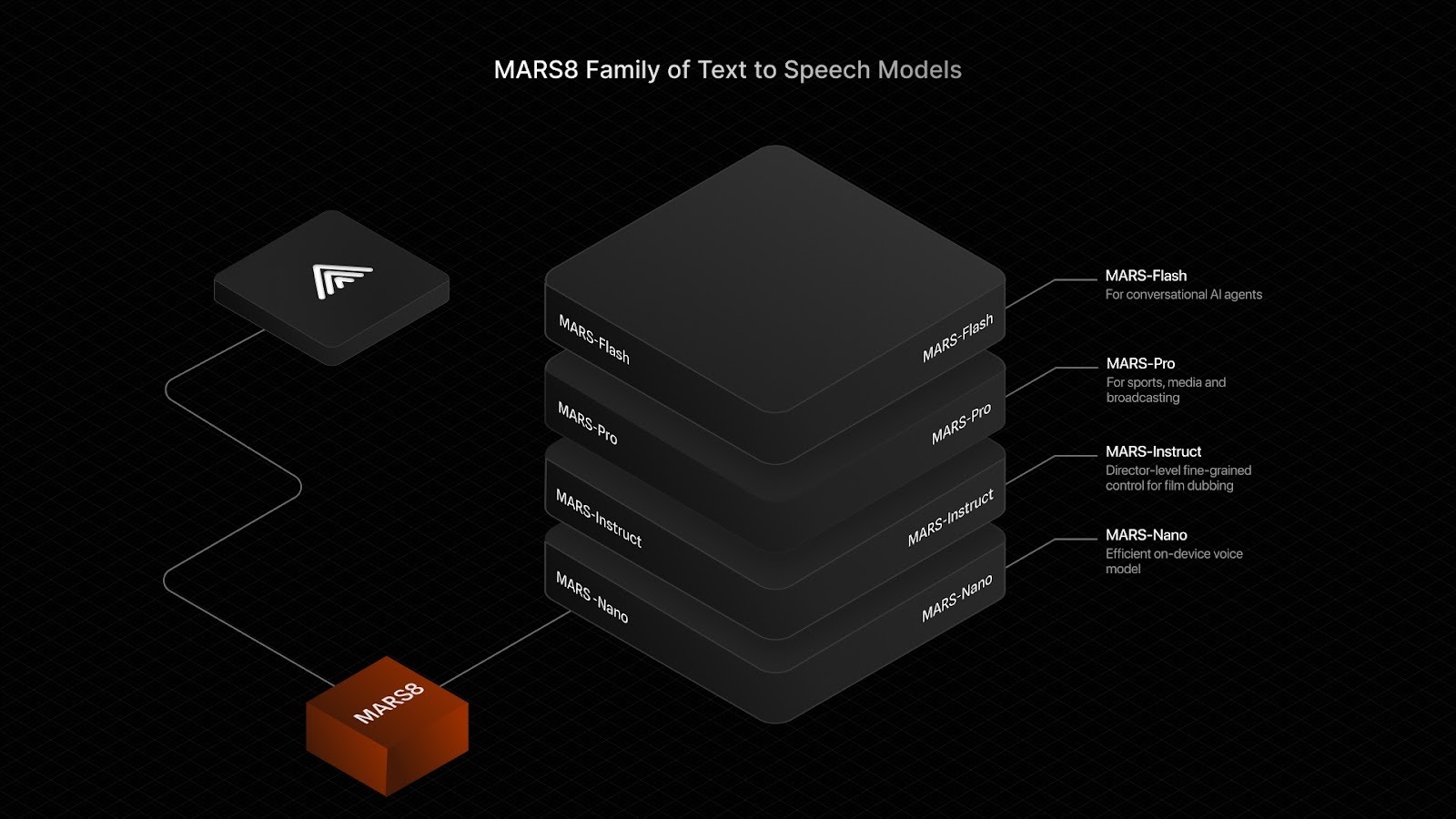
MARS8 moves away from the “black box” API model by offering four distinct architectures, each optimized for specific production constraints:
MARS-Flash: Ultra-low latency (sub-150ms TTFB) designed for real-time agents and call centers. Optimized for Blackwell GPUs, L4 and L40S
MARS-Pro: The workhorse for expressive dubbing and digital media, balancing fidelity with speed.
MARS-Instruct: Director-level control for high-end film production, allowing independent tuning of speaker and prosody.
MARS-Nano: A highly efficient 50M parameter model for on-device applications where compute is constrained.
Note: More information on the MARS8 family towards the end of the document.
A Compute-First Business Model
In a move set to disrupt the unit economics of Voice AI, MARS8 is launching with a “Compute-First” model. The status quo of “pay-per-character” API pricing destroys margins at scale. CAMB.AI is flipping the script.
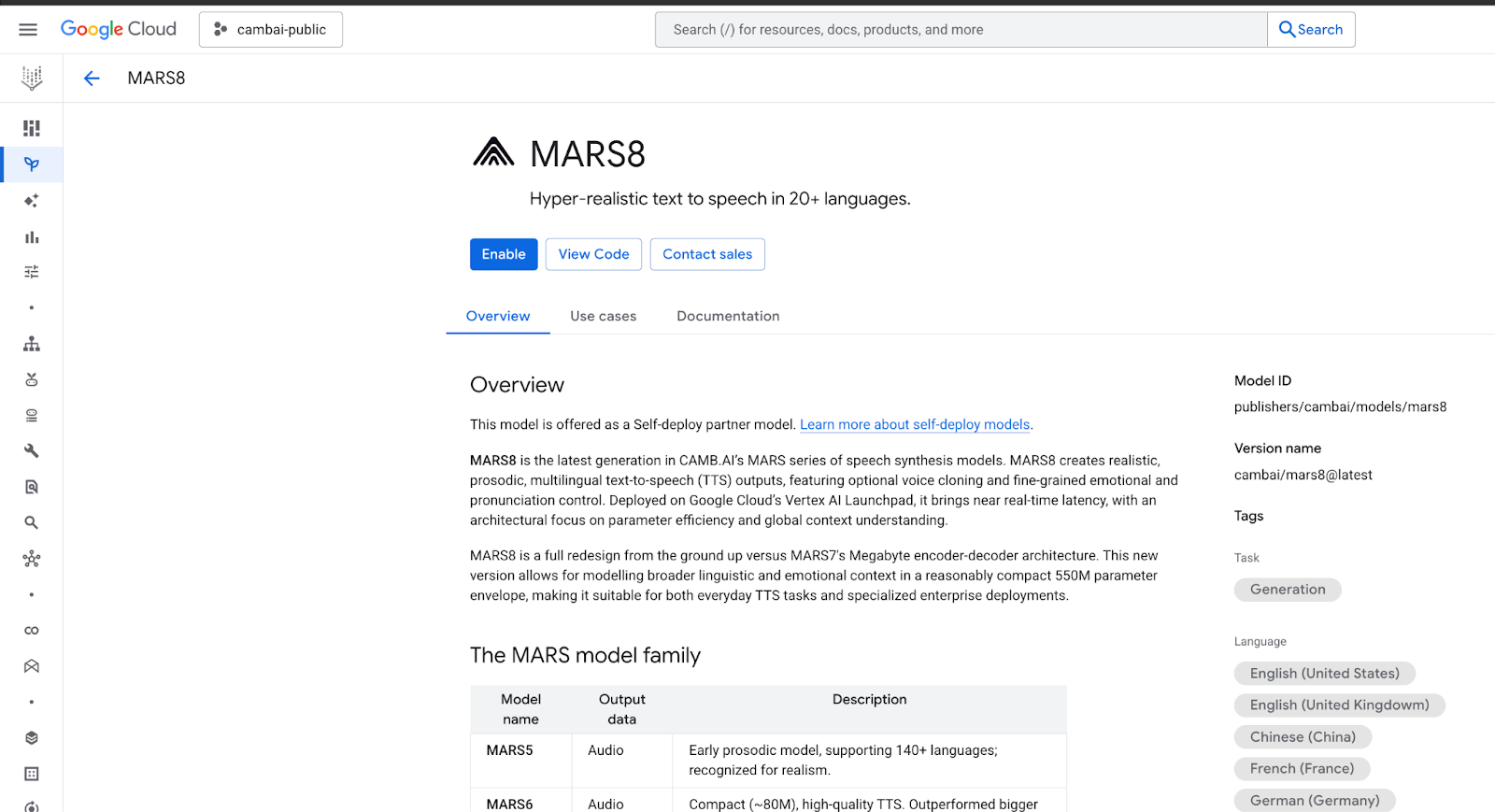
MARS8 allows enterprise customers to run the models on their own infrastructure – whether that is AWS Bedrock, Google Cloud Vertex AI, or specialized GPU platforms like Modal, Baseten and others. MARS8 is launching on 25+ compute platforms and on-device SDKs which marks a historic first in the Voice AI space.
Example of MARS8 ready for deployment on Google Cloud Model Garden, similar to Anthropic
“Token-based pricing scales linearly. Compute-based pricing flatlines costs even as usage spikes, saving enterprises up to 90%,” the company states. “Plus, by deploying in your own region, you control the latency floor and keep data within your compliance rails.”
Launch Ecosystem
MARS8 is launching with a robust partner ecosystem, bridging the gap between infrastructure and application:
Compute Partners: Ensuring MARS8 runs on the hardware developers already use (Google Cloud, AWS, Azure (coming soon), Hathora, Modal, Baseten and others).
Voice Agent Platforms: Integrating MARS-Flash directly into the workflow of top conversational AI providers for immediate deployment in contact centers.
MARS8 marks a turning point for production Voice AI. The days of forcing every use case through a single generic model are over. Whether you’re shipping a real-time voice agent, dubbing a feature film, or building an on-device assistant, you now have architecture built for your constraints, not compromises. And with compute-first pricing, scaling no longer means bleeding margin.
Ready to deploy? Explore the full MARS8 family at camb.ai/mars. For technical specs and architecture deep dives, check out camb.ai/blog-post/mars8-technical-report.
About CAMB.AI
CAMB.AI is the localization AI infrastructure company built to help the world’s biggest enterprises reach 8 billion consumers. Backed by real-world usage in live sports, cinema, and broadcasting, CAMB.AI is pioneering real-time, language-free access across text, audio, and video.
[email protected]
SOURCE: CAMB.AI
About Web3Wire Web3Wire – Information, news, press releases, events and research articles about Web3, Metaverse, Blockchain, Artificial Intelligence, Cryptocurrencies, Decentralized Finance, NFTs and Gaming. Visit Web3Wire for Web3 News and Events, Block3Wire for the latest Blockchain news and Meta3Wire to stay updated with Metaverse News.
Polymarket is facing bans in Portugal and Hungary, along with a lawsuit in Nevada and actions in other states.
The prediction market stands accused in several places of offering unregulated gambling services.
However, prediction markets operators argue that they are not providing gambling services, but rather event contracts.
Polymarket has kicked off 2026 facing a new slew of regulatory actions from jurisdictions in Europe and the U.S., even as it edges its way back into the American market.
On Friday, both the Hungarian Supervisory Authority for Regulated Activities and the Portuguese Gaming Regulatory Authority issued bans against the prediction market, accusing it of illegal gambling activity.
“The website is not authorized to offer betting in Portugal, and under national law, betting on political events or happenings, whether national or international, is not permitted,” Portuguese regulators told local outlet Rádio Renascença.
]]>
The same day, the Nevada Gaming Control Board filed a civil enforcement action against Polymarket, asking the court “for a declaration and injunction to stop Polymarket from offering unlicensed wagering.” Its actions follow a similar one in Tennessee earlier this month, when the state’s sports betting regulator ordered Polymarket, Kalshi, and Crypto.com to shut down their sports prediction markets and refund wagers.
Prediction markets have exploded in popularity over the last two years, particularly ahead of the U.S. presidential election in 2024. The markets, including top players Polymarket and its main competitor, Kalshi, are seeing combined volumes of over $13.5 billion monthly and processing over 43 million transactions, according to a November 2025 report by Dune and Keyrock. (Disclaimer: Decrypt’s parent company Dastan operates prediction market platform Myriad.)
The controversy surrounding them hinges on the claim by prediction markets that they are not gambling platforms. In April, the CEO of Kalshi—which is also facing a class action lawsuit in the Southern District of New York, filed last week, which contends it operates as an “illegal and unlicensed sports book”—Tarek Mansour told Axios that prediction markets offer “events contracts,” not bets.
“I just don’t really know what this has to do with gambling. If we are gambling, then I think you’re basically calling the entire financial market gambling,” he said at the time, describing the market as “an open financial marketplace” where people trade against each other instead of betting against a sportsbook.
But regulators beg to differ.
Further compounding the issue is that in many places, betting on the outcome of political events is illegal—including in Portugal and also Taiwan, where Polymarket users have been investigated for betting on the outcome of the most recent presidential elections.
Concerns have also been raised about the extent of insider trading on prediction markets. Earlier this month, a Polymarket user made over $436,000 after correctly betting that former Venezuelan President Nicolás Maduro would be removed from power before January 31. The bet was made just hours before U.S. forces removed him, leading to accusations the user had advance knowledge of what was going to happen.
It prompted U.S. Representative Ritchie Torres (D-NY) to draft a bill prohibiting federal employees from using prediction markets when in possession of relevant insider knowledge.
That said, at the Federal level, there has been a thaw in attitudes towards prediction markets in line with Trump’s favorable stance towards crypto. In November, the Commodity Futures Trading Commission approved the return of Polymarket to the U.S. market. It was previously banned and fined $1.4 million in 2022 for regulatory compliance failures.
Kevin de Patoul, CEO of Keyrock, told Decrypt that prediction markets are a fascinating test case for blockchain’s core promise of turning collective intelligence into tradable, verifiable data.
“But they’re also showing us how fragile that can be when incentives or visibility are misaligned,” he said. “It’s evident there’s a need for clearer boundaries between participation, governance, and influence. Markets built on trustless systems still need trusted frameworks if they’re going to inform anything meaningful beyond speculation.”
“The next phase will depend on who can design markets that preserve open access while embedding transparency and compliance by design,” de Patoul added. “That’s how I see prediction markets evolve from entertainment to reliable, institutional-grade signals.”
Whether Polymarket will be allowed back into jurisdictions like Portugal and Hungary is unclear. The ban in Hungary, for instance, is temporary. In a blog, law firm CMS said that in theory, several outcomes remain possible, including the lifting of the temporary block. However, enforcement trends suggest that the authority may ultimately take a firmer position.
“Further regulatory measures may be applied, depending on the authority’s final assessment of Polymarket’s activities,” its Budapest-based lawyers wrote. “The possibility of the block being removed cannot be entirely excluded at this stage.”
Decrypt reached out to Polymarket for comment on the bans, but did not immediately receive a response.
Daily Debrief Newsletter
Start every day with the top news stories right now, plus original features, a podcast, videos and more.
The Digital Payments Market reached US$ 8,450 billion in 2024 and is expected to reach US$ 22,300 billion by 2032, growing at a CAGR of 12.9% during the forecast period 2025-2032. The market is expanding rapidly as consumers and businesses increasingly shift toward cashless transactions driven by convenience, speed, and enhanced security across online and offline payment ecosystems.
Growth is supported by the widespread adoption of smartphones, rising e-commerce penetration, and the expansion of real-time payment infrastructure across emerging and developed economies. Advancements in AI-based fraud detection, contactless payments, digital wallets, and blockchain-enabled transactions are improving trust and efficiency. Additionally, government initiatives promoting financial inclusion and digital economies are accelerating the adoption of digital payment solutions across retail, banking, healthcare, and transportation sectors.
Get a Free Sample PDF Of This Report (Get Higher Priority for Corporate Email ID):- https://www.datamintelligence.com/download-sample/digital-payment-market?sai-v
Digital Payments Market is the global market for electronic payment technologies and platforms that enable cashless transactions through cards, mobile wallets, online banking, and real-time payment systems.
Key Developments✅ January 2026: In the United States, financial institutions and fintech companies expanded real-time and embedded digital payment capabilities, integrating AI-driven fraud detection and tokenization to enhance transaction security and customer experience.
✅ January 2026: In Europe, regulatory alignment with open banking frameworks accelerated adoption of instant payments, digital wallets, and account-to-account payment solutions across retail and enterprise segments.
✅ January 2026: In Japan, payment service providers advanced cashless ecosystems through expanded QR code payments, contactless cards, and mobile wallet interoperability.
✅ December 2025: In the United States, rising e-commerce volumes and subscription-based business models increased demand for seamless digital payment processing and cross-platform payment integration.
✅ December 2025: In Asia-Pacific, rapid growth of mobile commerce and super-app ecosystems supported wider adoption of digital wallets and real-time payment infrastructure.
✅ November 2025: In Europe, increased focus on cross-border digital payments drove enhancements in interoperability, settlement speed, and compliance capabilities.
Mergers & Acquisitions✅ January 2026: In the United States, a global payment technology provider acquired a fintech specializing in embedded payments and APIs to strengthen its merchant services portfolio.
✅ December 2025: In Europe, a digital payments company completed the acquisition of a cross-border payments platform to expand international transaction capabilities.
✅ December 2025: In Japan, a financial services group strengthened its cashless payment offerings through the acquisition of a mobile wallet technology provider.
✅ October 2025: In Asia-Pacific, a fintech conglomerate acquired a regional digital payments startup to enhance mobile payment reach and financial inclusion initiatives.
Key PlayersMastercard | Google | Amazon | Alipay | Visa | PayPal | ACI Worldwide | Aurus | Apple Pay | Paysafe | Others
Key HighlightsVisa and Mastercard dominate the ecosystem through their global card networks, extensive merchant acceptance, and strong partnerships with banks and fintech platforms.
PayPal remains a leading digital wallet and online payments provider, driven by strong adoption in e-commerce, peer-to-peer payments, and cross-border transactions.
Alipay plays a critical role in the Asia-Pacific market, supported by its deep integration with Alibaba’s ecosystem and widespread usage in mobile and QR-code payments.
Apple Pay and Google Pay continue to expand contactless and mobile payment adoption, leveraging smartphone penetration, secure tokenization, and seamless user experience.
Amazon strengthens its position through embedded payment solutions, one-click checkout capabilities, and integration across its global e-commerce platforms.
ACI Worldwide and Aurus focus on enterprise-grade payment processing, real-time payments, and omnichannel transaction management for banks and merchants.
Paysafe addresses niche and high-growth segments, including digital wallets, alternative payments, online gaming, and cross-border commerce.
Others include emerging fintech players and regional payment service providers enhancing competition through innovations in real-time payments, BNPL, and digital wallets.
Buy Now & Unlock 360° Market Intelligence: https://www.datamintelligence.com/buy-now-page?report=digital-payment-market?sai-v
Market Drivers– Rapid growth in e-commerce and mobile commerce driving demand for secure, convenient digital payment solutions.
– Increasing smartphone penetration and expanding internet connectivity facilitating mobile wallet and UPI usage.
– Rising consumer preference for contactless payments due to convenience, speed, and hygiene concerns.
– Strong investments in fintech innovations, blockchain, and secure digital payment infrastructure.
– Supportive government initiatives and regulatory frameworks promoting cashless economies and financial inclusion.
Industry Developments– Launch of next-generation digital wallets, QR-based payments, and real-time payment platforms.
– Integration of AI, machine learning, and biometrics for enhanced fraud detection and secure authentication.
– Strategic partnerships among banks, fintech firms, payment networks, and merchants to expand acceptance and interoperability.
– Introduction of buy-now-pay-later (BNPL), tokenization, and value-added services integrated with digital payments.
– Growing adoption of cross-border payment solutions and APIs for seamless global transactions.
Regional InsightsAsia Pacific – 38% share: “Driven by massive digital payment adoption, government-led financial inclusion initiatives, rapid surge in UPI and mobile wallets, and expanding fintech ecosystem.”
North America – 32% share: “Supported by high e-commerce penetration, advanced payment infrastructure, strong consumer credit usage, and innovation in contactless and mobile pay.”
Europe – 22% share: “Fueled by robust PSD2 frameworks, growth in digital banking, and rising adoption of contactless and open banking payments.”
Latin America – 5% share: “Driven by expanding acceptance networks, rising mobile money usage, and growing e-commerce transactions.”
Middle East & Africa – 3% share: “Supported by government digitization programs, mobile wallet growth, and expanding financial services access.”
Speak to Our Analyst and Get Customization in the report as per your requirements: https://www.datamintelligence.com/customize/digital-payment-market?sai-v
Key SegmentsBy ComponentSolutions hold the largest share of the market, driven by widespread adoption of integrated payment platforms, transaction processing software, fraud detection, and analytics tools. Services are gaining strong traction as organizations increasingly rely on consulting, system integration, maintenance, and managed services to ensure secure and seamless payment operations.
By Mode of PaymentPoint of sales remains a dominant segment, supported by extensive use in retail, hospitality, and physical commerce environments. Digital wallets are experiencing rapid growth, driven by rising smartphone penetration, convenience, and contactless payment adoption. Bank cards continue to represent a significant share due to their global acceptance and established infrastructure. Digital currencies are an emerging segment, gaining attention as blockchain-based payments evolve. Net banking maintains steady adoption for high-value and business transactions, while other payment modes contribute through niche and region-specific solutions.
By DeploymentCloud-based deployment dominates the market, driven by scalability, flexibility, lower upfront costs, and ease of integration with digital ecosystems. On-premises deployment continues to be preferred by organizations with strict data security, compliance, and customization requirements.
By Organization SizeLarge enterprises account for a major share, supported by high transaction volumes and complex payment needs across multiple channels. Small and medium-sized enterprises are witnessing strong growth, driven by increasing digitalization, affordability of cloud-based solutions, and expanding e-commerce adoption.
By End-UserBanking, financial services, and insurance represent the largest end-user segment, driven by continuous innovation in digital payments and financial services. Retail and e-commerce hold a substantial share due to omnichannel commerce expansion. Healthcare is growing steadily as digital payments simplify billing and patient transactions. Transportation, travel and hospitality, media and entertainment, and transportation and logistics are expanding rapidly, supported by digital ticketing, subscriptions, and on-demand services. Other end users contribute through diverse industry-specific payment applications.
Unlock 360° Market Intelligence with DataM Subscription Services: https://www.datamintelligence.com/reports-subscription
Power your decisions with real-time competitor tracking, strategic forecasts, and global investment insights all in one place.
✅ Competitive Landscape✅ Sustainability Impact Analysis✅ KOL / Stakeholder Insights✅ Unmet Needs & Positioning, Pricing & Market Access Snapshots✅ Market Volatility & Emerging Risks Analysis✅ Quarterly Industry Report Updated✅ Live Market & Pricing Trends✅ Import-Export Data Monitoring
Have a look at our Subscription Dashboard: https://www.youtube.com/watch?v=x5oEiqEqTWg
Contact Us –
Company Name: DataM IntelligenceContact Person: Sai KiranEmail: Sai.k@datamintelligence.comPhone: +1 877 441 4866Website: https://www.datamintelligence.com
About Us –DataM Intelligence is a Market Research and Consulting firm that provides end-to-end business solutions to organizations from Research to Consulting. We, at DataM Intelligence, leverage our top trademark trends, insights and developments to emancipate swift and astute solutions to clients like you. We encompass a multitude of syndicate reports and customized reports with a robust methodology.
Our research database features countless statistics and in-depth analyses across a wide range of 6300+ reports in 40+ domains creating business solutions for more than 200+ companies across 50+ countries; catering to the key business research needs that influence the growth trajectory of our vast clientele.
This release was published on openPR.
About Web3Wire Web3Wire – Information, news, press releases, events and research articles about Web3, Metaverse, Blockchain, Artificial Intelligence, Cryptocurrencies, Decentralized Finance, NFTs and Gaming. Visit Web3Wire for Web3 News and Events, Block3Wire for the latest Blockchain news and Meta3Wire to stay updated with Metaverse News.
The UK’s Treasury Committee warned regulators are leaning too heavily on existing rules as AI use accelerates across financial services.
It urged clearer guidance on consumer protection and executive accountability by the end of 2026.
Observers say regulatory ambiguity risks holding back responsible AI deployment as systems grow harder to oversee.
A UK parliamentary committee has warned that the rapid adoption of artificial intelligence across financial services is outpacing regulators’ ability to manage risks to consumers and the financial system, raising concerns about accountability, oversight, and reliance on major technology providers.
In findings ordered to be printed by the House of Commons earlier this month, the Treasury Committee said UK regulators, including the Financial Conduct Authority, the Bank of England, and HM Treasury, are leaning too heavily on existing rules as AI use spreads across banks, insurers, and payment firms.
“By taking a wait-and-see approach to AI in financial services, the three authorities are exposing consumers and the financial system to potentially serious harm,” the committee wrote.
]]>
AI is already embedded in core financial functions, the committee said, while oversight has not kept pace with the scale or opacity of those systems.
The findings come as the UK government pushes to expand AI adoption across the economy, with Prime Minister Keir Starmer pledging roughly a year ago to “turbocharge” Britain’s future through the technology.
While noting that “AI and wider technological developments could bring considerable benefits to consumers,” the committee said regulators have failed to provide firms with clear expectations for how existing rules apply in practice.
The committee urged the Financial Conduct Authority to publish comprehensive guidance by the end of 2026 on how consumer protection rules apply to AI use and how responsibility should be assigned to senior executives under existing accountability rules when AI systems cause harm.
Formal minutes are expected to be released later this week.
“To its credit, the UK got out ahead on fintech—the FCA’s sandbox in 2015 was the first of its kind, and 57 countries have copied it since. London remains a powerhouse in fintech despite Brexit,” Dermot McGrath, co-founder at Shanghai-based strategy and growth studio ZenGen Labs, told Decrypt.
Yet while that approach “worked because regulators could see what firms were doing and step in when needed,” artificial intelligence “breaks that model completely,” McGrath said.
The technology is already widely used across UK finance. Still, many firms lack a clear understanding of the very systems they rely on, McGrath explained. This leaves regulators and companies to infer how long-standing fairness rules apply to opaque, model-driven decisions.
McGrath argues the larger concern is that unclear rules may hold back firms trying to deploy AI to an extent where “regulatory ambiguity stifles the firms doing it carefully.”
AI accountability becomes more complex when models are built by tech firms, adapted by third parties, and used by banks, leaving managers responsible for decisions they may struggle to explain, McGrath explained.
Daily Debrief Newsletter
Start every day with the top news stories right now, plus original features, a podcast, videos and more.
NEW YORK CITY, NY / ACCESS Newswire / January 19, 2026 / Centeda announced continued development of record-based financial awareness tools reflecting an industry-wide movement toward clarity-focused preparation rather than projection-driven decision frameworks. The announcement addresses how financial planning activity increasingly incorporates public records as reference material alongside traditional financial documentation, particularly in matters involving property, asset continuity, and long-term administrative readiness.
Financial planning processes have traditionally centered on income, savings behavior, and forward-looking estimates. However, asset-related decisions are also influenced by information recorded outside financial accounts. Property ownership history, recorded interests, unresolved filings, and administrative annotations are maintained in public registries and may remain disconnected from conventional planning tools. These records can influence timing, documentation requirements, and sequencing of professional review during asset-related activity.
Centeda supports this shift by structuring public information into consolidated Property Reports designed for preparatory review. Additional educational material and updates on record-based financial awareness are available through the Centeda blog. These reports draw from publicly available property and judicial records and present historical and contextual data that may not be visible within bank statements or portfolio summaries. This structure aligns with a planning approach that prioritizes verification and documentation awareness before commitments are made.
Property records often reflect layered ownership structures, historical transfers, or recorded interests that extend beyond current use or income generation. Inherited assets, jointly held properties, or holdings located outside a primary place of residence may involve records maintained across multiple local jurisdictions. When these records are reviewed late in a planning process, additional administrative steps may be required to reconcile documentation or confirm status.
Public records are updated at varying intervals depending on jurisdiction and administrative processes. Aggregated databases may not immediately reflect recent changes recorded at the local level. During preparation for transactions such as transfers, refinancing, or estate documentation updates, timing differences between record systems can introduce discrepancies that require clarification. Earlier review of local records provides an additional reference point during planning activity.
Judicial records associated with property or individuals may also influence administrative readiness. Recorded filings can affect asset transfer processes or surface during due diligence, even when no immediate financial obligation is visible within standard financial summaries. Incorporating this information into early-stage planning allows records to be reviewed in context rather than under time constraints.
Centeda’s Property Reports are structured to support this broader view of financial preparation. The reports are not designed to forecast outcomes or evaluate financial performance. Instead, the focus remains on assembling public record information into a single reference framework that supports informed sequencing of professional review and documentation alignment.
The announcement reflects a broader trend in financial planning toward record validation as a foundation for orderly decision-making. Rather than relying solely on projections or assumptions, planning processes increasingly emphasize completeness of information and administrative awareness. This approach supports clarity in asset handling and reduces reliance on last-stage discovery.
As financial planning continues to evolve, access to organized public records is becoming part of preparatory review for individuals managing property-related matters. Centeda’s tools are positioned within this context as a data resource intended to support awareness rather than prediction.
About Company
Centeda provides access to consolidated public records through data tools designed to support financial awareness and planning preparation. The platform compiles publicly available property and judicial records into structured Property Reports to assist with review related to assets, ownership history, and recorded filings. Centeda is not a financial institution and does not operate as a credit reporting agency.
MEDIA DETAIL
Centeda[email protected]https://centeda.com/
SOURCE: Centeda
About Web3Wire Web3Wire – Information, news, press releases, events and research articles about Web3, Metaverse, Blockchain, Artificial Intelligence, Cryptocurrencies, Decentralized Finance, NFTs and Gaming. Visit Web3Wire for Web3 News and Events, Block3Wire for the latest Blockchain news and Meta3Wire to stay updated with Metaverse News.




 Example of MARS8 ready for deployment on Google Cloud Model Garden, similar to Anthropic


