CAMB.AI launches MARS8, the first family of text-to-speech models built for real-world deployment, enabling enterprises to run the right voice architecture for speed, quality, or efficiency at scale on their own infrastructure
SAN FRANCISCO, CA / ACCESS Newswire / January 20, 2026 / CAMB.AI, the AI voice infrastructure company founded by AI researchers from Apple and Carnegie Mellon, today announced the launch of MARS8. This is the first text-to-speech (TTS) system designed not as a single model, but as a family of specialized architectures built for production reality.
Since 2023, CAMB.AI’s MARS engine has powered AI voice-enabled applications reaching over 200 million users through partners like NASCAR, Broadcom, Australian Open, Eurovision Sport, IMAX, and Comcast NBCUniversal.
Powering Enterprise Scale Since 2023
Past viral launch and success of MARS5 in the open-source domain
After shipping voice AI into high-stakes production environments across 150+ languages, the team uncovered a critical flaw in the current market: No single TTS architecture wins across every use case.
“The market forces developers to choose between speed, quality, accuracy, and cost. We realized that was a false choice,” says Akshat Prakash, CTO at CAMB.AI. “A live voice assistant needs sub-150ms latency. A movie dubbing pipeline needs director-level emotional control. An automotive system has strict memory constraints. You cannot solve all three with one generic API.”
Introducing the MARS8 Family
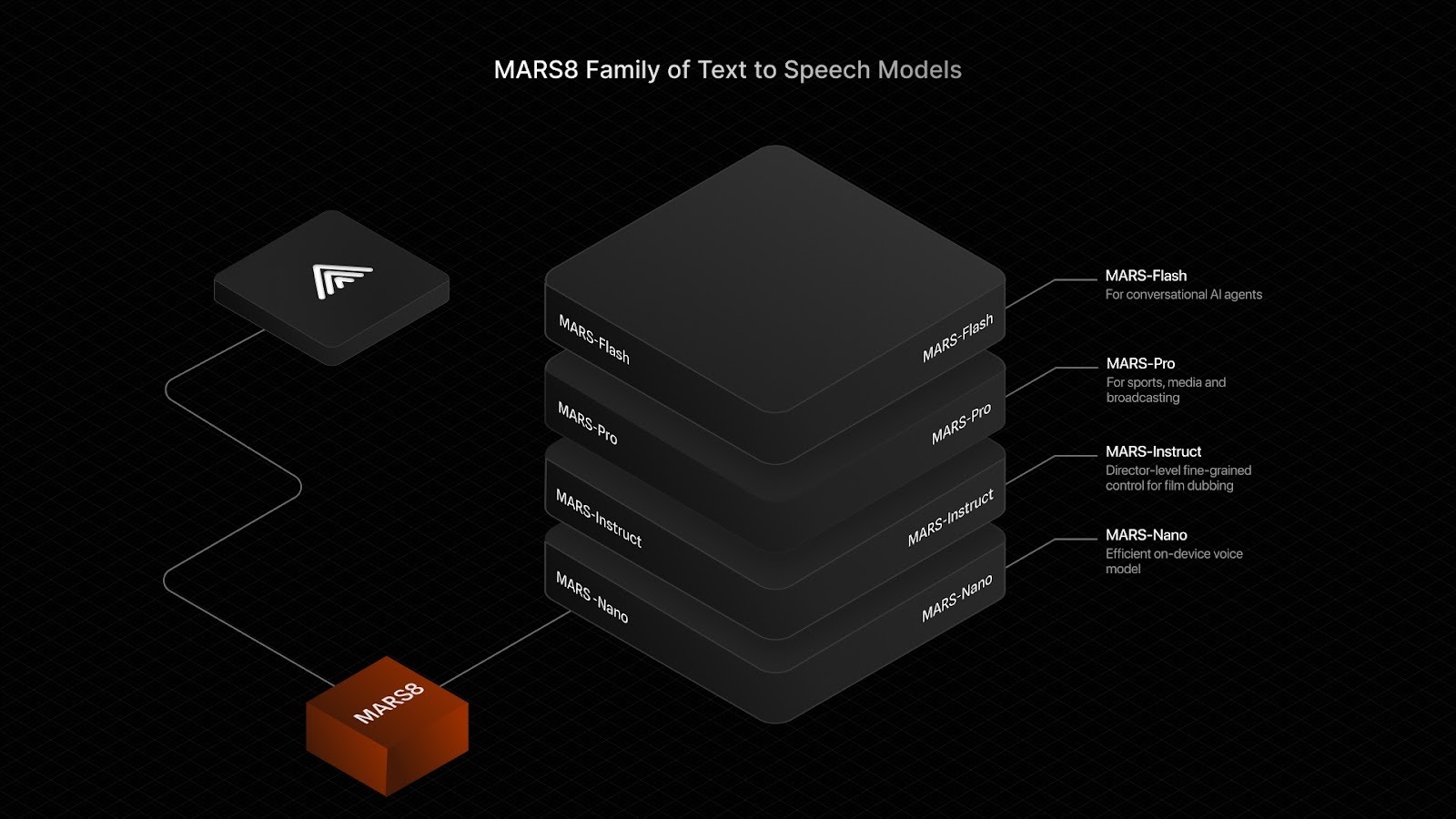
MARS8 moves away from the “black box” API model by offering four distinct architectures, each optimized for specific production constraints:
MARS-Flash: Ultra-low latency (sub-150ms TTFB) designed for real-time agents and call centers. Optimized for Blackwell GPUs, L4 and L40S
MARS-Pro: The workhorse for expressive dubbing and digital media, balancing fidelity with speed.
MARS-Instruct: Director-level control for high-end film production, allowing independent tuning of speaker and prosody.
MARS-Nano: A highly efficient 50M parameter model for on-device applications where compute is constrained.
Note: More information on the MARS8 family towards the end of the document.
A Compute-First Business Model
In a move set to disrupt the unit economics of Voice AI, MARS8 is launching with a “Compute-First” model. The status quo of “pay-per-character” API pricing destroys margins at scale. CAMB.AI is flipping the script.
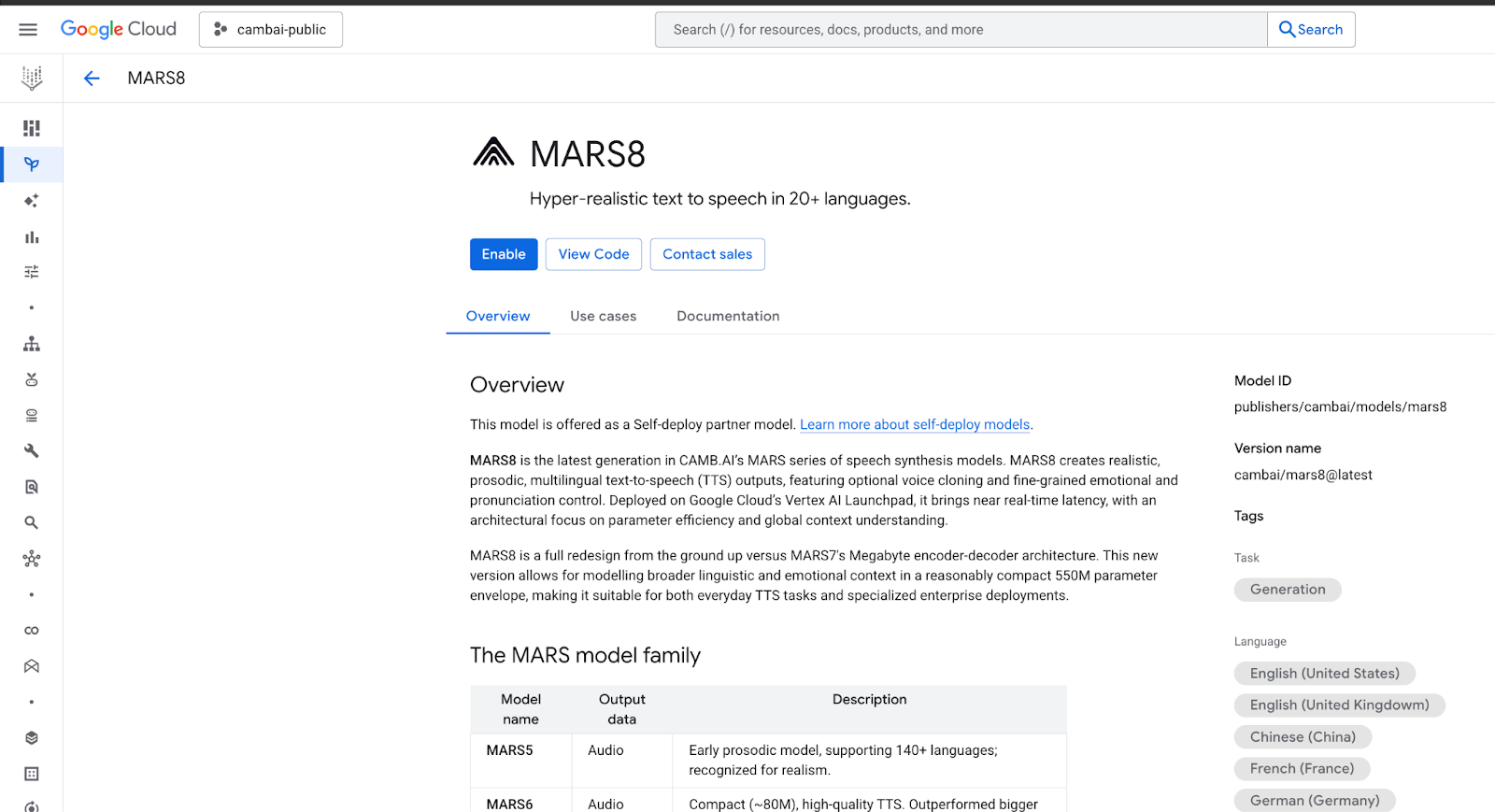
MARS8 allows enterprise customers to run the models on their own infrastructure – whether that is AWS Bedrock, Google Cloud Vertex AI, or specialized GPU platforms like Modal, Baseten and others. MARS8 is launching on 25+ compute platforms and on-device SDKs which marks a historic first in the Voice AI space.
Example of MARS8 ready for deployment on Google Cloud Model Garden, similar to Anthropic
“Token-based pricing scales linearly. Compute-based pricing flatlines costs even as usage spikes, saving enterprises up to 90%,” the company states. “Plus, by deploying in your own region, you control the latency floor and keep data within your compliance rails.”
Launch Ecosystem
MARS8 is launching with a robust partner ecosystem, bridging the gap between infrastructure and application:
Compute Partners: Ensuring MARS8 runs on the hardware developers already use (Google Cloud, AWS, Azure (coming soon), Hathora, Modal, Baseten and others).
Voice Agent Platforms: Integrating MARS-Flash directly into the workflow of top conversational AI providers for immediate deployment in contact centers.
MARS8 marks a turning point for production Voice AI. The days of forcing every use case through a single generic model are over. Whether you’re shipping a real-time voice agent, dubbing a feature film, or building an on-device assistant, you now have architecture built for your constraints, not compromises. And with compute-first pricing, scaling no longer means bleeding margin.
Ready to deploy? Explore the full MARS8 family at camb.ai/mars. For technical specs and architecture deep dives, check out camb.ai/blog-post/mars8-technical-report.
About CAMB.AI
CAMB.AI is the localization AI infrastructure company built to help the world’s biggest enterprises reach 8 billion consumers. Backed by real-world usage in live sports, cinema, and broadcasting, CAMB.AI is pioneering real-time, language-free access across text, audio, and video.
[email protected]
SOURCE: CAMB.AI
About Web3Wire Web3Wire – Information, news, press releases, events and research articles about Web3, Metaverse, Blockchain, Artificial Intelligence, Cryptocurrencies, Decentralized Finance, NFTs and Gaming. Visit Web3Wire for Web3 News and Events, Block3Wire for the latest Blockchain news and Meta3Wire to stay updated with Metaverse News.
Polymarket is facing bans in Portugal and Hungary, along with a lawsuit in Nevada and actions in other states.
The prediction market stands accused in several places of offering unregulated gambling services.
However, prediction markets operators argue that they are not providing gambling services, but rather event contracts.
Polymarket has kicked off 2026 facing a new slew of regulatory actions from jurisdictions in Europe and the U.S., even as it edges its way back into the American market.
On Friday, both the Hungarian Supervisory Authority for Regulated Activities and the Portuguese Gaming Regulatory Authority issued bans against the prediction market, accusing it of illegal gambling activity.
“The website is not authorized to offer betting in Portugal, and under national law, betting on political events or happenings, whether national or international, is not permitted,” Portuguese regulators told local outlet Rádio Renascença.
]]>
The same day, the Nevada Gaming Control Board filed a civil enforcement action against Polymarket, asking the court “for a declaration and injunction to stop Polymarket from offering unlicensed wagering.” Its actions follow a similar one in Tennessee earlier this month, when the state’s sports betting regulator ordered Polymarket, Kalshi, and Crypto.com to shut down their sports prediction markets and refund wagers.
Prediction markets have exploded in popularity over the last two years, particularly ahead of the U.S. presidential election in 2024. The markets, including top players Polymarket and its main competitor, Kalshi, are seeing combined volumes of over $13.5 billion monthly and processing over 43 million transactions, according to a November 2025 report by Dune and Keyrock. (Disclaimer: Decrypt’s parent company Dastan operates prediction market platform Myriad.)
The controversy surrounding them hinges on the claim by prediction markets that they are not gambling platforms. In April, the CEO of Kalshi—which is also facing a class action lawsuit in the Southern District of New York, filed last week, which contends it operates as an “illegal and unlicensed sports book”—Tarek Mansour told Axios that prediction markets offer “events contracts,” not bets.
“I just don’t really know what this has to do with gambling. If we are gambling, then I think you’re basically calling the entire financial market gambling,” he said at the time, describing the market as “an open financial marketplace” where people trade against each other instead of betting against a sportsbook.
But regulators beg to differ.
Further compounding the issue is that in many places, betting on the outcome of political events is illegal—including in Portugal and also Taiwan, where Polymarket users have been investigated for betting on the outcome of the most recent presidential elections.
Concerns have also been raised about the extent of insider trading on prediction markets. Earlier this month, a Polymarket user made over $436,000 after correctly betting that former Venezuelan President Nicolás Maduro would be removed from power before January 31. The bet was made just hours before U.S. forces removed him, leading to accusations the user had advance knowledge of what was going to happen.
It prompted U.S. Representative Ritchie Torres (D-NY) to draft a bill prohibiting federal employees from using prediction markets when in possession of relevant insider knowledge.
That said, at the Federal level, there has been a thaw in attitudes towards prediction markets in line with Trump’s favorable stance towards crypto. In November, the Commodity Futures Trading Commission approved the return of Polymarket to the U.S. market. It was previously banned and fined $1.4 million in 2022 for regulatory compliance failures.
Kevin de Patoul, CEO of Keyrock, told Decrypt that prediction markets are a fascinating test case for blockchain’s core promise of turning collective intelligence into tradable, verifiable data.
“But they’re also showing us how fragile that can be when incentives or visibility are misaligned,” he said. “It’s evident there’s a need for clearer boundaries between participation, governance, and influence. Markets built on trustless systems still need trusted frameworks if they’re going to inform anything meaningful beyond speculation.”
“The next phase will depend on who can design markets that preserve open access while embedding transparency and compliance by design,” de Patoul added. “That’s how I see prediction markets evolve from entertainment to reliable, institutional-grade signals.”
Whether Polymarket will be allowed back into jurisdictions like Portugal and Hungary is unclear. The ban in Hungary, for instance, is temporary. In a blog, law firm CMS said that in theory, several outcomes remain possible, including the lifting of the temporary block. However, enforcement trends suggest that the authority may ultimately take a firmer position.
“Further regulatory measures may be applied, depending on the authority’s final assessment of Polymarket’s activities,” its Budapest-based lawyers wrote. “The possibility of the block being removed cannot be entirely excluded at this stage.”
Decrypt reached out to Polymarket for comment on the bans, but did not immediately receive a response.
Daily Debrief Newsletter
Start every day with the top news stories right now, plus original features, a podcast, videos and more.
The Digital Payments Market reached US$ 8,450 billion in 2024 and is expected to reach US$ 22,300 billion by 2032, growing at a CAGR of 12.9% during the forecast period 2025-2032. The market is expanding rapidly as consumers and businesses increasingly shift toward cashless transactions driven by convenience, speed, and enhanced security across online and offline payment ecosystems.
Growth is supported by the widespread adoption of smartphones, rising e-commerce penetration, and the expansion of real-time payment infrastructure across emerging and developed economies. Advancements in AI-based fraud detection, contactless payments, digital wallets, and blockchain-enabled transactions are improving trust and efficiency. Additionally, government initiatives promoting financial inclusion and digital economies are accelerating the adoption of digital payment solutions across retail, banking, healthcare, and transportation sectors.
Get a Free Sample PDF Of This Report (Get Higher Priority for Corporate Email ID):- https://www.datamintelligence.com/download-sample/digital-payment-market?sai-v
Digital Payments Market is the global market for electronic payment technologies and platforms that enable cashless transactions through cards, mobile wallets, online banking, and real-time payment systems.
Key Developments✅ January 2026: In the United States, financial institutions and fintech companies expanded real-time and embedded digital payment capabilities, integrating AI-driven fraud detection and tokenization to enhance transaction security and customer experience.
✅ January 2026: In Europe, regulatory alignment with open banking frameworks accelerated adoption of instant payments, digital wallets, and account-to-account payment solutions across retail and enterprise segments.
✅ January 2026: In Japan, payment service providers advanced cashless ecosystems through expanded QR code payments, contactless cards, and mobile wallet interoperability.
✅ December 2025: In the United States, rising e-commerce volumes and subscription-based business models increased demand for seamless digital payment processing and cross-platform payment integration.
✅ December 2025: In Asia-Pacific, rapid growth of mobile commerce and super-app ecosystems supported wider adoption of digital wallets and real-time payment infrastructure.
✅ November 2025: In Europe, increased focus on cross-border digital payments drove enhancements in interoperability, settlement speed, and compliance capabilities.
Mergers & Acquisitions✅ January 2026: In the United States, a global payment technology provider acquired a fintech specializing in embedded payments and APIs to strengthen its merchant services portfolio.
✅ December 2025: In Europe, a digital payments company completed the acquisition of a cross-border payments platform to expand international transaction capabilities.
✅ December 2025: In Japan, a financial services group strengthened its cashless payment offerings through the acquisition of a mobile wallet technology provider.
✅ October 2025: In Asia-Pacific, a fintech conglomerate acquired a regional digital payments startup to enhance mobile payment reach and financial inclusion initiatives.
Key PlayersMastercard | Google | Amazon | Alipay | Visa | PayPal | ACI Worldwide | Aurus | Apple Pay | Paysafe | Others
Key HighlightsVisa and Mastercard dominate the ecosystem through their global card networks, extensive merchant acceptance, and strong partnerships with banks and fintech platforms.
PayPal remains a leading digital wallet and online payments provider, driven by strong adoption in e-commerce, peer-to-peer payments, and cross-border transactions.
Alipay plays a critical role in the Asia-Pacific market, supported by its deep integration with Alibaba’s ecosystem and widespread usage in mobile and QR-code payments.
Apple Pay and Google Pay continue to expand contactless and mobile payment adoption, leveraging smartphone penetration, secure tokenization, and seamless user experience.
Amazon strengthens its position through embedded payment solutions, one-click checkout capabilities, and integration across its global e-commerce platforms.
ACI Worldwide and Aurus focus on enterprise-grade payment processing, real-time payments, and omnichannel transaction management for banks and merchants.
Paysafe addresses niche and high-growth segments, including digital wallets, alternative payments, online gaming, and cross-border commerce.
Others include emerging fintech players and regional payment service providers enhancing competition through innovations in real-time payments, BNPL, and digital wallets.
Buy Now & Unlock 360° Market Intelligence: https://www.datamintelligence.com/buy-now-page?report=digital-payment-market?sai-v
Market Drivers– Rapid growth in e-commerce and mobile commerce driving demand for secure, convenient digital payment solutions.
– Increasing smartphone penetration and expanding internet connectivity facilitating mobile wallet and UPI usage.
– Rising consumer preference for contactless payments due to convenience, speed, and hygiene concerns.
– Strong investments in fintech innovations, blockchain, and secure digital payment infrastructure.
– Supportive government initiatives and regulatory frameworks promoting cashless economies and financial inclusion.
Industry Developments– Launch of next-generation digital wallets, QR-based payments, and real-time payment platforms.
– Integration of AI, machine learning, and biometrics for enhanced fraud detection and secure authentication.
– Strategic partnerships among banks, fintech firms, payment networks, and merchants to expand acceptance and interoperability.
– Introduction of buy-now-pay-later (BNPL), tokenization, and value-added services integrated with digital payments.
– Growing adoption of cross-border payment solutions and APIs for seamless global transactions.
Regional InsightsAsia Pacific – 38% share: “Driven by massive digital payment adoption, government-led financial inclusion initiatives, rapid surge in UPI and mobile wallets, and expanding fintech ecosystem.”
North America – 32% share: “Supported by high e-commerce penetration, advanced payment infrastructure, strong consumer credit usage, and innovation in contactless and mobile pay.”
Europe – 22% share: “Fueled by robust PSD2 frameworks, growth in digital banking, and rising adoption of contactless and open banking payments.”
Latin America – 5% share: “Driven by expanding acceptance networks, rising mobile money usage, and growing e-commerce transactions.”
Middle East & Africa – 3% share: “Supported by government digitization programs, mobile wallet growth, and expanding financial services access.”
Speak to Our Analyst and Get Customization in the report as per your requirements: https://www.datamintelligence.com/customize/digital-payment-market?sai-v
Key SegmentsBy ComponentSolutions hold the largest share of the market, driven by widespread adoption of integrated payment platforms, transaction processing software, fraud detection, and analytics tools. Services are gaining strong traction as organizations increasingly rely on consulting, system integration, maintenance, and managed services to ensure secure and seamless payment operations.
By Mode of PaymentPoint of sales remains a dominant segment, supported by extensive use in retail, hospitality, and physical commerce environments. Digital wallets are experiencing rapid growth, driven by rising smartphone penetration, convenience, and contactless payment adoption. Bank cards continue to represent a significant share due to their global acceptance and established infrastructure. Digital currencies are an emerging segment, gaining attention as blockchain-based payments evolve. Net banking maintains steady adoption for high-value and business transactions, while other payment modes contribute through niche and region-specific solutions.
By DeploymentCloud-based deployment dominates the market, driven by scalability, flexibility, lower upfront costs, and ease of integration with digital ecosystems. On-premises deployment continues to be preferred by organizations with strict data security, compliance, and customization requirements.
By Organization SizeLarge enterprises account for a major share, supported by high transaction volumes and complex payment needs across multiple channels. Small and medium-sized enterprises are witnessing strong growth, driven by increasing digitalization, affordability of cloud-based solutions, and expanding e-commerce adoption.
By End-UserBanking, financial services, and insurance represent the largest end-user segment, driven by continuous innovation in digital payments and financial services. Retail and e-commerce hold a substantial share due to omnichannel commerce expansion. Healthcare is growing steadily as digital payments simplify billing and patient transactions. Transportation, travel and hospitality, media and entertainment, and transportation and logistics are expanding rapidly, supported by digital ticketing, subscriptions, and on-demand services. Other end users contribute through diverse industry-specific payment applications.
Unlock 360° Market Intelligence with DataM Subscription Services: https://www.datamintelligence.com/reports-subscription
Power your decisions with real-time competitor tracking, strategic forecasts, and global investment insights all in one place.
✅ Competitive Landscape✅ Sustainability Impact Analysis✅ KOL / Stakeholder Insights✅ Unmet Needs & Positioning, Pricing & Market Access Snapshots✅ Market Volatility & Emerging Risks Analysis✅ Quarterly Industry Report Updated✅ Live Market & Pricing Trends✅ Import-Export Data Monitoring
Have a look at our Subscription Dashboard: https://www.youtube.com/watch?v=x5oEiqEqTWg
Contact Us –
Company Name: DataM IntelligenceContact Person: Sai KiranEmail: Sai.k@datamintelligence.comPhone: +1 877 441 4866Website: https://www.datamintelligence.com
About Us –DataM Intelligence is a Market Research and Consulting firm that provides end-to-end business solutions to organizations from Research to Consulting. We, at DataM Intelligence, leverage our top trademark trends, insights and developments to emancipate swift and astute solutions to clients like you. We encompass a multitude of syndicate reports and customized reports with a robust methodology.
Our research database features countless statistics and in-depth analyses across a wide range of 6300+ reports in 40+ domains creating business solutions for more than 200+ companies across 50+ countries; catering to the key business research needs that influence the growth trajectory of our vast clientele.
This release was published on openPR.
About Web3Wire Web3Wire – Information, news, press releases, events and research articles about Web3, Metaverse, Blockchain, Artificial Intelligence, Cryptocurrencies, Decentralized Finance, NFTs and Gaming. Visit Web3Wire for Web3 News and Events, Block3Wire for the latest Blockchain news and Meta3Wire to stay updated with Metaverse News.
The UK’s Treasury Committee warned regulators are leaning too heavily on existing rules as AI use accelerates across financial services.
It urged clearer guidance on consumer protection and executive accountability by the end of 2026.
Observers say regulatory ambiguity risks holding back responsible AI deployment as systems grow harder to oversee.
A UK parliamentary committee has warned that the rapid adoption of artificial intelligence across financial services is outpacing regulators’ ability to manage risks to consumers and the financial system, raising concerns about accountability, oversight, and reliance on major technology providers.
In findings ordered to be printed by the House of Commons earlier this month, the Treasury Committee said UK regulators, including the Financial Conduct Authority, the Bank of England, and HM Treasury, are leaning too heavily on existing rules as AI use spreads across banks, insurers, and payment firms.
“By taking a wait-and-see approach to AI in financial services, the three authorities are exposing consumers and the financial system to potentially serious harm,” the committee wrote.
]]>
AI is already embedded in core financial functions, the committee said, while oversight has not kept pace with the scale or opacity of those systems.
The findings come as the UK government pushes to expand AI adoption across the economy, with Prime Minister Keir Starmer pledging roughly a year ago to “turbocharge” Britain’s future through the technology.
While noting that “AI and wider technological developments could bring considerable benefits to consumers,” the committee said regulators have failed to provide firms with clear expectations for how existing rules apply in practice.
The committee urged the Financial Conduct Authority to publish comprehensive guidance by the end of 2026 on how consumer protection rules apply to AI use and how responsibility should be assigned to senior executives under existing accountability rules when AI systems cause harm.
Formal minutes are expected to be released later this week.
“To its credit, the UK got out ahead on fintech—the FCA’s sandbox in 2015 was the first of its kind, and 57 countries have copied it since. London remains a powerhouse in fintech despite Brexit,” Dermot McGrath, co-founder at Shanghai-based strategy and growth studio ZenGen Labs, told Decrypt.
Yet while that approach “worked because regulators could see what firms were doing and step in when needed,” artificial intelligence “breaks that model completely,” McGrath said.
The technology is already widely used across UK finance. Still, many firms lack a clear understanding of the very systems they rely on, McGrath explained. This leaves regulators and companies to infer how long-standing fairness rules apply to opaque, model-driven decisions.
McGrath argues the larger concern is that unclear rules may hold back firms trying to deploy AI to an extent where “regulatory ambiguity stifles the firms doing it carefully.”
AI accountability becomes more complex when models are built by tech firms, adapted by third parties, and used by banks, leaving managers responsible for decisions they may struggle to explain, McGrath explained.
Daily Debrief Newsletter
Start every day with the top news stories right now, plus original features, a podcast, videos and more.
NEW YORK CITY, NY / ACCESS Newswire / January 19, 2026 / Centeda announced continued development of record-based financial awareness tools reflecting an industry-wide movement toward clarity-focused preparation rather than projection-driven decision frameworks. The announcement addresses how financial planning activity increasingly incorporates public records as reference material alongside traditional financial documentation, particularly in matters involving property, asset continuity, and long-term administrative readiness.
Financial planning processes have traditionally centered on income, savings behavior, and forward-looking estimates. However, asset-related decisions are also influenced by information recorded outside financial accounts. Property ownership history, recorded interests, unresolved filings, and administrative annotations are maintained in public registries and may remain disconnected from conventional planning tools. These records can influence timing, documentation requirements, and sequencing of professional review during asset-related activity.
Centeda supports this shift by structuring public information into consolidated Property Reports designed for preparatory review. Additional educational material and updates on record-based financial awareness are available through the Centeda blog. These reports draw from publicly available property and judicial records and present historical and contextual data that may not be visible within bank statements or portfolio summaries. This structure aligns with a planning approach that prioritizes verification and documentation awareness before commitments are made.
Property records often reflect layered ownership structures, historical transfers, or recorded interests that extend beyond current use or income generation. Inherited assets, jointly held properties, or holdings located outside a primary place of residence may involve records maintained across multiple local jurisdictions. When these records are reviewed late in a planning process, additional administrative steps may be required to reconcile documentation or confirm status.
Public records are updated at varying intervals depending on jurisdiction and administrative processes. Aggregated databases may not immediately reflect recent changes recorded at the local level. During preparation for transactions such as transfers, refinancing, or estate documentation updates, timing differences between record systems can introduce discrepancies that require clarification. Earlier review of local records provides an additional reference point during planning activity.
Judicial records associated with property or individuals may also influence administrative readiness. Recorded filings can affect asset transfer processes or surface during due diligence, even when no immediate financial obligation is visible within standard financial summaries. Incorporating this information into early-stage planning allows records to be reviewed in context rather than under time constraints.
Centeda’s Property Reports are structured to support this broader view of financial preparation. The reports are not designed to forecast outcomes or evaluate financial performance. Instead, the focus remains on assembling public record information into a single reference framework that supports informed sequencing of professional review and documentation alignment.
The announcement reflects a broader trend in financial planning toward record validation as a foundation for orderly decision-making. Rather than relying solely on projections or assumptions, planning processes increasingly emphasize completeness of information and administrative awareness. This approach supports clarity in asset handling and reduces reliance on last-stage discovery.
As financial planning continues to evolve, access to organized public records is becoming part of preparatory review for individuals managing property-related matters. Centeda’s tools are positioned within this context as a data resource intended to support awareness rather than prediction.
About Company
Centeda provides access to consolidated public records through data tools designed to support financial awareness and planning preparation. The platform compiles publicly available property and judicial records into structured Property Reports to assist with review related to assets, ownership history, and recorded filings. Centeda is not a financial institution and does not operate as a credit reporting agency.
MEDIA DETAIL
Centeda[email protected]https://centeda.com/
SOURCE: Centeda
About Web3Wire Web3Wire – Information, news, press releases, events and research articles about Web3, Metaverse, Blockchain, Artificial Intelligence, Cryptocurrencies, Decentralized Finance, NFTs and Gaming. Visit Web3Wire for Web3 News and Events, Block3Wire for the latest Blockchain news and Meta3Wire to stay updated with Metaverse News.
A database migration issue on perps decentralized exchange Paradex led to the price of Bitcoin showing as $0, forcing a liquidation cascade.
The issue required a chain rollback to revert to its last normal state before the glitch took effect.
Service has since been restored and user funds are safe, according to the exchange’s status page.
The price of Bitcoin dropped to $0 on perps decentralized exchange Paradex overnight, according to numerous users, after a database migration issue affected the Paradex blockchain, its block explorer, bridge, and API.
An issue was first flagged on the Paradex status page at 12:36 a.m, ET on Monday, shortly after social media posts flagged a cascade of liquidations as the price of Bitcoin plunged to $0 on the exchange.
Around 2:00 a.m. ET, the exchange identified the issue and began instituting a fix that resulted in rolling back the state of Paradex Chain, a blockchain built using the Starknet stack. Starknet is an Ethereum layer-2 scaling network.
“We have identified the issue and will be rolling back chain state to block 1604710,” the status update reads. “This is the time before the DB maintenance and is the last known correct state. All accounts will be restored to the state before the DB maintenance. We will provide more updates as we continue with rollback.”
Shortly thereafter, Paradex force-cancelled all remaining open orders, and around 5:00 a.m. ET it confirmed that all user funds were safe as its recovery process was ongoing.
]]>
“Recovery efforts are ongoing. We can confirm that all user funds are SAFU,” a post on the status page at 5:16 a.m. ET reads.
It’s still unclear how much the liquidations tallied up to, but data from DeFiLlama indicates that the perps protocol has around $641 million in open interest. The protocol has facilitated around $37 billion in volume over the last 30 days.
All Paradex services are now operational, according to an update on the status page.
The exchange’s price glitch followed a volatile period of trading for BTC, which dropped from more than $95,000 to $92,284 just after 7:00 p.m. on Sunday. The 2% drop in the last 24 hours has eaten into the top crypto asset’s weekly gain, which now stands at 1.4% with BTC recently changing hands at $93,318.
The slide triggered a growing number of liquidations, which have now extended to more than $875 million over the last 24 hours—$234 million of which can be attributed to Bitcoin, according to data from CoinGlass.
Daily Debrief Newsletter
Start every day with the top news stories right now, plus original features, a podcast, videos and more.
Enterprise Vsat (Very Small Aperture Terminal) System Market Analysis
Latest Report, titled Enterprise VSAT (Very Small Aperture Terminal) System Market Trends, Share, Size, Growth, Opportunity and Forecast 2026-2033, by Coherent Market Insights offers a comprehensive analysis of the industry, which comprises insights on the market analysis. The report also includes competitor and regional analysis, and contemporary advancements in the market.
➤ The report features a comprehensive table of contents, figures, tables, and charts, as well as insightful analysis. The Enterprise VSAT (Very Small Aperture Terminal) System Market has been expanding significantly in recent years, driven by various key factors like increased demand for its products, expanding customer base, and technological advancements. This report provides a comprehensive analysis of the Enterprise VSAT (Very Small Aperture Terminal) System Market, including market size, trends, drivers and constraints, competitive aspects, and prospects for future growth.
➤ Get a Sample Copy of This Report (Complete TOC, Tables & Figures Included): https://www.coherentmarketresearch.com/samplepages/146246
The report sheds light on the competitive landscape, segmentation, geographical expansion, revenue, production, and consumption growth of the Enterprise VSAT (Very Small Aperture Terminal) System Market. The Enterprise VSAT (Very Small Aperture Terminal) System Market Size, Growth Analysis, Industry Trend, and Forecast provide details of the factors influencing the business scope. This report provides future products, joint ventures, marketing strategy, developments, mergers and acquisitions, marketing, promotions, revenue, import, export, CAGR values, the industry as a whole, and the particular competitors faced are also studied in the large-scale market.
➤ Overview and Scope of the Report:
This report is centred around the Enterprise VSAT (Very Small Aperture Terminal) System Market in the worldwide market, with a specific focus on North America, Europe, Asia-Pacific, South America, Middle East, and Africa. The report classifies the market by manufacturers, regions, type, and application. It presents a comprehensive view of the current market situation, encompassing historical and projected market size in terms of value and volume. Additionally, the report covers technological advancements and considers macroeconomic and governing factors influencing the market.
➤ This Report includes a company overview, company financials, revenue generated, market potential, investment in research and development, new market initiatives, production sites and facilities, company strengths and weaknesses, product launch, product trials pipelines, product approvals, patents, product width and breath, application dominance, technology lifeline curve. The data points provided are only related to the company’s focus related to Enterprise VSAT (Very Small Aperture Terminal) System Market. Leading global Enterprise VSAT (Very Small Aperture Terminal) System Market players and manufacturers are studied to give a brief idea about competitions.
➤ Key Opportunities:
The report examines the key opportunities in the Enterprise VSAT (Very Small Aperture Terminal) System Market and identifies the factors that are driving and will continue to drive the industry’s growth. It takes into account past growth patterns, growth drivers, as well as current and future trends.
➤ Get Full PDF Sample Copy of the Report (Including Full TOC, Tables & Charts) @: https://www.coherentmarketresearch.com/samplepages/146246
➤ Highlights of Our Report:
•Extensive Market Analysis: A deep dive into the manufacturing capabilities, production volumes, and technological innovations within the Enterprise VSAT (Very Small Aperture Terminal) System Market.• Corporate Insights: An in-depth review of company profiles, spotlighting major players and their strategic manoeuvres in the market’s competitive arena.•Consumption Trends: A detailed analysis of consumption patterns, offering insight into current demand dynamics and consumer preferences.•Segmentation Details: An exhaustive breakdown of end-user segments, depicting the market’s spread across various applications and industries.• Pricing Evaluation: A study of pricing structures and the elements influencing market pricing strategies.• Future Outlook: Predictive insights into market trends, growth prospects, and potential challenges ahead.
➤ Purchase Now Up to 40% Discount on This Premium Report @: https://www.coherentmarketinsights.com/customnew/buy-now/146246
➤ Why Should You Obtain This Report?
• Statistical Advantage: Gain access to vital historical data and projections for the Enterprise VSAT (Very Small Aperture Terminal) System Market, arming you with key statistics.• Competitive Landscape Mapping: Discover and analyze the roles of market players, providing a panoramic view of the competitive scene.• Insight into Demand Dynamics: Obtain comprehensive information on demand characteristics, uncovering market consumption trends and growth avenues.• Identification of Market Opportunities: Astutely recognize market potential, aiding stakeholders in making informed strategic decisions.
➤ Questions Answered by the Report:
(1) Which are the dominant players of the Enterprise VSAT (Very Small Aperture Terminal) System Market?(2) What will be the size of the Enterprise VSAT (Very Small Aperture Terminal) System Market in the coming years?(3) Which segment will lead the Enterprise VSAT (Very Small Aperture Terminal) System Market?(4) How will the market development trends change in the next five years?(5) What is the nature of the competitive landscape of the Enterprise VSAT (Very Small Aperture Terminal) System Market?(6) What are the go-to strategies adopted in the Enterprise VSAT (Very Small Aperture Terminal) System Market?
Author of this marketing PR:Ravina Pandya, Content Writer, has a strong foothold in the market research industry. She specializes in writing well-researched articles from different industries, including food and beverages, information and technology, healthcare, chemical and materials, etc.
About Us:Coherent Market Insights Pvt. Ltd leads into data and analytics, audience measurement, consumer behaviors, and market trend analysis. From shorter dispatch to in-depth insights, CMI has exceled in offering research, analytics, and consumer-focused shifts for nearly a decade. With cutting-edge syndicated tools and custom-made research services, we empower businesses to move in the direction of growth. We are multifunctional in our work scope and have 450+ seasoned consultants, analysts, and researchers across 26+ industries spread out in 32+ countries.
Contact Us:
Mr. ShahCoherent Market Insights533 Airport Boulevard,Suite 400, Burlingame,CA 94010, United StatesUS: + 12524771362UK: +442039578553AUS: +61-8-7924-7805India: +91-848-285-0837
This release was published on openPR.
About Web3Wire Web3Wire – Information, news, press releases, events and research articles about Web3, Metaverse, Blockchain, Artificial Intelligence, Cryptocurrencies, Decentralized Finance, NFTs and Gaming. Visit Web3Wire for Web3 News and Events, Block3Wire for the latest Blockchain news and Meta3Wire to stay updated with Metaverse News.
The move allows customers to allocate funds via PayID and bank transfer for the first time since mid-2023.
Binance did not identify the banks or payment providers supporting the renewed fiat channels.
The rollout follows regulatory scrutiny and the wind-down of the company’s Australian derivatives business.
Binance Australia has restored direct dollar deposits and withdrawals for local users, reopening PayID and bank-transfer access after more than two years of disruption to its banking services in the country.
The exchange said the functionality is now available to all Australian customers following a phased rollout to a smaller user group in recent months.
Users can move funds between their bank accounts and Binance in Australian dollars, marking the first time since mid-2023 that the platform has offered direct fiat on and off-ramps in the market.
]]>
Australian banks have taken a cautious approach to crypto-related services in recent years, citing the well-worn narratives of fraud and compliance risks.
As a result, Binance’s Australian users had previously been limited to funding their accounts via debit or credit cards after local banking channels were cut, a restriction that raised costs and limited transaction flexibility compared with rival exchanges that retained PayID access.
PayID is an Australian real-time payments system that allows users to send and receive funds using an identifier such as a mobile number or email address, rather than a bank account number.
The return of real-time payments places Binance closer to parity with competitors operating in Australia and removes an operational hurdle that weighed on user activity and market share during the period of restricted access.
“Access and integration with traditional financial services directly affects participation, confidence, and trust in the market,” Binance Australia and New Zealand General Manager Matt Poblocki said in a statement. “Without it, both investors and exchanges face unnecessary barriers that can slow adoption and limit the growth of Australia’s digital asset ecosystem.”
A survey commissioned by Binance Australia found that access to fiat on and off-ramps remains a point of friction for some crypto users, with a majority of respondents expecting to fund exchange accounts without restrictions. A smaller share said they had switched banks to make purchasing digital assets easier.
The company has not disclosed which banks or payment providers are supporting the renewed fiat rails, nor whether any transaction limits apply. It also did not link the rollout to any specific regulatory clearance, describing the move as the result of internal compliance and operational work.
The rollout follows a turbulent period for Binance in Australia, during which regulatory scrutiny, the loss of local banking support, and the 2023 shutdown of its derivatives business significantly curtailed its operations in the market.
In late 2024, the country’s financial regulator, ASIC, filed civil penalty proceedings alleging that the derivatives arm had misclassified hundreds of retail clients as wholesale, denying them consumer protections.
Binance Australia did not provide additional comment beyond its statement.
Daily Debrief Newsletter
Start every day with the top news stories right now, plus original features, a podcast, videos and more.
Vitalik Buterin framed 2026 as the year Ethereum reverses a decade of convenience-first compromises. His thesis: the protocol stayed trustless, but the defaults drifted. Wallets outsourced verification to centralized RPCs.
Decentralized applications became server-dependent behemoths that leak user data to dozens of endpoints. Block building is concentrated in the hands of a few sophisticated actors. The base layer held, but the experience became something else entirely.
The response is a concrete menu of infrastructure fixes designed to make the trust-minimized path the easy path.
Verified RPC clients that turn untrusted providers into locally verifiable endpoints. Private information retrieval to hide what users query from the servers they query. Fork-choice-enforced inclusion lists that make censorship resistance structurally enforceable. Block-level access lists make running a node cheaper and faster.
Additionally, Kohaku is the Ethereum Foundation’s wallet-delivery vehicle for turning protocol research into default user behavior.
Polygon CEO and founder Sandeep Nailwal characterized the episode as a coordination gap between consensus and infrastructure.
Jul 30, 2025·Gino Matos
Helios and the local RPC problem
Ethereum wallets today route nearly everything through remote procedure call providers: centralized services that answer queries about balances, state, and transaction status.
Helios, a light client built by a16z crypto, converts data from an untrusted RPC into a verifiably safe local RPC. It syncs in roughly 2 seconds, runs a local JSON-RPC server on port 8545, and supports Ethereum and OP Stack networks like Optimism and Base.
Instead of blindly trusting what a remote server returns, Helios verifies cryptographic proofs and serves locally verified data.
The trade-off is explicit: Helios still relies on weak subjectivity checkpoints for bootstrapping and leans on an upstream execution endpoint for certain data paths. It reduces trust, but does not erase it.
However, the point is verifiability as a default user experience, not as a hobbyist stance. If wallets embed a verified light client path by default, RPC decentralization becomes a feature users experience rather than a technical preference they have to configure.
The Kohaku wallet effort, backed by the Ethereum Foundation, explicitly plans to ship with Helios integrated.
Related Reading
Ethereum isn’t chasing 5.3% yield, Vitalik says – but the outage risk is over 5× bigger than regulation shocks
Vitalik says Ethereum’s “game” isn’t convenience or marginal yield boosts; it’s worst-case survivability and permissionless access.
Jan 6, 2026·Gino Matos
PIR, ORAM, and the metadata leak problem
Private payments are useless if every balance check and dapp interaction leaks metadata to servers that can monetize access patterns.
Private information retrieval and oblivious RAM are the cryptographic tools designed to hide what users query from the providers they query. Vitalik’s privacy roadmap outlines a progression from trusted execution environments toward PIR as the endgame for private reads.
The Privacy and Scaling Explorations team clearly frames the scale challenge: a trie with roughly 33 million leaves is about 1 gigabyte, and PIR aims to bring bandwidth per query down to the kilobyte range, with significant server-side computational trade-offs.
This is still research and early engineering. The language around 2026 should present PIR and ORAM as trajectories and prototypes, rather than as something users have today.
Yet, the forward-looking angle is structural: private reads are the missing half of the privacy user experience.
The Kohaku roadmap explicitly includes privacy-service abstraction as a first-phase deliverable, signaling that wallet-side tooling for private reads is moving from theory to implementation.
Diagram compares two dapp architectures: Panel A shows current centralized RPC reliance, while Panel B presents a 2026 trust-minimized approach using local verification.
Related Reading
If Web3 is decentralized, why do DeFi dApps still break when the cloud goes down?
For all its talk of decentralization, Web3 still lives inside the same data centers as everyone else, and October’s cloud failure made that impossible to ignore.
Oct 31, 2025·Andjela Radmilac
FOCIL and enforceable inclusion
Builder centralization is the most visible backslide in Ethereum’s transaction inclusion guarantees. A few sophisticated builders dominate block production, and censorship resistance degrades when inclusion depends on their cooperation.
Fork-choice-enforced inclusion lists, formalized as EIP-7805, are the structural response.
A committee of 16 validators produces inclusion lists, which are small batches of transactions that must be included in the next block. Builders and proposers who ignore the list face a fork-choice penalty: attesters will not vote for blocks that violate inclusion constraints.
The maximum size per inclusion list is eight kilobytes.
FOCIL is explicitly motivated by builder dominance. The EIP’s rationale states that a few builders controlling block production degrade censorship resistance, and that inclusion lists enforced by fork choice allow the validator set to force inclusion even when block building is centralized.
The mechanism matters more as private transaction flows, such as account abstraction and private mempools, become common, because those flows are easier to censor at the builder layer if no structural inclusion guarantee exists.
FOCIL is currently a draft, and the EIP explicitly discusses bandwidth and denial-of-service concerns that still need to be resolved.
Block-level access lists and the sync problem
Running a node went from easy to hard as the state grew and execution costs climbed.
Block-level access lists, formalized as EIP-7928, are plumbing that makes nodes cheaper to run and faster to sync.
The block records which accounts and storage slots were accessed, along with post-state values, enabling parallel disk reads, parallel transaction validation, parallel state root computation, and executionless state updates.
A widely circulated early benchmark in the Ethereum Magicians thread reports a roughly 30% improvement in live sync with Geth using an initial BAL variant, though the result is preliminary.
Client teams are treating BALs as a priority. A Besu tracking issue labels EIP-7928 as related to Glamsterdam, the umbrella term for Ethereum’s anticipated 2026 upgrade bucket, and describes why it matters for parallel execution and snap-sync healing.
BALs are boring infrastructure, but boring infrastructure is what nudges Ethereum back toward “running a node is normal.”
Kohaku and the reference implementation
Kohaku is the Ethereum Foundation’s effort to turn protocol research into wallet defaults. The third Protocol Update describes Kohaku as an SDK plus a power-user reference wallet, starting with a browser extension to reduce trust assumptions.
The first phase ships with a Helios light client, privacy-service abstraction, private addresses, and private balance and send flows.
The roadmap clarifies that the reference wallet is not consumer-oriented, but rather a fork of Ambire designed to demonstrate what privacy-by-default and verified-RPC-by-default look like in practice.
The roadmap also explicitly lists native account abstraction as a dependency and states that the team will work toward it in 2026.
Kohaku is the “make it real” layer. If verified RPC, private reads, and safer recovery patterns stay in research papers and EIPs, they do not change user behavior. If they ship as default wallet features in an open-source SDK that other wallets can adopt, they shift the baseline.
Maturity ladder shows development stages of six blockchain infrastructure initiatives targeting a 2026 reversal, from research to shipping phases.
Verification without re-execution
Zero-knowledge Ethereum Virtual Machine proofs on layer-1 are often framed as a scaling story, but the Ethereum Foundation’s zkEVM site frames them as a decentralization protection mechanism.
Today, every validator re-executes every transaction to verify the chain. In a zkEVM world, validators verify a cheap proof instead, shifting from N-of-N execution to 1-of-N proving.
The core challenge is proving a full block within the 12-second slot, and the zkEVM research roadmap treats incentives and censorship resistance as first-class concerns.
That is why Vitalik bundles “full nodes get easier” with zkEVM and BALs in the same breath. If proving is cheap and verification is cheaper, the cost of trustless participation drops.
If the prover market concentrates, the trust problem reappears at a different layer. The zkEVM roadmap explicitly treats that risk as a core workstream.
Trust cutWhat broke (default drift)Fix (mechanism)Concrete spec/number (from your text)StatusKey tradeoff / riskHelios (verified RPC)Wallets defaulted to trusting centralized RPCs for reads (balances/state), turning “verify” into an opt-in.Light client that verifies data from an untrusted upstream and serves it as a local RPC.~2s sync, local JSON-RPC :8545, uses weak subjectivity checkpoints.Live / usableStill needs bootstrapping trust (weak subjectivity) and may rely on an upstream execution endpoint for some paths.Private reads (PIR / ORAM)Dapp usage leaks metadata and access patterns to RPCs and middleware (even if payments are private).Cryptographic/system techniques to hide what you queried from the server (PIR/ORAM).~33M leaves ≈ ~1GB trie, PIR targets KB/query, with heavy server-side compute.Research / early prototypesCost shifts to servers (compute), engineering complexity, and likely latency/UX tradeoffs in early deployments.FOCIL (EIP-7805)Block building concentrated; inclusion guarantees became dependent on a few actors, weakening censorship resistance in practice.Fork-choice enforced inclusion lists: committee publishes transactions that must be included or blocks get penalized.Committee = 16, max inclusion list = 8 KiB.Draft (EIP)New DoS/bandwidth surfaces; committee + list sizing, propagation, and enforcement need tight bounds.BAL (EIP-7928)Running a node got harder as state/execution costs rose; syncing/verification burdens drifted upward.Block-level access lists: record accessed state + post-state to enable parallelization and executionless update paths.“Executionless state updates”; early claim: ~30% live sync improvement (prelim) on Geth.Prototype / EIP in progressExtra data/complexity; “30%” is preliminary; real gains depend on client adoption + spec finalization.Kohaku (wallet execution track)Even good protocol research doesn’t change reality if wallets keep defaulting to centralized infra + leaky UX.EF-backed SDK + reference wallet to ship “trust cuts” as defaults (verified RPC + privacy plumbing).“Ships with Helios”, “privacy-service abstraction”, “native AA dependency (work through 2026)”.Prototype / roadmapNot consumer-oriented; adoption depends on other wallets integrating the SDK + native AA timelines.zkEVM on L1Verification requires re-execution by every validator, raising costs and pushing trust-minimized participation out of reach.Shift from N-of-N execution → 1-of-N proving; validators verify cheap proofs instead of re-executing.Prove within 12-second slot; risk: prover market concentration recreates central chokepoints.Research / roadmapHard realtime proving constraint + incentive design; “trust” can migrate to the proving layer if markets centralize.
What this means
The baseline scenario for 2026 is that verified RPC becomes a wallet option, BALs advance through client prototypes, and FOCIL stays in draft until risks are better bounded.
The acceleration scenario is that Glamsterdam lands with BALs, wallets integrate verified RPC by default, and “RPC trust” stops being a silent assumption.
The risk scenario is that zkEVM and prover markets scale but concentrate, recreating centralized relays at the proving layer and shifting the trust problem without solving it.
Vitalik’s message was aimed at Ethereum’s builder community, but the pipes he described are the same ones that determine whether self-sovereignty and trustlessness are protocol properties or marketing claims.
HTF MI recently introduced Global Digital Clinical Workspaces Market study with 143+ pages in-depth overview, describing about the Product / Industry Scope and elaborates market size (2025-2032). The market Study is segmented by key regions which is accelerating the marketization. At present, the market is developing its presence.
Major Companies in Digital Clinical Workspaces Market are: Citrix, VMware, Microsoft, Epic Systems, Cerner, Allscripts, MEDITECH, Oracle Health, Imprivata, IBM, Amazon Web Services, Google Cloud Healthcare, Dell Technologies, HP Healthcare, Nutanix, VMware Horizon, Okta, Cisco, Red Hat, Change Healthcare, Altera Digital Health, NextGen Healthcare, athenahealth, DrFirst, Cloud Software Providers,others
Get inside Scoop of Digital Clinical Workspaces Market:👉 https://www.htfmarketintelligence.com/sample-report/global-digital-clinical-workspaces-market?utm_source=Umang_OpenPR&utm_id=Umang
HTF Market Intelligence projects that the global Digital Clinical Workspaces market will expand at a compound annual growth rate (CAGR) of 13.10% from 2025 to 2032, from 5.8 billion in 2025 to 13.6 billion by 2032.
By ApplicationHospitals, Clinics, Telehealth, Diagnostics centers, Research institutes
Definition:Digital clinical workspaces unify healthcare applications, patient data, and communication tools into a single secure digital environment for clinicians. They improve productivity by enabling seamless access to electronic health records, imaging systems, telehealth platforms, and collaboration tools from any device. These workspaces reduce administrative burden, enhance care coordination, and support remote and hybrid clinical workflows. Growth is driven by hospital digitization, interoperability mandates, cybersecurity needs, and clinician burnout reduction strategies.
Market Trends• Zero-trust security, cloud-hosted workspaces, AI-assisted workflows, device independence, and unified clinician access platforms are major trends.
Market Drivers:• Growth of telemedicine, clinician mobility needs, cybersecurity requirements, EHR integration, and workflow efficiency drive demand.
Market Challenges:• Data security risks, system interoperability, user resistance, infrastructure complexity, and compliance costs pose challenges.
Dominating_Region :North America
FastestGrowing_Region:Europe
Have a query? Market an enquiry before purchase 👉 👉 https://www.htfmarketintelligence.com/enquiry-before-buy/global-digital-clinical-workspaces-market?utm_source=Umang_OpenPR&utm_id=Umang
The titled segments and sub-section of the market are illuminated below:In-depth analysis of Digital Clinical Workspaces market segments by Types: Virtual desktops, Secure access platforms, Cloud workspaces, Device-agnostic workspaces, Identity-based accessDetailed analysis of Digital Clinical Workspaces market segments by Applications: Hospitals, Clinics, Telehealth, Diagnostics centers, Research institutes
Global Digital Clinical Workspaces Market -Regional Analysis• North America: United States of America (US), Canada, and Mexico.• South & Central America: Argentina, Chile, Colombia, and Brazil.• Middle East & Africa: Kingdom of Saudi Arabia, United Arab Emirates, Turkey, Israel, Egypt, and South Africa.• Europe: the UK, France, Italy, Germany, Spain, Nordics, BALTIC Countries, Russia, Austria, and the Rest of Europe.• Asia: India, China, Japan, South Korea, Taiwan, Southeast Asia (Singapore, Thailand, Malaysia, Indonesia, Philippines & Vietnam, etc) & Rest• Oceania: Australia & New Zealand
Digital Clinical Workspaces Market Research Objectives:– Focuses on the key manufacturers, to define, pronounce and examine the value, sales volume, market share, market competition landscape, SWOT analysis, and development plans in the next few years.– To share comprehensive information about the key factors influencing the growth of the market (opportunities, drivers, growth potential, industry-specific challenges and risks).– To analyze the with respect to individual future prospects, growth trends and their involvement to the total market.– To analyze reasonable developments such as agreements, expansions new product launches, and acquisitions in the market.– To deliberately profile the key players and systematically examine their growth strategies.
Buy Now Latest Edition of Digital Clinical Workspaces Market Report https://www.htfmarketintelligence.com/buy-now?format=1&report=23155-global-digital-clinical-workspaces-market?utm_source=Umang_OpenPR&utm_id=Umang
FIVE FORCES & PESTLE ANALYSIS:In order to better understand market conditions five forces analysis is conducted that includes the Bargaining power of buyers, Bargaining power of suppliers, Threat of new entrants, Threat of substitutes, and Threat of rivalry.• Political (Political policy and stability as well as trade, fiscal, and taxation policies)• Economical (Interest rates, employment or unemployment rates, raw material costs, and foreign exchange rates)• Social (Changing family demographics, education levels, cultural trends, attitude changes, and changes in lifestyles)• Technological (Changes in digital or mobile technology, automation, research, and development)• Legal (Employment legislation, consumer law, health, and safety, international as well as trade regulation and restrictions)• Environmental (Climate, recycling procedures, carbon footprint, waste disposal, and sustainability)
Points Covered in Table of Content of Global Digital Clinical Workspaces Market:
Chapter 01 – Digital Clinical Workspaces Executive SummaryChapter 02 – Market OverviewChapter 03 – Key Success FactorsChapter 04 – Global Digital Clinical Workspaces Market – Pricing AnalysisChapter 05 – Global Digital Clinical Workspaces Market Background or HistoryChapter 06 – Global Digital Clinical Workspaces Market Segmentation (e.g. Type, Application)Chapter 07 – Key and Emerging Countries Analysis Worldwide Digital Clinical Workspaces MarketChapter 08 – Global Digital Clinical Workspaces Market Structure & worth AnalysisChapter 09 – Global Digital Clinical Workspaces Market Competitive Analysis & ChallengesChapter 10 – Assumptions and AcronymsChapter 11 – Digital Clinical Workspaces Market Research Method
Thanks for reading this article; you can also get individual chapter-wise sections or region-wise report versions like North America, MINT, BRICS, G7, Western / Eastern Europe, or Southeast Asia. Also, we can serve you with customized research services as HTF MI holds a database repository that includes public organizations and Millions of Privately held companies with expertise across various Industry domains.
About Author:HTF Market Intelligence Consulting is uniquely positioned to empower and inspire with research and consulting services to empower businesses with growth strategies, by offering services with extraordinary depth and breadth of thought leadership, research, tools, events, and experience that assist in decision-making.
This release was published on openPR.
About Web3Wire Web3Wire – Information, news, press releases, events and research articles about Web3, Metaverse, Blockchain, Artificial Intelligence, Cryptocurrencies, Decentralized Finance, NFTs and Gaming. Visit Web3Wire for Web3 News and Events, Block3Wire for the latest Blockchain news and Meta3Wire to stay updated with Metaverse News.




 Example of MARS8 ready for deployment on Google Cloud Model Garden, similar to Anthropic


