Web3

Home Web3 Page 34

Collaborative Authoring Tools Market is set to Fly High Growth in Years to Come | Web3Wire

0
Collaborative Authoring Tools Market is set to Fly High Growth in Years to Come | Web3Wire


Collaborative Authoring Tools Market

The latest study released on the Global Collaborative Authoring Tools Market by HTF MI Research evaluates market size, trend, and forecast to 2033. The Collaborative Authoring Tools study covers significant research data and proofs to be a handy resource document for managers, analysts, industry experts and other key people to have ready-to-access and self-analyzed study to help understand market trends, growth drivers, opportunities and upcoming challenges and about the competitors.

Consider how these insights might influence your strategic decisions 👉 👉https://www.htfmarketreport.com/sample-report/4372339-collaborative-authoring-tools-market

Definition:Collaborative authoring tools are software platforms that enable multiple users to simultaneously create, edit, and manage documents, reports, code, or digital content in real time. Features include version control, access permissions, workflow management, commenting, and integration with productivity suites. Adoption is driven by remote work, digital transformation, and team collaboration needs. Tools enhance efficiency, reduce duplication, and ensure consistency in content creation. Integration with cloud storage, project management software, and compliance systems increases usability. Providers focus on security, user access control, and audit trail functionality. Collaborative authoring tools support enterprise knowledge management, project documentation, and streamlined content workflows. Effective use contributes to productivity, compliance, and operational efficiency

The Major Players Covered in this Report: Microsoft 365 (Word Online), Google Workspace (Docs), Notion, Quip (Salesforce), Dropbox Paper, Zoho Writer, Confluence (Atlassian), Coda, GitBook, Overleaf, Scrivener, OnlyOffice, WPS Office, Craft, Airtable

Market Trends:AI-assisted content suggestions and grammar checks are trending, Cloud-native collaborative platforms are gaining traction, Version control and audit tracking features are expanding, Integration with communication tools like chat and video is increasing, Mobile access and cross-platform compatibility are emerging.

Market Drivers:Remote and hybrid work trends drive adoption, Increasing demand for real-time document collaboration boosts usage, Cloud-based productivity initiatives enhance deployment, Enterprise digital transformation supports market growth, Integration with project management systems strengthens adoption.

Market Opportunities:Expansion in corporate, education, and creative industries offers growth, SME adoption of collaborative suites creates opportunities, Integration with document management systems enhances value, Subscription-based SaaS models provide recurring revenue, Customizable workflow features increase adoption.

Market Challenges:Data security and intellectual property protection remain critical, User resistance to new tools affects adoption, Integration with legacy systems may be complex, Feature overload may reduce usability, Platform downtime and cloud dependency impact productivity.

Dominating Region:North America

Fastest-Growing Region:Europe

If you have questions about the data, reflect on how it may impact your sector👉 https://www.htfmarketreport.com/enquiry-before-buy/4372339-collaborative-authoring-tools-market

The titled segments and sub-sections of the market are illuminated below:

In-depth analysis of Collaborative Authoring Tools market segments by Types: Cloud-Based Document Editors; Real-Time Collaboration Software; AI-Powered Writing Tools

Detailed analysis of Collaborative Authoring Tools market segments by Applications: Enterprise Documentation; Academic Research; Content Marketing; Technical Writing

Geographically, the detailed analysis of consumption, revenue, market share, and growth rate of the following regions:

– The Middle East and Africa (South Africa, Saudi Arabia, UAE, Israel, Egypt, etc.)– North America (United States, Mexico & Canada)– South America (Brazil, Venezuela, Argentina, Ecuador, Peru, Colombia, etc.)– Europe (Turkey, Spain, Turkey, Netherlands Denmark, Belgium, Switzerland, Germany, Russia UK, Italy, France, etc.)– Asia-Pacific (Taiwan, Hong Kong, Singapore, Vietnam, China, Malaysia, Japan, Philippines, Korea, Thailand, India, Indonesia, and Australia).

Major questions answered:

– What are influencing factors driving the demand for Collaborative Authoring Tools near future?– What is the impact analysis of various factors in the Global Collaborative Authoring Tools market growth?– What are the recent trends in the regional market and how successful they are?– How feasible is Collaborative Authoring Tools market for long-term investment?

Evaluate how these developments might help your operating needs: https://www.htfmarketreport.com/buy-now?format=1&report=4372339

Key Points Covered in Collaborative Authoring Tools Market Report:

– Collaborative Authoring Tools Overview, Definition and Classification Market drivers and barriers– Collaborative Authoring Tools Market Competition by Manufacturers– Collaborative Authoring Tools Capacity, Production, Revenue (Value) by Region (2025-2033)– Exclusive cooking classes Supply (Production), Consumption, Export, Import by Region (2025-2033)– Collaborative Authoring Tools Production, Revenue (Value), Price Trend by Type {Cloud-Based Document Editors; Real-Time Collaboration Software; AI-Powered Writing Tools}– Collaborative Authoring Tools Market Analysis by Application {Enterprise Documentation; Academic Research; Content Marketing; Technical Writing}– Collaborative Authoring Tools Manufacturers Profiles/Analysis Collaborative Authoring Tools Manufacturing Cost Analysis, Industrial/Supply Chain Analysis, Sourcing Strategy and Downstream Buyers, Marketing– Strategy by Key Manufacturers/Players, Connected Distributors/Traders Standardization, Regulatory and collaborative initiatives, Industry road map and value chain Market Effect Factors Analysis.

Thanks for reading this article; you can also get individual chapter-wise sections or region-wise report versions like North America, LATAM, Europe, or Southeast Asia.

Contact Us:Nidhi Bhawsar (PR & Marketing Manager)HTF Market Intelligence Consulting Private LimitedPhone: +15075562445sales@htfmarketintelligence.com

About Author:HTF Market Intelligence is a leading market research company providing end-to-end syndicated and custom market page, consulting services, and insightful information across the globe. With over 15,000+ page from 27 industries covering 60+ geographies, value research page, opportunities, and cope with the most critical business challenges, and transform businesses. Analysts at HTF MI focus on comprehending the unique needs of each client to deliver insights that are most suited to their particular requirements.

This release was published on openPR.

About Web3Wire Web3Wire – Information, news, press releases, events and research articles about Web3, Metaverse, Blockchain, Artificial Intelligence, Cryptocurrencies, Decentralized Finance, NFTs and Gaming. Visit Web3Wire for Web3 News and Events, Block3Wire for the latest Blockchain news and Meta3Wire to stay updated with Metaverse News.


Source link

Bitcoin ETFs Shed $817M as BTC Hits Nine-Month Low – Decrypt

0
Bitcoin ETFs Shed 7M as BTC Hits Nine-Month Low – Decrypt


In brief

U.S. spot Bitcoin ETFs saw $817 million in net outflows Thursday, led by BlackRock’s IBIT with $317.8 million in outflows.
Analysts point to Kevin Warsh’s potential Fed Chair nomination as a “hawkish” signal that is forcing a massive deleveraging of arbitrage capital.
Bitcoin’s correlation with tech stocks returned as Microsoft’s disappointing 2026 guidance added to the global risk-off mood.

U.S. spot Bitcoin exchange-traded funds (ETFs) notched a massive $817 million net outflow on Thursday, as the leading cryptocurrency’s price plummeted to a nine-month low.

The exodus was led by BlackRock’s IBIT, which saw $317.81 million in redemptions—a figure higher than the combined outflows of Fidelity’s FBTC ($168.05M) and Grayscale’s GBTC ($119.44M), according to SoSoValue data.

The aggressive selling followed a streak of negative catalysts that pushed Bitcoin out of its multi-week trading range, with the price bottoming at $81,315 in early trading—its lowest level since April 2025.

Bitcoin’s price crash

The price drop and ETF outflows were driven by a confluence of policy shifts and disappointing corporate data. This includes the looming announcement of a new Federal Reserve Chair—with speculation centering on Kevin Warsh—and a spillover effect from the equity markets, according to a previous Decrypt report.

Users on prediction market Myriad, owned by Decrypt’s parent company Dastan, have sharply repriced their outlook after Thursday’s collapse. Bitcoin’s chance of hitting $100,000, as a result, has dropped from 70% yesterday to 49% as of this writing.

]]>

“A streak of negative catalysts pushed Bitcoin to break its multi-week trading range to the downside,” Aurelie Barthere, Principal Research Analyst at Nansen, told Decrypt.

Barthere noted that Bitcoin’s correlation with U.S. equities has turned positive again. “Bitcoin sold off with equities following the market’s disappointment in Microsoft’s Q4 2025 financial results and its cautious guidance for 2026.”

The transition in Fed leadership is also fundamentally altering the “basis trade” that has sustained ETF volumes for months, Tim Sun, senior researcher at HashKey Group, told Decrypt.

“From a capital structure perspective, Bitcoin spot ETFs function as a critical channel for leveraged capital to engage in spot-futures and basis arbitrage,” Sun explained. He said that the market is repricing the interest rate path as the probability of Kevin Warsh becoming the next Fed Chair rises.

“This segment of capital is exceptionally sensitive to shifts in liquidity,” Sun said. “As investors lower their overall risk profiles, they are rotating out of high-volatility assets and into traditional safe-haven and inflation-hedge assets like gold.

This shift has amplified ETF outflows and contributed to the sluggishness in Bitcoin’s recovery.”

Macro headwinds mount

Other macro headwinds have compounded the pressure.

While a potential U.S. government shutdown was averted late Thursday by a Senate funding deal, the market remains on edge over Trump’s executive order declaring a national emergency regarding oil tariffs and ongoing tensions in the South China Sea.

“Flow-wise, we have been observing a slow capitulation in ETFs, options, and miner activity for some time,” Barthere added.

Bitcoin is currently trading at $82,687, down nearly 6% over the past 24 hours, according to CoinGecko, as the market awaits the official White House announcement of the Fed Chair nominee later today.

Daily Debrief Newsletter

Start every day with the top news stories right now, plus original features, a podcast, videos and more.


Source link

Data Center Power Market to Reach USD 31.0 Billion by 2028, Says Stratview Research | Web3Wire

0
Data Center Power Market to Reach USD 31.0 Billion by 2028, Says Stratview Research | Web3Wire


Stratview Research

The global Data Center Power Market – encompassing power solutions and services that ensure uninterrupted, efficient electrical supply for data centers – is projected to reach USD 31.0 billion by 2028, expanding from an estimated USD 20.2 billion in 2021, at a CAGR of 6.2% during the forecast period (2022-2028). This growth is primarily driven by the rapid adoption of advanced technologies such as cloud computing and modular data centers, which require highly resilient power infrastructure to support increasing digital workloads and operational demands.

Stratview Research, a global market research firm, has launched a report on the global market, which provides a comprehensive outlook of the global and regional industry forecast, current & emerging market trends, segment analysis, competitive landscape, & more.

Request a free sample report: https://www.stratviewresearch.com/Request-Sample/2228/Data-Center-Power-Market.html#form

Market Statistics

• Market size in 2021: USD 20.2 billion• Forecast value by 2028: USD 31.0 billion• CAGR (2022-2028): 6.2%• Forecast period: 2022-2028• Base year: 2021• Total number of segments: 4 major categories• Tables & figures: 100+• Country-Level Market Assessment: 20

Market Segmentation

By Component• Service (Support and maintenance, training and consulting, System integration)• Solution (Power backup, Power distribution and measurement, Cabling infrastructure)

By Data Center Size• Small & Mid-Sized Data Center• Large Data Center

By Application• Telecom & IT• Banking, Financial Services and Insurance (BFSI)• Government• Other

By Region• North America (The USA, Canada, and Mexico)• Europe (Germany, France, The UK, Russia, and Rest of Europe)• Asia-Pacific (China, Japan, South Korea, India, and Rest of Asia-Pacific)• Rest of the World (Brazil, Saudi Arabia, and Others)

Segment Analysis

Within Application, the Telecom & IT segment accounts for the largest share, driven by continued expansion of cloud services and enterprise digital transformation; this underscores the need for reliable power systems that can support mission-critical communications and IT infrastructure.

In the Regional category, North America is the dominant market, propelled by significant investments in data center capacity, modular designs, and advanced power technologies; this dominance suggests that suppliers and investors should focus on partnerships and infrastructure projects in the region to capitalize on sustained demand.

Regional Insights

North America: North America accounted for the largest share of the Data Center Power Market, supported by key market players and increasing adoption of modular, high-efficiency data centers that require advanced power solutions; businesses focusing on this region can benefit from established infrastructure and technology adoption trends.

Market Drivers

• Growth in cloud computing and digital transformation fueling demand for reliable, uninterrupted power infrastructure.• Expansion of modular and large-scale data centers that require scalable power solutions.• Enterprises seeking reduced operational expenses through energy-efficient and resilient power systems.• Increasing demand for power distribution and backup systems due to rising data workloads.• Technological advancements in power measurement and cabling infrastructure that enhance uptime and efficiency.

Competitive Landscape

Top Companies in the Market• Vertiv Holdings Co (US)• Raritan (US)• ABB Ltd (Switzerland)• Eaton Corporation Plc (Ireland)• General Electric Company (US)• Rittal GmbH & Co. KG (Germany)• Schneider Electric SE (France)• Cummins (US)• Tripp Lite (US)• Hewlett-Packard Development (US)• Delta Power Solutions (Taiwan)• CyberPower Systems (US)• Santak (China).

FAQs

1. How large is the global Data Center Power Market expected to be by 2028?The market is projected to reach USD 31.0 billion by 2028.

2. What is the projected compound annual growth rate (CAGR) for the Data Center Power Market from 2022 to 2028?The market is expected to grow at a CAGR of 6.2% during the forecast period.

3. Which segment holds the largest share in the Data Center Power Market by application?The Telecom & IT segment accounted for the largest market share.

4. Why is North America a leading region in the Data Center Power Market?North America leads due to strong investments in modular data centers and advanced power infrastructure adoption.

5. What are the key components driving demand in the Data Center Power Market?The Solution segment, which includes power backup, distribution, and measurement systems, dominates due to the need for reliable and efficient power delivery in data centers.

Related Links:

Hot melt amorphous polyalphaolefin market: https://www.ganjingworld.com/news/1i5nookcuhu266WEY9XAahBrQ1831c/hot-melt-amorphous-polyalphaolefin-market-driving-growth-with-high-performance-adhesive-solutionsIndustrial ammonium sulfate market: https://scrapbox.io/mrnews/Global_Industrial_Ammonium_Sulfate_Market:_Applications,_Growth_Drivers,_and_Future_OpportunitiesLinear displacement sensor market: https://velog.io/@stella_reed/Linear-Displacement-Sensor-Market-Precision-Technology-Driving-Industrial-Efficiencylora chipsets market: https://network.musicdiffusion.com/read-blog/62167Medical grade silicone market: https://ivebo.co.uk/read-blog/208633

400 Renaissance Center, Suite 2600,Detroit, Michigan, MI 48243United States of America

Website: http://www.stratviewresearch.comMail Us: sales@stratviewresearch.comPress: media@stratviewresearch.com

Stratview Research is a global market research firm that highly specializes in aerospace & defense, chemicals, and a few other industries.

It launches a limited number of reports annually on the above-mentioned specializations. Thorough analysis and accurate forecasts in this report enable the readers to take convincing business decisions.

Stratview Research has been helping companies meet their global and regional growth objectives by offering customized research services. These include market assessment, due diligence, opportunity screening, voice of customer analysis, market entry strategies, and more.

This release was published on openPR.

About Web3Wire Web3Wire – Information, news, press releases, events and research articles about Web3, Metaverse, Blockchain, Artificial Intelligence, Cryptocurrencies, Decentralized Finance, NFTs and Gaming. Visit Web3Wire for Web3 News and Events, Block3Wire for the latest Blockchain news and Meta3Wire to stay updated with Metaverse News.


Source link

Strategy, BitMine Stock Prices Dive as Bitcoin and Ethereum Sink – Decrypt

0
Strategy, BitMine Stock Prices Dive as Bitcoin and Ethereum Sink – Decrypt


In brief

Bitmine and Strategy stocks both dropped nearly 10% on Thursday amid government shutdown concerns.
Bitmine holds $11.9 billion in Ethereum, while Strategy holds $about 60 billion in Bitcoin.
Bitcoin hit a two-month low on Thursday, while Ethereum put up an even larger daily percentage dip.

Ethereum giant BitMine Immersion Technologies and top Bitcoin treasury Strategy and have seen their stocks slide amid a fresh round of investor worry, with both of their respective assets of choice both falling hard Thursday.

Upon the close of markets on Thursday, BitMine, which trades under the BMNR ticker on the Nasdaq, had shed nearly 10% and was changing hands for $26.70. BMNR dipped as low as $26.02 on the day, matching its $26.02 close on November 2, 2025.

At the start of the week, Tom Lee’s BitMine made its biggest buy yet in 2026 by acquiring $116 million worth of ETH. Since the start of the year, the company has made three other purchases: $108 million, $76 million, and $100 million. The Ethereum treasury company now holds approximately $11.9 billion worth of ETH, or 3.5% of the total supply, according to a tracker maintained by price aggregator CoinGecko.

]]>

Meanwhile, Strategy saw its shares take a similar slide, reaching a lot not seen in more than a year. As of the close of trading, MSTR had also fallen by nearly 10% and was changing hands for $143.19. Thursday’s low of $139.36 was the lowest price registered for MSTR since September 2024, according to Yahoo Finance data.

The company, co-founded by chairman and outspoken Bitcoin bull Michael Saylor, added to its treasury on Monday, too. MSTR announced that it spent $267 million on Bitcoin last week. The 712,647 BTC in its treasury is now valued at approximately $60 billion at current prices.

Thursday’s decline across both the equities and crypto markets came amid signs of potential turmoil. The U.S. Senate blocked a continuing resolution that would stave off a partial government shutdown on Thursday afternoon. Lawmakers have until Saturday to strike a deal. It also came as Microsoft’s stock plunge fueled lingering fears of an AI bubble.

Bitcoin has fallen more than 5% on the day, recently trading for $84,416 after partially recovering from a daily low of $83,407. It’s still above the recent low it hit in late November, when it briefly dipped below $83,000 as a BTC billionaire dumped their entire $1.3 billion stash on the market. Ethereum, meanwhile, had slid to $2,816 and was trading 6.6% lower than it was yesterday, according to CoinGecko.

The rocky price action has spurred users on Myriad, a prediction market platform owned by Decrypt parent company Dastan, to up the odds that Ethereum will see $2,500 before it can climb back to $4,000. On Thursday, users predicting that the token will sink further increased their odds from 65% to more than 75%.

Daily Debrief Newsletter

Start every day with the top news stories right now, plus original features, a podcast, videos and more.


Source link

Autonomous Mobile Robots Market to Reach USD 7.72 Billion by 2029, Says Stratview Research | Web3Wire

0
Autonomous Mobile Robots Market to Reach USD 7.72 Billion by 2029, Says Stratview Research | Web3Wire


Stratview Research

The global Autonomous Mobile Robots (AMR) Market – consisting of robotic systems capable of navigating and operating in industrial and commercial environments without human intervention – is projected to grow from approximately USD 2.98 billion in 2022 to USD 7.72 billion by 2029, expanding at a robust CAGR of 14.42% during the forecast period (2023-2029). The primary driver of this growth is the accelerating demand for automation in warehouses and manufacturing facilities, where AMRs significantly enhance operational efficiency, reduce labor dependency, and improve throughput by autonomously handling material movement and fleet tasks.

Stratview Research, a global market research firm, has launched a report on the global market, which provides a comprehensive outlook of the global and regional industry forecast, current & emerging market trends, segment analysis, competitive landscape, & more.

Request a free sample report: https://www.stratviewresearch.com/Request-Sample/3291/autonomous-mobile-robots-market.html#form

Market Statistics

• Market size (2022): USD 2.98 billion• Forecast value (2029): USD 7.72 billion• CAGR (2023-2029): 14.42%• Forecast period: 2023-2029• Base year: 2022• Total number of segments: 4 major categories• Tables & figures: 100+• Country-Level Market Assessment: 20

Market Segmentation

By Type• Self Driving Forklifts• Autonomous Inventory Robots• Goods to Person Picking Robots• Unmanned Aerial Vehicles

By End-User Type• Warehouse or Distribution Center• Manufacturing

By Application Type• Sorting• Pick and Place• Tugging• Warehouse Fleet Management

By Region• North America (Country Analysis: The USA, Canada, and Mexico)• Europe (Country Analysis: Germany, France, The UK, Russia, and The Rest of Europe)• Asia-Pacific (Country Analysis: Japan, China, India, and the Rest of Asia-Pacific)• Rest of the World (Country Analysis: Brazil, Argentina, and Others)

Segment Analysis

In the Type category, the Goods to Person Picking Robots segment is dominant, accounting for more than a 45% share of global revenue as of 2022 because these robots significantly reduce manual picking time and labor costs in warehouses, enabling faster order fulfillment; suppliers focused on this segment can capitalize on continued investments in logistics automation.

Within End-User Type, the Warehouse or Distribution Center segment leads as these facilities are increasingly deploying AMRs to streamline intralogistics and achieve near-real-time inventory movements, which directly supports higher throughput and lower cycle times; OEMs should tailor solutions that integrate with warehouse management systems to capture long-term contracts.

For Application Type, Sorting represents a key segment due to its critical role in handling high-velocity material flows in logistics operations, where AMRs improve accuracy and speed relative to manual systems; this trend encourages developers to refine algorithm-driven navigation and sorting efficiencies.

Regional Insights

Asia-Pacific is identified as the fastest growing region for the Autonomous Mobile Robots Market, driven by burgeoning e-commerce sectors and rapid adoption of automation for inventory management in developing economies, which is expected to translate into sustained investments in AMR technologies across logistics and manufacturing ecosystems.

Market Drivers

• Rapid rise in e-commerce and omnichannel logistics requiring scalable automation to handle order volumes.• Persistent labor shortages and rising labor costs driving demand for autonomous systems.• Advancements in AI, machine learning, and sensor technologies improving navigation and efficiency.• Increased focus on safety and productivity in warehouses and factories.• Expansion of digital supply chains that rely on real-time data and autonomous coordination.

Competitive Landscape

Top Companies in the Market• Boston Dynamics• Clearpath Robotics Inc• Conveyco Technologies• Geekplus Technology Co Ltd• IAM Robotics• KUKA AG• MHS Global• Omron Group• Teradyne Inc• Locus Robotics

FAQs

1. How big was the autonomous mobile robots market in 2022?The global autonomous mobile robots market was valued at approximately USD 2.98 billion in 2022.

2. What is the expected market value of autonomous mobile robots by 2029?The market is projected to reach USD 7.72 billion by 2029.

3. Which robot type holds the largest share in the autonomous mobile robots market?Goods to person picking robots dominated the market with more than a 45% share in 2022.

4. Which end-user deploys the most autonomous mobile robots?Warehouse or distribution centers are the largest end-users of AMRs due to automation needs in logistics operations.

5. What region is expected to grow fastest for autonomous mobile robots?Asia-Pacific is anticipated to register the highest growth rate over the forecast period.

Related Links:

Network attached storage devices market: https://logcla.com/blogs/1047393/Global-NAS-Devices-Market-Rapid-Growth-Driven-by-Data-ExplosionOled display panel market: https://www.bundas24.com/blogs/179279/OLED-Display-Panel-Market-Advancing-High-Performance-Display-TechnologiesPaint thinners market: https://webyourself.eu/blogs/1719183/Paint-Thinners-Market-Driving-Efficiency-and-Sustainability-in-CoatingsPressure washers market: https://www.leenkup.com/read-blog/71392Sodium nitrate market: https://www.omaada.com/blogs/265180/Sodium-Nitrate-Market-Steady-Growth-Driven-by-Agriculture-and-Industrial

400 Renaissance Center, Suite 2600,Detroit, Michigan, MI 48243United States of America

Website: http://www.stratviewresearch.comMail Us: sales@stratviewresearch.comPress: media@stratviewresearch.com

Stratview Research is a global market research firm that highly specializes in aerospace & defense, chemicals, and a few other industries.

It launches a limited number of reports annually on the above-mentioned specializations. Thorough analysis and accurate forecasts in this report enable the readers to take convincing business decisions.

Stratview Research has been helping companies meet their global and regional growth objectives by offering customized research services. These include market assessment, due diligence, opportunity screening, voice of customer analysis, market entry strategies, and more.

This release was published on openPR.

About Web3Wire Web3Wire – Information, news, press releases, events and research articles about Web3, Metaverse, Blockchain, Artificial Intelligence, Cryptocurrencies, Decentralized Finance, NFTs and Gaming. Visit Web3Wire for Web3 News and Events, Block3Wire for the latest Blockchain news and Meta3Wire to stay updated with Metaverse News.


Source link

World Liberty Financial’s USD1 Tops $5B Market Cap as TRUMP Meme Coin Stumbles – Decrypt

0
World Liberty Financial’s USD1 Tops B Market Cap as TRUMP Meme Coin Stumbles – Decrypt


In brief

Trump-linked stablecoin USD1 crossed $5B in market cap in less than a year, boosted by Binance integration and a pending U.S. trust bank charter.
Last month, Senator Elizabeth Warren (D-MA) raised concerns over USD1’s national security risks, citing PancakeSwap activity and North Korea–linked fund flows.
The TRUMP meme coin is down over 93% from its peak, with lawmakers previously warning about supply concentration and investor risk.

A Trump-linked stablecoin has crossed a $5 billion market cap in under a year, while the U.S. President’s official meme coin has collapsed more than 94% from its peak, as capital flows shift toward yield-bearing, institution-friendly stablecoins.

World Liberty Financial’s dollar-backed stablecoin USD1 surpassed $5 billion in market capitalization this week, making it the fifth-largest stablecoin less than a year after its launch, according to CoinGecko data.

Over the same period, the Solana-based Official Trump (TRUMP) meme coin has fallen more than 93% from its all-time high of roughly $75, and is now trading at $4.66.

“Built in America, designed for real-world scale, and adopted by serious institutions,” World Liberty Financial co-founder Donald Trump Jr. tweeted on Wednesday. “This is what happens when you focus on infrastructure over noise.”

USD1’s ascent comes as World Liberty Financial applied to form a national trust bank to the U.S. Office of the Comptroller of the Currency.

If approved, the proposed World Liberty Trust Company will handle USD1’s issuance, redemption, conversion services, custody operations, and reserve management under direct federal supervision.

USD1 under scrutiny

USD1 first gained prominence after it was used in a $2 billion investment in Binance from Abu Dhabi-based sovereign wealth fund MGX, with the capital paid in USD1—a move that drew scrutiny from U.S. lawmakers including Senator Elizabeth Warren (D-MA) over potential conflicts of interest.

Addressing the deal, Binance founder Changpeng Zhao recently told CNBC the arrangement had been “misconstrued,” saying that MGX chose USD1 and that he requested crypto payment because “I don’t want to deal with banks, really.”

Following the MGX deal and CZ’s presidential pardon, USD1 was integrated into Binance’s core infrastructure last month.

Last month, Warren warned Treasury Secretary Scott Bessent and Attorney General Pam Bondi that USD1 could pose national security risks, citing its trading on decentralized exchange PancakeSwap, where blockchain data showed $263 million in North Korea–linked laundered funds, and the DEX’s liquidity partnership with World Liberty Financial to promote USD1 pairs.

TRUMP slumps

Meanwhile, the TRUMP meme coin, launched days before Trump’s second inauguration, has sharply declined. “Utility is starting to win over pure hype,” Narek Gevorgyan, founder and CEO of CoinStats, told Decrypt, regarding USD1’s growth and TRUMP token’s crash.

Gevorgyan noted that insiders extracted over $800 million from the TRUMP token before the narrative collapsed, leaving what he described as a high-risk technical trade with credibility that’s “probably gone for good.”

Lawmakers have raised concerns regarding TRUMP over conflicts of interest, foreign influence, and the risk of a future rug pull once the token’s three-year lockup expires, with Sen. Warren noting in January 2025 that the Trump Organization controlled 80% of the meme coin’s supply.

Peter Chung, head of research at Presto Labs, told Decrypt the TRUMP token’s decline reflects “a memecoin-wide phenomenon, not specific to Trump or politics,” noting that USD1’s recent growth is happening primarily offshore through programs like Binance rewards.

The broader stablecoin sector has grown substantially following last year’s passage of the GENIUS Act, which created a federal regulatory framework for dollar-pegged cryptos.

Total U.S. dollar stablecoin supply now stands at $312 billion, per CoinGecko data, with users on Myriad, a prediction market owned by Decrypt’s parent company Dastan, seeing just a 2% likelihood that the sector’s market cap will surpass $360 billion before next month.

Daily Debrief Newsletter

Start every day with the top news stories right now, plus original features, a podcast, videos and more.


Source link

Dive Into Tripo: Integrated AI 3D Model Generator for Modern Creators | Web3Wire

0
Dive Into Tripo: Integrated AI 3D Model Generator for Modern Creators | Web3Wire


NEW YORK CITY, NY / ACCESS Newswire / January 29, 2026 / Ever dreamed of breathing life into a distinctive character for your game or designing an eye-catching 3D logo for your project, but found yourself hindered by complicated 3D software and a daunting learning process?

Now, AI is reshaping that reality. AI 3D model generators are democratizing 3D content creation, turning what was once a niche expertise into an efficient and intuitive creative workflow. At the forefront of this shift is Tripo AI, the creators of Tripo Studio – a unified, AI-driven 3D creation platform designed to transform the way digital 3D assets are conceived and developed for diverse industries.

Addressing the Disjointed 3D Creation Process

For years, the creation of 3D content has been hindered by disconnected and inefficient workflows. Designers and artists have been forced to navigate a maze of specialized software – using one program for modeling, a different one for texturing, another for rigging, and additional tools for optimization. This constant need to switch between applications not only saps creative momentum but also redirects valuable focus from artistic innovation to mere technical logistics. Tripo Studio was conceived specifically to eliminate this longstanding challenge.

“What we’ve developed with Tripo Studio is a fundamental redesign of the 3D content creation pipeline,” explained Simon Song, co-founder of Tripo AI. “Instead of simply creating another standalone AI generator, we concentrated on the entire user journey – integrating generation, editing, refinement, and export into one unified and intuitive workspace.”

How Tripo Studio Transforms the 3D Workflow: Exploring Its Core Features

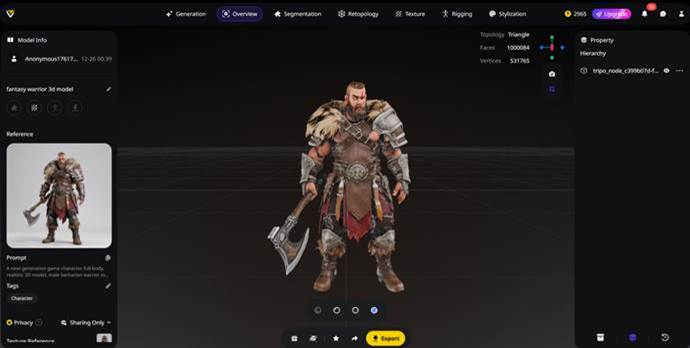
Tripo Studio moves beyond the concept of a basic AI 3D model generator by seamlessly incorporating a comprehensive suite of powerful, AI-native tools into one unified environment. This is where the disjointed production pipeline becomes integrated, marking the true point of transformation.

Below, we examine the key functionalities that enable this shift:

1. Text to 3D

The Text to 3D Model feature empowers creators to produce detailed 3D models instantly from simple written descriptions. By entering a prompt that outlines an object’s form, material, and aesthetic style, users can transform a concept into a fully formed, usable 3D asset within seconds – completely bypassing the need for manual modeling.

For instance, a description like “a bust of Medusa with coiled snakes, rendered as a weathered stone sculpture in grayscale” can be converted into a structured 3D model that accurately captures both its overall shape and surface texture. This capability accelerates early-stage ideation and offers remarkable creative flexibility, allowing for rapid iteration and experimentation. It embodies a true AI 3D model generator from text, turning imaginative language into tangible digital form.

2. Image to 3D

With the Image to 3D Model function, creators can convert standard 2D images into fully-realized 3D models, complete with precise geometry and authentic textures. Users simply upload a single reference photo or a collection of visual guides to rapidly produce 3D assets that maintain the original object’s form, intricate surface details, and visual cohesion. This positions the platform as a practical AI 3D model generator from image, especially valuable for projects that begin with existing visual materials – such as concept sketches, product photos or illustrated character designs.

For greater accuracy and artistic control, Tripo Studio supports multi-view image input. This allows creators to upload several angles of the same subject, resulting in a more dependable and structurally sound 3D reconstruction. Additionally, integrated tools like Nano Banana enable users to generate, polish or modify their reference imagery before the conversion process, ensuring a higher-quality final 3D model.

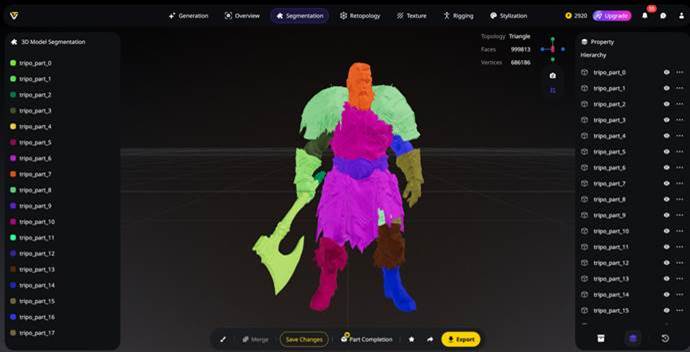
3. AI Model Segmentation

Tripo’s Intelligent Segmentation technology is engineered to deconstruct complex 3D models into clean, logically organized, and independently editable parts. Rather than dealing with a single, fused mesh, the system automatically analyzes the model’s geometry and intelligently separates it into distinct, meaningful components. This grants creators far greater precision and flexibility during the editing process.

This eliminates manual mesh splitting, letting creators refine specific sections without affecting the rest of the model. Components can be adjusted, merged or reorganized easily – ideal for creating variations, optimizing assets for games or 3D printing, and preparing models with controlled Level of Detail (LOD). The result is a faster, more streamlined way to manage detailed 3D content.

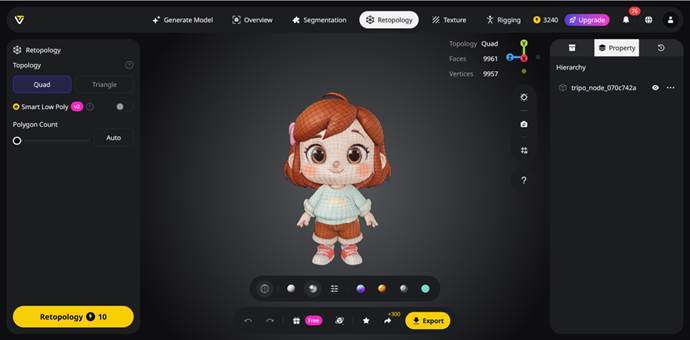
4. Smart Retopology

AI Retopology automates the rebuilding of clean, efficient mesh structures from existing 3D models. By analyzing geometry intelligently, it generates optimized quad or triangle meshes that retain key visual details while stripping away excess complexity. This creates lighter, well-structured assets that are easier to edit and more compatible with downstream pipelines.

Rather than reconstructing topology manually, users can depend on automated remeshing to achieve production-ready results in a fraction of the time. The resulting optimized meshes are ideal for real-time uses – including games, VR/AR, and interactive media – where performance and visual quality must be carefully balanced. By streamlining this traditionally labor-intensive step, Tripo Studio lets creators focus on design, not technical cleanup.

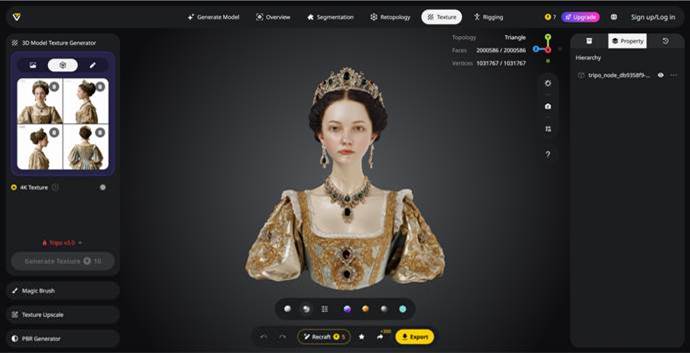
5. Powerful AI Texturing

This AI 3D model generator’s texturing system delivers more than basic material application by automatically creating complete, production-ready PBR texture sets. Using just a text prompt or reference image, the system applies unified artistic styles while generating realistic surface details, accurate material properties, and visually cohesive results. This allows creators to texture 3D models efficiently while ensuring compatibility with modern rendering and real-time pipelines.

For detailed artistic control, the built-in Magic Brush enables localized texture edits directly on the 3D model. Users can refine specific areas – such as adding wear, varying surfaces or emphasizing materials – while the AI intelligently blends these adjustments to maintain overall visual harmony. Recent upgrades further boost output quality through an Ultra HD texturing engine and a dedicated Texture Upscale function, which capture crisp micro-details and enhance resolution without compromising the original artistic style. The result is high-fidelity textured assets that are ready for export into game development, visualization, and product design workflows.

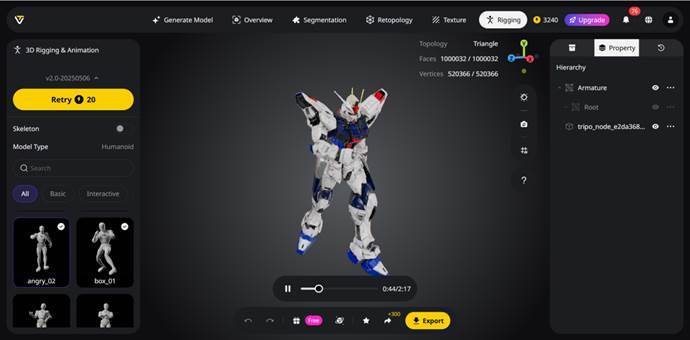
6. Auto Rigging

Rigging has traditionally been one of the most time-intensive and technically challenging phases of 3D production. This AI 3D model generator tackles that hurdle with an auto-rigging system that swiftly and accurately converts static meshes into fully rigged, animation-ready models. Rather than requiring manual skeleton placement and weight painting, users can obtain clean, editable rigs with natural deformation in just a few clicks.

The system intelligently analyzes model geometry to produce appropriate skeleton structures and optimized skin weights, accommodating a broad spectrum of assets – from humanoids and creatures to mechanical objects. To speed up prototyping and preview, creators can instantly apply a built-in library of over 100 motion-capture-quality biped animations, testing movement and poses without any additional setup.

For greater flexibility, the Lock Frame feature allows any animated pose to be frozen and exported as a standalone static model. This makes it easy to create pose variations or prepare assets for 3D printing without needing to re-rig. All generated rigs are built for seamless compatibility and can be imported directly into industry-standard software like Blender, Maya, and Unreal Engine, ensuring a smooth transition from model creation to professional animation pipelines.

7. AI Model Stylization

Model Stylization allows you to transform existing 3D assets into a variety of distinct artistic styles without manual remodeling. With Tripo Studio, you can reinterpret a single model in styles like Lego-inspired block forms, voxel-based designs or intricate Voronoi patterns – enabling fast exploration of creative directions that would otherwise require lengthy reconstruction.

Stylized models remain fully editable after generation. They can be exported in standard formats such as OBJ, FBX or GLB, ensuring seamless compatibility with most 3D pipelines. The stylization process is fully automated and doesn’t require 3D expertise, making it accessible for beginners while offering professionals flexibility for further refinement in external software.

How Tripo Studio Empowers Diverse Creators

From seasoned professionals to aspiring creators, modern 3D workflows are often complex and time-intensive. Now, AI 3D model generators like Tripo Studio are transforming this landscape-making high-quality 3D content creation more accessible, efficient, and widely applicable across the 3D industry.

Here’s a look at who benefits most from adopting this technology:

Game Developers: Rapidly prototype characters, props, and environments.

3D Printing Makers: Create ready-to-print, watertight models with ease.

Animators & Filmmakers: Turn concepts into animation-ready, rigged assets faster.

Product Designers: Visualize and iterate on 3D concepts without rebuilding.

AR/VR Creators: Generate optimized, real-time-ready assets for immersive experiences.

Architects & Designers: Quickly populate scenes with 3D assets for visualization.

Educators & Students: Bring ideas to life in 3D without a steep learning curve.

Tripo Studio empowers these users by automating complex tasks, allowing them to focus on creativity and execution.

Creating the Future of 3D With Tripo

Tripo has empowered over a million creators with intelligent, end-to-end 3D generation – shaping how games, films, and immersive experiences are made. As the need for rapid iteration grows, Tripo helps creators experiment freely and bring ideas to life faster.

Easy for beginners, powerful for professionals. You can start creating immediately – Tripo can serve as a free AI 3D model generator for exploration and prototyping. As projects grow, it seamlessly scales into a full-production AI 3D model generator, ready to deliver professional results.

Ready to create what’s next? Start with Tripo and bring your vision to life in 3D.

Contact Details:Company Name: TRIPOEmail: [email protected]Website: https://www.tripo3d.ai/

SOURCE: TRIPO

About Web3Wire Web3Wire – Information, news, press releases, events and research articles about Web3, Metaverse, Blockchain, Artificial Intelligence, Cryptocurrencies, Decentralized Finance, NFTs and Gaming. Visit Web3Wire for Web3 News and Events, Block3Wire for the latest Blockchain news and Meta3Wire to stay updated with Metaverse News.


Source link

OpenAI Rolls Out Free Science Platform Prism as Experts Warn of Privacy Concerns – Decrypt

0
OpenAI Rolls Out Free Science Platform Prism as Experts Warn of Privacy Concerns – Decrypt


In brief

OpenAI launched Prism, a free LaTeX-based research platform with GPT-5.2 integrated into scientific workflows.
The launch follows OpenAI statements signaling future outcome-based pricing in research and drug discovery.
Experts warn of privacy, hallucination, and intellectual property concerns.

OpenAI is expanding into the scientific pipeline with Prism, a new workspace launched on Tuesday in a sign of the company’s clearest bid yet to make its models part of high-value research.

The tool is a web-based application that integrates ChatGPT (5.2) directly into scientific writing, enabling in-place drafting, revision, and collaboration, according to a statement on Tuesday.

“Over the past year, we’ve begun to see AI accelerate scientific work across domains,” OpenAI wrote. “Advanced reasoning systems like GPT‑5 are helping push the frontiers⁠ of mathematics, accelerating the analysis⁠ of human immune-cell experiments, and speeding up experimental iteration⁠ in molecular biology.”

In a town hall on Tuesday, OpenAI CEO Sam Altman said the company is already hearing meaningful feedback from scientists about “nontrivial” research progress using its latest model.

]]>

“With 5.2, a special version we use internally, we’re now for the first time hearing from scientists that the scientific progress of these models is no longer super trivial,” Altman said. “I can’t believe that a model that can come up with new scientific insights is not also capable, with a different harness and trained a little bit differently, of coming up with new insights about products to build.”

Prism is based on Crixet, a San Francisco-based “LaTeX platform” that OpenAI acquired earlier this month. A LaTeX platform is a specialized writing environment that lets researchers write, format, and typeset scientific papers using code-based commands, making it easier to handle complex equations, citations, and technical layouts consistently.

Privacy, Ownership, and the Limits of AI

For Jonathan Schaeffer, a distinguished university professor emeritus of artificial intelligence at the University of Alberta and co-founder of AI developer Synsira, there are both promising and concerning factors in the use of AI in research.

“There are two issues with writing papers,” Schaeffer told Decrypt in an interview. “One of which is composing the text, and the other is doing the research or making the inferences or the insights that you’re going to add to your paper.”

He said Prism appears to excel at the former in that it helps researchers with writing, proofreading, and citations, which he said is great for literature search as opposed to actually aiding in the research process, which he called “a completely different can of worms.”

In August, research published in Science found that 22% of computer science papers showed signs of artificial intelligence as researchers increasingly turned to the technology.

More troubling, Schaeffer noted, are the intellectual property implications, saying that “the devil is in the details.”

“Standard protocol is, if I’m writing a paper, all I am doing is documenting my scientific research, and it’s my intellectual property, and I own it,” Schaeffer said. “Now, if you’re going to use ChatGPT to write these papers, then you’re actually exposing your intellectual property to a multinational company,” he said, noting additional privacy concerns or whether OpenAI would have any legal right to claim researchers’ intellectual property.

When questioned about the continued issue of AI hallucinations, Schaeffer predicted that “hallucinations will not go away. It will never get down to zero.”

He advocates thinking of AI as “augmented intelligence” rather than artificial intelligence, calling AI models “impressive but fallible.”

“Think of Prism or any of these large language models for research or writing or whatever you’re doing as being your graduate student or intern,” he said. “They can be used to suggest things to you, perhaps a paragraph of text, or perhaps they’re going to spout out a conclusion. They’re going to suggest things to you, but it’s your paper. You have to take responsibility.”

Despite the continued risk of hallucinations, the Prism launch coincides with a strategic pivot by OpenAI’s leadership and a focus on “outcome-based pricing.”

Last week, OpenAI CFO Sarah Friar published a blog post outlining an evolving business model for AI developers beyond subscriptions and API fees.

In the post, Friar wrote that as AI moves into “scientific research, drug discovery, energy systems, and financial modeling, new economic models will emerge.”

“Licensing, IP-based agreements, and outcome-based pricing will share in the value created,” Friar wrote. “That is how the internet evolved. Intelligence will follow the same path.”

While Prism is currently free for personal users, the company’s recent focus on fields like drug discovery suggests a long-term strategy of sharing in the economic value created by the breakthroughs researchers achieve using its tools.

During the town hall, Altman cautioned that, despite recent advances, today’s models still fall short of operating independently in scientific research.

“I think it’s still a long or reasonably long way away from the models doing truly completely closed loop autonomous research in most areas,” Altman said.

OpenAI did not immediately respond to Decrypt’s request for comment.

Daily Debrief Newsletter

Start every day with the top news stories right now, plus original features, a podcast, videos and more.


Source link

Transync AI Launches Real‑Time Language Translation Platform to Empower Global Communication | Web3Wire

0
Transync AI Launches Real‑Time Language Translation Platform to Empower Global Communication | Web3Wire


SHANGHAI, CHINA / ACCESS Newswire / January 28, 2026 / The Personal Cost of Language Barriers

For most people, language barriers feel like an invisible tax on ambition. You want to join an international video call, but you’re nervous about not understanding everything. You want to expand your freelance business globally, but client communication feels risky. You want to learn from experts around the world, but the language gap creates friction at every turn.

I founded Transync AI because I experienced this tax firsthand. As someone who worked across multiple markets, I realized that the real cost of language barriers isn’t measured in dollars spent on interpreters-it’s measured in opportunities lost, relationships never built, and potential never realized.

The expensive part of not understanding another language isn’t hiring translation services. It’s the career you didn’t pursue. The client you didn’t acquire. The knowledge you didn’t gain. The person you didn’t connect with.

That’s the language tax that matters. And it’s personal.

The Individual’s Dilemma: Why Current Solutions Fall Short

Let me be honest about what’s out there. Translation apps exist. Video call subtitle tools exist. But they all share a fundamental flaw: they’re designed for businesses, priced like they’re for businesses, and they feel like you’re compromising when you use them.

The Real Problems:

Expensive Integration: Enterprise translation solutions cost thousands per month and require complex setup. They’re built for corporations with IT departments, not individuals trying to build their careers.

Awkward Delays: Free translation apps introduce lag that breaks natural conversation flow. When you’re negotiating with a client or joining a team meeting, even 500ms of delay makes you sound robotic and disconnected.

Accuracy Issues: Generic translation tools don’t understand context. They miss industry terminology, cultural nuance, and the specific way you communicate professionally.

Complexity: Most solutions require constant switching between apps, manual language selection, and technical troubleshooting. You end up managing the tool instead of using it.

The result: individuals stay in their comfort zones. They turn down international opportunities. They avoid conversations that could transform their careers.

That’s what I wanted to change.

The Breakthrough: Real-Time AI for Individual Users

When we built Transync AI, we started with a single question: What would real-time interpretation look like if it was designed specifically for individuals?

Not corporations. Not enterprises. You.

The answer led us to develop something different from everything else on the market:

Near-Zero Latency Translation: Using cutting-edge end-to-end AI voice models, we achieve near-zero latency across 60 languages. You’re not waiting. You’re communicating naturally, as if language wasn’t even a barrier.

Affordable for Everyone: At just 8.99/month, you get 10 hours of dual-column real-time translation. That’s the cost of a coffee. Compare that to hiring an interpreter for a single hour-50-200 depending on language-and the value becomes obvious.

Designed for Your Workflow: Whether you’re on Zoom, Google Meet, or Teams, Transync AI works seamlessly. No plugins. No complicated setup. You subscribe, you use it, you communicate.

60 Languages, Automatic Detection: Chinese, English, Japanese, Korean, German, French, Russian, Spanish, Italian-and 50 more. The system automatically detects which language people are speaking. You don’t have to do anything.

From One Person to Unlimited Possibility

Let me walk you through what changes when you have real-time interpretation in your pocket:

The Freelancer: You’re a UI designer in São Paulo. A startup in Berlin wants to hire you, but the founder only speaks German. Previously, you’d miss this opportunity. Now? You join the call, Transync AI translates in real-time, you understand everything naturally, and you land a client that opens doors to the European market.

The Student: You’re studying renewable energy in Thailand, but the world’s leading researchers publish in English and German. Attending their online seminars used to mean struggling through translation. Now you experience their insights in real-time, in your native language, with perfect comprehension. Your learning accelerates.

The Job Seeker: You’re applying for positions with international companies. Previously, interviews with non-English speaking hiring managers felt risky. Now you interview with confidence, understanding every nuance, your personality coming through clearly regardless of which language is being spoken.

The Entrepreneur: You’re expanding your e-commerce business internationally. Your customers speak 5 different languages. Instead of hiring customer service staff fluent in multiple languages-expensive and complex-you respond to every customer naturally through Transync AI, building loyalty across borders.

The Remote Worker: Your global team collaborates across 6 time zones and 4 languages. Team meetings used to be exhausting translation exercises. Now everyone participates naturally, and the AI automatically generates meeting minutes capturing action items in everyone’s native language.

Each of these isn’t a hypothetical. These are real scenarios playing out right now with Transync AI users around the world.

AI Powers Your Global Advantage: Real Moments That Matter

AI Real-Time Translation in Client Negotiations: You’re closing a deal with someone whose native language isn’t yours. Transync AI captures every word across 60 languages with near-zero latency, displaying original and translated content side-by-side. You understand their reactions perfectly, read hesitation, and build rapport naturally-you’re present in the moment because you’re not struggling to understand. Trust closes deals.

AI Meeting Notes in Contract Documentation: A freelancer closes a contract with an international client. The AI automatically generates complete transcripts, extracts key decisions, and identifies action items. She has perfect documentation of exactly what was agreed to without lifting a finger-no ambiguity, no disputes.

AI Keywords & Context in Knowledge Building: You’re watching a technical talk by a researcher who only presents in Mandarin. Because you’ve defined your industry context, Transync AI translates with 95%+ accuracy using terminology your field respects. You don’t just consume the knowledge-you participate in the conversation, ask intelligent questions, and build relationships with the world’s top talent.

AI Real-Time Translation in Job Interviews: The hiring manager prefers their native language for nuanced discussions. With Transync AI, you communicate in their language while understanding every question with perfect clarity. Your personality, expertise, and professionalism come through authentically because you’re fully present.

AI Meeting Notes in Team Collaboration: Your remote team spans multiple countries and languages. Everyone participates naturally, and the AI captures everything accurately. Follow-up is frictionless because action items and decisions are documented automatically in all languages.

These aren’t edge cases. These are the moments where AI becomes a competitive advantage that transforms your career trajectory.

Real People, Real Impact: Stories from Our Community

Sarah, Freelance Copywriter (UK) “I was charging £25/hour to UK clients only. I was afraid my English would sound ‘off’ to non-native speakers. With Transync AI, I now work with agencies across Europe and Asia. My income tripled in 6 months. The tool paid for itself on my first international client.”

Kenji, Software Engineer (Japan) “I wanted to contribute to open-source projects but felt intimidated by English-speaking communities. Now I participate in code reviews, contribute to discussions, and even mentor junior developers. Language stopped being my limiting factor.”

María, Small Business Owner (Mexico) “I was selling handmade products only in Mexico. Now I serve customers across Spain, Argentina, and the US without hiring bilingual staff. I handle customer service directly through Transync AI. My business is 4x bigger, and I still run it solo.”

David, Career Changer (India) “I was applying for jobs in tech, but phone interviews with international companies made me nervous. The combination of interview anxiety plus language anxiety was paralyzing. With Transync AI, I nailed three interviews and landed a role at a Silicon Valley company. Life-changing.”

These aren’t corporate case studies. These are individuals who used a 8.99/month tool to eliminate a barrier that was limiting their entire lives. They didn’t become better linguists. They became bolder professionals. They didn’t learn new languages. They accessed global opportunity directly.

Your Language Doesn’t Define Your Limits Anymore

The language tax I experienced wasn’t about money. It was about potential trapped behind borders that didn’t need to exist.

When AI can translate in real-time with near-zero latency, when it captures everything you need to remember, when it understands your industry and context-language stops being a barrier to opportunity. It becomes invisible.

What happens next is what excites me most: you stop thinking about language and start thinking about what you’re actually trying to accomplish. You negotiate with confidence. You interview without anxiety. You serve customers globally. You build networks that span continents. You access knowledge regardless of which language it’s published in.

That’s not a translation tool anymore. That’s liberation.

Access Global Opportunity Today

Media info:

Company: Transync AIWebsite: https://transyncai.comEmail: [email protected]Person: Ziyi Gong

SOURCE: Transync AI

About Web3Wire Web3Wire – Information, news, press releases, events and research articles about Web3, Metaverse, Blockchain, Artificial Intelligence, Cryptocurrencies, Decentralized Finance, NFTs and Gaming. Visit Web3Wire for Web3 News and Events, Block3Wire for the latest Blockchain news and Meta3Wire to stay updated with Metaverse News.


Source link

Coinbase Shares Extend Losses as It Expands Into New Metal Futures – Decrypt

0
Coinbase Shares Extend Losses as It Expands Into New Metal Futures – Decrypt


Coinbase’s stock extended losses on Tuesday, even as the crypto exchange rolled out copper and platinum futures trading in its latest bid to diversify beyond digital assets that have hammered investor confidence.

The company announced Tuesday that traders can now access copper and platinum futures on its platform, joining previously available gold and silver contracts.

Coinbase shares fell 1.24% to as low as $208 in intraday trading, the stock’s lowest point since May of last year, before clawing back some losses to close at $210. After-hours trading saw little gain, Google Finance data shows.

Its stock is down more than 10% since the year began and a further 46% from its July all-time high of $398.

The stock has dropped 9.9% over the past month, pointing to broader uncertainty in both crypto markets and investor appetite for high-beta risk assets.

The metals push arrives as crypto markets attempt to stabilize, with Bitcoin remaining relatively stable above $88,000, according to CoinGecko data.

A quarterly report from Coinbase Institutional and Glassnode released Tuesday suggests the market is entering a healthier phase, with “excess leverage having been flushed from the system in Q4,” and that “the macro environment looks sound, and monetary policy should be supportive.”

]]>

Steven Wu, COO of Clearpool, told Decrypt that Coinbase’s stock decline reflects “wider market conditions rather than a specific loss of confidence in execution,” noting it trades as a “high-beta risk asset” as investors rotate toward commodities and yield.

Expanding into metals futures is “less about hedging crypto volatility directly and more about gradually broadening Coinbase’s role as a derivatives venue,” Wu said, though he cautioned that metals are “unlikely to offset crypto market swings in any meaningful way in the near term.”

Allen Ding, Head of Bitfire Research, echoed that sentiment, telling Decrypt that the addition of new metals futures is “tactical product diversification rather than a complete strategic hedge.”

“Deep liquidity for metals remains concentrated in legacy venues like the CME,” making the offerings “more of a complementary feature for user retention rather than a primary growth engine,” he said.

“Ultimately, these products diversify the suite but may not fully insulate the business from the inherent volatility of the crypto-native market,” Ding added.

Wu noted how regulatory uncertainty around the proposed CLARITY stablecoin framework could “materially impact USDC adoption and Coinbase’s earnings,” especially if yield distribution to users is restricted.

Coinbase’s withdrawal of support for the Senate’s market structure bill has helped stall the CLARITY Act’s markup in the Senate Banking Committee, underscoring unresolved industry concerns over provisions including stablecoin-reward restrictions and other rules that could affect innovation and business models.

Because stablecoin interest income is “high-margin and flows directly to the bottom line,” regulatory risk “weighs disproportionately on investor sentiment,” even as trading volume remains Coinbase’s primary revenue driver, he said.

Daily Debrief Newsletter

Start every day with the top news stories right now, plus original features, a podcast, videos and more.


Source link

Popular Posts

My Favorites

How Much Faster Is The Ps5 Pro Compared To The Ps5?

0
The PlayStation 5 Pro is widely anticipated as an enhanced version of Sony’s current PS5 console, expected to deliver higher performance and faster...