Web3

Home Web3 Page 243

WAX Blockchain: Revolutionizing NFTs and Digital Assets with Key Innovations – Web3oclock

0
WAX Blockchain: Revolutionizing NFTs and Digital Assets with Key Innovations – Web3oclock


Who Invented WAX Blockchain? 

Key Features of WAX Blockchain

The Role of WAX Blockchain in Digital Assets & NFTs

Top Projects on WAX Blockchain

Future of WAX Blockchain 


Source link

Rarible vs. OpenSea: NFT Marketplace Comparison – Web3oclock

0
Rarible vs. OpenSea: NFT Marketplace Comparison – Web3oclock


Key Differences Between Rarible and OpenSea

Pros & Cons of Rarible & OpenSea

Which Platform is Best for You?

Future Outlook of Rarible & OpenSea

FeatureRaribleOpenSeaLaunch Date20202017Key FeatureCommunity governance through $RARI tokenLargest selection of NFTs across categoriesUser InterfaceCreator-focused, but can be clutteredBeginner-friendly, intuitive, and scalableSupported BlockchainsEthereum, Flow, TezosEthereum, Polygon, KlaytnGas FeesHigh on Ethereum, lower on Tezos/FlowHigh on Ethereum, gas-free with PolygonPlatform Fees2.5% (charged to buyer and seller)2.5% (charged to seller only)MintingStandard minting process, gas fees upfront“Lazy minting” allows for gas-free creation until saleRoyaltiesFully customizable by creatorsCustomizable by creatorsGovernanceDecentralized, users participate via $RARI tokenCentralized, private companySecuritySome issues with fake NFTs, improving verificationGenerally secure, with verification for major creatorsCommunityCommunity-driven, DAO participation through $RARILarge, engaged, but no decentralized governanceBest ForCreators valuing decentralization and royaltiesNew users, traders looking for variety and cost-efficiencyEnvironment ImpactLower with Tezos and FlowReduced with Polygon integration

1. Decentralized Governance: 

2. Royalties: 

3. Creative Control: 

1. Smaller Marketplace: 

2. Higher Learning Curve: 

1. The largest NFT Marketplace: 

2. Friendly Interface: 

3. Multi-chain Support: 

1. No Community Governance: 

2. High Traffic, High Competition: 


Source link

Step-by-Step Guide to Launch Your Fizz Node

0
Step-by-Step Guide to Launch Your Fizz Node


Spheron’s Fizz Nodes offer a low-barrier entry point for anyone looking to contribute resources to Spheron’s decentralized compute network—and earn ongoing rewards for their contributions.

Whether you’re looking to run a basic CPU configuration or a powerful GPU setup, this guide will walk you through the entire process, from Fizz Node registration to management. Let’s dive in!

For a step-by-step guide on getting started, head over to our YouTube Tutorial below.

You don’t need to be a high-end crypto miner or have access to a top-tier data center to participate in running a Fizz Node. In fact, even if you have a laptop with decent GPU capabilities and a few good CPU threads, you’re more than ready to contribute to the decentralized network. Your underutilized resources are all you need to help power the future of decentralized infrastructure!

Fizz Nodes are currently supported on macOS and Linux, with Windows support arriving soon. Performance may vary based on the operating system in use. Below are the necessary specs for running your own Fizz Node:

Minimum Specifications

4 CPUs

8 GB RAM

100 GB Disk Space

Maximum Specifications

32 CPUs

128 GB RAM

2000 GB Disk Space

Note: To run the Fizz Node in privileged mode, root or sudo access is required. This elevated permission is essential for executing system-level operations necessary for node functionality.

Step-by-Step Guide to Registering Your Fizz Node

Once you’ve completed the requirements to run your own fizz node, setting things up only takes a few quick steps.

Register Your Fizz Node

Open Your Browser: Navigate to fizz.spheron.network.

Sign up or log in through Gmail or Github.

Click on the “Register New Fizz Node” Button.

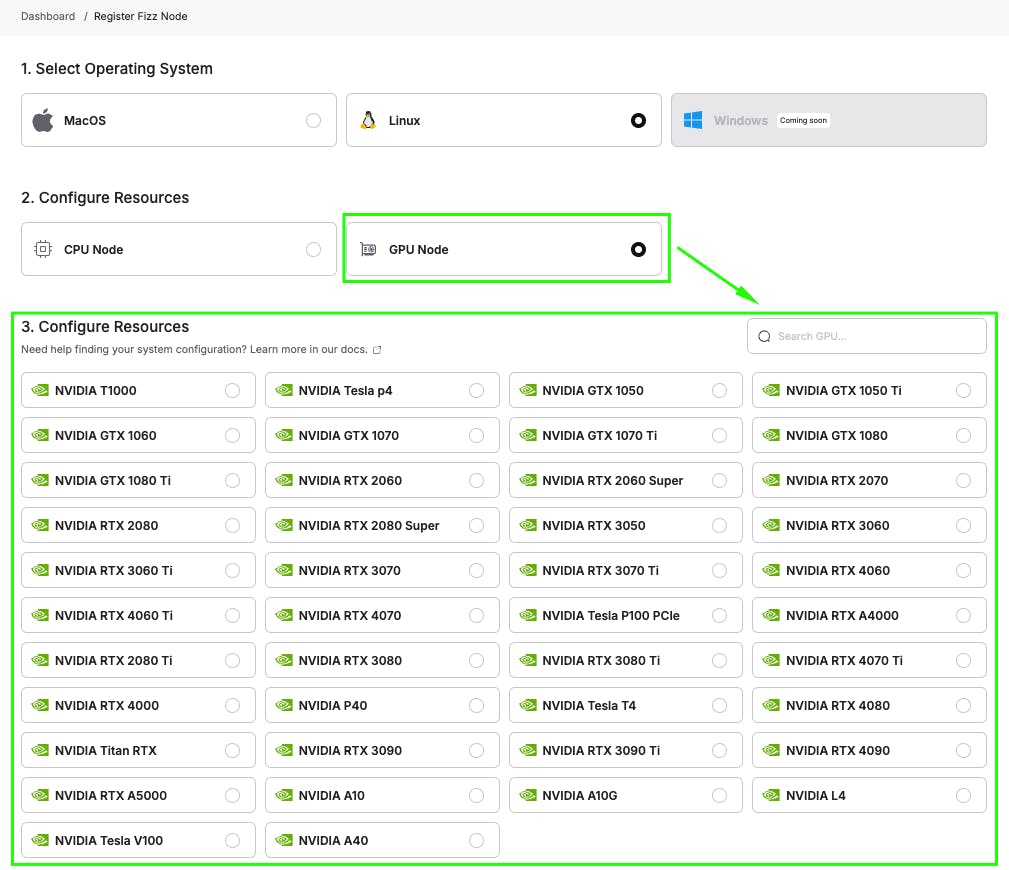
4. select your node’s OS from the options provided (MacOS, Linux, or Windows—coming soon) in the next window.

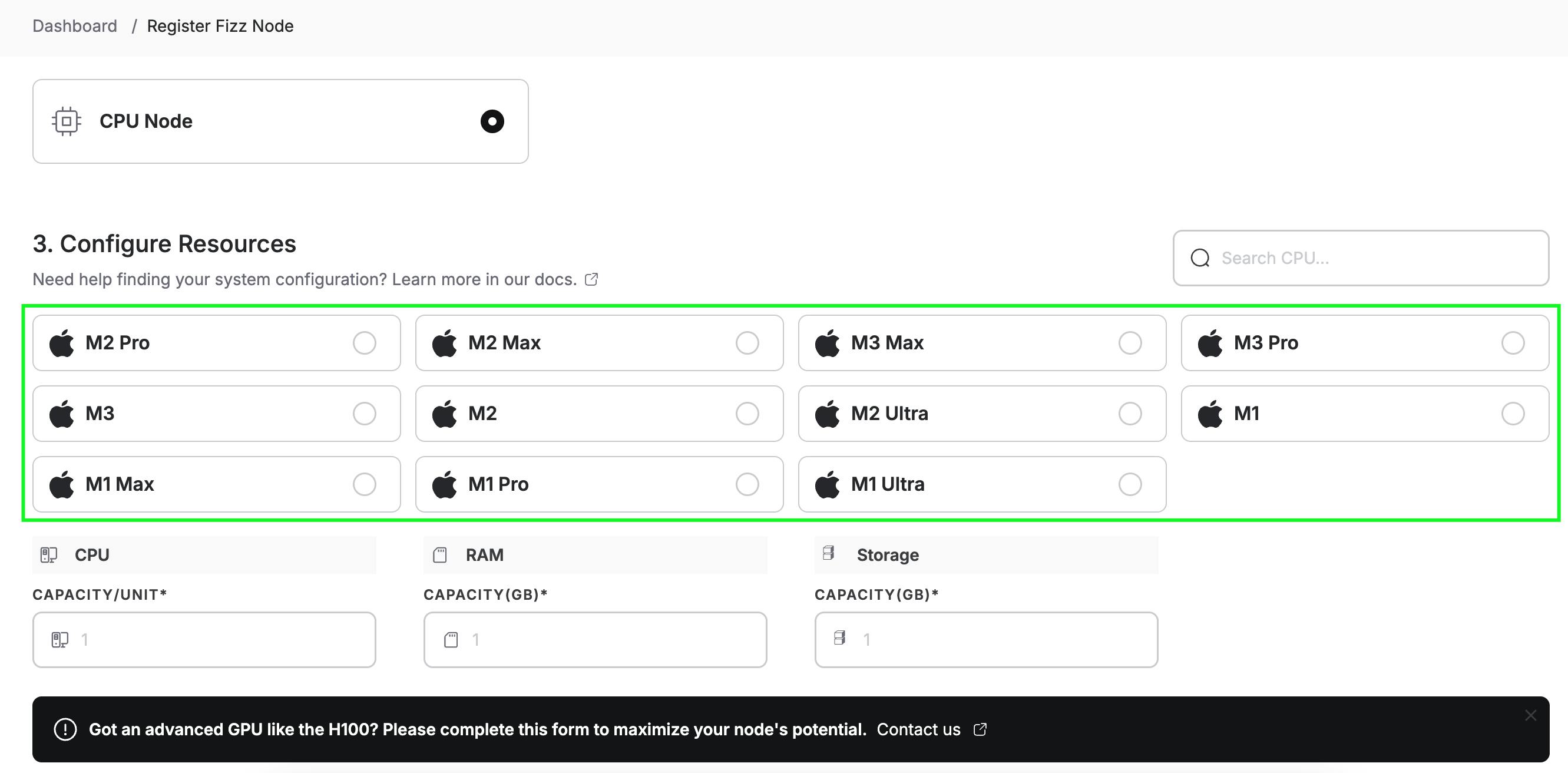
5. For Mac OSIf you select MacOS, You need to choose which Apple laptop mode you have. Need help finding your system configuration? Learn more in our docs here

For LinuxIf you select Linux, You can choose which Nvidia GPU specifications you have. Need help finding your system configuration? Learn more in our docs here.

6. Resource Details: Provide accurate information about the resources you’re willing to lend, including:

CPU cores

RAM capacity

Available storage

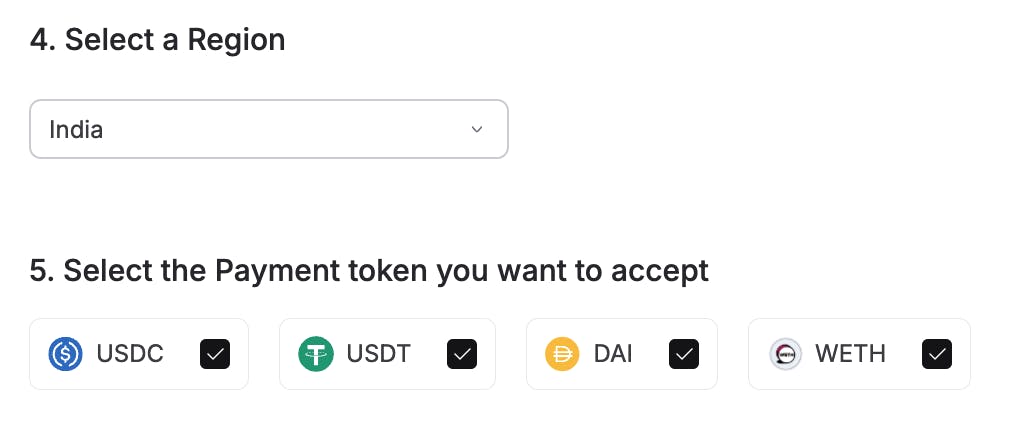
7. Region: Select the geographical location where your node is situated. This helps users choose nodes based on their proximity requirementsPayment Tokens: Choose the cryptocurrencies or tokens you will accept as payment for your services.

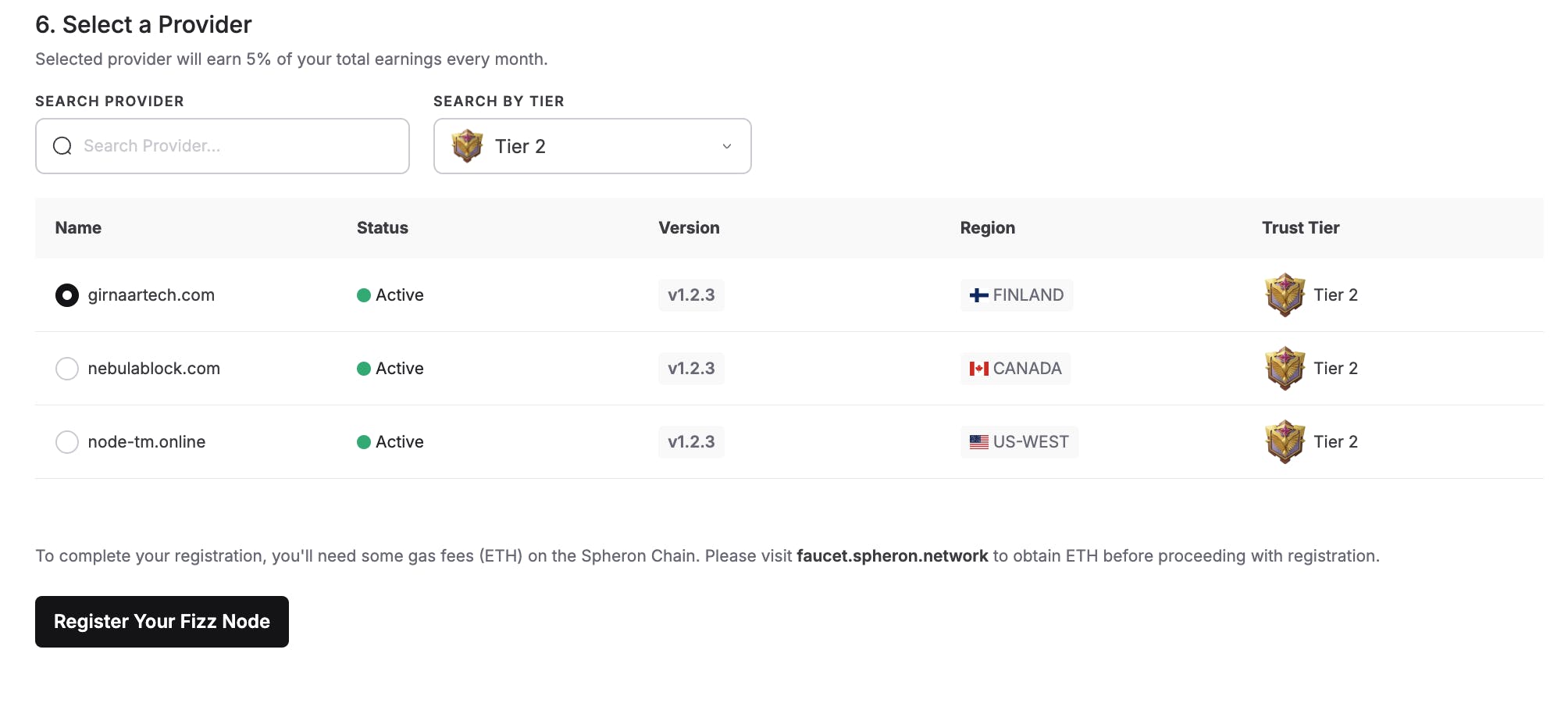
8. Provider Selection: This is a crucial step. Choose a provider carefully, considering factors such as:

Uptime track record: A provider with high uptime increases your chances of getting deployments.

Provider tier: Higher-tier providers may offer better opportunities.

Overall reputation in the network

9. Click “Register Your Fizz Node“, To complete the registration, you’ll need some ETH on the Spheron chain for gas fees. If you don’t have any, you can get some from our faucet at faucet.spheron.network.

Once you confirm the transaction, your node will be officially registered in the Spheron network, and you can proceed to the next steps.

Boom 💥— You’re officially part of the decentralized revolution!

Running the Fizz Node Client

After successfully registering your node, you need to set up and run the Fizz node client on your machine. This client software connects your node to the Spheron network and manages resource allocation. Follow these steps:

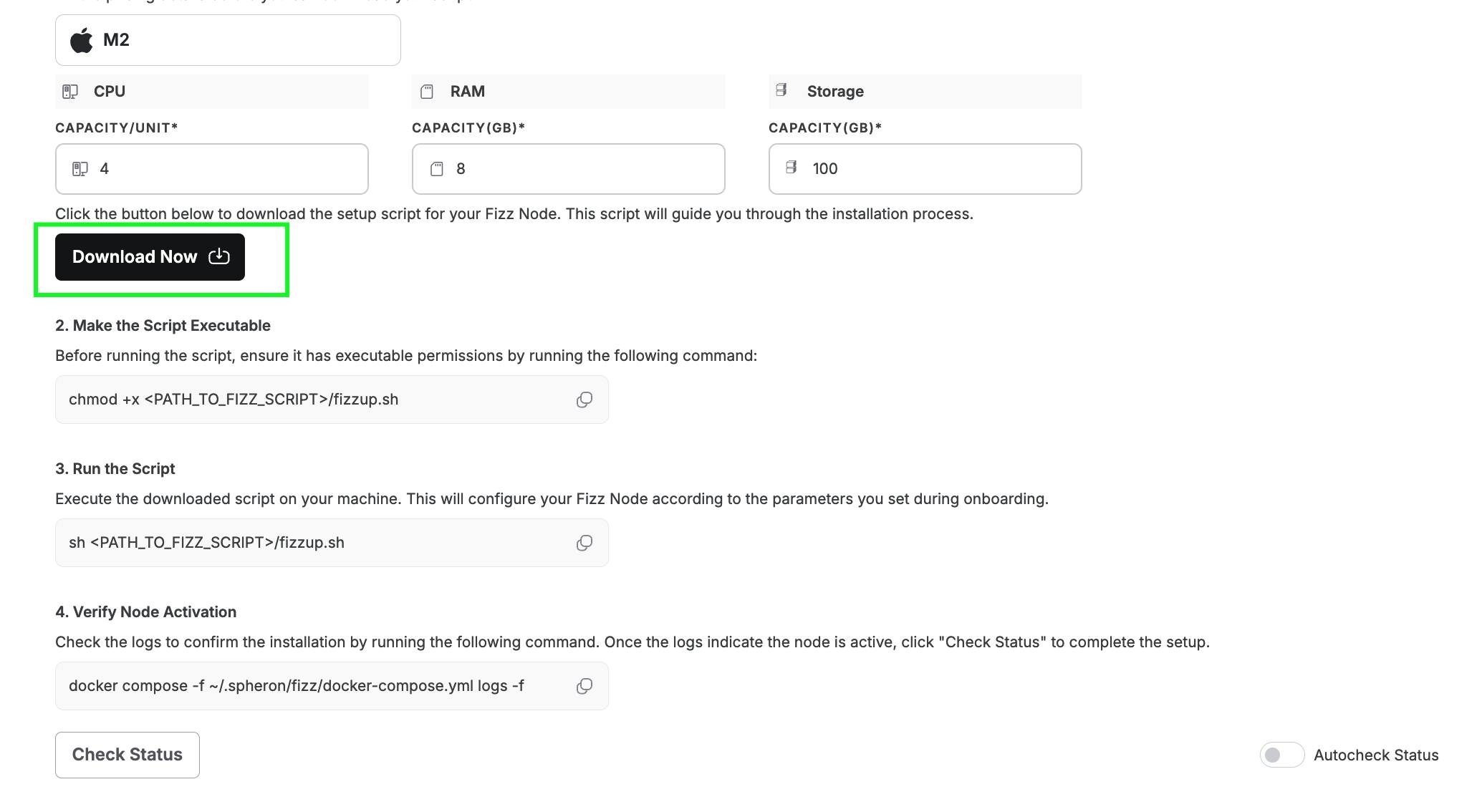
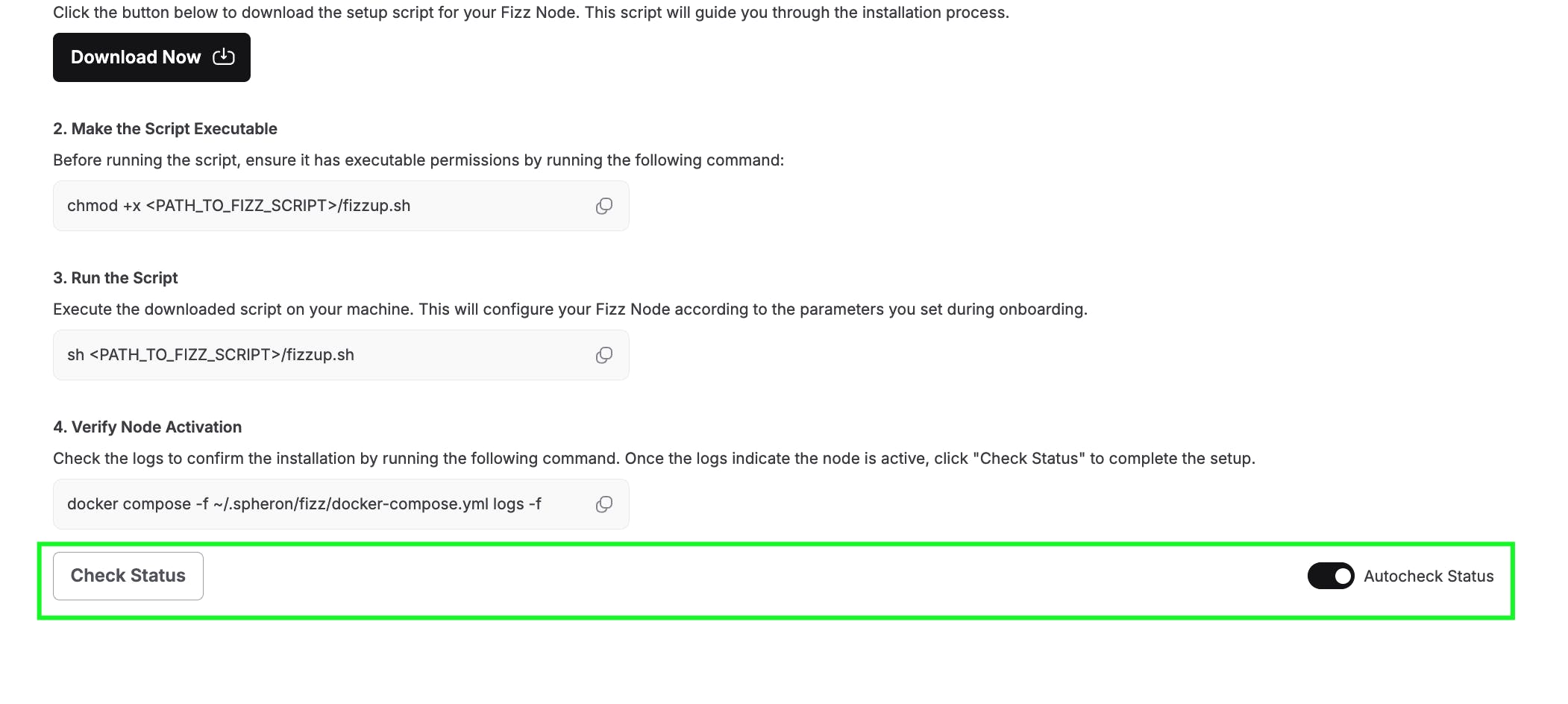
Access the setup page for your registered node. There, You should find a link to download the fizzup.sh script.

Download the fizzup.sh script to your machine. Save it in a location you can easily access via a terminal or command prompt.

Open your terminal or command prompt and navigate to the directory where you saved the script. Make the script executable by running the following command:

chmod +x <location of fizzup script>/fizzup.sh

Replace <location of fizzup script> with the actual path to the script’s directory.

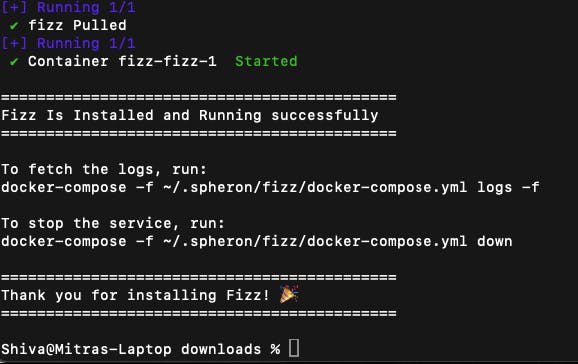
Run the script by entering the following command:

<location of fizzup script>/fizzup.sh

This command executes the script and starts the Fizz node client on your machine.

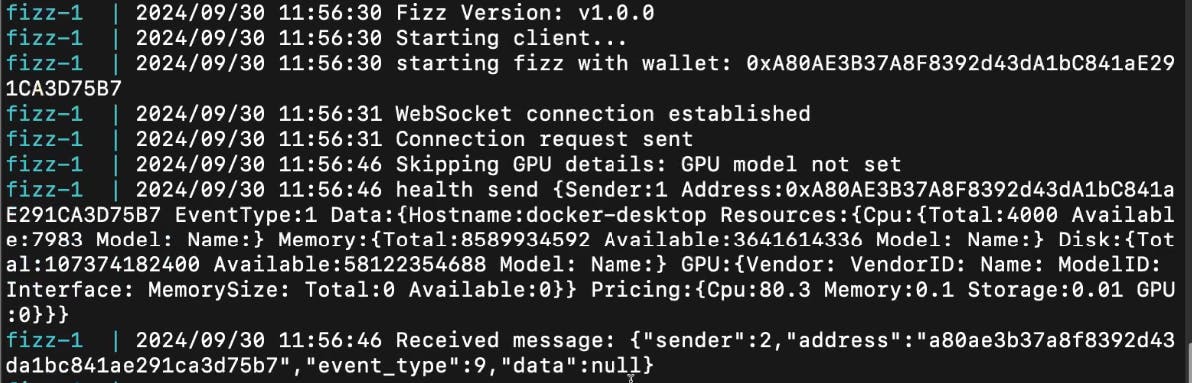
To verify if your Fizz node is running, use the following command:

docker-compose -f ~/.spheron/fizz/docker-compose.yml logs -f

If this doesn’t work, try:

docker compose -f ~/.spheron/fizz/docker-compose.yml logs -f

These commands will show you the logs of your Fizz node, allowing you to confirm it’s running correctly.

Once you’ve verified the node is running, return to the setup page on the Spheron Fizz App.

On the setup page, you’ll see a “Check Status” button and a switch to “Automatically check status.” Click the “Check Status” button to manually initiate a status check for your Fizz node.

Alternatively, you can toggle on the “Automatically check status” switch to have the system periodically check your node’s status without manual intervention.

The system will now perform checks to validate if your node is active and correctly configured.

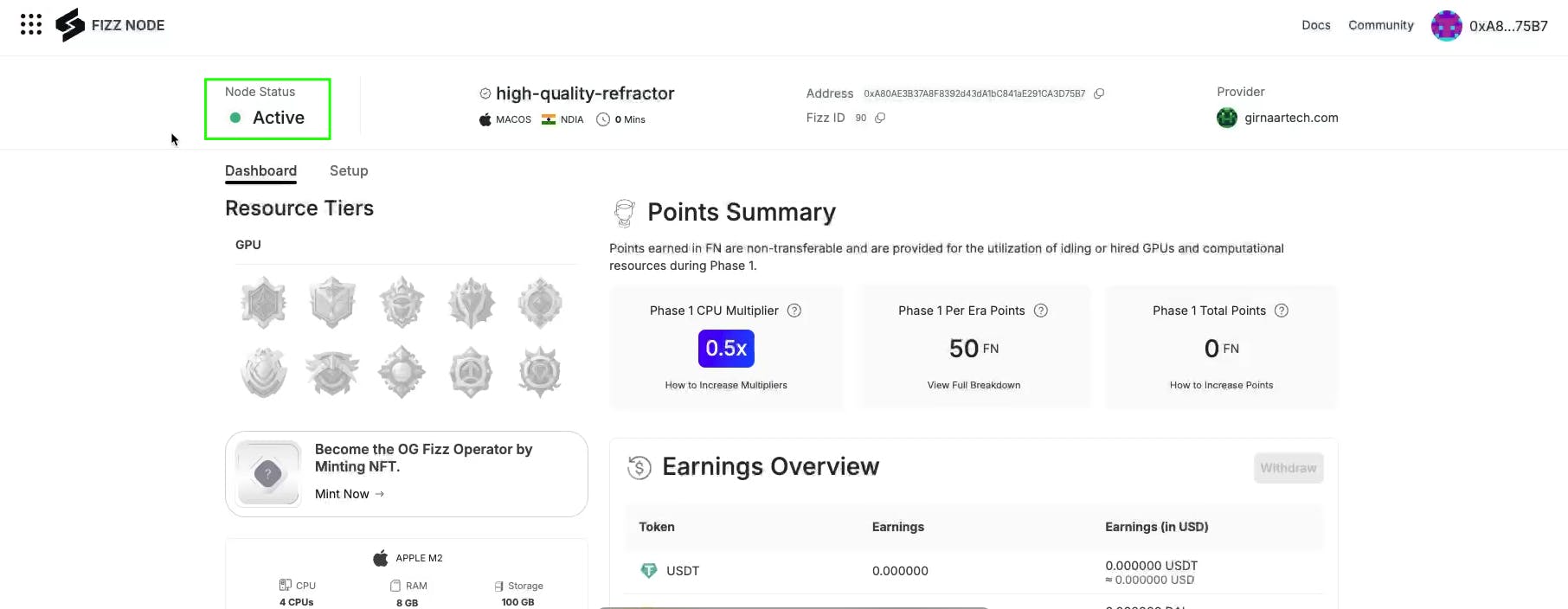
The validation process may take a few minutes. During this time, the system verifies your node’s connectivity, resource availability, and configuration. Once your node is confirmed active, you will be automatically directed to your Fizz dashboard.

Fizz Nodes earn rewards based on two factors: resource contribution and uptime.

Resource Contribution: You’ll earn more if your node provides higher-tier resources such as a powerful GPU or more CPU cores.

Uptime: Fizz Nodes must maintain at least 50% uptime within an ERA (24 hours) to receive rewards.

The final reward calculation is a combination of the resource performance and uptime factor. This system encourages node operators to maintain stable, reliable operations while rewarding those who contribute higher-quality resources to the network.

On top of that, Fizz Node operators also earn direct payments from users who lease their compute resources. Operators keep 90% of the payment, with a small fee going to the network and providers. You can withdraw these earnings at any time from your dashboard.

Fizz Node Benefits

Beyond providing decentralized compute resources, running a Fizz Node offers several exclusive perks:

Monetize your idle compute power by selling resources in an open market.

Earn $FN points that will eventually merge with $SPHN tokens.

Join the first DePIN Super Compute Network, designed to distribute energy usage and help reduce carbon emissions.

Become eligible for the Fizzer Special Discord Role, unlocking special rewards like $500 monthly quests—on top of regular rewards from resource contributions.

Early Access to Updates & Announcements – Be the first to learn about Spheron Network’s upcoming features so you can prepare and take full advantage.

And More to Come – As we approach our token launch, there are plenty of additional perks in the pipeline!

At the end of the day, Fizz Nodes represent a new model for decentralized compute—one that’s accessible, profitable, and easy to manage. They’re a critical piece in Spheron’s broader decentralized vision that lets anyone with a modest setup participate in a network traditionally reserved for institutional players.

So if you’ve ever wanted to dip your toes into decentralized compute without needing to break the bank on hardware, now’s your chance. Get your node up and running, and start contributing to the future of decentralized compute today!


Source link

UK believes trial to embrace digital securities can protect ‘market integrity’

0
UK believes trial to embrace digital securities can protect ‘market integrity’


Receive, Manage & Grow Your Crypto Investments With Brighty

The UK’s Financial Conduct Authority (FCA) and the Bank of England have officially launched the next phase of their Digital Securities Sandbox (DSS), enabling firms to explore distributed ledger technology (DLT) and tokenized securities within traditional financial markets.

The DSS, which will be operational until December 2028, provides a structured environment for testing and implementing DLT applications, aiming to enhance market efficiency, transparency, and resilience.

The initiative seeks to position the UK as a global leader in financial innovation by fostering conditions conducive to investment and sustainable growth. Divided into sequential stages known as gates, the DSS allows sandbox entrants to progressively increase their level of permitted activity as they advance through each phase.

Activities will go live after the Gate 2 stage, involving the issuance, trading, and settlement of actual digital securities. These securities are designed to function similarly to traditional counterparts, facilitating use in repurchase agreements and derivative contracts. Eligible financial instruments encompass equities, corporate and government bonds, money market instruments, fund units, and emissions allowances.

Open to UK-based firms of all sizes and development stages—including both existing financial institutions and new market entrants—the DSS invites applications until approximately March 2027. This timeframe allows regulators and participating firms to prepare for a potential transition to a new permanent regime, contingent upon the successful implementation of the new technologies.

In conjunction with the DSS launch, the FCA and the Bank of England published Policy Statement PS24/12, outlining the final policy approach and addressing industry feedback. Per the Policy Statement, several targeted changes have been made following consultation. These include extending the scope to incorporate non-pound sterling-denominated assets and adopting a more flexible method for setting firm-specific limits during the go-live stage by introducing limit ranges instead of fixed limits.

Additional adjustments involve reducing the minimum capital requirement for a Digital Securities Depository (DSD) to six months of operating expenses, down from the initially proposed nine months. Clarifications have also been made regarding provisions related to securities settlement systems, aiming to simplify understanding and navigation of the DSS rules.

Firms interested in participating are advised to review the provided guidance and complete the online application process, ensuring adherence to the outlined requirements. Upon submission, applications will be shared with both regulators, and further information may be requested as part of the evaluation.

The DSS represents a step forward in exploring the potential of blockchain and other emerging technologies within the UK’s financial markets. By facilitating innovation while safeguarding “financial stability” and “market integrity,” the initiative aims to contribute to a safe, sustainable, and efficient financial system.

However, it’s important to note that the UK’s focus on DLT does not necessarily mean it intends to promote the decentralized ethos that engulfs Web3.


Source link

Unlocking the Power of Solana Blockchain: The Future of Decentralized Finance – Web3oclock

0
Unlocking the Power of Solana Blockchain: The Future of Decentralized Finance – Web3oclock


History of Solana Blockchain

What Makes Solana Blockchain Unique?

Solana VS Ethereum VS Bitcoin

How to Invest in Solana Blockchain? 

Innovative Technologies & Features

Popular Projects on Solana Blockchain

Imagine paying less for faster transactions – sounds like a dream, right? Well, why wait for the future when Solana offers it now? While other blockchains often get slow down due to heavy usage and charge higher fees, Solana Blockchain offers lighting fast speeds at lower costs. Solana Blockchain is making waves as one of the quickest and most cost-effective blockchains ever, perfect for developers and users as well. Now, in this blog, we will explore why Solana Blockchain is a better choice for your next crypto move. 

5. Smooth Developer Experience:

6. Ecosystem Growth and Innovation:

7. Energy Efficiency:

Solana VS Ethereum VS Bitcoin:

FeatureSolanaEthereumBitcoinConsensus MechanismProof of History (PoH) + Proof of Stake (PoS)Proof of Stake (PoS) (Ethereum 2.0)Proof of Work (PoW)Transaction SpeedUp to 65,000 transactions per second (TPS)15-30 TPS (Ethereum 1.0); Potentially higher with Layer 2 and Ethereum 2.05-7 TPSTransaction FeesLess than $0.01 per transactionVaries; typically higher (can reach $10-$50 or more)Varies; typically $1-$5 or moreScalabilityHighly scalable without Layer 2 solutionsUses Layer 2 scaling solutions (e.g., Rollups)Limited scalabilityEnergy EfficiencyEnergy-efficient (PoS + PoH)More energy-efficient with PoS (Ethereum 2.0)Energy-intensive (PoW mining)Smart Contract SupportYes, full support for dApps and DeFiYes, widely used for dApps and DeFiNo smart contract supportLaunch Year20202015 (Ethereum 1.0); Transition to Ethereum 2.0 in 20222009Block Time~400 milliseconds~12-14 seconds~10 minutesPrimary Use CasesDeFi, NFTs, dApps, fast paymentsDeFi, NFTs, dApps, smart contractsDigital gold, store of value, peer-to-peer transactionsEcosystem GrowthRapidly growing ecosystem, diverse applicationsA large ecosystem with DeFi, NFTs, Layer 2 solutionsFocused on being a secure store of valueMarket Cap$7-10 billion (as of 2024)$200-300 billion (as of 2024)$500-600 billion (as of 2024)GovernanceToken-based governance, SOL holders can voteToken-based governance, ETH holders can voteNo formal governance; development by the Bitcoin Core teamSecurity ModelPoS with slashing for validator misbehaviorPoS (Ethereum 2.0) with slashingPoW, highly secure but energy-intensiveDeveloper ToolsRust, C, and robust developer supportSolidity, Vyper, large developer ecosystemNo smart contract functionality

For enhanced security, it might be a good idea to use a self-custodial wallet. Solana-compatible wallets like Solflare and Phantom are specialized for the Solana network which includes storing SOL tokens, viewing NFTs, and performing in-app swaps. Those who like to take an extra step to secure their investments, hardware wallets such as Trezor and Ledger are supported by SOL can be settled and are best for long-term storage.

Innovative Technologies and Features of Solana Blockchain: 

1. Tower Byzantine Fault Tolerance (BFT) Algorithm:

2. Gulf Stream:

3. Sealevel:

4. Wormhole:

Wormhole is a cross-chain communication protocol that enables interoperability between different blockchain networks.

1. Serum:

2. Raydium:

3. Solend:

4. Phantom:

5. Mango Markets:

6. Audius:

Overview: Audius is a decentralized platform that allows artists to publish and monetize their music without intermediaries. Although originally built on Ethereum, Audius integrated Solana to improve scalability and transaction speed.

7. Star Atlas:

8. Magic Eden:

9. Orca:

10. Kin:


Source link

Blockchain in Healthcare: Real-World Case Studies and Implementations – Web3oclock

0
Blockchain in Healthcare: Real-World Case Studies and Implementations – Web3oclock


Role of Blockchain in Healthcare

Benefits of Using Blockchain in Healthcare

Case Studies & Implementations of Blockchain in Healthcare

Challenges & Limitations of Using Blockchain in Healthcare

10. Public Health Surveillance:

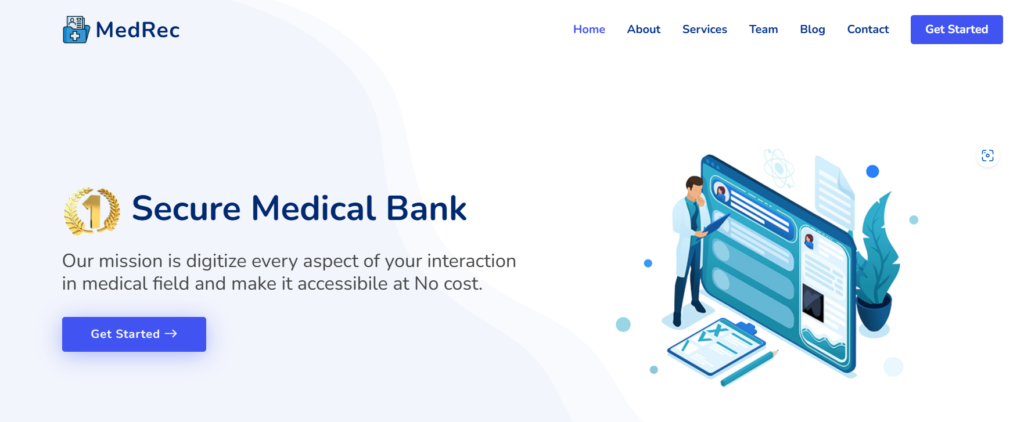
1. MedRec: Blockchain for Electronic Medical Records (EMR)

2. MedicalChain: Blockchain for Secure Health Record Sharing

3. Guardtime: Blockchain for Healthcare Data Integrity in Estonia

4. Pharmaceutical Supply Chain: IBM and Walmart’s Blockchain Initiative

5. SimplyVital Health: Blockchain for Healthcare Payments and Data Sharing

6. Solve. Care: Blockchain for Healthcare Administration

7. BurstIQ: Blockchain for Precision Medicine and Data Sharing


Source link

Solving post-TGE fundraising challenges: How Vellos is transforming token markets

0
Solving post-TGE fundraising challenges: How Vellos is transforming token markets


Receive, Manage & Grow Your Crypto Investments With Brighty

The journey for blockchain protocols doesn’t end after their Token Generation Event (TGE); in many ways, it’s just the beginning. While pre-TGE projects often bask in the glow of investor hype and support, post-TGE protocols frequently face significant hurdles when attempting to raise additional funds by selling discounted tokens from their treasury.

Fragmented fundraising environments and liquidity issues plague these projects, diverting their focus from development to fundraising. Enter Vellos—a groundbreaking platform designed to address these challenges head-on.

The Fragmented Fundraising Environment

For pre-TGE projects, the fundraising landscape is bustling with venture capitalists, brokers, and launchpads eager to invest in the next big thing. However, this enthusiasm often wanes once the TGE is complete. Post-TGE protocols find themselves in a fragmented environment where:

Limited Access to Investors: VCs and funds that specialize in pre-TGE investments may not extend their services to post-TGE projects, leaving a gap in support.Focus on New Hype: Many investors chase after the newest projects generating buzz, sidelining established protocols that still require capital to grow.Time-Consuming Funding Hunts: Protocol founders are forced to spend valuable time seeking funding instead of advancing their platforms.

The lack of a centralized marketplace for post-TGE investments means there’s no streamlined way for these projects to connect with suitable investors, impeding their progress and innovation.

The Liquidity Conundrum

Liquidity poses another significant challenge:

Difficult Offloading: Existing players in the discount token market deal primarily with pre-existing SAFTs or token warrants laden with conditions, making them hard to offload.Large Ticket Sizes: Big-ticket discount token deals are tough to sell, limiting the pool of potential buyers.Concentration of Tokens: When large amounts of a protocol’s tokens are held by a single entity, it creates selling pressure as tokens vest, potentially destabilizing the token’s value.

These issues contribute to a less dynamic market, where both buyers and sellers face obstacles that hinder the ecosystem’s overall health.

Introducing Vellos: A New Opportunity for Post-TGE Protocols

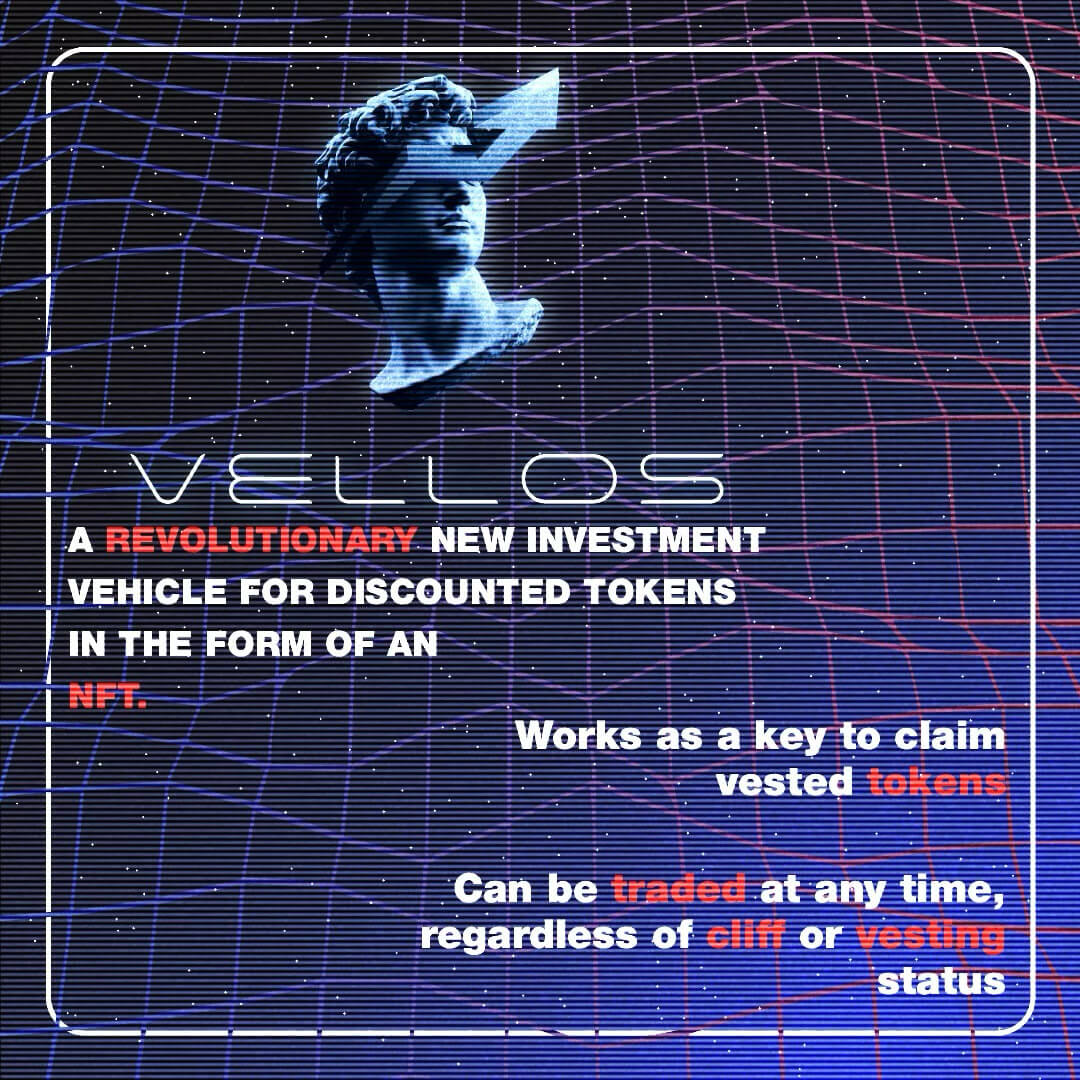
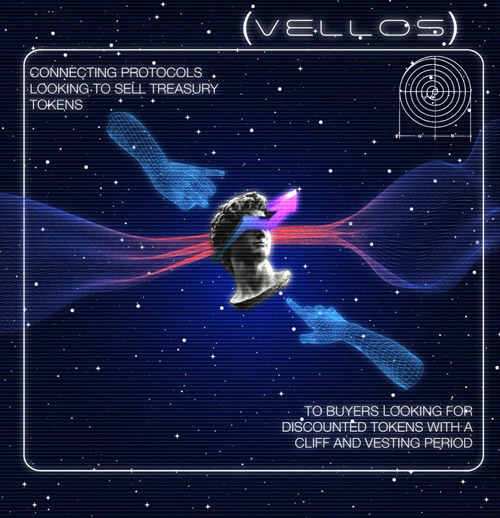
Vellos emerges as a solution to these persistent problems. It is a discount token marketplace specifically tailored for post-TGE projects, aiming to democratize access to discounted tokens and streamline the fundraising process.

What is Vellos?

Vellos is a platform where projects can offer their treasury tokens at a discount directly to their loyal community and a broad spectrum of other users. By breaking down large raises into smaller, manageable ticket sizes, Vellos enables individual users to participate in funding rounds traditionally reserved for big players.

How Vellos Addresses the Challenges

Unified Marketplace: Vellos creates a centralized environment where post-TGE projects and interested investors can connect effortlessly.Enhanced Liquidity: By dealing with new investment vehicles rather than pre-existing ones, Vellos simplifies the process of buying and selling discounted tokens.Dynamic NFTs: Vellos employs proprietary dynamic NFTs that act as keys to the underlying tokens. As tokens vest, NFT owners can claim them at will, adding a layer of flexibility and security.

Key Features of Vellos

Automated Onboarding: The entire process is permissionless and automated, including wallet and token checks, reducing administrative burdens.NFT Resale Marketplace: To introduce liquidity for buyers, NFTs can be traded at any time, even before vesting begins, providing an exit strategy and market dynamism.Revenue Sharing: Projects receive a portion of the revenue from secondary NFT trades, creating an ongoing revenue stream.

The Benefits for Protocols

By leveraging Vellos, protocols can unlock several advantages:

Direct Funding from the Community

Protocols can raise funds by offering discounted tokens directly to the community that has supported them from the start. This inclusivity strengthens community bonds and diversifies the investor base.

Creation of ‘Micro-KOLs’

Each user who purchases discounted tokens becomes a ‘micro-Key Opinion Leader.’ With skin in the game at a favorable price, these users are more likely to advocate for the project, amplifying its reach and influence.

Controlled Selling Pressure

Protocols can set custom cliff and vesting terms proportional to the discount offered, allowing them to manage the selling pressure and maintain token stability.

Consistent Revenue Stream

By earning a share of the revenue from secondary NFT trades, protocols establish an additional, consistent income source that can fund ongoing development and operations.

Focus on Core Development

With fundraising streamlined through Vellos, protocol founders can dedicate more time and resources to building and enhancing their products, driving innovation and value creation.

Vellos Telegram App: Bootstrapping Community Growth

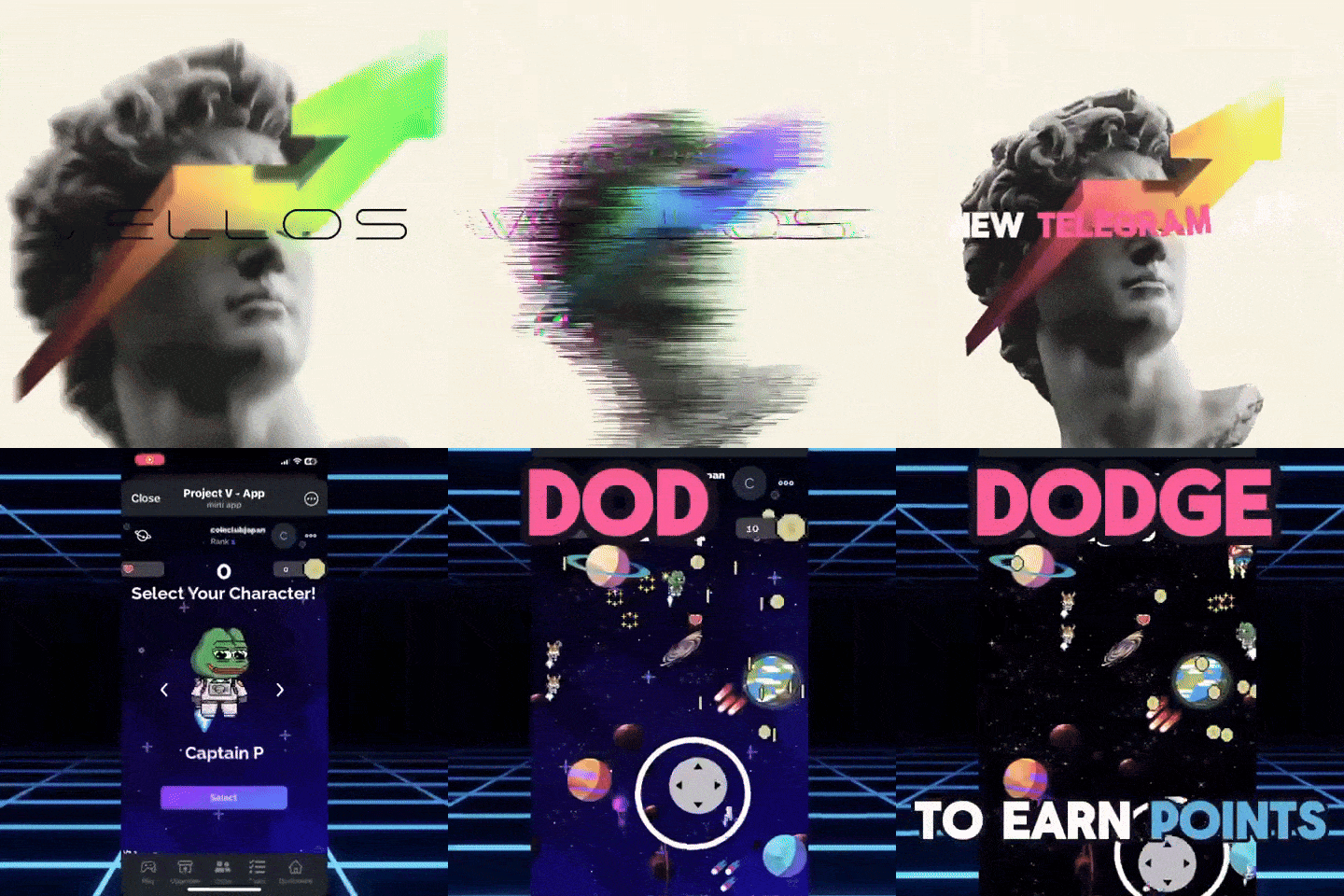
To expand and engage its community, Vellos recently launched a Telegram app that has quickly gained traction. Within the first two weeks since its launch, the app amassed 240,000 active users, signaling strong interest and participation.

The app allows users to interact with several engaging features, earning points along the way:

Doge To Earn: Players can participate in the “Doge To Earn” game, where they dodge enemies to accumulate points. The more successful they are at avoiding obstacles, the more points they can earn. Players can also use these points to upgrade their in-game features, enabling them to boost their point-earning potential over time.

Invite: Users can invite their friends to join the app, earning significant points for each referral. Additionally, they benefit from passive point-earning opportunities, receiving 16% of the points earned by their direct friends and 8% from indirect friends.

Task: Players can complete tasks, such as following Vellos on various social networks (SNS), to earn extra points and rewards.

Looking beyond just point farming, Vellos aims to utilize the Telegram app as a platform for education and community-building, providing valuable content and resources that enhance user experience and engagement over time.

Conclusion

Vellos stands poised to disrupt the post-TGE fundraising landscape by addressing the fragmentation and liquidity issues that have long hindered protocols.

By creating a unified, automated, and liquid marketplace for discounted tokens, Vellos empowers projects to connect with a broader investor base, engage their communities, and focus on what truly matters—building exceptional products in the web3 space.

To learn more:

Disclaimer: CryptoSlate is a strategic advisor for Vellos.

Mentioned in this article


Source link

Blockchain Whitepaper – A Comprehensive Overview for Investors and Enthusiasts – Web3oclock

0
Blockchain Whitepaper – A Comprehensive Overview for Investors and Enthusiasts – Web3oclock


Importance of whitepapers in blockchain projects

Standard Whitepaper Components

How to read and analyze a whitepaper

Importance of whitepapers in blockchain projects: 

1. Clear Project Vision:

2. Technical Blueprint:

3. Problem-Solution Explanation:

4. Transparency and Trust:

5. Investor Attraction:

6. Guidance for Developers:

7. Legal and Regulatory Clarity:

8. Marketing Tool:

9. Community Engagement:

10. Roadmap and Development Timeline:

The Components of Blockchain Whitepaper:

1. Introduction:

2. Market Overview:

3. Problem Statement:

4. Solution:

5. Technology and Architecture:

6. Tokenomics (Token Economy):

7. Roadmap:

8. Team:

9. Legal and Regulatory Information:

10. Conclusion:

How to Read and Analyze a Blockchain Whitepaper: 5 Simple Steps

1. Start with the Problem and Solution:

2. Understand the Technology:

3. Check the Tokenomics:

4. Evaluate the Team and Roadmap:

5. Look for Legal and Regulatory Compliance:

Top Blockchain Whitepapers: 

1. Bitcoin Whitepaper (2008):

2. Ethereum Whitepaper (2013):

3. Polkadot Whitepaper (2016):

4. Cardano Whitepapers (2017):

5. Libra (Diem) Whitepaper (2019):

6. Filecoin Whitepaper (2017):

7. Solana Whitepaper (2017):


Source link

Tron Blockchain – Everything You Need to Know About Its Features, Tokens, and Future – Web3oclock

0
Tron Blockchain – Everything You Need to Know About Its Features, Tokens, and Future – Web3oclock


History of Tron blockchain

Tron Token in Tron Blockchain 

Features and use cases of Tron Blockchain

How Tron Blockchain Works

Benefits of Tron Blockchain

Tron Blockchain’s ecosystem and dApps

Future of Tron Blockchain

Tron Blockchain is a decentralized platform, focused on building a free, global digital content entertainment system with distributed storage technology, enabling easy and cost-effective sharing of digital content. Tron Blockchain tries to eliminate intermediaries, allowing creators to interact with consumers. It has become a major player in the Blockchain space. 

History of Tron Blockchain:

What is TRX in Tron Blockchain? 

How Does Tron Blockchain Work? 

Step 1: Understanding Bandwidth Points

Step 3: Earning and Spending TRX

Step 4: Using Smart Contracts

Step 5: The Broker Ratio and Reward Distribution

Example in Action

1. High Transaction Speed:  

2. Low Transaction Costs:

3. Scalability:

4. Delegated Proof of Stake (DPoS):

5. Support for dApps:

6. Rewards: 

7. Staking and Passive Income:

1. TRX (Tron’s Native Token) in Tron Blockchain:

Examples of Popular dApps in Tron’s Ecosystem:

JustLend:

Sun.io: 

WinkLink: 

BitTorrent (BTT): 

WINk: 

JUST Network:

3. TronLink Wallet:

4. BitTorrent Chain (BTTC):

5. Tron DeFi (Decentralized Finance):

6. Entertainment on Tron:


Source link

SocialFi super app Phaver launches SOCIAL token airdrop rewarding Lens, Farcaster users

0
SocialFi super app Phaver launches SOCIAL token airdrop rewarding Lens, Farcaster users


Receive, Manage & Grow Your Crypto Investments With Brighty

SocialFi app Phaver launched its Phavercoin (SOCIAL) token today, initiating the Phairdrop event that marks the platform’s transition to a token-powered decentralized social ecosystem. The token generation event signifies Phaver’s move from the “DeSoc” era to the “SocialFi” era, integrating the SOCIAL token into its point economy and in-app functionalities.

As of press time, SOCIAL is trading around $0.0148 with a market cap of $146 million.

The SOCIAL token has a total supply of 10 billion tokens. While the initial circulating supply has not been specified, the token distribution involves several methods. Users who opted in on Cyber will receive tokens directly in their Phaver Primary Wallet today. Others can claim tokens on the Phaver website using their Primary Wallet, which requires Base ETH for gas fees. Eligibility criteria include possessing a Lens profile, a Farcaster profile, or at least one Cred item connected on Phaver. The Season 1 snapshot has already determined user allocations based on these criteria.

Trading of SOCIAL commenced today on multiple exchanges. Bybit has confirmed the listing, making the token accessible to its user base. The SOCIAL/USDT trading pair began trading on Sept. 24 at 10:00 UTC. Deposits are already open on MEXC, and withdrawals will be enabled on Sept. 25 at 10:00 UTC. The token is issued on the Base network, with the contract address ‘0xD3C68968137317a57a9bAbeacC7707Ec433548B4‘ provided for verification.

Phavercoin utility in decentralized social media apps

The utilities of the SOCIAL token within the Phaver ecosystem are multifaceted. Users can earn SOCIAL by redeeming Phaver Points in unique campaigns, with higher Cred levels affording better point-to-token conversion ratios. Holding SOCIAL tokens enhances a user’s Cred score and accumulates more Points, which are instrumental in the platform’s reward system. Higher Cred levels unlock benefits such as increased monthly withdrawal quotas, VIP support, preferential visibility, and early access to new features and whitelists.

Per Phaver’s whitepaper, the token can be utilized for various platform features, including advertising, boosting posts, and collaboration tools. Additionally, SOCIAL tokens can be used to purchase Points within the app, offering a more cost-effective option than other in-app payment methods.

Tokenomics details reveal that 300 million tokens (3% of the total supply) are allocated for user airdrops. Season 2 redemptions are set at 200 million tokens (2% of the total supply), scheduled to occur one month after the token generation event. Eligibility for Season 2 redemptions depends on user levels, with Level 1 users being ineligible. The conversion ratio for redemptions is influenced by the user’s Cred level and average SOCIAL holdings over 30 days before redemption, potentially offering up to a 60x multiplier.

Phaver’s platform integrates with Lens Protocol and Farcaster Protocol, enabling cross-posting capabilities that enhance user experience across decentralized social networks. The Phaver Point system incentivizes community participation, while the Cred credibility score system is designed to prevent bot abuse and improve the utility of NFTs within the platform.

Holding SOCIAL tokens may provide access to future opportunities, including whitelists, airdrops, and benefits from Phaver’s partners, which include notable companies like Animoca, Pudgy Penguins, and Rakuten Group. By encouraging users to hold tokens, Phaver aims to foster a sustainable ecosystem that rewards long-term engagement and supports the token’s value over time.

As Phaver embarks on this new phase with the launch of the SOCIAL token, users and investors are advised to stay informed through official channels for updates on token distribution, exchange listings, and platform developments and to stay vigilant of scams. Links to token claiming are available through Phaver’s iOS and Android apps via the Phairdrop website.

Mentioned in this article


Source link

Popular Posts

My Favorites

Trump Aides Look To Reform USAID With Blockchain For ‘Transparency’: Report...

0
Trump administration officials have crafted a proposal to overhaul U.S. foreign aid programs, with a section exploring how it could make use of...