Web3

Home Web3 Page 240

LilyPad: A Comprehensive Overview

0
LilyPad: A Comprehensive Overview


Lilypad is developing a serverless, distributed compute network that enables internet-scale data processing, AI, ML, and other arbitrary computation while unleashing idle processing power and unlocking a new marketplace for compute.

You can use Lilypad to run AI workload models, including Stable Diffusion and Stable Diffusion Video, or add your module to the Lilypad Network. Using Lilypads distributed compute nodes, you can build and run your own containerized workloads that require high-performance computing.

Overview

Lilypad provides distributed computational services underpinned by the Bacalhau Project. The network provides infrastructure for use cases like AI inference, ML training, DeSci, and more. Lilypad strategically collaborates with decentralized infrastructure networks, such as Filecoin, to formulate a transparent, efficient, and accessible computational ecosystem.

Perform off-chain decentralized compute over data, with on-chain guarantees. Call this functionality directly from a smart contract, CLI, and an easy to use abstraction layer.

In the video above, Ally Haire, Co-Founder of Lilypad, introduces the project and its goals.

The network is laying the groundwork for multi-chain integration and deploying an incentivized testnet.

Lilypad has evolved from earlier versions (v0, v1 & v2), where the network served as a proof of concept for verifiable, decentralized compute directly from smart contracts. These earlier iterations established the groundwork for a robust, scalable platform with expanded features and multichain support.

Bacalhau has been integral to Lilypad since its early versions (v0 and v1), serving as the backbone for verifiable off-chain compute. In these early iterations, Bacalhau was used for Proof of Concept projects, helping users execute decentralized compute jobs from smart contracts.

Find Lilypad on GitHub or visit the blog.

Objective and problem statement

Lilypad aims to mitigate the challenges predominantly associated with the accessibility of high-performance computational hardware. Numerous barriers impede developers and organizations from smoothly integrating projects that require high-performance computing, such as AI technologies, into their applications.

Unlike conventional centralized systems, where access to powerful compute hardware is restricted and costly, Lilypad endeavors to democratize this access. Through its verifiable, trustless, and decentralized computational network, Lilypad extends unrestricted, global access to computational power. By leveraging decentralized infrastructure networks such as Filecoin, Lilypad is strategically positioned to enhance the efficiency, transparency, and accessibility of high-performance computing hardware.

Lilypad Architecture

The architecture consists of several components:

Controller: A public-facing contract that acts as the network gateway and understands a job’s end-to-end workflow.

Storage: Stores deals, agreements, results, and disputes. Acts as a “database” for the controller contract.

Mediation: Starts as a “single mediator” and can be upgraded to a “consortium of mediators.”

Payments: Manages the movement of funds for Lilypad actions and handles the escrow account in the token on behalf of jobs.

ERC-20: A standard ERC-20 contract with additional methods for handling escrow.

Lilypad Services

Mediator: The “Ticket Inspector” that checks results if the client requests.

Smart Contracts: Deployed to IPC, these contracts need to be initialized by both parties to start a job.

Job Creator: The “Client” that posts a “Job Offer” to the solver and pays money into the smart contract as collateral.

Solver: Off-chain market maker that matches resource providers and job creators.

Resource Provider: Posts a “Resource Offer” to the solver and pays money into the smart contract as collateral against its results.

Applications

Perform off-chain decentralized compute over data, with on-chain guarantees, and to call this functionality directly from a smart contract, CLI, API, and an easy-to-use abstraction layer opens the door to a multitude of possible applications, including:

Inference AI jobs

ML training jobs

Invoking & supporting generic ZK computations

Cross-chain interoperability complements to bridge protocols

Utilizing inbuilt storage on IPFS

Federated Learning consensus (with Bacalhau insulated jobs)

IoT & Sensor Data integrations

Providing a platform for Digital twins

Supply chain tracking & analysis

ETL & data preparation jobs

Key features of Lilypad

Some of the key features of Lilypad include:

Verifiable Serverless Decentralized Compute Network: Lilypad is a decentralized compute network that aims to provide global, permissionless access to compute power. The Network orchestrates off-chain compute (a global GPU marketplace) and uses on-chain verification (Arbitrum L2 on Ethereum) to guarantee compute success.

Mainstream Web3 Application Support: Lilypad is designed to enable mainstream web3 applications to use its compute network with the Lilypad CLI and Smart Contracts. It aims to make decentralized AI compute more accessible, efficient, and transparent for developers and users.

Open Compute Network: Lilypad is an open compute network allowing users to access and run AI models/other programs in a serverless manner. Module creators and general users can access a curated set of modules or can easily create their own Lilypad module to run an AI model/other program on the network.

Multichain Support: The Lilypad Incentivized Testnet first launched on Arbitrum in June 2024 and plans to go multi-chain in the near future. Supporting multiple blockchain networks will increase scalability and interoperability, allowing users to choose the best blockchain that suits their needs.

Incentivized Test Net: The Lilypad IncentiveNet is live! The IncentiveNet program provides users with Lilybit_ rewards to participate in running nodes, testing, and improving the network. Learn more by checking out the IncentiveNet Leaderboard.

Decentralization of Mediators: The team also aims to decentralize the mediators in the network. This means that the decision-making process and governance of the network will be distributed among multiple participants, ensuring a more decentralized and resilient system.

What is the Bacalhau Project?

Bacalhau is a peer-to-peer computation network that enables compute-over-data jobs like GPU-enabled AI, ML, analytics, data engineering, data science, de-sci, and more. With the open-source Bacalhau Project, you can streamline your existing workflows without rewriting by running Docker containers and WebAssembly (WASM) images as tasks. This architecture is also referred to as Compute-over-Data (or CoD).

To find out more about it, see the Bacalhau Docs!

Lilypad Roadmap

For the latest Lilypad Project Report: October 10, 2024, you can go here and check out the full details.

Lilypad Leadership Team

Lilypad is assembling a cross-functional and experienced team to drive innovation in the decentralized compute network space, addressing complex R&D challenges related to verification, privacy, and token economics. The leadership and core team bring expertise from leading tech companies and academic institutions, offering a diverse range of skills and backgrounds to develop a robust decentralized computing infrastructure.

Alison Haire (CEO)With previous experience at Filecoin, IBM, and Accenture, Alison leads Lilypad, drawing on her deep expertise in decentralized networks and enterprise solutions.

Steve King (COO)Steve has held leadership positions at Atlassian, Canva, and is a founder himself, bringing extensive operational experience to Lilypad.

Kartika Chendorain-Tulusan (CPO)Kartika, formerly of IBM and EvolutionAI, leads product strategy with a strong background in product management and AI-driven innovation.

Stanley Bishop, PhD (Head of Research)An AI and ML engineer with research credentials from Stanford University, Stanley oversees the research efforts at Lilypad, pushing the boundaries of decentralized computing.

Emma Coochin (CMO)With marketing experience at LaunchVIC, Paypal, and ENTO, Emma leads the company’s marketing and outreach strategies.

Steve Coochin (CIO)Steve brings experience from IBM, Lumigo, Paypal, and Snyk, overseeing the company’s information systems and technological innovation.

Spheron X Lilypad: Powering the Future of AI and Beyond

Lilypad and Spheron have come together to revolutionize the decentralized compute landscape. This strategic collaboration combines the power of Lilypad’s innovative distributed compute network with Spheron’s secure and scalable decentralized infrastructure, offering unmatched computational solutions for AI, LLM, machine learning, and distributed data processing by unleashing untapped compute power across the globe. Key highlights include:
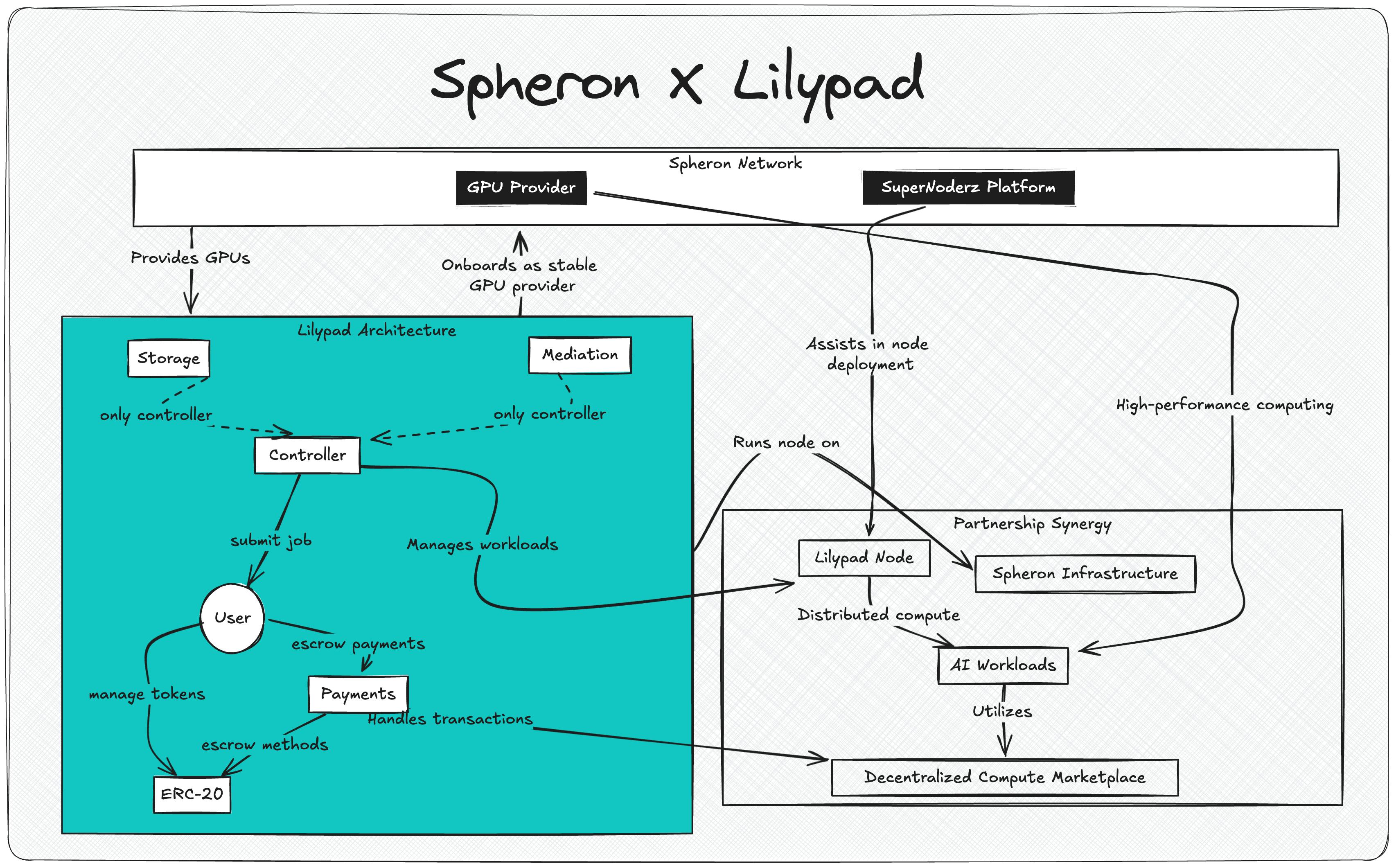
Running Lilypad Nodes on Spheron: Lilypad will leverage Spheron’s robust infrastructure to run its distributed compute nodes, enhancing the network’s performance and scalability.

Spheron as a Trusted GPU Provider: Spheron will supply high-performance GPUs to the Lilypad network, empowering AI workloads like Stable Diffusion and Stable Diffusion Video.

Onboarding Spheron to Lilypad’s GPU Marketplace: Lilypad will integrate Spheron as a stable GPU provider, allowing developers to access cutting-edge decentralized GPU resources.

Integration with SuperNoderz: Lilypad nodes will be added to Spheron’s SuperNoderz platform, simplifying the deployment process and improving the user experience.

Co-Marketing and Branding Initiatives: Both teams will collaborate on marketing efforts to spotlight the powerful synergy between the two networks.

This partnership unlocks new horizons for developers and enterprises seeking efficient, cost-effective, scalable compute solutions for AI, ML, and other high-performance workloads. Stay tuned as we continue to innovate and build a decentralized compute future together!

Contribute to the Lilypad Network during Hactoberfest! They have joined the open source fun and will support contributions of all types.

Improvements to the IncentiveNet slashing mechanism, rewards calculation, and more are underway. This work aims to improve the system’s economics and job reliability. As the network scaled quickly, the Lilypad team has carefully implemented changes to scale up the network infrastructure accordingly.

Follow the updates-rp channel in the Lilypad Discord to keep updated with the latest RP updates and announcements!

Lilypad Linktree – Learn more and join the community!


Source link

FalconX Unveils Auto-Liquidation Service for APAC Crypto Miners Amid Sector Woes – Decrypt

0
FalconX Unveils Auto-Liquidation Service for APAC Crypto Miners Amid Sector Woes – Decrypt


Digital asset prime brokerage FalconX has launched an auto-liquidation service designed to enhance capital efficiency for crypto mining firms in the Asia-Pacific region, following a turbulent two years that have strained the sector.

The service, part of the firm’s broader platform rollout targeting the industry, is designed to help miners operating in capital-constrained environments manage liquidity more efficiently.

Its offering automates the conversion of crypto mining rewards, including Bitcoin, Litecoin, and other proof-of-work tokens, into U.S. dollars, the company shared exclusively with Decrypt.

FalconX said the service would streamline miners’ operations by enabling faster reinvestment into their businesses, removing the need for manual trading or reliance on third-party providers.

The company added that its service offers enhanced liquidity while minimizing costs, with low execution fees and minimal slippage.

As part of the process, miners who sign up for the service will receive a dedicated deposit address, through which their crypto rewards are automatically converted to cash. 

The company emphasized that this process would improve operational efficiency—critical for an industry known for its tight profit margins.

It follows a tumultuous 24 months for the crypto industry and miners, who have faced significant challenges due to volatile market conditions, rising energy costs, and a rising Bitcoin hash rate.

Many miners have also struggled with profitability as Bitcoin’s price fluctuations and tightening access to capital have put pressure on their operations.

FalconX claims the new platform consistently outperforms leading global exchanges in Bitcoin trades, with over 90% of transactions executed at a lower cost.

“FalconX aggregates over 94% of global spot liquidity, and hence, we outperform the pricing and depth of major global exchanges,” a spokesperson told Decrypt.

The launch is part of FalconX’s broader strategy to bolster crypto’s capital markets by providing liquidity and financial services tailored to mining firms. 

The company said it remains committed to supporting miners as they navigate an increasingly complex and capital-intensive environment.

FalconX, which is backed by investors including Accel, American Express Ventures, and Tiger Global, has a presence in major financial hubs such as New York, London, Hong Kong, and Singapore.

Daily Debrief Newsletter

Start every day with the top news stories right now, plus original features, a podcast, videos and more.


Source link

Meta Unveils “Movie Gen” AI Tool for Creating Videos and Sound

0
Meta Unveils “Movie Gen” AI Tool for Creating Videos and Sound


Meta is stepping into the AI video generation arena with the introduction of its latest tool, Movie Gen. This new research preview showcases a video and sound generator that can handle complex visual effects (VFX) tasks such as replacing environments, extending sets, swapping characters, removing objects, and adding particle effects with realistic lighting interactions.

Movie Gen delivers video quality comparable to OpenAI’s Sora and allows users to upload their own photos and integrate them into the generated video. Users can enhance their creations further by adding custom sound effects generated from text descriptions.

Movie Gen represents Meta’s third wave of advancements in generative AI.

Meta has shared this research, believing that such technology empowers users to express themselves in new, creative ways and provides opportunities to those who might not otherwise have access to such tools.

What Is Movie Gen?

Movie Gen is a set of foundational models developed by Meta that generate high-quality videos and audio. These models are trained on extensive datasets comprising images, videos, and audio using a combination of text-to-image and text-to-video techniques.

The system generates 1080p HD videos in various aspect ratios, delivering state-of-the-art performance across multiple video generation tasks. Movie Gen’s audio component can create synchronized soundtracks, including sound effects and music, that complement the generated visuals seamlessly.

The results of this tool are indeed impressive.

How Does Movie Gen Work?

Movie Gen’s models are built on a Transformer architecture, utilizing advanced techniques like flow matching during training. The training process consists of several stages, starting with pre-training on large datasets, followed by fine-tuning on high-quality, curated data to achieve realistic and aesthetically pleasing outputs.

The training approach began with treating image edits like single-frame video edits. Meta’s team then created synthetic video editing tasks by animating these still images and leveraging AI models such as SAM and DINO for object segmentation. The models improved by learning to reconstruct the original videos from their edited versions.

Meta has published a whitepaper detailing the technology behind Movie Gen for those interested in the finer technical aspects.

Four Key Features of Movie Gen

Movie Gen Video: This 30-billion-parameter transformer model generates high-quality, high-definition images and videos from a single text prompt.

Movie Gen Audio: With 13 billion parameters, this model can take a video input and optional text prompts to create high-fidelity audio synchronized with the video. It generates ambient sound, background music, and foley sound with state-of-the-art alignment between video, audio, and text.

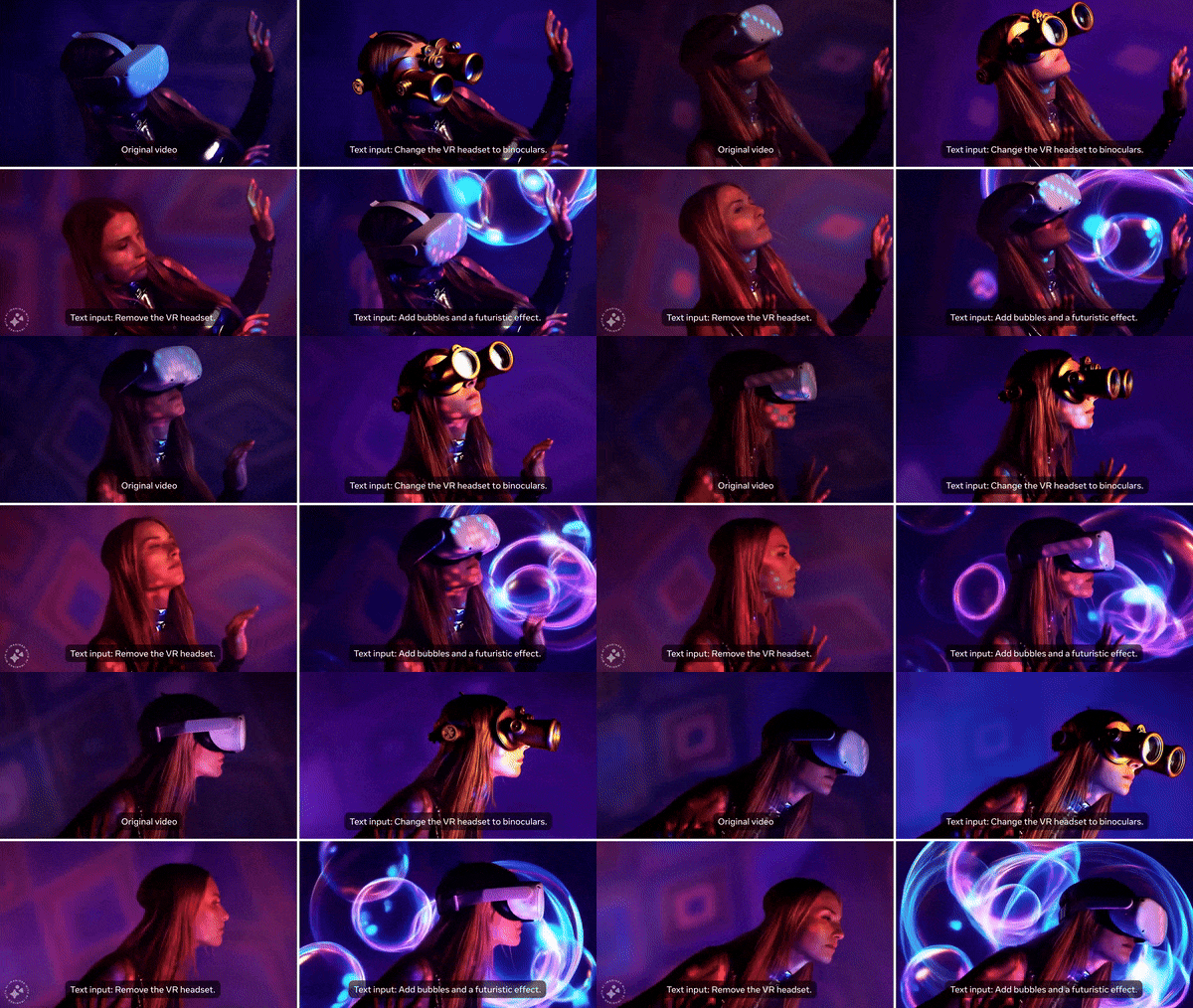
Precision Video Editing: Movie Gen enables localized edits, such as adding or removing objects, and global changes, like adjusting backgrounds or styles, using both generated and existing video content combined with text instructions.

Personalized Videos: The model can generate personalized videos with exceptional character preservation and realistic motion using a simple image and text prompt.

Top Features of Movie Gen Video

Text-to-Video Generation: You can create videos simply by describing the desired scene with a text prompt.

Examples:

| Prompt: The camera is behind a man. The man is shirtless, wearing a green cloth around his waist. He is barefoot. With a fiery object in each hand, he creates wide circular motions. A calm sea is in the background. The atmosphere is mesmerizing, with the fire dance.

Movie Gen Output: Meta’s model generates a stunning video based on this detailed description.

Meta Movie Gen: Prompt: The camera is behind a man. The man is shirtless, wearing a green cloth around his waist. He is barefoot. With a fiery object in each hand, he creates wide circular motions. A calm sea is in the background. The atmosphere is mesmerizing, with the fire dance.

Prompt: A sloth in pink sunglasses lounges on a donut float in a pool, holding a tropical drink. The scene is set in a sunny, tropical world, with soft shadows cast by the sunlight.

Movie Gen Output: Meta’s tool brings this playful, colorful scene to life.

Meta movie gen: Prompt: A sloth with pink sunglasses lays on a donut float in a pool. The sloth is holding a tropical drink. The world is tropical. The sunlight casts a shadow.

Video Editing with Text Prompts: Movie Gen enables users to make changes to existing videos by providing text instructions. You can add or remove elements, modify backgrounds, or change the overall style of a video using simple text descriptions.

None

Create Personalized Videos: Imagine seeing yourself as the star of your own video! With Movie Gen, you can upload a picture and input a text description, and the model will generate a video placing you in different scenes.

Examples:

Prompt: A woman sits on the grass in a pumpkin patch, wearing a scarf and holding a cup. Behind her are rows of pumpkins.

Meta movie gen: Prompt: A woman is sitting on the grass of a pumpkin patch. She is wearing a scarf and holding a cup. The background is filled with rows of pumpkin

Prompt: A cowgirl, wearing denim pants and a leather belt, sits atop a majestic white horse in an old western town. The sun shines brightly on the Rocky Mountains in the background.

Meta movie gen: Prompt: A cowgirl wearing denim pants is on a white horse in an old western town. A leather belt cinches at her waist. The horse is majestic, with its coat gleaming in the sunlight. The Rocky Mountains are in the background.

Synchronized Sound Effects and Soundtracks: Movie Gen isn’t limited to visuals alone. It can generate soundtracks synchronized with the video, including ambient noises, music, and sound effects.

How Does Movie Gen Stack Up Against the Competition?

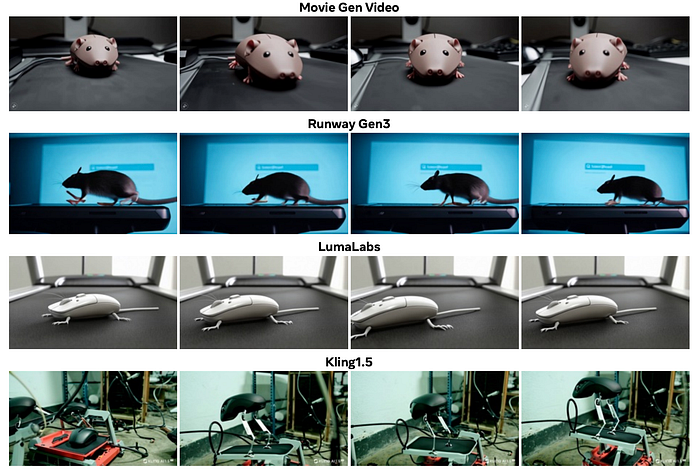
Meta has compared Movie Gen with other models, including commercial systems like Runway Gen-3, LumaLabs, Kling 1.5, and OpenAI’s Sora. According to Meta’s research, Movie Gen outperforms these systems in terms of overall video quality.

Examples:

Prompt: A computer mouse with legs runs on a treadmill.

Meta movie gen: Prompt: A computer mouse with legs running on a treadmill

Prompt: A kangaroo wearing purple overalls and boots strolls through Johannesburg at sunset.

meta movie gen: Prompt: a kangaroo in purple overalls and boots walking in Johannesburg during sunset

Prompt: A toy robot in a green dress walks through Antarctica during a storm.

Meta movie gen: Prompt: a toy robot in a green dress and sun hat walking in Antarctica during a storm

Movie Gen’s strong performance stems from its extensive training data, its use of flow matching for efficient training, and a multi-stage training process that blends text-to-image and text-to-video tasks.

How Can You Access Movie Gen?

Movie Gen remains in the research phase and has not been officially released to the public. Meta is working with creative professionals to refine the tool for a potential launch.

Meta is continuously gathering feedback from the creative community and plans to share more information about the tool’s capabilities and potential applications in the future.

Final Thoughts

Meta’s Movie Gen is an impressive step forward in generative AI technology. The company’s continued investment in AI research is paying off, as Movie Gen has the potential to revolutionize video generation and sound synchronization.

If Meta releases this tool to the public, it could be a game-changer for the industry, seriously challenging competitors like Runway, Kling, and OpenAI’s Sora.

However, it’s important to remain cautious. The videos presented so far were hand-picked for the announcement, and the real test will come when the public can experiment with the tool in real-world scenarios.

Still, the possibilities are exciting, and I can’t wait to see how Movie Gen develops.

FAQs

When will Movie Gen be available to the public?

Currently, Movie Gen is in the research phase, with no confirmed release date for the general public. Meta is working with creative professionals to prepare for a potential launch.

What makes Movie Gen different from other AI video generators?

Movie Gen stands out because it combines high-quality video generation, precise video editing capabilities, and the ability to produce personalized videos and synchronized soundtracks.

Can Movie Gen be used for professional video production?

While still in its research stage, Movie Gen’s features indicate that it could be a powerful tool for creative professionals looking to integrate AI into their video production workflows.

What kind of prompts can Movie Gen handle?

Movie Gen can generate complex scenes from simple text prompts, add custom objects, adjust backgrounds, and create personalized content from user-uploaded photos.

Is Movie Gen’s output comparable to commercial video generators?

Meta’s research suggests that Movie Gen surpasses many commercial systems in overall video quality, offering state-of-the-art performance across various tasks.


Source link

5G Applications and Services Market Set to Achieve USD 590223.45 Million By 2032, Growing at 13.47% CAGR | Web3Wire

0
5G Applications and Services Market Set to Achieve USD 590223.45 Million By 2032, Growing at 13.47% CAGR | Web3Wire


5G Applications and Services Market Set to Achieve USD 590223.45 Million By 2032, Growing at 13.47% CAGR | Web3Wire

5G Applications and Services Market

The 5G Applications and Services Market Size was valued at USD 166766.3 Million in 2023. The market is projected to grow to USD 590223.45 Million by 2032, exhibiting a compound annual growth rate (CAGR) of 13.47% from 2024 to 2032.

In-Depth Analysis of 5G Applications and Services Market | Research Report [2024-2032] – https://www.globalmarketstatistics.com/market-reports/5g-applications-and-services-market-10691

“5G Applications and Services Market” Research Report Revealing a Comprehensive Analysis of Industry Trends, Growth, and Opportunities By Types (Enhanced Mobile Broadband, Ultra-Reliable Low Latency Communications, Massive Machine Type Communications), By Application (Telecommunications, Automotive, Government, Media, Entertainment, Consumer Electronics, Banking, Energy, Utilities, Others), By Regional Outlook and Forecast, 2024 – 2032″

Browse Detailed TOC of 5G Applications and Services Market report which is spread across 116+ Pages, Tables and Figures with Charts that provides exclusive data, information, vital statistics, trends, and competitive landscape details in this niche sector.

Who is the largest manufacturers of 5G Applications and Services Market worldwide?

China Mobile Limited (China)EITC (UAE)Telstra Wholesale (Australia)Nokia (Finland)AT & T Intellectual Property (U.S.)Telefonaktiebolaget LM Ericsson (Sweden)Cisco (U.S.)SAMSUNG (South Korea)Airtel India (India)NTT DOCOMO Inc. (Japan)Intel Corporation (U.S.)Verizon Wireless (U.S.)KT Corp. (South Korea)Deutsche Telekom AG (Germany)Vodafone Limited (U.K.)Request a Free Sample Copy @ – https://www.globalmarketstatistics.com/enquiry/request-sample-pdf/10691

Short Description About 5G Applications and Services Market:

The Global 5G Applications and Services market is anticipated to rise at a considerable rate during the forecast period, between 2024 and 2032. In 2023, the market is growing at a steady rate and with the rising adoption of strategies by key players, the market is expected to rise over the projected horizon.

North America, especially The United States, will still play an important role which cannot be ignored. Any changes from United States might affect the development trend of 5G Applications and Services. The market in North America is expected to grow considerably during the forecast period. The high adoption of advanced technology and the presence of large players in this region are likely to create ample growth opportunities for the market.

Europe also play important roles in global market, with a magnificent growth in CAGR During the Forecast period 2024-2032.

5G Applications and Services Market size is projected to reach Multimillion USD by 2032, In comparison to 2024, at unexpected CAGR during 2024-2032.

Despite the presence of intense competition, due to the global recovery trend is clear, investors are still optimistic about this area, and it will still be more new investments entering the field in the future.

This report focuses on the 5G Applications and Services in global market, especially in North America, Europe and Asia-Pacific, South America, Middle East and Africa. This report categorizes the market based on manufacturers, regions, type and application.

The report focuses on the 5G Applications and Services market size, segment size (mainly covering product type, application, and geography), competitor landscape, recent status, and development trends. Furthermore, the report provides detailed cost analysis, supply chain.

Technological innovation and advancement will further optimize the performance of the product, making it more widely used in downstream applications. Moreover, Consumer behavior analysis and market dynamics (drivers, restraints, opportunities) provides crucial information for knowing the Co-Living market.

Request a Free Sample Copy @ – https://www.globalmarketstatistics.com/enquiry/request-sample-pdf/10691

What are the factors driving the growth of the 5G Applications and Services Market?Growing demand for below applications around the world has had a direct impact on the growth of the 5G Applications and Services

TelecommunicationsAutomotiveGovernmentMediaEntertainmentConsumer ElectronicsBankingEnergyUtilitiesOthersWhat are the types of 5G Applications and Services available in the Market?Based on Product Types the Market is categorized into Below types that held the largest 5G Applications and Services market share In 2023.

Enhanced Mobile BroadbandUltra-Reliable Low Latency CommunicationsMassive Machine Type CommunicationsWhich regions are leading the 5G Applications and Services Market?North America (United States, Canada and Mexico)Europe (Germany, UK, France, Italy, Russia and Turkey etc.)Asia-Pacific (China, Japan, Korea, India, Australia, Indonesia, Thailand, Philippines, Malaysia and Vietnam)South America (Brazil, Argentina, Columbia etc.)Middle East and Africa (Saudi Arabia, UAE, Egypt, Nigeria and South Africa)Request a Free Sample Copy @ – https://www.globalmarketstatistics.com/enquiry/request-sample-pdf/10691

This 5G Applications and Services Market Research/Analysis Report Contains Answers to your following Questions

What are the global trends in the 5G Applications and Services market? Would the market witness an increase or decline in the demand in the coming years?What is the estimated demand for different types of products in 5G Applications and Services? What are the upcoming industry applications and trends for 5G Applications and Services market?What Are Projections of Global 5G Applications and Services Industry Considering Capacity, Production and Production Value? What Will Be the Estimation of Cost and Profit? What Will Be Market Share, Supply and Consumption? What about Import and Export?Where will the strategic developments take the industry in the mid to long-term?What are the factors contributing to the final price of 5G Applications and Services? What are the raw materials used for 5G Applications and Services manufacturing?How big is the opportunity for the 5G Applications and Services market? How will the increasing adoption of 5G Applications and Services for mining impact the growth rate of the overall market?How much is the global 5G Applications and Services market worth? What was the value of the market In 2023?Who are the major players operating in the 5G Applications and Services market? Which companies are the front runners?Which are the recent industry trends that can be implemented to generate additional revenue streams?What Should Be Entry Strategies, Countermeasures to Economic Impact, and Marketing Channels for 5G Applications and Services Industry?Request Free Sample PDF @ – https://www.globalmarketstatistics.com/enquiry/request-sample-pdf/10691

Browse Other GMS Report Coverage:Diketene Derivatives Market @ – https://www.globalmarketstatistics.com/market-reports/diketene-derivatives-market-10947

Business Process Management (BPM) Market @ – https://www.globalmarketstatistics.com/market-reports/business-process-management-bpm-market-11150

Ice Hockey Helmet Market @ – https://www.globalmarketstatistics.com/market-reports/ice-hockey-helmet-market-10682

Detailed TOC of Global 5G Applications and Services Market Research Report, 2024-20321 Market Overview1.1 Product Overview and Scope of 5G Applications and Services1.2 Classification of 5G Applications and Services by Type1.2.1 Overview: Global 5G Applications and Services Market Size by Type: 2017 Versus 2022 Versus 20321.2.2 Global 5G Applications and Services Revenue Market Share by Type in 20221.3 Global 5G Applications and Services Market by Application1.3.1 Overview: Global 5G Applications and Services Market Size by Application: 2017 Versus 2022 Versus 20321.4 Global 5G Applications and Services Market Size and Forecast1.5 Global 5G Applications and Services Market Size and Forecast by Region1.6 Market Drivers, Restraints and Trends1.6.1 5G Applications and Services Market Drivers1.6.2 5G Applications and Services Market Restraints1.6.3 5G Applications and Services Trends Analysis

2 Company Profiles2.1 Company2.1.1 Company Details2.1.2 Company Major Business2.1.3 Company 5G Applications and Services Product and Solutions2.1.4 Company 5G Applications and Services Revenue, Gross Margin and Market Share (2020,2021,2022, and 2023)2.1.5 Company Recent Developments and Future Plans

3 Market Competition, by Players3.1 Global 5G Applications and Services Revenue and Share by Players (2020,2021,2022, and 2023)3.2 Market Concentration Rate3.2.1 Top3 5G Applications and Services Players Market Share in 20223.2.2 Top 10 5G Applications and Services Players Market Share in 20223.2.3 Market Competition Trend3.3 5G Applications and Services Players Head Office, Products and Services Provided3.4 5G Applications and Services Mergers and Acquisitions3.5 5G Applications and Services New Entrants and Expansion Plans

4 Market Size Segment by Type4.1 Global 5G Applications and Services Revenue and Market Share by Type (2017-2023)4.2 Global 5G Applications and Services Market Forecast by Type (2023-2031)

5 Market Size Segment by Application5.1 Global 5G Applications and Services Revenue Market Share by Application (2017-2023)5.2 Global 5G Applications and Services Market Forecast by Application (2023-2032)

6 Regions by Country, by Type, and by Application6.1 5G Applications and Services Revenue by Type (2017-2032)6.2 5G Applications and Services Revenue by Application (2017-2032)6.3 5G Applications and Services Market Size by Country6.3.1 5G Applications and Services Revenue by Country (2017-2031)6.3.2 United States 5G Applications and Services Market Size and Forecast (2017-2032)6.3.3 Canada 5G Applications and Services Market Size and Forecast (2017-2032)6.3.4 Mexico 5G Applications and Services Market Size and Forecast (2017-2032)

7 Research Findings and Conclusion

8 Appendix8.1 Methodology8.2 Research Process and Data Source8.3 Disclaimer

9 Research Methodology

10 Conclusion

Continued….

Request Free Sample PDF @ – https://www.globalmarketstatistics.com/enquiry/request-sample-pdf/10691

Global Market Statistics

Office No.- B, 2nd Floor Icon Tower, Baner – Mhalunge Road, Baner, Pune 411045 Maharashtra, India.

About Us:

https://www.globalmarketstatistics.com/ is a unique organization that offers expert analysis and accurate data-based market intelligence, aiding companies of all shapes and sizes to make well-informed decisions. We tailor inventive solutions for our clients, helping them tackle any challenges that are likely to emerge from time to time and affect their businesses.

This release was published on openPR.

About Web3Wire Web3Wire – Information, news, press releases, events and research articles about Web3, Metaverse, Blockchain, Artificial Intelligence, Cryptocurrencies, Decentralized Finance, NFTs and Gaming. Visit Web3Wire for Web3 News and Events, Block3Wire for the latest Blockchain news and Meta3Wire to stay updated with Metaverse News.


Source link

The success of DePIN is in all of our pockets

0
The success of DePIN is in all of our pockets


Receive, Manage & Grow Your Crypto Investments With Brighty

The following is a guest post from J.D. Seraphine, Founder and CEO at Raiinmaker.

In an era where technology advancements continuously reshape the landscape of our daily lives, mobile devices have emerged as an integral tool for driving connectivity. Growing hand in hand with this connectivity has been the public’s consciousness and concern for the security and privacy of their data, as well as their awareness of the suboptimally centralized nature of many of our legacy systems. 

Intriguingly, however, it is mobile devices, the source and driver of many of society’s privacy and security issues, that may hold the key to realizing a more decentralized and secure digital future via decentralized physical infrastructure networks (DePIN). Smartphones, with their omnipresence, advanced capabilities, and seamless connectivity, provide the perfect platform to support and expand decentralized infrastructure and distributed networks. 

Additionally, Web3 phones are now hitting the market in earnest – just this month, Solana Mobile garnered $70 million in preorders for its second blockchain smartphone, Seeker, which is set to launch in 2025. Among its features, Seeker includes an upgraded crypto wallet and new reward mechanisms that are specifically tailored toward unlocking the transformational potential of DePIN.

DePIN as the Solution to the Crisis of Centralization

The recent technical issue with CrowdStrike’s centralized software – which led to a global outage affecting numerous sectors – again highlighted the issues created by the centralization of much of the core systems that the modern world relies upon, and the urgent need to move away from monolithic entities, towards a more decentralized future.

Projected to grow up to $3.5 trillion by 2028 – DePIN technology has emerged as one of the revolutionary advancements in the journey toward a more distributed world. DePIN projects seek to replace the existing centralized model by creating peer-to-peer (P2P) networks where individuals can contribute and own shared control over the network, ​​promoting active community participation, and giving users decision making authority. As well as decentralizing control, data is distributed across multiple nodes – making it less vulnerable to single points of failure, and attack from malicious actors.

Mobile Devices Key to Achieving DePIN at Scale

First and foremost, leveraging DePIN on mobile devices has the clear benefit of enhancing security through decentralized data distribution, providing users with greater control over their personal data, and addressing their privacy concerns. Additionally, for DePIN to really take off and provide a credible alternative to the current centralized system, a key requirement will be the ample availability of nodes to drive the efficiency and effectiveness of networks.

In the modern world, the ubiquity of mobile devices means that people are always connected, always online – the World Advertising Research Center (WARC) has predicted that by 2025 72.6% of internet users or nearly 3.7 billion people will access the web through their smartphones. This constant connectivity of the modern population is a crucial factor for DePIN technology, which relies on the network effect – the more people who are connected and contributing to the network, the more robust and efficient the network becomes. With smartphones in billions of people’s pockets, DePIN projects can leverage this vast, existing infrastructure to reach and engage users at an incredibly significant scale.

Taking things to the next level, mobile phones are becoming ever more powerful and capable – equipped with advanced processors, significant storage, and high-speed 5G internet connectivity. These capabilities make them ever-improving and ideal nodes in a decentralized network, capable of performing complex tasks, storing data securely, and communicating with other devices seamlessly. 

A recent study also reinforced the idea of mobile devices as catalysts for efficient decentralized infrastructure networks. The research found that by harnessing the power of mobile devices, projects can: enhance network efficiency and accessibility, promote decentralization by distributing computational tasks – reducing reliance on centralized data centers, and become more energy-efficient, contributing to sustainable network operations.

Clearly, the integration of mobile devices into DePINs has the very real potential to represent a significant step in the evolution of decentralized networks, improving accessibility, efficiency, and sustainability – offering a scaled alternative to the current centralized models and opening up more and more transformative real-world use cases.

Transformative Real-World Use Cases

It should also be stressed that while DePIN technology must scale further, it is not just a theoretical concept at this stage – it is already demonstrating its capabilities to transform critical infrastructure and create real-world impact across various industries, such as AI training and development, AI reputation management, telecommunications, and much more.

To explain further, training AI models requires massive amounts of data and computational power and therefore, access to powerful AI capabilities has been monopolized by major tech players. DePIN opens the door for individuals and smaller entities to harness the potential of AI, by leveraging a decentralized network of mobile devices that is more efficient and cost-effective.

This decentralized approach democratizes AI development, allowing more individuals and organizations to participate in and benefit from AI advancements. Projects like Render Network and VALDI are just some examples of this process already in action – and allow users worldwide to leverage decentralized infrastructure for AI, fostering inclusivity, and also sparking innovation from the ground up.

Similarly, DePIN has transformative potential in the realm of telecommunications – as the traditional infrastructure systems are centralized, expensive, and often fail to reach remote or underserved areas. A distributed network approach, pursued by projects like Helium, offers a decentralized alternative where individuals can share their internet connections, creating a community-driven network. This approach can significantly reduce costs and extend connectivity, addressing the urgent need to bridge the digital divide for the 3 billion people who still remain unconnected. This increase in connectivity has the added benefit of increasing the availability of mobile devices to act as nodes for DePIN projects, driving forward additional adoption.

These use cases are just a small glimpse into DePIN’s potential and illustrate the diverse applications across various industries, leveraging decentralized infrastructure to enhance efficiency, security, and sustainability.​

Path Forward

The path forward is clear – a mobile device-driven approach is key to the mass adoption of Web3 technologies, ​and key to realizing the full potential of DePIN to achieve scaled trustless networks built on reputation and present genuine alternatives to existing centralized solutions. 

The ubiquity of mobile devices around the world presents a major opportunity for DePIN to succeed, if we can just find ways to attract more and more people to participate, contribute, and benefit from decentralized networks. As more people join, the network becomes stronger and more robust, driving further adoption and creating a positive feedback loop.


Source link

What Is ‘Off the Grid’? The Buzzy Battle Royale Shooter Built on Avalanche – Decrypt

0
What Is ‘Off the Grid’? The Buzzy Battle Royale Shooter Built on Avalanche – Decrypt


If you’ve been on the online shooter video game portion of the internet over the last few days, then you’ve likely heard of Off the Grid, a brand new battle royale game that is picking up serious steam with players. Off the Grid has already topped the Epic Games Store’s list of the most popular free-to-play games, plus it’s commanding huge crowds on Twitch. In short: It’s a hit.

But what you might not know is that Off the Grid is a blockchain game built on Avalanche, with plans for a crypto token and the ability to mint rare items as tradeable NFTs. While these features aren’t yet fully implemented, it’s fair to say that Off the Grid has already made a bigger splash with mainstream gamers than any previous blockchain game—and the future looks bright.

Here’s what you need to know about Off the Grid, the current early access release, and the crypto and NFT plans ahead.

What is Off the Grid? 

Off the Grid is a new third-person battle royale shooter that has launched into early access on PlayStation 5, Xbox Series X and S, and PC via the Epic Games Store.

A screenshot from Off the Grid in early access. Image: Decrypt

Set in a fictional future where cybernetics can augment humans to make them even more deadly, you and two teammates will jump onto the sizable city map and fight it out against other trios to be the last ones standing, just like any good battle royale game.

However, Off The Grid touts itself as an Extraction Royale, adding in some extraction shooter style mechanics as well. In matches, you can find what are essentially loot boxes, and if you either hold them as you win, or manage to extract them at certain locations on the map, then you can use them to unlock cosmetic items or new weapons and skills for your loadouts.

Off the Grid is developed by Gunzilla Games, a studio co-founded by “District 9” and “Chappie” film director Neill Blomkamp—and as the studio’s chief creative officer, his style is strongly felt throughout the game.

The game is built around a future competition that essentially turns the battle royale premise into a televised competition between cybernetically-augmented humans. And unlike battle royale games like Fortnite and Apex Legends, Off the Grid promises 60 hours of narrative-driven gameplay, with cinematics that bookend matches and provide added flavor and motivation to the experience.

How do I play Off the Grid?

To play Off The Grid in early access, you simply need to download the free-to-play game on your chosen platform and boot it up, but it’s not quite as simple as it sounds. It’s available on the Epic Games Store on PC, as well as on PlayStation 5 and Xbox Series X and S, and it can be downloaded freely on all of those platforms.

A screenshot from Off the Grid in early access. Image: Decrypt

Once you have the game downloaded, you simply need to boot it up and play your first game. It’s pretty easy to pick up if you’ve ever played a battle royale before, and there’s already a ton of guides available on the web.

The early access version contains just one mode (Extraction Royale) and the single, but very large map, though the future full release is expected to pack more modes and content.

Where does crypto come in?

In the initial early access build, there’s no obvious crypto integration. But it’s apparently humming along in the background, and there’s more coming on the horizon.

Off the Grid is being built on GUNZ, a dedicated L1 (or subnet) on the Avalanche blockchain network. Currently, GUNZ is on testnet and the network’s GUN token has yet to go live on mainnet, but those moves are on the horizon. Items in the game are denominated in GUN, which you can also earn by completing missions, however it’s effectively an in-game currency for now since the token isn’t live on mainnet.

A screenshot from Off the Grid in early access. Image: Decrypt

However, the game is racking up some serious numbers on the GUNZ testnet, with millions of wallets created during the first week of early access, along with millions of daily transactions. We haven’t gotten full clarity yet from Gunzilla Games on how this works, but it appears that a testnet wallet is created when a user starts playing the game.

Eventually, when the GUNZ network launches its mainnet, Gunzilla has said that players will be able to mint items as unique NFTs, which can be traded and sold on marketplaces and within the game itself. Gunzilla created the GUNZ network to let other developers utilize the tech, as well, so the ambition is for the GUN token to be usable across multiple games in the future.

When will Off The Grid launch? 

There’s no word on when the full game release will come, but for now the early access launch appears to be going down well. Gunzilla Games enlisted (aka paid) major streamers like Tyler “Ninja” Blevins and Seth “Scump” Abner to play the game for hours and hours during the launch week for their sizable audiences, and that investment appears to be paying off with buzz.

We’ll see whether Off the Grid can hold onto that initial momentum as the game evolves and expands in the near future, and whether mainstream gamers take kindly to the ability to mint and trade NFTs and utilize the future GUN token.

Edited by Andrew Hayward

GG Newsletter

Get the latest web3 gaming news, hear directly from gaming studios and influencers covering the space, and receive power-ups from our partners.


Source link

Smart Greenhouse Market Size is projected to reach $3.23 billion by 2027 | Web3Wire

0
Smart Greenhouse Market Size is projected to reach .23 billion by 2027 | Web3Wire


Smart Greenhouse Market Size is projected to reach .23 billion by 2027 | Web3Wire

Allied Market Research published an exclusive report, titled, “Smart Greenhouse Market Size, Share, Competitive Landscape and Trend Analysis Report by Type, Component and End User : Global Opportunity Analysis and Industry Forecast, 2020-2027”.

The global smart greenhouse market size was valued at $1.37 billion in 2019 and is projected to reach $3.23 billion by 2027, growing at a CAGR of 11.4% from 2020 to 2027.

𝐃𝐨𝐰𝐧𝐥𝐨𝐚𝐝 𝐑𝐞𝐬𝐞𝐚𝐫𝐜𝐡 𝐑𝐞𝐩𝐨𝐫𝐭 𝐒𝐚𝐦𝐩𝐥𝐞 & 𝐓𝐎𝐂 : https://www.alliedmarketresearch.com/request-sample/988

The smart greenhouse report offers a detailed analysis of prime factors that impact the market growth such as key market players, current market developments, and pivotal trends. The report includes an in-depth study of key determinants of the global market including drivers, challenges, restraints, and upcoming opportunities.

The smart greenhouse report encompasses driving factors of the market coupled with prime obstacles and restraining factors that hamper the market growth. The report helps existing manufacturers and entry-level companies devise strategies to battle challenges and leverage lucrative opportunities to gain a foothold in the global market.

𝐊𝐞𝐲 𝐌𝐚𝐫𝐤𝐞𝐭 𝐏𝐥𝐚𝐲𝐞𝐫𝐬:The smart greenhouse size report offers an in-depth analysis of the 10 prime market players that are active in the market. Moreover, it provides their thorough financial analysis, business strategies, SWOT profile, business overview, and recently launched products & services. In addition, the report offers recent market developments such as market expansion, mergers & acquisitions, and partnerships & collaborations. The prime market players studied in the report are Argus Controls, Certhon, Cultivar, Greentech Agro LLC, Heliospectra AB, Hort Americas, Lumigrow Inc., Netafim, Rough Brothers and Sensaphone.

𝐑𝐞𝐪𝐮𝐞𝐬𝐭 𝐅𝐨𝐫 𝐂𝐮𝐬𝐭𝐨𝐦𝐢𝐳𝐚𝐭𝐢𝐨𝐧 @ https://www.alliedmarketresearch.com/request-for-customization/988

𝐒𝐞𝐠𝐦𝐞𝐧𝐭𝐚𝐭𝐢𝐨𝐧 𝐀𝐧𝐚𝐥𝐲𝐬𝐢𝐬:The smart greenhouse is segmented into type, component, end user, and region. The report offers an in-depth study of every segment, which helps market players and stakeholders to understand the fastest growing segments and highest grossing segments in the market.

The smart greenhouse is analyzed across the globe and highlight several factors that affect the performance of the market across the various region including North America (United States, Canada, and Mexico), Europe (Germany, France, UK, Russia, and Italy), Asia-Pacific (China, Japan, Korea, India, and Southeast Asia), South America (Brazil, Argentina, Colombia), Middle East and Africa (Saudi Arabia, UAE, Egypt, Nigeria, and South Africa).

The smart greenhouse report provides thorough information about prime end-users and annual forecast during the period from 2022 to 2030. Moreover, it offers revenue forecast for every year coupled with sales growth of the market. The forecasts are provided by skilled analysts in the market and after an in-depth analysis of the geography of the market. These forecasts are essential for gaining insight into the future prospects of the industrial cooking fire protection system industry.

𝐓𝐡𝐞 𝐑𝐞𝐩𝐨𝐫𝐭 𝐰𝐢𝐥𝐥 𝐡𝐞𝐥𝐩 𝐭𝐡𝐞 𝐑𝐞𝐚𝐝𝐞𝐫𝐬:– Figure out the market dynamics altogether.– Inspect and scrutinize the competitive scenario and the future smart greenhouse landscape with the help of different strictures including Porter’s five forces.– Understand the impact of different government regulations throughout the global health crisis and evaluate the smart greenhouse condition in the tough time.– Consider the portfolios of the protruding players functional in the market in consort with the thorough study of their products/services.– Have a compact idea of the highest revenue generating segment.

The research operandi of the global smart greenhouse includes significant primary as well as secondary research. When the primary methodology encompasses widespread discussion with a plethora of valued participants, the secondary research involves a substantial amount of product/service descriptions. Furthermore, several government sites, industry bulletins, and press releases have also been properly examined to bring forth high-value industry insights.

𝐈𝐧𝐪𝐮𝐢𝐫𝐲 𝐁𝐞𝐟𝐨𝐫𝐞 𝐁𝐮𝐲𝐢𝐧𝐠 : https://www.alliedmarketresearch.com/purchase-enquiry/988

COVID-19 Impact Analysis:The COVID-19 pandemic hit almost all sectors across the globe. The government restrictions and guidelines issued by World Health Organization (WHO) have temporarily suspended the manufacturing facilities. In addition, the prolonged lockdown across several countries led to disruption of the supply chain and increased raw material prices. Such factors affected the global smart greenhouse growth . The report offers an in-depth analysis of the impact of the COVID-19 outbreak on the market.

𝐓𝐡𝐞 𝐑𝐞𝐩𝐨𝐫𝐭 𝐎𝐟𝐟𝐞𝐫𝐬:• Evaluation of market share for regional and country-level segments.• Market analysis of top industry players.• Strategic recommendations for new entrants.• All mentioned segments, and regional market forecasts for the next 10 years.• Market Trends (Drivers, Difficulties, Opportunities, Threats, Challenges, Investment Opportunities and Recommendations)• Strategic recommendations in the main business segment of the market forecast.• Competitive landscaping of major general trends.• Company profiling with detailed strategy, financial and recent developments.• Latest technological progress mapping supply chain trends.

The market study further promotes a sustainable market scenario on the basis of key product offerings. On the other hand, Porter’s five forces analysis highlights the potency of buyers and suppliers to enable stakeholders make profit-oriented business decisions and strengthen their supplier-buyer network. The report provides an explicit global smart greenhouse breakdown and exemplifies how the opposition will take shape in the new few years to come. Rendering the top ten industry players functional in the market, the study emphasizes on the policies & approaches integrated by them to retain their foothold in the industry.

Contact:David Correa1209 Orange Street,Corporation Trust Center,Wilmington, New Castle,Delaware 19801 USA.Int’l: +1-503-894-6022Toll Free: +1-800-792-5285Fax: +1-800-792-5285help@alliedmarketresearch.comWeb:https://www.alliedmarketresearch.com

About Us:

Allied Market Research (AMR) is a full-service market research and business-consulting wing of Allied Analytics LLP based in Wilmington, Delaware. Allied Market Research provides global enterprises as well as medium and small businesses with unmatched quality of “Market Research Reports” and “Business Intelligence Solutions.” AMR has a targeted view to provide business insights and consulting to assist its clients to make strategic business decisions and achieve sustainable growth in their respective market domain.

We are in professional corporate relations with various companies, and this helps us in digging out market data that helps us generate accurate research data tables and confirms utmost accuracy in our market forecasting. Each and every data presented in the reports published by us is extracted through primary interviews with top officials from leading companies of domain concerned. Our secondary data procurement methodology includes deep online and offline research and discussion with knowledgeable professionals and analysts in the industry.

This release was published on openPR.

About Web3Wire Web3Wire – Information, news, press releases, events and research articles about Web3, Metaverse, Blockchain, Artificial Intelligence, Cryptocurrencies, Decentralized Finance, NFTs and Gaming. Visit Web3Wire for Web3 News and Events, Block3Wire for the latest Blockchain news and Meta3Wire to stay updated with Metaverse News.


Source link

Sentient: A Comprehensive Overview

0
Sentient: A Comprehensive Overview


The AI x Blockchain landscape has been buzzing with new projects, but not all of them truly combine the strengths of these two transformative technologies. While many claims to merge artificial intelligence with blockchain, whether these claims are valid is often questionable. However, one project that genuinely stands out in this space is Sentient.

Sentient takes a unique approach by implementing Model Fingerprinting—a technology I recently learned about in an AI Safety class—and using it to enforce the ownership and monetization of open AI models in a decentralized environment. This article will explore how Sentient operates, its vision for creating a hybrid AI model ecosystem, and the technical foundations that make it a standout project in the AI x Blockchain sector.

Overview of Sentient

Sentient is an AI research organization fostering a new Open AGI Economy for AI Builders and Creators. The team is building platforms and protocols to enable open-source AI developers to:

(1) monetize their models, data, and other innovations, (2) collaborate to build powerful AIs collectively, and (3) be significant stakeholders in a new Open AGI economy.

You can read the Sentient Whitepaper to learn how the whole ecosystem works.

Why Only Sentient?

Today, the development of AI is almost entirely controlled by a few organizations and a few individuals at those organizations. These organizations are locked into a feverish race to build AGI and, in the process, make critical decisions for all of humanity.

On the other hand, a large fraction of humanity is working to build AI developers and user s’ skills. They have limited ways to showcase and contribute their skills and, even worse, ways to be gainfully employed.

At Sentient, The aim is to bring ownership rights to open AI development. They will birth an era of AI entrepreneurship by inventing science and technology that enables anyone to build, collaborate, own, and monetize AI products.

image

Sentient envisions establishing a thriving ecosystem of natively incentivized researchers, developers, and users collaborating on an open AI platform to build AGI, transcending the boundaries of traditional monolithic and closed API-based AI platforms.

Unlocking the potential of these millions to contribute sincerely to AGI development is essential for aligning the AI Sentient builds with humanity. With many working on humanity’s AI rather than a few, there are more eyes to watch out for dangerous systems and more heads to think about how Sentient can build aligned AI.

As a community-built open AGI platform, Sentient will enable unprecedented community governance of AGI. Through this platform, the community can decide AGI development, usage, and safety as one rather than fighting individuals or corporations.

The new AI economy is open, competitive, collaborative, and enabled by new technology.

How Sentient Does It

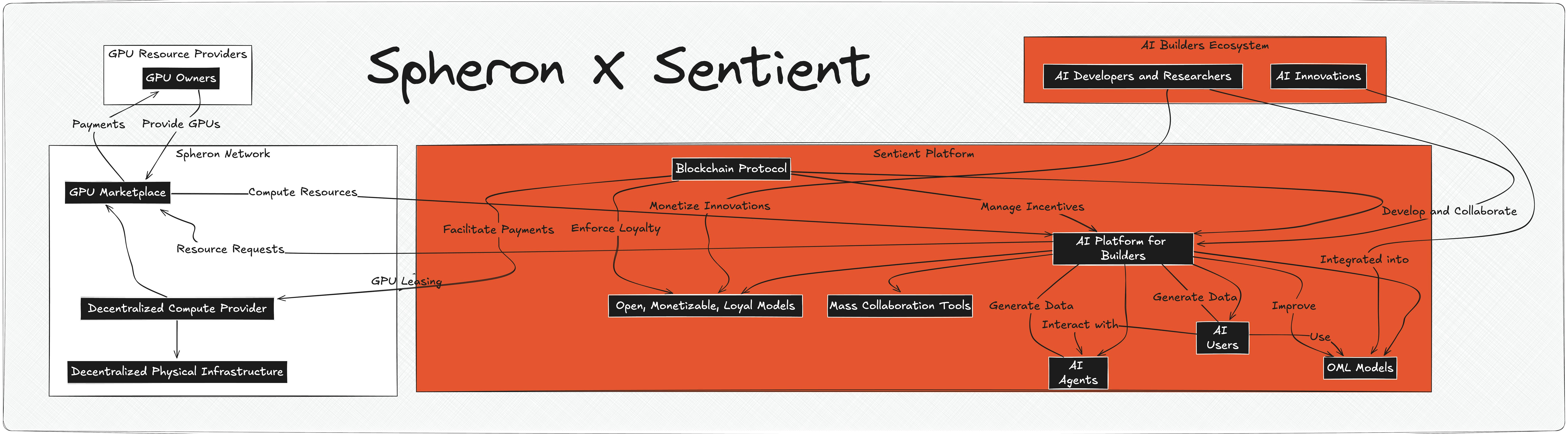
Sentient is building an AI platform for builders to collaborate and monetize innovations. AI builders are this economy’s workhorses and principal actors, innovating and collaborating to build powerful new AI offerings. The underlying blockchain protocol and incentive mechanism provide the necessary economic alignment for the evolution of Open AGI in this collective offering.

For all this to work, the powerful AI models hosted on Sentient must be Open, Monetizable, and loyal (OML)—“loyal” models remain aligned with the community that built them, enforced by the underlying blockchain protocol.

Sentient has pioneered a new and ambitious field in AI research using OML models. OML models will drive a shared Open AGI economy, supporting millions of AI agents and further downstream applications for billions of AI users.

Beyond introducing this new format, The platform will enable mass collaboration and discussion through the systems the Sentient team is working on. Sentient building the tools for a new era of technology, finance, and society.

image

A Platform for Agents and Humans: The next generation of AI can reason, plan, and act strategically. This AI will be built using new innovative agents and learning from interactions between these agents, underlying models, and humans. The Sentient AI platform will enable the community and the AI they built to participate and learn from these interactions, with the underlying blockchain protocol ensuring everyone is incentive-aligned.

The Sentient Foundation

The Sentient Foundation is a non-profit organization supporting the development and growth of open-source AI technologies. The Sentient Foundation aims to create a decentralized, transparent, open AI landscape. It is dedicated to creating a new Open AGI economy where the AI builder is the principal actor and a significant stakeholder. It will provide the necessary infrastructure and resources to create this economy and ensure that the AI revolution benefits all of humanity. By promoting the development of Open Monetizable Loyal (OML) Models, the foundation will counter the rent-seeking behavior of centralized AI companies and usher in a collaborative ecosystem where diverse contributions are valued and rewarded.

Sentient Foundation Committee

NameRoleBackground

Pramod ViswanathResearchForrest G. Hamrick Professor of Engineering at Princeton University

Himanshu TyagiTechnologyProfessor of Engineering at the Indian Institute of Science

Sandeep NailwalStrategyFounder at Polygon

SensysGrowthVenture studio creating advanced products and applications for Sentient

Sentient Foundation Contributors

NameRoleBackground

Sewoong OhAI ResearchProfessor of Computer Science at the University of Washington

Sai KrishnaPlatformSVP of Platform at Polygon

Yihan JiangAI ResearchAI and Communications Research, University of Washington

Zerui ChengAI ResearchAI and Blockchains Research, Princeton University

Oleg GolevAI ResearchComputer Science, Princeton University

Edoardo ContenteAI ResearchDeep Learning / ML, Princeton University

Ramakrishna VenkataramanEngineeringData Architech @ IBM, Tech Fellow Goldman Sachs

Anshul NaseryAI ResearchPhd @ U of Washington, Prev Google Research, IIT

Mit DaveAI EngineerFull stack engineer, Flipcart

Jonathan HayaseAI ResearchCS Phd @ U of Washington

Ben Tsengel FinchProductElectrical and Computer Engineering, Princeton University

Sentient’s $85 Million Seed Round

Sentient successfully closed an $85 million seed funding round, a significant milestone in the Sentient mission to build an open, community-driven AGI platform. This round was co-led by Founders Fund, the renowned venture capital firm founded by Peter Thiel, alongside Pantera Capital and Framework Ventures.

This round included contributions from a diverse array of forward-thinking funds and organizations, including:

Founders Fund, Pantera Capital, Framework Ventures, Ethereal, Robot Ventures, Symbolic Capital, Dao5, Delphi, Primitive Ventures, Nomad, Hack VC, Arrington Capital, Hypersphere, IDG, Topology, Protagonist, Folius, Sky9, Canonical Crypto, Dispersion Capital, Mirana, Foresight, Hashkey, Spartan, Republic, Frontiers Capital

This incredible backing strengthens Sentient’s ability to accelerate the development of open AI and underscores the confidence these investors have in a future where AGI is community-built and owned. With this funding, Sentient will continue to expand its platform, empower AI builders, and bring innovative, ethical AI to the forefront of technology development.

The team looks forward to working closely with their investors as they build a decentralized, transparent, and collaborative AI economy that benefits all of humanity.

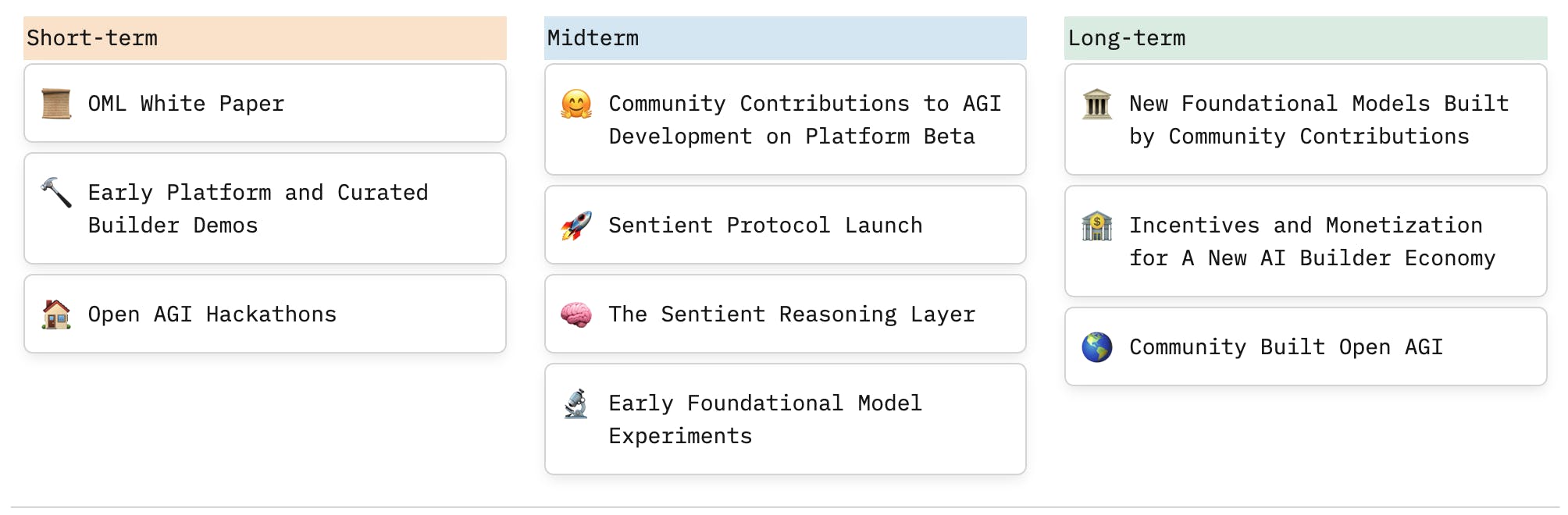
Sentient Product Roadmap

Join the Sentient Movement: How You Can Get Involved

There are several meaningful ways to become a part of Sentient’s mission and contribute to the development of open AGI. Whether you’re a developer, researcher, or AI enthusiast, here’s how you can join us:

Engage in Discussions: Dive into the conversations on the OpenAGI Discourse Forum and follow us on X (formerly Twitter). Share your insights, ideas, and feedback with fellow AI innovators and stay up-to-date with the latest developments.

Join the Sentient Community: Be among the first to experience Sentient by filling out the early access form. This will give you an inside look at the platform, where you can connect with other AI builders and collaborators.

Contribute to Model Development: Participate in calls for contributions to take an active role in shaping the future of AGI. Your expertise could directly impact the Sentient platform’s development of advanced AI models.

Attend the Open AGI Summit: Stay engaged with Sentient’s initiatives by following the Open AGI Summit, a community event where you can collaborate with leading minds in AI, learn from experts, and contribute to the broader discussion on AGI.

By becoming a part of Sentient, you’re not just joining a platform—you’re joining a movement to democratize AI development and ensure a future where AGI is community-built and aligned with humanity’s values.

Sentient X Spheron: Unite to Power the Open AGI Economy with Decentralized Compute

We are feeling incredible about announcing the partnership between Sentient and Spheron. Together, we will accelerate the future of AI development through decentralized, scalable infrastructure. This collaboration combines Sentient’s pioneering Open AGI platform and Spheron’s cutting-edge decentralized GPU leasing network, providing AI builders unparalleled access to the compute power necessary for training, running, and monetizing AI models.

Why This Partnership Matters

Sentient’s vision of an Open AGI Economy empowers AI developers and creators to build, collaborate, and monetize their innovations in a decentralized environment. The partnership with Spheron strengthens this mission by offering access to a decentralized compute marketplace, where developers can seamlessly lease powerful GPUs—ensuring the high performance needed to support OML (Open, Monetizable, Loyal) models and the vast network of AI agents operating on Sentient’s platform.

Spheron’s decentralized infrastructure not only lowers the cost barrier but also ensures the scalability and security that open-source AI developers need. By tapping into Spheron’s global network of GPUs, Sentient’s AI builders can now train more advanced models without relying on centralized, costly providers.

What This Means for AI Builders and the AGI Community

This collaboration opens up new possibilities for AI innovators by enabling them to access compute power on-demand directly from Spheron’s decentralized network, allowing them to focus on what they do best—creating revolutionary AI solutions. The sentient community will benefit from the following:

Scalable GPU resources for AI model training and deployment.

Cost-effective and secure compute infrastructure, decentralized and owned by the community.

Monetization opportunities are available through Sentient’s and Spheron’s platforms.

Sentient and Spheron are setting a new standard for how the next generation of AI will be developed—decentralized, open, and community-driven. We are excited to empower AI builders to push the boundaries of innovation, shaping the future of AGI for the benefit of all humanity.

Stay tuned for more updates on this exciting collaboration!


Source link

Uniswap Reveals Plans to Launch Ethereum Layer-2 Network Unichain – Decrypt

0
Uniswap Reveals Plans to Launch Ethereum Layer-2 Network Unichain – Decrypt


Leading Ethereum decentralized exchange Uniswap announced plans Thursday to launch its own layer-2 network called Unichain, which will be built on Optimism tech. Uniswap Labs framed the move as one to cut costs, improve transaction speeds, and boost liquidity across various chains.

“After years of building and scaling DeFi products, we’ve seen where blockchains need improvement and what’s required to continue advancing Ethereum’s roadmap,” said Uniswap Labs CEO Hayden Adams, in a release. “Unichain will deliver the speed and cost savings already enabled by L2s, but with better access to liquidity across chains and more decentralization.”

Editor’s note: This story is breaking and will be updated with additional detail.

Daily Debrief Newsletter

Start every day with the top news stories right now, plus original features, a podcast, videos and more.


Source link

Introducing Linea ENS Support in Hyperledger Web3j

0
Introducing Linea ENS Support in Hyperledger Web3j


Ethereum addresses, with their 42 characters, have become a hallmark of the web3 ecosystem. However, memorizing these long strings is nearly impossible for most users. The Ethereum Name Service (ENS) addresses this issue by offering a decentralized naming protocol on the Ethereum blockchain. 

As of July 30th, ENS domains are also available on Linea, the fastest-growing zkEVM on Ethereum. With the recent updates in Hyperledger Web3j, developers can now seamlessly integrate Linea ENS functionality into their Java applications. This makes it easier to interact with these human-readable domain names across the Ethereum ecosystem.

What is Linea ENS?

The adoption of ENS on Linea marks a significant milestone. Linea, a zkEVM Layer 2 blockchain, has implemented the EIP-3668 standard – CCIP Read, enabling efficient operation of ENS with lower gas costs and improved interoperability. Linea ENS domains take the format name.linea.eth and provide users with a human-readable alternative to their Ethereum addresses, all while ensuring high security and lower transaction costs. 

This system simplifies the user experience, reduces the likelihood of transaction errors, and increases accessibility. Users can switch their wallet address to a human-readable domain. Developers can use CCIP Read (ERC-3668) for cross-chain data retrieval. 

ENS Implementation in Linea

Linea Support in Hyperledger Web3j

Hyperledger Web3j, the Java library for interacting with Ethereum, now supports Linea ENS, thanks to recent updates. We have added the ENS registry contracts for both Linea Mainnet and Linea Sepolia testnet from their GitHub repository. 

This enhancement allows developers to seamlessly integrate Linea ENS functionality into their Java applications. It enables them to resolve all ENS names into addresses or reverse resolve addresses into Linea ENS domains. The inclusion of both the Linea Mainnet and Linea Sepolia testnet ensures that developers can test and deploy their applications across different environments with ease.

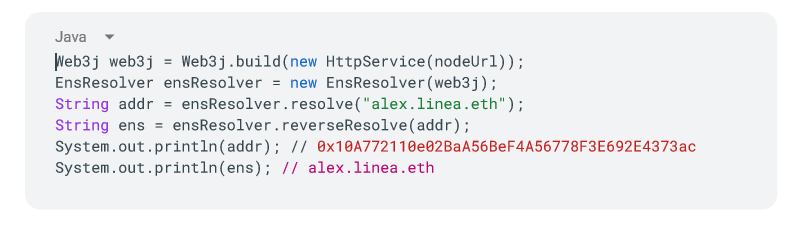
Code Example: Resolving Linea ENS with Hyperledger Web3j

Below is a simple example of how to use ENS on the Linea network using Hyperledger Web3j:

This code snippet demonstrates how to resolve a Linea ENS domain (alex.linea.eth) to its associated Ethereum address and then reverse resolve that address back to the ENS name. The functionality is available for both Linea Mainnet and Linea Sepolia testnet, ensuring full support for developers working across different stages of deployment.

For more details, you can check the pull request on GitHub.

Conclusion

The addition of Linea ENS support in Hyperledger Web3j, now an LF Decentralized Trust project, marks a significant step forward for developers looking to build on the Linea network. By enabling easier interaction with ENS domains on Linea, this update reduces complexity and fosters a more user-friendly experience within the Ethereum ecosystem.


Source link

Popular Posts

My Favorites