The collaboration focuses on establishing a repeatable, outcome-driven framework to evaluate impact with clarity and accountability
JERSEY CITY, NJ / ACCESS Newswire / March 2, 2026 / Amdocs (NASDAQ:DOX), a leading provider of software and services to communications and media companies, today announced a research collaboration with researchers from the Software Engineering Productivity Research Group at Stanford University. The collaboration will examine how large-scale integration of AI tools affects software engineering workflows in enterprise environments, with a focus on rigorous, evidence-based measurement of outcomes.
The research effort is designed to develop and refine methodological frameworks for evaluating AI’s impact on engineering productivity, code quality, and delivery performance. The goal is to contribute empirical insights that advance understanding of AI adoption in complex, real-world software systems.
“Access to enterprise-scale engineering environments allows us to rigorously test and improve scientific methods for measuring AI’s impact on software development,” said Yegor Denisov-Blanch of Stanford University. “Our objective is to generate generalizable insights that advance research and inform practice.”
“We are excited to collaborate with researchers at Stanford University to further substantiate the impact of generative AI,” said Anthony Goonetilleke, Group President of Technology and Head of Strategy at Amdocs. “Together, we are initiating a research collaboration to develop a measurement framework that connects AI-assisted engineering practices to outcomes leaders care about most, including delivery performance, quality, and sustainable ways of working, and that are more closely connected to business results.”
The research will be conducted in accordance with Stanford University policies and applicable regulations. The study uses de-identified engineering data and does not involve direct interaction with individuals as research participants. Stanford researchers retain academic independence, including the right to publish findings in accordance with university policies and applicable confidentiality requirements.
Supporting Resources
About Amdocs
Amdocs helps the world’s leading communications and media companies deliver exceptional customer experiences through reliable, efficient, and secure operations at scale. We provide software products and services that embed intelligence into how work runs across business, IT, and network domains – delivering measurable outcomes in customer experience, network performance, cloud modernization, and revenue growth. With our talented people, and more than 40 years of experience running mission-critical systems around the globe, Amdocs runs billions of transactions daily. Our technology is relied on every day, connecting people worldwide and advancing a more inclusive, connected world. Together, we help those who shape the future to make it amazing. Amdocs is listed on the NASDAQ Global Select Market (NASDAQ:DOX) and reported revenue of $4.53 billion in fiscal 2025. For more information, visit http://www.amdocs.com.
Amdocs’ Forward-Looking Statement
This press release includes information that constitutes forward-looking statements made pursuant to the safe harbor provision of the Private Securities Litigation Reform Act of 1995, including statements about Amdocs’ growth and business results in future quarters and years. Although we believe the expectations reflected in such forward-looking statements are based upon reasonable assumptions, we can give no assurance that our expectations will be obtained or that any deviations will not be material. Such statements involve risks and uncertainties that may cause future results to differ from those anticipated. These risks include, but are not limited to, the effects of general macroeconomic conditions, prevailing level of macroeconomic, business and operational uncertainty, including as a result of geopolitical events or other regional events or pandemics, changes to trade policies including tariffs and trade restrictions, as well as the current inflationary environment, and the effects of these conditions on the Company’s customers’ businesses and levels of business activity, including the effect of the current economic uncertainty and industry pressure on the spending decisions of the Company’s customers. Amdocs’ ability to grow in the business markets that it serves, Amdocs’ ability to successfully integrate acquired businesses, adverse effects of market competition, rapid technological shifts that may render the Company’s products and services obsolete, security incidents, including breaches and cyberattacks to our systems and networks and those of our partners or customers, potential loss of a major customer, our ability to develop long-term relationships with our customers, our ability to successfully and effectively implement artificial intelligence and Generative AI in the Company’s offerings and operations, and risks associated with operating businesses in the international market. Amdocs may elect to update these forward-looking statements at some point in the future; however, Amdocs specifically disclaims any obligation to do so. These and other risks are discussed at greater length in Amdocs’ filings with the Securities and Exchange Commission, including in our Annual Report on Form 20-F for the fiscal year ended September 30, 2025, filed on December 15, 2025, and for the first quarter of fiscal 2026 on February 3, 2026.
Media Contacts
Swati SharmaAmdocs Public RelationsE-mail: [email protected]
SOURCE: Amdocs Management Limited
About Web3Wire Web3Wire – Information, news, press releases, events and research articles about Web3, Metaverse, Blockchain, Artificial Intelligence, Cryptocurrencies, Decentralized Finance, NFTs and Gaming. Visit Web3Wire for Web3 News and Events, Block3Wire for the latest Blockchain news and Meta3Wire to stay updated with Metaverse News.
U.S. Central Command reportedly used Anthropic’s Claude for intelligence assessments, target identification, and battle simulation during the Iran strikes.
Experts warn the six-month phase-out timeline understates the true cost of replacing an AI model embedded across classified defence pipelines.
OpenAI made a deal with the Pentagon following Anthropic’s fallout.
Hours after President Donald Trump ordered federal agencies to halt use of Anthropic’s AI tools, the U.S. military carried out a major airstrike on Iran that reportedly relied on the company’s Claude platform.
U.S. Central Command used Claude for intelligence assessments, target identification, and simulating battle scenarios during the Iran strikes, people familiar with the matter confirmed to the Wall Street Journal on Saturday.
It came despite Trump’s directive on Friday that agencies begin a six-month phase-out of Anthropic products following a breakdown in negotiations between the company and the Pentagon over how the latter can use commercially developed AI systems.
Decrypt has reached out to the Department of Defense and Anthropic for comment.
]]>
“When AI tools are already embedded in live intelligence and simulation systems, decisions at the top don’t instantly translate to changes on the ground,” Midhun Krishna M, co-founder and CEO of LLM cost tracker TknOps.io, told Decrypt. “There’s a lag—technical, procedural, and human.”
“By the time a model is embedded across classified intelligence and simulation systems, you’re looking at sunk integration costs, retraining, security re-certifications, and parallel testing, so a six-month phase-out may sound decisive, but the real financial and operational burden runs far deeper,” Krishna added.
“Defense agencies will now prioritize model portability and redundancy,” he said. “No serious military operator wants to discover during a crisis that its AI layer is politically fragile.”
Anthropic CEO Dario Amodei said Thursday the company would not strip safeguards preventing Claude from being deployed for mass domestic surveillance or fully autonomous weapons.
“We cannot in good conscience accede to their request,” Amodei wrote, after the Defense Department demanded contractors allow their systems for “any lawful use.”
“The Leftwing nut jobs at Anthropic have made a DISASTROUS MISTAKE trying to STRONG-ARM the Department of War,” Trump later wrote on Truth Social, ordering agencies to “immediately cease” all use of Anthropic products.
Defense Secretary Pete Hegseth followed, designating Anthropic a “supply-chain risk to national security,” a label previously reserved for foreign adversaries, barring every Pentagon contractor and partner from commercial activity with the company.
Anthropic called the designation “unprecedented” and vowed to challenge it in court, saying it had “never before publicly applied to an American company.”
The company added that, to its knowledge, the two disputed restrictions had not affected a single government mission to date.
“The debate isn’t about whether AI will be used in defense, that’s already happening,” Krishna added. “It is whether frontier labs can maintain differentiated guardrails once their systems become operational assets under ‘any lawful use’ contracts.”
OpenAI moved quickly to fill the gap with CEO Sam Altman announcing a Pentagon deal on Friday night covering classified military networks, claiming it included the same guardrails Anthropic had sought.
Yesterday we reached an agreement with the Department of War for deploying advanced AI systems in classified environments, which we requested they make available to all AI companies.
We think our deployment has more guardrails than any previous agreement for classified AI…
— OpenAI (@OpenAI) February 28, 2026
Asked whether the Pentagon’s effective blacklisting of Anthropic set a troubling precedent for future disputes with AI firms, OpenAI CEO Sam Altman responded on X, “Yes; I think it is an extremely scary precedent, and I wish they handled it a different way.
“I don’t think Anthropic handled it well either, but as the more powerful party, I hold the government more responsible. I am still hopeful for a much better resolution,” he added.
Meanwhile, nearly 500 employees from OpenAI and Google signed an open letter warning that the Pentagon was attempting to pit AI companies against each other.
Daily Debrief Newsletter
Start every day with the top news stories right now, plus original features, a podcast, videos and more.
BEIJING, CHINA / ACCESS Newswire / March 1, 2026 / OpenClaw has rapidly become the foundational infrastructure for autonomous AI agents, gaining significant traction among leading AI researchers and enterprise developers. However, scaling an open-source project from a trending GitHub repository to a production-ready platform requires rigorous infrastructural engineering. Today, Yinghao Sang, a highly specialized AI Engineer and former Kling AI developer, announced a major milestone as his independent contributions secured his position among the top 50 all-time contributors to OpenClaw. His definitive work focuses on resolving the framework’s critical early-stage architectural bottlenecks.
It is one thing to build an experimental AI tool; it is another to ensure it survives high-concurrency enterprise traffic. Sang brings a unique combination of academic rigor-drawing on advanced AI principles from his ongoing Master of Science in Engineering (MSE-AI) studies at the University of Pennsylvania-and massive-scale distributed systems experience to the open-source community. Operating as a leading independent contributor, he functioned as a critical infrastructure optimization expert, diagnosing edge cases that only surface under extreme production stress.
His engineering contributions targeted three main friction points that typically block corporate adoption. First, Sang resolved a deep-seated state inconsistency bug within the framework’s instruction runtime. He optimized the context evaluation logic to ensure custom agent workflows maintain instruction fidelity during extended operations, a crucial requirement for enterprise automation.
Second, he tackled silent data loss in OpenClaw’s multi-modal pipelines. Recognizing that voice and media processing are vulnerable to localized network jitter, Sang integrated custom exponential backoff logic and fortified context-thread targeting. This system-level overhaul decisively mitigated data drops and improved multi-modal delivery rates, keeping the framework stable in degraded network environments.
Finally, Sang patched an underlying gateway vulnerability where system reboots caused cross-channel context leaks-a major security red flag. Alongside this, he optimized the CLI lifecycle to prevent memory-draining process hangs. These foundational fixes ensured strict data isolation and prevented systemic exhaustion during distributed deployments, directly contributing to a more secure infrastructure.
“The true test of any autonomous AI infrastructure is how it handles edge cases and network degradation under continuous load,” Yinghao Sang explained regarding his engineering approach. “By implementing strict fault-tolerance mechanisms and routing integrity at the gateway level, we transition these frameworks from fragile laboratory experiments into resilient, enterprise-grade standards. Securing these open-source frameworks is not just a technical challenge; it is critical for enterprise data security and the robust deployment of AI infrastructures across industries.”
Sang’s work underscores the reality of modern AI development: advanced generative models rely entirely on the strength of the distributed systems running them. His foundational interventions remain embedded in OpenClaw’s architecture, providing the stability required for its broad industry adoption and furthering the advancement of secure AI technologies.
About Yinghao Sang
Yinghao Sang is a specialized Artificial Intelligence Engineer focusing on hyper-scale distributed systems, multi-modal pipelines, and AI infrastructure. Currently serving as an AI Engineer at a leading global technology company, with previous engineering experience at Kling AI, he is an MSE-AI candidate at the University of Pennsylvania. He is globally recognized as a leading independent contributor to the OpenClaw AI framework based on objective GitHub commit metrics.
Media Contact:
Company Name: Independent AI ResearcherMedia Contact Person: Yinghao SangEmail: [email protected]Phone: +86 17616016657Social Media Link: https://www.linkedin.com/in/yinghaosang
SOURCE: Independent AI Researcher
About Web3Wire Web3Wire – Information, news, press releases, events and research articles about Web3, Metaverse, Blockchain, Artificial Intelligence, Cryptocurrencies, Decentralized Finance, NFTs and Gaming. Visit Web3Wire for Web3 News and Events, Block3Wire for the latest Blockchain news and Meta3Wire to stay updated with Metaverse News.
Last month, a security researcher found 300 million messages from 25 million users sitting in a publicly accessible database. No hack. Just a misconfigured backend on a wrapper chatbot built on top of Claude, ChatGPT, and Gemini.
Medical questions, legal discussions, personal confessions, all of it free for the taking. The worst part? It wasn’t even an attack. Just negligence.
It’s enough to give those concerned about privacy a scare, and then there’s the more deliberate stuff some companies are doing: LinkedIn quietly opted users into AI training. Google flipped Gmail access on by default for its AI model Gemini. Meta cited “legitimate interest” to train on years of EU users’ Facebook posts. A court ordered OpenAI to preserve all ChatGPT logs—including deleted ones—for legal discovery.
]]>
As Moxie Marlinspike, the cryptographer who built the privacy-focused messaging app Signal, put it: using mainstream AI is like confessing to a “data lake.”
So if you still want AI in your life—and many of you probably do—here are some tools that at least make a serious effort to keep your data private.
Confer: What if Signal was a chatbot?
Moxie Marlinspike developed Signal so users could have privacy in the middle of the Web 2.0 revolution. Confer, his AI project launched in December 2024, is the logical continuation now that interactions with AI are found everywhere on the internet.
With Confer, your message encrypts on your device before it goes anywhere. It then travels to a Trusted Execution Environment: a hardware-isolated vault on the server that even Confer’s own engineers cannot access or read. The response comes back encrypted. The entire codebase is open source and verifiable. Anyone can check that what’s actually running on the servers matches what’s published.
That last part is called remote attestation. It’s a big deal. It means you don’t have to trust their privacy policy; you can verify the architecture itself.
No chat logs. No training. No advertising. No data stored after your session ends.
Confer requires an account but supports alias emails and uses passkeys (Face ID, Touch ID, device PIN) instead of passwords, so your encryption keys never leave your device. The free tier gives you 20 messages a day; paid is $34.99 a month, which is expensive. The trade-off is real: The AI quality is decent but not at the level of GPT-5 or Claude Opus, and there’s no image generation, no file uploads, no character modes, no web search, no agents. It’s a chatbot, and that’s it. But for the things you’d normally type into a therapist’s notes or a lawyer’s email, this is currently one of the safer alternatives.
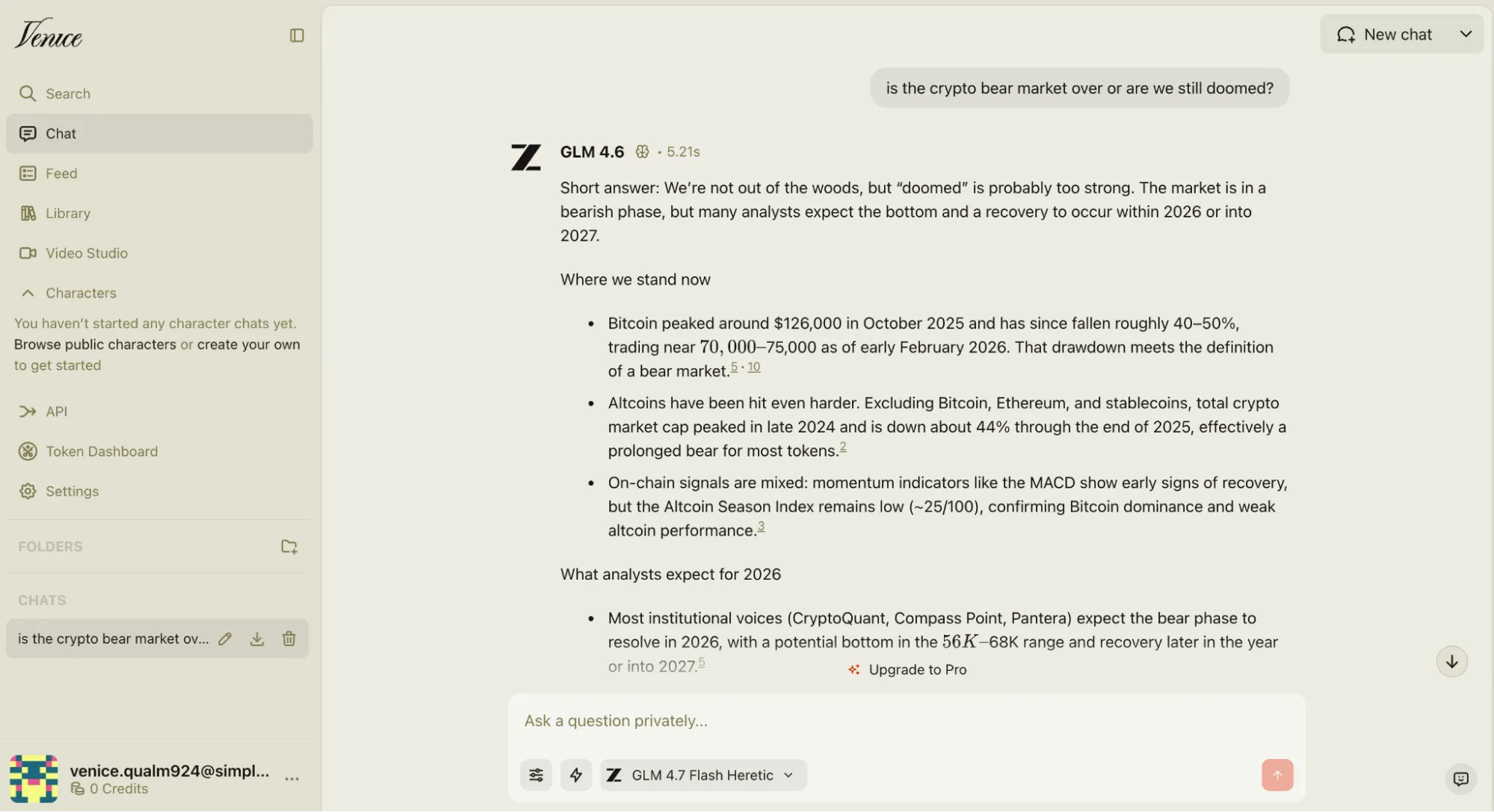
Venice: The one that actually has features
Founded by privacy advocate and Bitcoin OG Erik Voorhees, Venice is where you go when you want Confer-level privacy but also want a wider range of capabilities beyond simple text chats.
The key mechanic: your chat history lives in encrypted local browser storage on your device. Venice says it cannot access your conversation content. If they get subpoenaed, they have nothing to hand over. That’s a meaningful guarantee, not just a policy checkbox.
One good thing is you can use Venice as a guest without an account. Alias emails work for signup. Passkeys are supported, though our account creation flow had a few hiccups in testing before it clicked.
Feature-wise, it’s legitimately stacked: Wide model selection including open-source and uncensored models; Sora-level video generation through a credit system; image generation; a “characters” feature for roleplay and persona-based interactions; the ability to set up custom system prompts; and web search.
For anyone who wants most of what ChatGPT Plus offers without OpenAI reading every word, Venice is probably the answer.
Lumo: Proton’s AI, and that alone says a lot
Proton has been building encrypted infrastructure since 2014. Lumo is their AI assistant, and it carries the same philosophy: zero-access encryption, no training on your data, no third-party data sharing.
There’s an auto-destroy setting that wipes your chats when you log out. File uploads work natively with Proton Drive, which no other AI tool allows. Web search is a toggle.
It also runs on Proton’s own model, not a third-party API.
It’s not feature-rich, though. There’s no image generation, no model selection, no character modes. But it’s clean. It’s E.U.-based and GDPR compliant, it works nicely, and the company behind it has a decade-long track record of not selling you out. For someone already in the Proton ecosystem, it’s an obvious add.
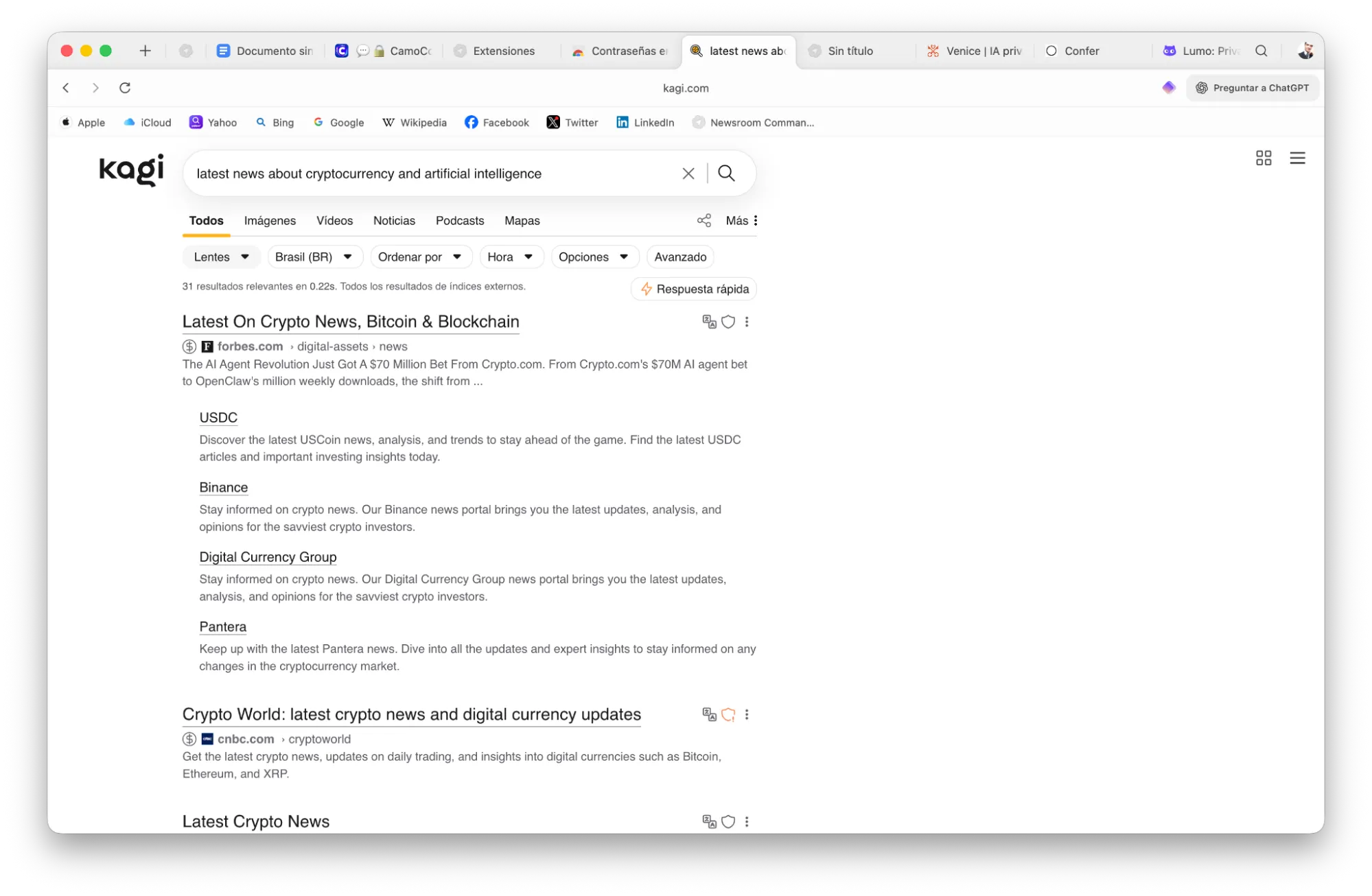
Kagi: Not an assistant, but your new default search
Kagi is a search engine, not a chatbot. And that’s a feature, not a bug.
You pay a subscription, and in return, it doesn’t track your clicks, doesn’t run ad networks, and doesn’t build a behavioral profile on you. The results look like Google (actual links, actual URLs) instead of the Perplexity/ChatGPT model that tries to answer everything so you never visit the original source.
The Kagi Assistant feature is pretty clever. You pick a source and ask the assistant questions. The AI answers exclusively based on that site. We tested it and got a seven-URL briefing on the crypto bear market, all sourced from Decrypt, formatted like a Perplexity summary but scoped entirely to one domain.
Kagi says neither it nor its LLM providers train on your assistant data. Threads delete after 24 hours by default. An account is required, but alias emails also work.
If you’re a journalist, researcher, or anyone who reads a lot and hates being profiled for it, Kagi belongs in your stack.
Also, the fact that it works as a Google-like search engine that provides links instead of briefings means that it’s less prone to hallucinations.
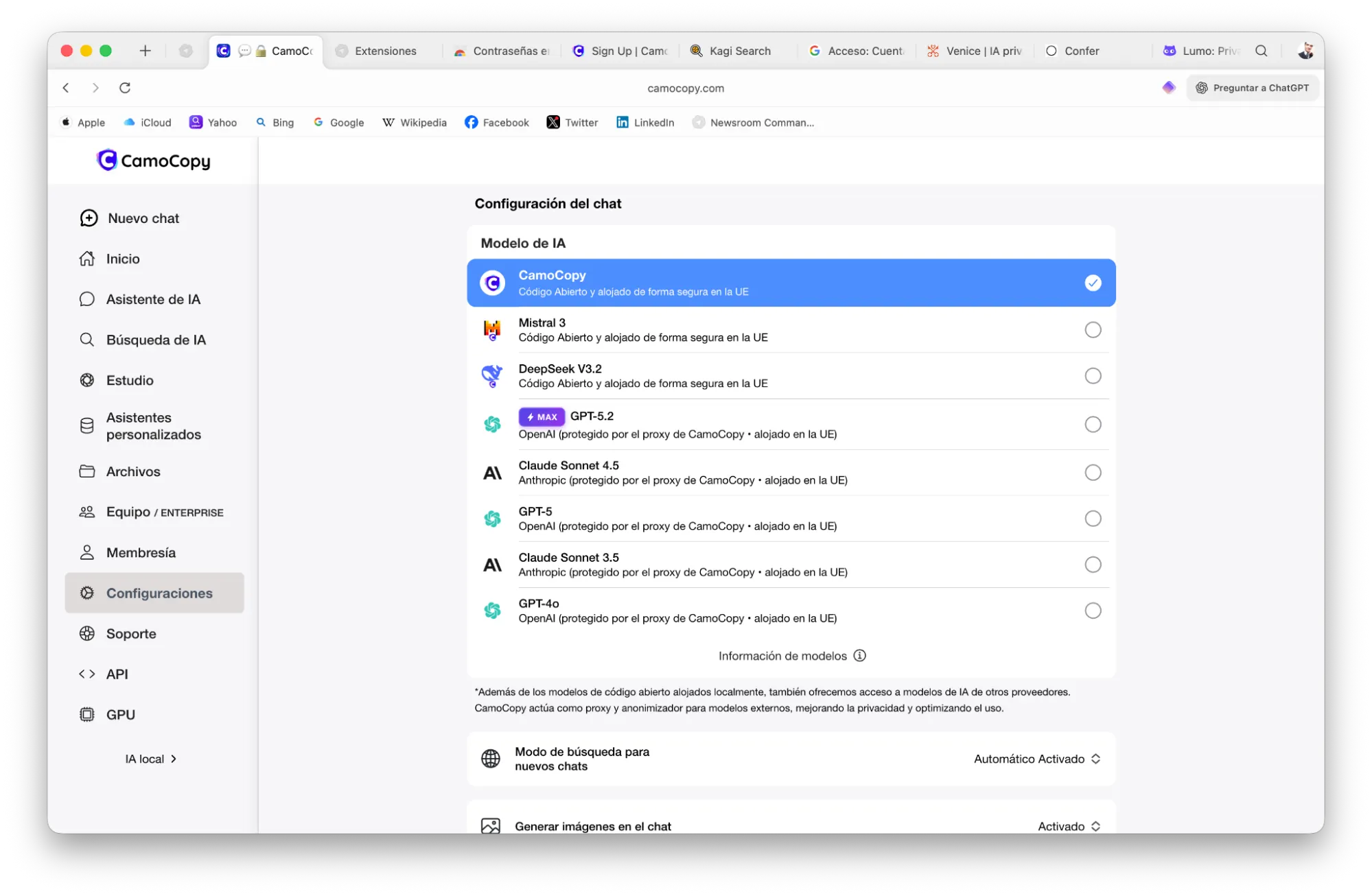
CamoCopy: European-routed, feature-complete, and honest about the tradeoffs
CamoCopy is a German-built AI platform that routes your Claude and ChatGPT requests through E.U. infrastructure, under GDPR constraints. The argument is that this makes those interactions legally unusable for training by the upstream providers.
It’s got the full suite: custom assistants (think GPTs), deep research agents, web search, image generation, wide model selection. You can even rent GPU access to run local models through the platform, which is a serious privacy upgrade over cloud-only options.
Again, an account is required, but alias emails work for signup here too.
There’s a caveat worth pointing out: CamoCopy is a wrapper. The 300-million-message leak mentioned at the top of this article happened to a wrapper app. The E.U. routing and no-training policy are better than most, but the surface area is bigger. The privacy promise lives at the policy level. By contrast, Confer’s promise lives at the architectural level. Those are different things.
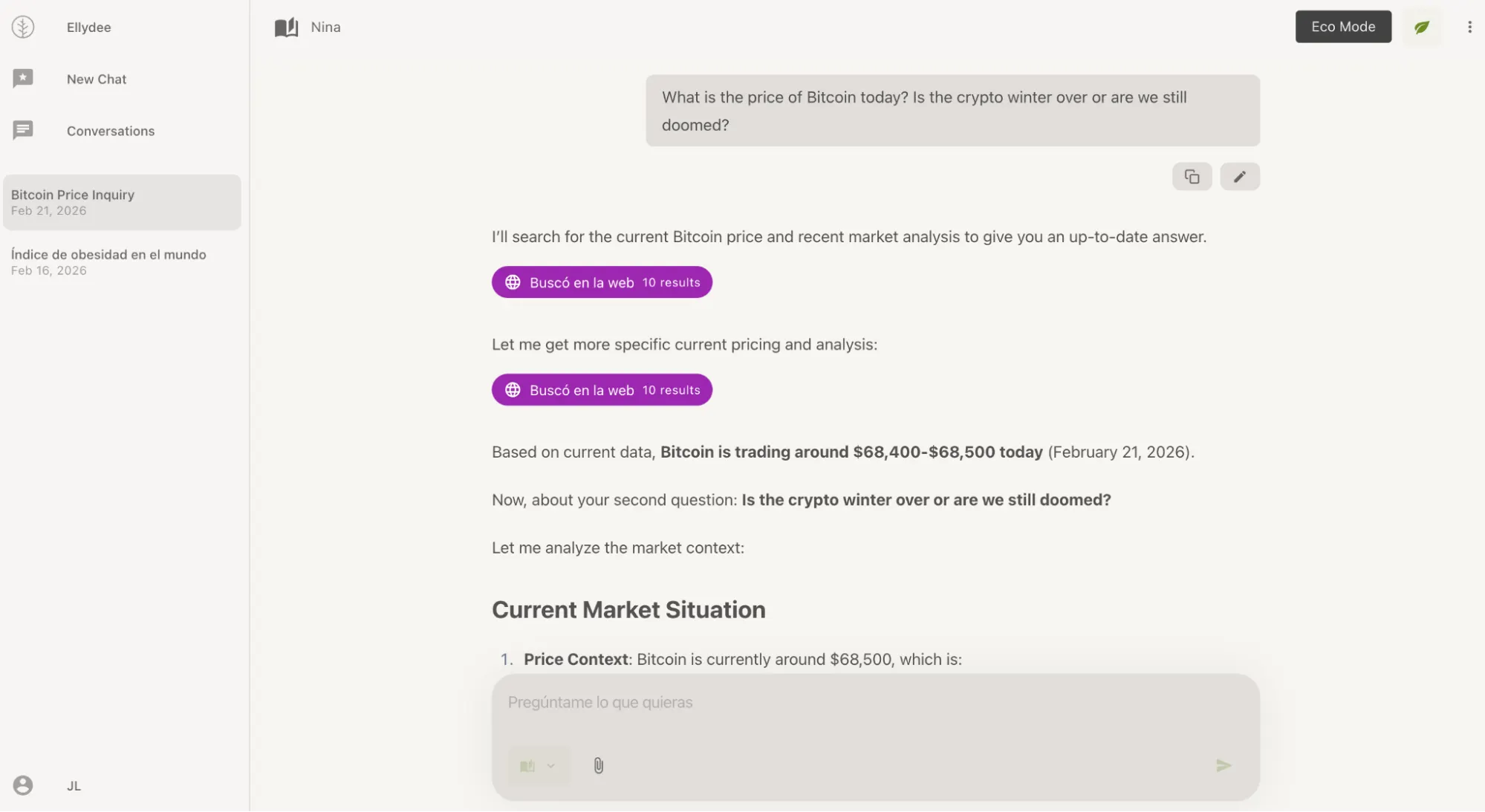
Ellydee: Great on paper, rocky in practice, good for environmentalists
Ellydee is a Canadian-built assistant that routes requests through 100% renewable energy data centers. Good for the planet, and it’s solid branding.
The privacy policy is aggressive: no prompts stored, no training, no data retained beyond temporary IP logs for security, full account deletion within 24 hours. It has iOS and Android apps, its own model or finetune called Brightside, web search, an image editor, a character creator, and several distinct modes for different writing contexts.
It also has a pretty active community on Reddit which makes it easier to share tips, interact with other enthusiasts, and improve user practices.
Ellydee doesn’t use passwords by default, instead it sends a fresh code to your email each time. In testing, the system sent a new code, then rejected it, effectively forcing us to login through a Google or Apple account to bypass the bug. That’s a frustrating irony for a privacy-first product.
If you’re committed to alias-only, no-OAuth access, it requires patience. The promises are there. The engineering still needs to catch up.
xPrivo: The open-source option for people who want control
xPrivo is open-source, and you can self-host it. That’s the headline.
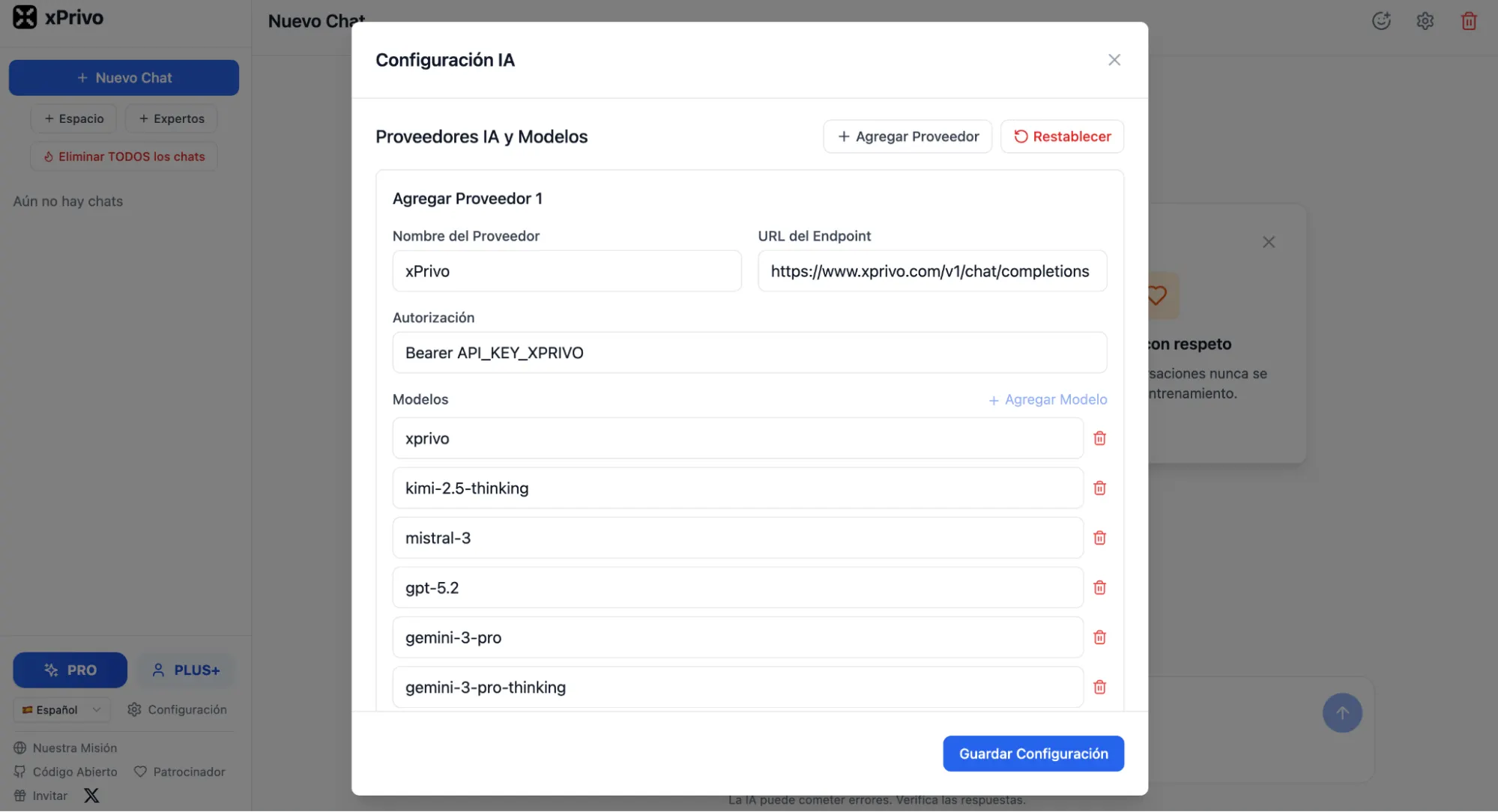
The free tier includes Mistral 3 and xPrivo’s own model. Paid unlocks Kimi K 2.5 with reasoning, Gemini 3 Pro with and without reasoning, and GPT-5.2. You can add your own API endpoints, which means you can plug in a locally running model and keep everything off their servers entirely. Web search and archive uploads are both supported.
The “experts” feature is a set of domain-specific system prompts for things like legal research, coding, and medical questions. A custom system prompt option gives you full control over AI behavior. A personalization feature shapes how it responds to you generally.
The privacy promise holds strongest when you self-host and connect a local model. Nothing leaves your machine. When you route to Gemini or GPT-5.2 through their API, you’re back to those providers’ data terms. xPrivo is the interface, not the model. The weakest link still applies.
If you know what an API endpoint is and you’re okay setting things up yourself, xPrivo gives you the most flexibility of anything on this list.
Internxt AI: A (way too) simple bet on anonymity
You’ve probably heard of Internxt as a cloud storage provider, which started as a crypto project back when it was cool to start a crypto project. The Spanish company, based in Valencia, has been building GDPR-native, quantum-resistant, end-to-end encrypted infrastructure since 2020. In December 2025, they added an AI chatbot to the stack.
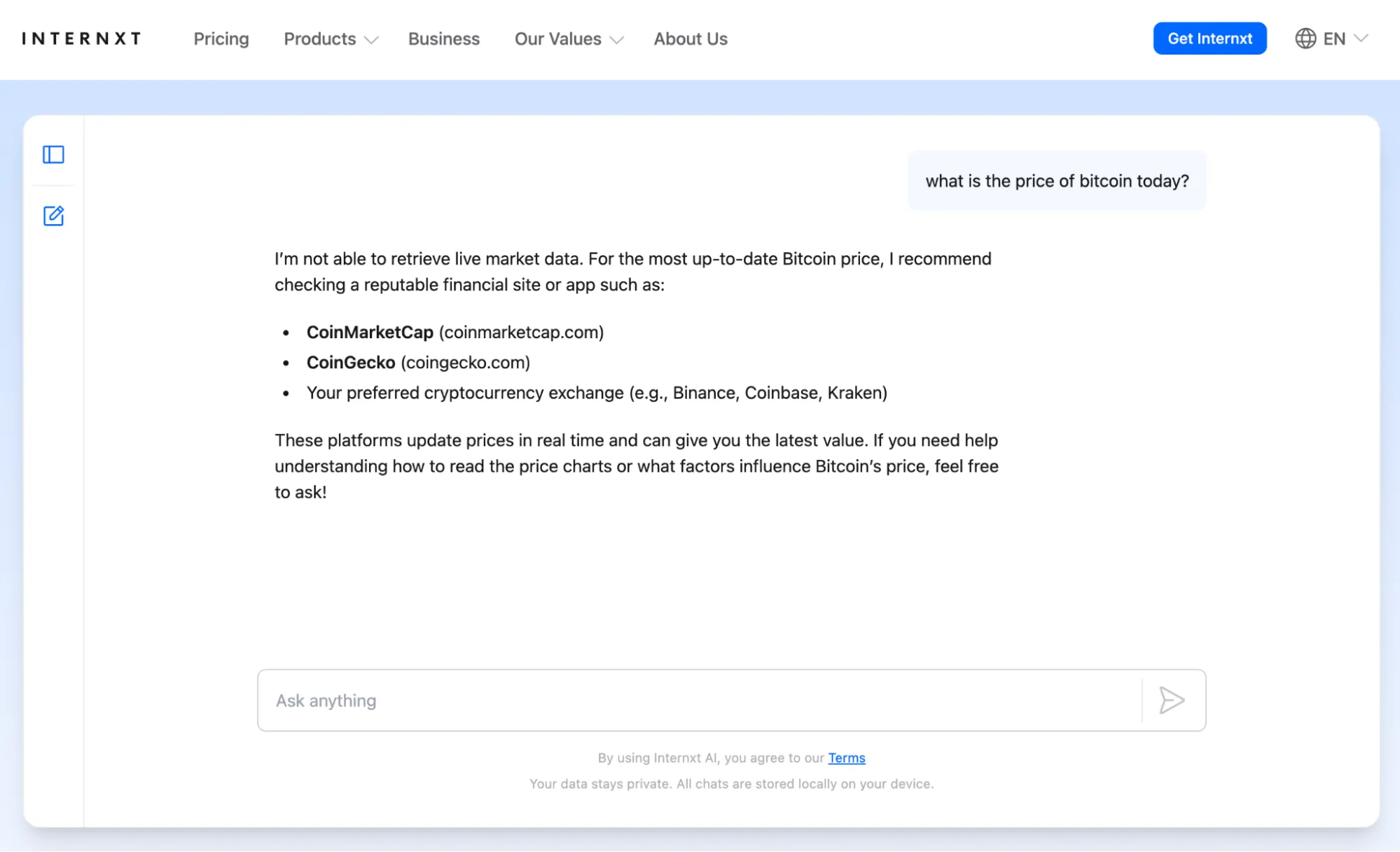
The pitch is simple and it works: no registration required. You open the site and start chatting. No email. No account. No trace linking you to the session.
Internxt claims zero-access encryption and no server-side chat logs—the same architecture philosophy that made their storage product credible. The codebase is open source, and E.U. server jurisdiction applies throughout.
The catch is equally simple: It’s way too basic. So basic it feels like a product built to simply catch some of the AI hype. No web search, no image generation, no model selection, no agents, no file uploads. It’s a clean text box with a privacy-first AI behind it. That’s it.
As a standalone daily driver, it won’t replace anything on this list. But as a tool to spin up an anonymous session when you need one (no account, no footprint), there’s nothing simpler.
Duck.ai (DuckDuckGo): The one normies will actually use
DuckDuckGo has been the default “I don’t want Google tracking me” search engine for over a decade. Duck.ai is what happens when they apply the same logic to chatbots.
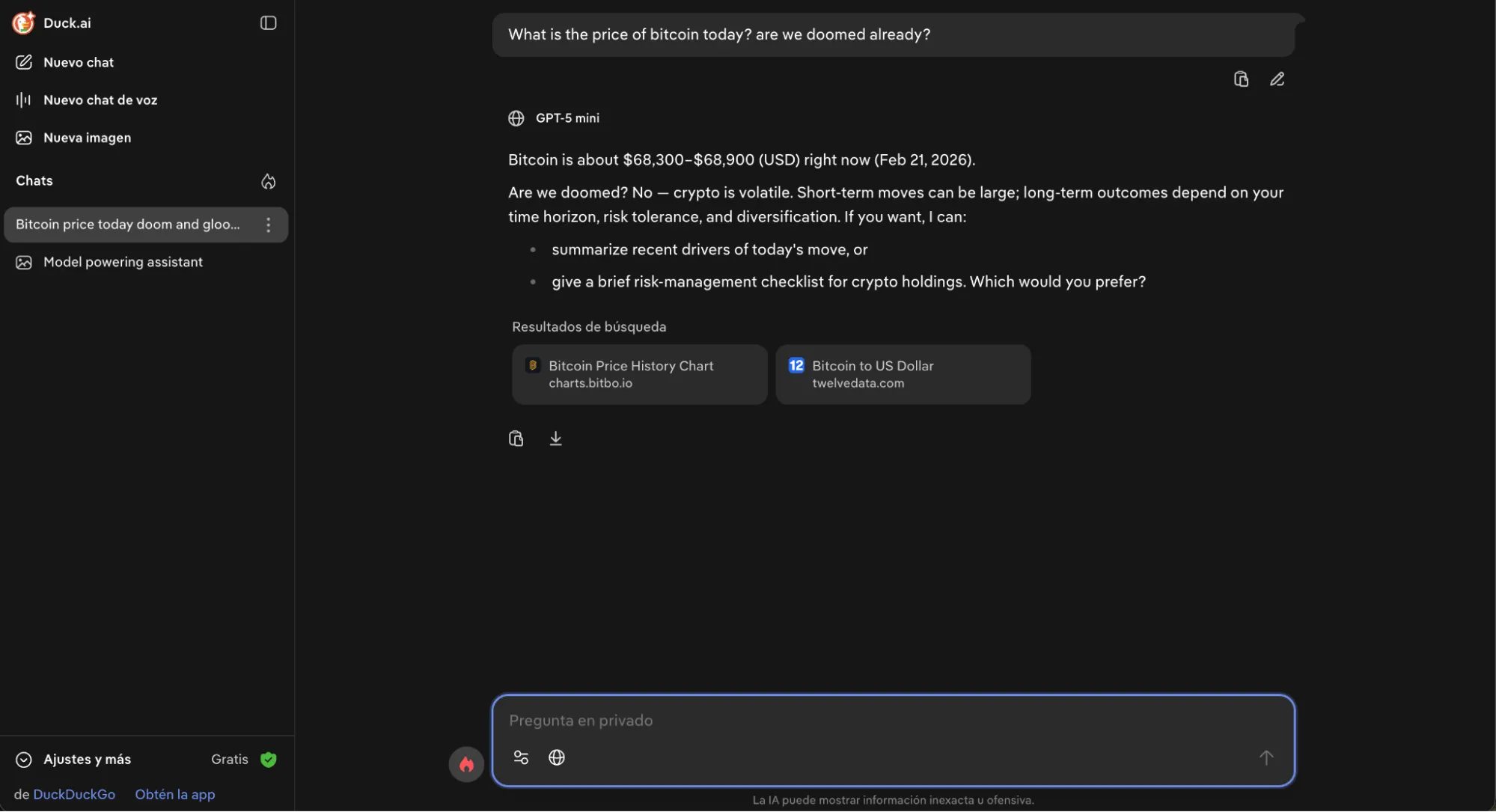
The mechanic is called proxying. When you send a message, DuckDuckGo strips your IP address, swaps it with their own, and forwards the request to the underlying model—Claude, GPT-4o, Llama, Mistral, take your pick. The AI provider sees a request from DuckDuckGo, not from you. They also have contractual agreements with all providers requiring deletion of received data within 30 days.
There’s no account required for the free tier and no registration. You open the site and start chatting. Recent chats save locally on your device, not on their servers. There’s a “Fire Button” that wipes everything in one click, which is either practical or extremely satisfying depending on your personality.
The free tier gives you access to Claude 3.5 Haiku, Llama 4 Scout, Mistral Small, and GPT-4o mini. The paid subscription ($10/month, which also includes a VPN and identity theft protection) unlocks GPT-5.1, Claude, Llama 4, Mistral GPT OSS, and even GPT-4o—which is a “yay!” for those who already mourn its deprecation by OpenAI. Image generation is available, and in January 2026 it added voice chat—also proxied and also not retained after the session ends.
There’s one downside: DuckDuckGo is U.S.-based, which means U.S. law applies. The proxying model is solid, but it’s still a policy and contractual arrangement—not an architectural guarantee like Confer’s TEE. You’re trusting that DuckDuckGo and its provider agreements hold up.
That said, for most people who want meaningfully better privacy than ChatGPT but aren’t running a whistleblower operation, Duck.ai is a very easy on-ramp. No setup. No account. Free. And it works.
Who wins for your specific situation
Privacy is a broad term, and all these models can be good enough if you just want some level of confidentiality. However depending on your specific needs, there may be platforms that beat others. Remember: This list is for people who put privacy over anything else. For this group, a dumb AI model with strong anonymity and privacy is more valuable than a ChatGPT membership.
Ideally, you should not depend on a single service. Use different providers depending on your needs. Here are some ideas:
Most people (privacy + sanity): Kagi for search. Lumo for daily assistant work. Simple, trusted, no rabbit holes. Venice for a feature rich ChatGPT substitute with options for creative work. Duck AI if you like the browser.
Privacy freaks: Confer for anything sensitive like sources, legal questions, etc. xPrivo with a self-hosted local model for day-to-day drafting that must not leave your machine. Kagi when you need web retrieval and accept the API call tradeoff.
Ideally, a fully self-hosted AI assistant using oLlama or LMStudio is the best option. You can generate images with Z-images, videos with Wan, reasoning with Deepseek R1 or Minimax, NSFW roleplay with an abliterated (stripped of censorship) LLM and all that offline. For research or online functionality, you can use an MCP server with a local model that supports it, use a system VPN and remain as anonymous as you can be.
Privacy policies are usually just marketing until something goes wrong. The best protection isn’t trusting a good privacy policy. It’s choosing tools where even a misconfiguration or the scariest of the subpoenas can’t expose what was never stored.
Daily Debrief Newsletter
Start every day with the top news stories right now, plus original features, a podcast, videos and more.
HONG KONG, HK / ACCESS Newswire / March 1, 2026 / Oukitel, a global leader in outdoor technology, is revolutionizing the industry with groundbreaking devices designed to exceed users’ highest expectations and drive a more sustainable future. At MWC 2026, the world’s premier tech showcase, Oukitel will unveil its latest all-in-one devices, engineered to conquer any challenge in every scenario.
Among Oukitel’s highlights, the WP61 series stands out with its top-tier satellite communication, keeping users connected while rewriting the rules of mobile technology. The RG14-P solar-powered laptop delivers uninterrupted productivity, even in the toughest outdoor conditions. The high-capacity P5000 Pro power station ensures resilient, long-lasting power from off-grid expeditions to home backup. Don’t miss the opportunity to experience the pioneering technologies firsthand at Booth 7F46 from March 2 to March 5, 2026.
Oukitel WP61 Series: The Next Generation of Professional Rugged Innovation
At the forefront of mobile innovation, the WP61 series is the world’s first rugged professional flagship to seamlessly combine satellite, thermal imaging, and walkie-talkie technologies. With cutting-edge NTN two-way satellite connectivity, the lineup ensures users stay connected in even the most extreme environments, providing unparalleled reliability and safety.
The WP61 series’s DMR walkie-talkie enables real-time communication, empowering users to coordinate efficiently during industrial operations, rescue missions, or outdoor adventures. Equipped with industry-leading thermal technology with a 256×192 resolution, it reveals heat signatures with exceptional precision, helping users identify potential hazards during security, maintenance, and inspection tasks. Additionally, this series packs a massive 20,000mAh battery, supporting 45W fast charging and reverse charging.
Oukitel RG14-P: Pioneers Sustainable Productivity with Solar-Powered Technology
The RG14-P is shaping the future of sustainable productivity as the world’s first rugged industrial laptop with integrated solar charging. Built for off-grid environments, it keeps performance unstoppable, making it the leading choice for outdoor tasks, industrial projects, and remote missions.
Equipped with a 3,000mAh main battery and a 5200mAh backup, complemented by 65W fast charging, the laptop ensures continuous operation during intensive workloads and critical situations. Running Windows 11, it handles heavy tasks effortlessly while its 14.1″ touchscreen enables users to interact directly with the display for a faster, more intuitive experience. The RG14-L also comes in a variant featuring a built-in camping light for low-light use.
Oukitel RT10 Series: Redefines Industrial-Grade All-in-One Tablets for the Most Demanding Operations
The RT10 series, the world’s first industrial-grade multifunctional tablet, pushes all-in-one performance to new heights, handling complex operations without compromise. It combines a customizable industrial fingerprint capture module, ensuring secure and precise enrollment, with an integrated 2D barcode scanner for lightning-fast scanning. These features streamline workflows and enhance efficiency across warehousing, logistics, and manufacturing.
Powered by a massive 25,000mAh battery with reverse charging, the compact RT10 series sets a new benchmark for endurance. Its 5W dual speakers deliver crisp audio over 130 dB, while the ultra-bright camping light with multiple lighting modes adapts effortlessly to demanding work and outdoor environments. Among the RT10 lineup, the RT10 Pro variant, featuring a built-in projector, will also be showcased at the event.
Oukitel P5000 Pro: The Ultimate Green Portable Power Solution for Any Situation
The P5000 Pro is the unrivaled leader in large-capacity portable power stations, marking a milestone in green, sustainable energy solutions. Featuring a colossal 5120Wh capacity, it powers 99% of devices, supplying the energy needed for home backup, camping, RVs, and power outages. Its 3600W AC output effortlessly powers multiple heavy-duty devices simultaneously, while the 1800W AC input charges it to 80% in just 1.5 hours. The advanced LiFePO4 battery ensures maximum safety, supporting up to 5000 cycles and offering a remarkable 10-year lifespan.
These Oukitel devices are the best choice for those seeking cutting-edge, sustainable technology. Get an exclusive look at them at Booth 7F46 during MWC 2026.
CONTACT:
Leo Wu, Marketing Director[email protected] / +86 135 6469 0683
SOURCE: Oukitel
About Web3Wire Web3Wire – Information, news, press releases, events and research articles about Web3, Metaverse, Blockchain, Artificial Intelligence, Cryptocurrencies, Decentralized Finance, NFTs and Gaming. Visit Web3Wire for Web3 News and Events, Block3Wire for the latest Blockchain news and Meta3Wire to stay updated with Metaverse News.
IRAEmpire has announced its new and updated list of the best gold IRA companies of March 2026 to help Americans make better informed decisions in this sector.
LOS ANGELES, CALIFORNIA / ACCESS Newswire / February 28, 2026 / Retirement planning in March 2026 looks very different than it did just a few years ago. Persistent inflation, global economic shifts, and continued stock market volatility have forced investors to rethink traditional portfolio strategies. As a result, Gold IRAs continue gaining momentum as one of the most trusted ways to diversify retirement savings.
After in-depth evaluation and comparison, IRAEmpire has ranked the following companies as the best Gold IRA providers for March 2026:
If you are considering opening a Gold IRA or rolling over an existing 401(k) or IRA, this guide will help you make a confident, informed decision.
Find The Best Gold IRA Company in Your State Here
Michael Hunt, Senior Writer at IRAEmpire, explains:
“Our March 2026 rankings highlight the most reliable Gold IRA companies based on transparency, customer satisfaction, reputation, and overall investor value.”
Why Gold IRAs Continue to Surge in March 2026
Gold IRAs have steadily transitioned from a niche retirement strategy into a mainstream portfolio diversification tool. As we move further into 2026, several factors continue driving demand:
1. Inflation Protection
Although inflation has moderated compared to previous peaks, it continues to erode purchasing power. Gold has historically served as a long-term hedge against inflation and currency depreciation.
2. Market Uncertainty
Interest rate changes, geopolitical developments, and unpredictable equity markets have increased investor caution. Gold often performs differently than stocks, helping balance volatility.
3. Retirement Risk Management
Many Americans nearing retirement are prioritizing capital preservation over aggressive growth. Physical gold provides tangible asset backing within a tax-advantaged account.
For these reasons, Gold IRAs remain one of the fastest-growing retirement strategies in March 2026.
Read the Free Gold IRA Guide on IRAEmpire
Best Gold IRA Companies March 2026 – Official Rankings
After reviewing dozens of providers, the following companies stood out for their performance across key evaluation categories including trustworthiness, fee transparency, rollover support, customer service, and buyback programs.
#1 – Augusta Precious Metals (Best Overall Gold IRA Company)
Augusta Precious Metals continues to hold the #1 position for March 2026.
The company has earned a strong national reputation for its education-first approach, transparent pricing model, and lifetime customer support.
Read Augusta Precious Metals Reviews, Fees and More
Why Augusta Ranks #1
Exceptional industry credibility
No-pressure educational consultations
Clear and straightforward pricing
Dedicated account specialists
Strong buyback program
Augusta is especially ideal for first-time Gold IRA investors who value clarity and support throughout the rollover process.
Best For
Retirement savers seeking stability
Investors who prioritize transparency
Individuals wanting premium, long-term support
For March 2026, Augusta Precious Metals remains the clear overall leader.
#2 – Lear Capital (Best for Longevity and Experience)
Lear Capital secures the #2 position in March 2026 thanks to its long-standing presence in the precious metals industry.
With decades of experience, Lear Capital has built a recognizable brand and helped thousands of investors diversify retirement portfolios.
Read Lear Capital Reviews, Fees and More
Why Lear Capital Is Ranked #2
Established industry history
Competitive pricing options
Broad selection of metals
Price match guarantee
Streamlined account setup
Lear is particularly attractive for investors who prefer working with a seasoned, nationally recognized company.
Ideal For
#3 – Goldencrest Metals (Best for Personalized Service)
Goldencrest Metals continues to build strong momentum and ranks #3 for March 2026.
The company stands out for its client-focused service model and transparent pricing structure.
Read Goldencrest Metals Reviews, Fees and More
Why Goldencrest Metals Is Ranked #3
Growing positive client feedback
Clear, upfront fee explanations
Strong rollover support
Hands-on account guidance
Goldencrest Metals emphasizes relationship-building rather than aggressive sales tactics.
Best For
Investors seeking attentive support
Clients wanting personalized guidance
Individuals preferring a modern service experience
#4 – Preserve Gold (Best for Beginner Investors)
Preserve Gold rounds out the March 2026 rankings at #4.
The company has gained popularity for making Gold IRAs accessible and easy to understand for newcomers.
Read Preserve Gold Reviews, Fees and More
Why Preserve Gold Ranks #4
Simple onboarding process
Beginner-friendly education
Helpful rollover specialists
Competitive minimum investment levels
Best Suited For
Find the Best Gold IRA Company of Your US State
How IRAEmpire Ranked the Best Gold IRA Companies for March 2026
Not all Gold IRA providers operate with the same standards. To determine our official March rankings, IRAEmpire evaluated companies based on:
1. Reputation and Industry Standing
2. Customer Satisfaction
3. Fee Transparency
Clear disclosure of setup, storage, and annual fees
No hidden markups
Honest commission structures
4. Buyback Policies
Fair resale pricing
Easy liquidation process
No-pressure exit options
5. Education and Support
Only companies that performed strongly across all categories were included.
How to Choose the Best Gold IRA Company
Choosing the best Gold IRA company is one of the most important steps in protecting your retirement savings. Not all providers operate with the same level of transparency, service quality, or pricing structure, so careful evaluation is essential.
Start by reviewing the company’s reputation. Look at BBB ratings, third-party review platforms, and complaint history. A strong track record over several years typically indicates stability and reliability.
Next, evaluate fee transparency. The best Gold IRA companies clearly disclose setup fees, annual maintenance costs, storage fees, and any markups on precious metals. Avoid companies that are vague about pricing or reluctant to provide written documentation.
Customer support is another critical factor. A reputable provider should offer dedicated account representatives who guide you through the rollover process, explain IRS rules, and answer long-term questions without using high-pressure sales tactics.
Also review the company’s buyback policy. A fair and simple liquidation process ensures flexibility if you need to sell your metals in the future.
Finally, confirm that the company works with trusted custodians and IRS-approved depositories for secure storage. By focusing on reputation, transparency, support, and security, investors can confidently select a Gold IRA company that aligns with their long-term retirement goals.
Read this Free Gold IRA Guide on IRAEmpire
Gold IRA vs 401(k) in 2026: Which Is Better?
A 401(k) primarily invests in stocks, bonds, and mutual funds. While it may offer employer matching contributions and strong long-term growth potential during bull markets, it remains closely tied to overall market performance. When equities decline due to recessions, interest rate hikes, or geopolitical instability, 401(k) balances can experience significant short-term losses. For younger investors with long time horizons, this volatility may be manageable. However, for those nearing retirement, large swings in portfolio value can create serious financial stress.
A Gold IRA, by contrast, holds physical precious metals stored in IRS-approved depositories. Instead of relying on corporate earnings or bond yields, gold derives value from global supply and demand dynamics and its long-standing reputation as a store of wealth. Historically, gold has often performed differently than stocks, sometimes rising during periods of market turbulence. This makes it an effective hedge against inflation and systemic financial risk.
Another key difference lies in asset ownership. A 401(k) contains paper-based assets, while a Gold IRA holds tangible bullion that cannot be printed or digitally inflated. That physical backing provides psychological and financial reassurance to many conservative investors.
In 2026, many retirement planners recommend a diversified strategy. Rather than choosing one over the other, investors often combine both accounts-leveraging employer matching and growth potential in a 401(k) while allocating a portion to a Gold IRA for stability and downside protection. This balanced approach can help create a more resilient retirement portfolio.
>>Find The Best Gold Investment Company of Your State Here.
What Is a Gold IRA?
A Gold IRA is a self-directed retirement account that allows investors to hold IRS-approved precious metals such as gold, silver, platinum, and palladium. Unlike traditional IRAs that typically contain stocks, bonds, and mutual funds, a Gold IRA gives investors access to physical, tangible assets within a tax-advantaged structure.
It follows the same tax rules as traditional and Roth IRAs but requires:
Approved metal purity standards (gold must be at least 99.5% pure)
Storage in IRS-approved depositories
Use of a qualified custodian
Because it is self-directed, investors have greater control over asset selection. However, they must follow strict IRS regulations regarding eligible coins and bars. Popular options often include American Gold Eagles, Canadian Maple Leafs, and approved gold bullion bars that meet federal standards.
One important rule to understand is that investors cannot personally store Gold IRA assets at home. All metals must be securely held in insured, IRS-approved vault facilities to maintain the account’s tax-advantaged status.
Most investors fund Gold IRAs through rollovers from existing retirement accounts such as 401(k)s, 403(b)s, or traditional IRAs. A properly executed rollover avoids taxes and penalties while transferring funds into the new self-directed account.
For individuals seeking portfolio diversification, inflation protection, and long-term wealth preservation, a Gold IRA offers a structured way to add physical precious metals to retirement planning in 2026 and beyond.
Summary – Best Gold IRA Companies March 2026
After reviewing leading providers, IRAEmpire’s official March 2026 rankings are:
Augusta Precious Metals – Best Overall
Lear Capital – Best for Experience
Goldencrest Metals – Best Customer Service
Preserve Gold – Best for Beginners
Each of these companies offers reliable pathways to diversifying retirement savings with physical gold.
For most investors, Augusta Precious Metals remains the top choice due to its transparency, education-first model, and strong industry reputation.
About IRAEmpire.com
IRAEmpire.com provides independent research, rankings, and educational resources on Gold IRAs and precious metals investing. The platform is dedicated to helping Americans make informed, data-driven retirement decisions through transparent analysis and expert insights.
CONTACT:Ryan Paulson[email protected]
SOURCE: IRAEmpire LLC
About Web3Wire Web3Wire – Information, news, press releases, events and research articles about Web3, Metaverse, Blockchain, Artificial Intelligence, Cryptocurrencies, Decentralized Finance, NFTs and Gaming. Visit Web3Wire for Web3 News and Events, Block3Wire for the latest Blockchain news and Meta3Wire to stay updated with Metaverse News.
The price of Bitcoin rapidly fell overnight as the United States and Israel began joint “major combat operations” in Iran, bombing numerous military targets in what officials said were attempts to end the country’s nuclear and ballistic missile programs, as well as take out key military leaders.
But while Bitcoin plunged from a price of $65,572 to $63,176 in about an hour overnight following word of the strikes, the leading cryptocurrency has mostly recovered that ground in the hours since.
It’s currently trading for $65,051, according to data from CoinGecko, still showing an approximately 0.8% loss on the day and 5.2% fall over the last seven days.
]]>
Major altcoins like Ethereum, XRP, and Solana also fell sharply following the overnight attacks, but have similarly made up most of that ground as of this writing, showing daily losses of less than 2% each.
Crypto liquidations surged overnight amid the rapid market plunge, with CoinGlass showing about $490 million worth of positions liquidated over the past 24 hours, led by Bitcoin and Ethereum longs. Overall, Bitcoin positions make up $196 million worth of the liquidations, with Ethereum following at $132 million.
At its overnight low, Bitcoin was approximately 50% down from its all-time high mark above $126,000 set last October. The leading cryptocurrency has fallen sharply over the last month, about 23% during that span. Bitcoin started the year at a price around $87,000.
Crypto prices have historically been impacted by geopolitical turmoil, and this time around is no different. For example, the price of Bitcoin and other assets fell sharply after Russia invaded Ukraine in 2022.
The overnight strikes led Iran to launch retaliatory attacks against U.S. military assets across the Middle East, while Iran reckons with the fallout from the bombings. News agencies have reported mass civilian casualties in Iran, including a reported 85 deaths after a girls school was struck in the Minah province.
Users on Myriad—a prediction market operated by Decrypt’s parent company, Dastan—increasingly believe that the Iranian regime will collapse before October, currently penciling in a 51% chance of that happening. Those odds rose 20% over the last day.
Daily Debrief Newsletter
Start every day with the top news stories right now, plus original features, a podcast, videos and more.
The OCC proposed rules that would restrict certain stablecoin rewards programs under the GENIUS Act.
The language could affect Coinbase’s USDC rewards arrangement with Circle, some industry experts said.
But the rules are changeable, and not final, and others believe they won’t outlaw top stablecoin rewards programs.
A key Treasury Department bureau released preliminary rules this week detailing how it will implement the stablecoin-focused GENIUS Act—and industry experts are split about whether the proposal could impact America’s top stablecoin rewards program.
On Thursday, the Office of the Comptroller of the Currency, the nation’s top banking regulator, released a massive, 376-page proposed rulemaking detailing how it intends to implement the GENIUS Act, which was signed into law by President Donald Trump last summer.
Among the proposed rules—which are subject to a 60-day public comment period—are multiple sections prohibiting certain types of stablecoin rewards. The prohibitions appear to outlaw certain arrangements between stablecoin issuers and third parties in which the third parties pass yield onto stablecoin holders in connection with their “holding, use, or retention” of the tokens.
]]>
That sounds not so far from the current arrangement between USDC issuer Circle and Coinbase. Both companies share revenue from the yield generated on USDC’s reserves, and Coinbase currently offers users roughly 4% yield, essentially a type of interest payment, on their USDC deposits.
Multiple crypto policy leaders told Decrypt they think the OCC’s proposed language could impact Coinbase’s current USDC rewards program, but emphasized the complexity of the proposed rule and the possibility that it could be worked around.
One of the policy leaders said Coinbase was likely always going to need to adjust its USDC rewards program at least somewhat after the implementation of the GENIUS Act. Coinbase did not immediately respond to Decrypt’s request for comment on this story.
Last year, Coinbase reported $1.3 billion in stablecoin revenue. The company cited its USDC rewards program as its key growth driver in 2025.
Some crypto executives have denounced the OCC’s proposed rulemaking, deeming it regressive.
Scott Johnsson, a finance lawyer and crypto-focused venture capitalist, told Decrypt he thinks the language “most likely does” impact Coinbase’s USDC rewards program. But he also expects the rule will be challenged, and changed.
But others have taken a different tune. Circle’s head of global policy, notably, commended the OCC on its proposed regulations—a sentiment echoed by Circle’s CEO, Jeremy Allaire.
“This is all part of accelerating U.S. leadership in transforming the economic and financial system and rebuilding it natively on the internet,” Allaire said.
Perhaps underscoring the possibility that Coinbase and Circle needn’t worry too much about the proposed rules, a banking industry source told Decrypt that the OCC’s announcement does not give them much comfort. The banking lobby has been pushing for months to restrict stablecoin rewards, which it worries could siphon customers away from traditional, low-yield bank accounts.
“It really doesn’t solve the problem,” the banking industry source said, alluding to potential loopholes in the OCC’s proposed restrictions. The source emphasized that rulemakings “can always be changed.”
The banking industry would rather have restrictions on stablecoin yield permanently enshrined in law, the source said. For over a month, banking and crypto representatives have gone back and forth negotiating the issue of stablecoin yield, as part of negotiations on crypto’s stalled market structure bill. The meetings, led by the White House, were intended to arrive at a deal by this weekend—but a deal is unlikely to materialize so soon, Decryptreported earlier Friday.
“This doesn’t fix the debate,” Todd Phillips, a law professor at Georgia State focused on bank regulation, said of the OCC’s proposed rules. “This is not going to satisfy the two warring sides.”
Daily Debrief Newsletter
Start every day with the top news stories right now, plus original features, a podcast, videos and more.
According to a new study by DataHorizzon Research, the Fiberglass Geogrid Market is projected to grow at a CAGR of 5.2% from 2025 to 2033. This structurally supported and infrastructure-investment-anchored expansion is being driven by accelerating global road construction and rehabilitation activity, growing adoption of pavement reinforcement geosynthetics in highway and airport runway maintenance programs, expanding rail track bed stabilization applications, and increasing use of fiberglass geogrid materials in retaining wall and slope stabilization construction across emerging and developed economy infrastructure markets. As governments worldwide direct substantial capital toward road network rehabilitation, rail infrastructure modernization, and resilient transportation corridor development, the fiberglass geogrid market is evolving from a specialty geosynthetic product category into a mainstream pavement and ground reinforcement material with broad civil engineering specification adoption. The fiberglass geogrid market is simultaneously benefiting from superior material performance credentials – including exceptional tensile modulus, dimensional stability at elevated asphalt temperatures, and long-term creep resistance – that are driving specification preference over polymer geogrid alternatives across technically demanding pavement reinforcement applications globally.
Fiberglass Geogrid Market Key Growth Drivers and Demand Factors
The fiberglass geogrid market is valued at approximately USD 1.2 billion in 2024 and is anticipated to reach around USD 1.8 billion by 2033, reflecting a CAGR of 5.2% from 2025 to 2033.
The fiberglass geogrid market is advancing on the strength of infrastructure investment cycles, pavement engineering specification evolution, and material performance advantage recognition that collectively create durable demand across road rehabilitation, new highway construction, rail track bed, and retaining structure application categories globally.
Road pavement rehabilitation represents the most immediately powerful demand driver within the fiberglass geogrid market. Aging highway networks across North America, Europe, and developed Asian economies require cost-effective pavement life extension strategies that reduce the frequency and total lifecycle cost of full-depth reclamation and reconstruction. Fiberglass geogrid interlayer reinforcement – installed between existing pavement layers and new asphalt overlay courses – demonstrably extends overlay service life by inhibiting reflective cr*ck propagation from the underlying distressed pavement through to the new surface course, delivering a proven cost-per-service-year advantage that is driving specification adoption across state, provincial, and national road authority maintenance programs.
New road construction in emerging economies – across Southeast Asia, South Asia, Africa, and Latin America – is generating growing fiberglass geogrid market volume as infrastructure agencies and construction contractors adopt geogrid subgrade stabilization and base course reinforcement techniques that enable acceptable pavement performance on weak subgrade soils without the full soil replacement or lime stabilization operations that alternative design approaches would require.
Rail track bed stabilization is emerging as a strategically significant application expansion within the fiberglass geogrid market. High-speed rail and heavy-haul freight rail track ballast stabilization programs are adopting sub-ballast fiberglass geogrid layers to control ballast lateral spreading, reduce differential settlement, and extend track geometry maintenance intervals – generating procurement volumes that are progressively contributing to fiberglass geogrid market revenue diversification beyond traditional road pavement applications.
Investment in fiberglass geogrid manufacturing capacity expansion – particularly in Asia-Pacific where domestic geosynthetics producers are scaling production to serve rapidly growing regional infrastructure demand – is simultaneously improving product availability and competitive pricing across the fiberglass geogrid market.
Get a free sample report: https://datahorizzonresearch.com/request-sample-pdf/fiberglass-geogrid-market-30145
Why Choose Our Fiberglass Geogrid Market Research Report
DataHorizzon Research’s fiberglass geogrid market report delivers the civil engineering-informed commercial intelligence and forecast precision that fiberglass geogrid manufacturers, geosynthetics distributors, infrastructure construction contractors, and materials sector investors require to navigate this technically specialized and geographically diverse market with strategic confidence. Unlike broad geosynthetics or construction materials industry overviews, this report examines the fiberglass geogrid market as a discrete commercial domain – segmenting demand by product type, aperture size and tensile strength class, application function, end-user sector, and geographic market with the analytical granularity that product development strategy, distribution channel investment, and capital allocation decisions genuinely require.
The report’s competitive landscape analysis evaluates leading and emerging fiberglass geogrid market participants across tensile modulus and creep performance benchmarks, coating system durability and chemical resistance specifications, product certification and specification approval status across national road and rail authority procurement frameworks, manufacturing geographic footprint, and distribution network reach across contractor and infrastructure agency procurement channels. Forecast models are constructed through bottom-up application demand analysis by infrastructure investment program and end-user sector, road rehabilitation program pipeline assessment, and primary research with civil engineering specification and procurement teams across the fiberglass geogrid market’s highest-volume geographic markets.
For geogrid manufacturers, the report provides segment-level volume and revenue forecasts anchoring product development and capacity investment decisions. For distributors and construction material suppliers, it maps demand trajectory data against channel economics. For investors, it delivers risk-calibrated growth scoring grounded in verified infrastructure investment signals – making the fiberglass geogrid market report the definitive intelligence resource for strategic engagement with pavement reinforcement geosynthetics.
Important Points
• Pavement reinforcement and reflective cr*ck mitigation applications account for the largest revenue share within the fiberglass geogrid market, with highway overlay reinforcement driving the most consistent high-volume procurement across national and state road authority maintenance budgets
• Asia-Pacific dominates the fiberglass geogrid market in both consumption volume and manufacturing output, with China’s road construction program scale, India’s highway expansion investment, and Southeast Asia’s infrastructure development activity collectively generating the highest regional demand concentration
• Fiberglass geogrid’s superior tensile modulus at operating temperatures – maintaining dimensional stability within hot-mix asphalt compaction temperature ranges where polymer geogrid alternatives may deform – is the most technically decisive material performance advantage driving specification preference within demanding pavement reinforcement applications
• Rail track bed stabilization applications represent the fastest-growing emerging end-use segment within the fiberglass geogrid market, with high-speed rail network expansion and heavy-haul freight rail rehabilitation programs creating new procurement channels beyond traditional road construction distribution architectures
• Government infrastructure funding programs – including the U.S. Infrastructure Investment and Jobs Act, EU Cohesion Fund road investments, and national highway development programs across India, Indonesia, and Nigeria – are functioning as policy-anchored demand accelerants for the fiberglass geogrid market across multiple high-growth geographic markets simultaneously
Top Reasons to Invest in the fiberglass geogrid market Report
• Identify which segments of the fiberglass geogrid market – by product type, tensile class, application function, and end-user infrastructure sector – deliver the highest revenue concentration and margin expansion potential through the 2033 forecast horizon
• Leverage detailed competitive benchmarking to evaluate manufacturing acquisition targets, regional distribution partnership opportunities, or product certification program investment priorities within the fiberglass geogrid market competitive landscape
• Use application-level volume and value forecasting to align production capacity investment, fiberglass yarn and coating material sourcing strategy, and geographic market entry sequencing with verified fiberglass geogrid market demand inflection points across road rehabilitation, new construction, and rail infrastructure procurement program cycles
• Assess road and rail authority specification approval requirements – including AASHTO, EN, and national geosynthetic testing and approval frameworks – across key fiberglass geogrid market geographies to build proactive product certification investment roadmaps that establish procurement eligibility within the highest-value infrastructure agency buyer segments
• Understand competitive dynamics between fiberglass and polyester geogrid alternatives across pavement reinforcement application segments to identify where material performance advantages and lifecycle cost arguments are most effectively shifting specification preference toward fiberglass geogrid market products among engineering consultants and procurement teams
• Gain early positioning intelligence on emerging fiberglass geogrid market demand categories – including airport runway pavement reinforcement, bridge deck overlay reinforcement, and reinforced soil retaining wall applications – before competitive product certification programs narrow first-mover specification adoption advantages within these high-value application niches
Fiberglass Geogrid Market Challenges, Risks, and Barriers
The fiberglass geogrid market faces a set of structural and operational headwinds requiring active management. Infrastructure investment program budget variability – driven by government fiscal constraints, political procurement prioritization shifts, and macroeconomic slowdown impacts on capital works spending – creates cyclical demand volatility that complicates production capacity planning for fiberglass geogrid market manufacturers dependent on large public infrastructure procurement programs. Fiberglass geogrid’s higher initial material cost relative to woven polyester and biaxial polypropylene geogrid alternatives creates specification adoption barriers in cost-driven procurement environments where lifecycle cost argumentation is insufficiently weighted in award criteria. E-glass fiber and coating material input cost volatility adds margin management complexity. Additionally, engineering consultant and contractor familiarity gaps with fiberglass geogrid installation and performance monitoring requirements create technical adoption friction within construction markets where polyester geogrid specification experience predominates across the fiberglass geogrid market.
By Material:o Fiberglasso Basalt Fibero Polymer-coated Fiberglass
By Tensile Strength:o Low Tensile Strengtho Medium Tensile Strengtho High Tensile Strength
By End-use Industry:o Constructiono Transportationo Miningo Agricultureo Others
By Region:o North Americao Europeo Asia-Pacifico Middle East and Africao Latin America
Recent Developments
• GeoFiber Reinforcement Systems launched its Cr*ckDefend Ultra 200 self-adhesive fiberglass geogrid system in Q1 2025, featuring a newly developed polymer bitumen self-adhesive backing that eliminates tack coat application requirements during overlay installation – reducing pavement rehabilitation project schedule duration and improving interlayer bonding consistency across variable ambient temperature installation conditions within the fiberglass geogrid market
• StrataGrid Technologies announced a strategic distribution partnership with a pan-Asian geosynthetics distributor to expand its high-tensile fiberglass geogrid product line reach across India, Vietnam, Thailand, and the Philippines – targeting the highway construction and rehabilitation programs driving accelerating fiberglass geogrid market demand across South and Southeast Asian infrastructure investment geographies
• FiberGeo Industries secured a USD 47 million growth equity investment to fund expansion of its E-glass yarn processing and geogrid weaving and coating production capacity, targeting growing demand from North American state highway authority pavement rehabilitation programs and railway track bed stabilization project procurement within the fiberglass geogrid market
• TerraWeave Geosynthetics completed acquisition of a specialist composite geogrid manufacturer producing fiberglass geogrid bonded to nonwoven geotextile carrier fabrics – adding integrally combined reinforcement and filtration product capability that addresses subgrade separation and drainage applications where standalone fiberglass geogrid installation would require separate geotextile layer specification
• GridCore Construction Materials entered a five-year preferred supplier agreement with a major national highway construction program covering fiberglass geogrid supply for a 2,400-kilometer highway expansion and rehabilitation project across a high-growth emerging economy infrastructure corridor – representing one of the largest single-program procurement commitments within the fiberglass geogrid market competitive landscape in the current forecast period
• GlassGrid Civil Engineering unveiled a triaxial fiberglass geogrid product platform specifically engineered for granular base course reinforcement and unpaved road stabilization applications – addressing the growing demand for fiberglass geogrid market solutions in low-volume road and haul road construction contexts where biaxial geogrid confinement efficiency limitations reduce reinforcement effectiveness in multi-directional load applications
The fiberglass geogrid market demonstrates well-differentiated regional demand patterns shaped by road network condition, infrastructure investment program scale, engineering specification maturity, and geosynthetics manufacturing development. Asia-Pacific commands the largest fiberglass geogrid market revenue share, with China’s massive road construction and rehabilitation program scale, India’s National Highway Development Program investment, and Southeast Asia’s infrastructure expansion collectively generating the highest regional procurement volumes. North America demonstrates strong demand driven by aging highway network rehabilitation investment funded through federal infrastructure legislation and state transportation authority maintenance budgets. Europe maintains consistent demand anchored by EU cohesion infrastructure investment and national road rehabilitation programs. Latin America is a growing fiberglass geogrid market driven by highway expansion investment. Middle East & Africa show accelerating demand tied to road network development and mining infrastructure construction programs.
How Fiberglass Geogrid Market Insights Drive ROI Growth
For organizations operating across the fiberglass geogrid market value chain – from E-glass fiber and coating material producers and geogrid manufacturers to geosynthetics distributors, infrastructure construction contractors, and civil engineering materials investors – rigorous market intelligence translates directly into quantifiable strategic and financial advantage. Precise application-level demand forecasting within the fiberglass geogrid market enables manufacturers to calibrate production capacity and yarn procurement commitments against the road rehabilitation program schedules and new highway construction timelines that drive the highest-volume and most predictable geogrid procurement events – reducing the inventory cost exposure and production capacity underutilization that is particularly damaging during inter-program transition periods within infrastructure procurement cycles characterized by large project award clustering.
Competitive benchmarking drawn from the fiberglass geogrid market growth analysis allows product development and specification support teams to identify the tensile performance gaps, coating durability limitations, and installation system feature deficiencies in competitor product lines that represent the most actionable differentiation opportunities within road authority specification evaluation and contractor procurement assessment frameworks. As buyer evaluation criteria within the fiberglass geogrid market evolve toward total pavement lifecycle cost frameworks that incorporate verified overlay service life extension values, reflective cr*ck delay performance test data, and long-term creep resistance certification – intelligence-grounded product performance positioning and supporting technical documentation investment generates disproportionate specification adoption and contract award outcomes among infrastructure agency buyers managing long-duration road asset maintenance commitments.
For investors evaluating civil engineering materials and geosynthetics sector positions, the fiberglass geogrid market forecast’s application segment profiling – distinguishing between structurally consistent road rehabilitation demand that tracks infrastructure maintenance budget cycles and more variable new construction demand that tracks economic development investment intensity – provides the business model risk-return differentiation framework needed to identify fiberglass geogrid market participants with the most balanced and durable commercial revenue profiles across infrastructure investment cycle variations through 2033.
Sustainability & Regulatory Outlook
The fiberglass geogrid market is operating within a regulatory and sustainability environment that is generating both direct product performance standard obligations and meaningful indirect demand stimulus through the infrastructure investment programs and pavement lifecycle sustainability frameworks that are reshaping how road authorities evaluate and specify pavement reinforcement geosynthetics across their maintenance and construction programs. At the most direct regulatory level, national and regional geosynthetic product testing and certification frameworks – including EN 13249 and EN ISO standards in Europe, AASHTO M288 and state DOT approved product lists in North America, and national geosynthetics specification frameworks in India, China, and Australia – establish minimum tensile, durability, and installation performance requirements that fiberglass geogrid market products must meet to achieve procurement eligibility within formal infrastructure agency tender specifications. These regulatory frameworks are simultaneously establishing quality floors that create market access barriers against substandard imported geogrid products and providing technical credibility frameworks that certified fiberglass geogrid manufacturers leverage to justify premium pricing relative to lower-cost polyester and polypropylene alternatives in competitive specification processes.
Pavement sustainability assessment frameworks – including lifecycle carbon accounting methodologies being adopted progressively by road authorities in the EU, UK, Australia, and Canada as components of green infrastructure procurement policy – are creating specification-level incentives for pavement reinforcement strategies that demonstrably extend overlay service life, reduce resurfacing frequency, and thereby reduce the carbon intensity and aggregate material consumption associated with road maintenance over multi-decade asset holding periods. Fiberglass geogrid’s proven overlay life extension performance – converting this long-claimed technical advantage into quantified lifecycle carbon footprint reduction arguments – is enabling fiberglass geogrid market participants to engage with sustainability-motivated procurement criteria that are progressively supplementing lowest-initial-cost award frameworks at environmentally progressive road authority procurement organizations.
Manufacturers investing in environmental product declaration development, recycled glass content fiber integration research, and supply chain carbon footprint quantification are building sustainability positioning within the fiberglass geogrid market that increasingly influences specification adoption at forward-thinking infrastructure agencies managing their own operational sustainability reporting commitments alongside traditional pavement engineering performance objectives.
Company Name: DataHorizzon ResearchAddress: North Mason Street, Fort Collins,Colorado, United States.Mail: sales@datahorizzonresearch.com
DataHorizzon is a market research and advisory company that assists organizations across the globe in formulating growth strategies for changing business dynamics. Its offerings include consulting services across enterprises and business insights to make actionable decisions. DHR’s comprehensive research methodology for predicting long-term and sustainable trends in the market facilitates complex decisions for organizations.
This release was published on openPR.
About Web3Wire Web3Wire – Information, news, press releases, events and research articles about Web3, Metaverse, Blockchain, Artificial Intelligence, Cryptocurrencies, Decentralized Finance, NFTs and Gaming. Visit Web3Wire for Web3 News and Events, Block3Wire for the latest Blockchain news and Meta3Wire to stay updated with Metaverse News.
Developed by researchers and industry across the Quantum Australia [https://www.quantum-australia.com/] network
When most Australians hear the word “quantum”, they think of something futuristic. A lab experiment. A distant breakthrough. Perhaps something to do with quantum computers…?
But quantum technology is not confined to the future.
Quantum physics is the branch of science that explains how matter and energy behave at the smallest scales, inside atoms and subatomic particles. Over the past century, engineers have learned to harness that behaviour and build it into real systems that underpin critical infrastructure around the world.
Many of these are often described as “first-generation” quantum technologies, or systems built on well-understood quantum principles that have been engineered into reliable infrastructure over decades. It’s the emerging wave that will constitute quantum’s next wave, in areas like quantum computing, advanced sensing, and secure communications.
So how exactly does quantum physics affect everyday life now?
In more ways than most people realise.
Here are five real-world applications of quantum technology that are already embedded in modern life.
1. GPS relies on quantum atomic clocks
Every time you open Google Maps, track a parcel or order a rideshare, you are using quantum technology.
The Global Positioning System (GPS) works because satellites carry atomic clocks. These clocks measure time using energy transitions inside atoms and are accurate to billionths of a second.
That level of precision is essential. If atomic clocks were even slightly inaccurate, GPS errors would accumulate rapidly, reaching kilometres within a short period.
Navigation apps, aviation systems and emergency services all depend on this quantum timekeeping. [REMOVED THE SENTENCE ON IT BEING ONE OF THE EARLIEST TECHNOLOGIES]
2. MRI scanners use quantum physics
Modern medical imaging is another practical use of quantum physics.
Magnetic resonance imaging, or MRI, relies on a quantum property known as nuclear spin. When placed in a magnetic field, these particles respond in predictable ways that can be measured and translated into detailed images.
This allows doctors to see soft tissue clearly, monitor brain activity and diagnose injuries or disease without surgery.
MRI scanners are used in hospitals across Australia and around the world. They are a clear example of applied quantum technology improving health outcomes in everyday settings, and have led to many subsequent medical imaging technologies based on quantum.
3. Smartphones and screens depend on quantum semiconductors
The screen you are reading this on works because of quantum principles.
Smartphones, televisions and computer monitors rely on semiconductors designed around quantum behaviour. Electrons can only occupy specific energy levels inside materials. In light-emitting devices such as LEDs and OLED displays, when electrons move between those levels, they emit light.
That is how LEDs and OLED displays produce the images we see.
Without quantum semiconductor physics, modern electronics would not function as they do today. That includes everything from streaming a series to sending a message home.
While public attention often focuses on quantum computing, it is worth recognising that quantum-enabled devices have already shaped the digital economy for decades.
4. Financial markets depend on quantum timekeeping
Quantum technology also supports global financial systems.
Financial markets require precise time-stamping to coordinate transactions across continents. High-frequency trading, digital payments and settlement systems all rely on synchronisation with atomic clocks.
Shared, accurate time standards reduce disputes, enable regulatory compliance, and ensure transactions can be sequenced accurately across markets.
When your salary lands in your account or you tap your card at the supermarket, atomic clock synchronisation is quietly helping that transaction occur smoothly.
This is a practical example of how quantum technology supports economic stability and commercial activity.
5. Navigation beyond GPS uses quantum sensors
Quantum sensing is another applied technology beginning to move beyond research laboratories.
In environments where GPS signals are unreliable or unavailable, advanced navigation systems can draw on highly sensitive sensors that measure tiny changes in gravity, rotation and magnetic fields.
Advanced quantum sensors are therefore being developed to enhance navigation in these environments, with the aim of reducing drift and improving resilience in aviation, maritime, and defence applications.
These emerging technologies are also being explored beyond defence for commercial aviation safety, environmental monitoring, and medical diagnostics and are likely over time to operate quietly in the background of modern aviation and critical infrastructure.
Quantum technology is already embedded in modern life
The examples above are not speculative. They are operational systems in healthcare, finance, navigation, and communications.
Quantum computing often captures headlines, and it holds significant promise for areas such as drug discovery, advanced materials and climate modelling. But long before large-scale quantum computers become mainstream, quantum technologies such as atomic clocks, MRI scanners and quantum sensors are already delivering measurable value.
For Australia, this matters.
Australia has world-class quantum researchers and a growing ecosystem of startups and industry partners. As CEO of Quantum Australia, the national centre for quantum growth, I see firsthand how applied quantum technology is transitioning from research into commercialisation.
The next phase is not about proving that quantum physics works. That has already happened.
It is about scaling existing and emerging quantum technologies, integrating them into industry, strengthening national capability and ensuring Australia captures the economic and productivity gains that follow.
Quantum technology is not a distant promise. It already underpins GPS, medical imaging, and the precise time synchronisation systems that support digital payments and communications.
The future of quantum will build on systems that are already embedded in everyday life.
Media ContactCompany Name: QuantumContact Person: Kim SmithEmail:Send Email [https://www.abnewswire.com/email_contact_us.php?pr=futuristic-actually-the-are-already-using-quantum-technology-every-day]City: SydneyCountry: AustraliaWebsite: https://www.quantum-australia.com/
Legal Disclaimer: Information contained on this page is provided by an independent third-party content provider. ABNewswire makes no warranties or responsibility or liability for the accuracy, content, images, videos, licenses, completeness, legality, or reliability of the information contained in this article. If you are affiliated with this article or have any complaints or copyright issues related to this article and would like it to be removed, please contact retract@swscontact.com
This release was published on openPR.
About Web3Wire Web3Wire – Information, news, press releases, events and research articles about Web3, Metaverse, Blockchain, Artificial Intelligence, Cryptocurrencies, Decentralized Finance, NFTs and Gaming. Visit Web3Wire for Web3 News and Events, Block3Wire for the latest Blockchain news and Meta3Wire to stay updated with Metaverse News.