Web3

Home Web3 Page 215

Heurist: A Comprehensive Overview

0
Heurist: A Comprehensive Overview


<![CDATA[
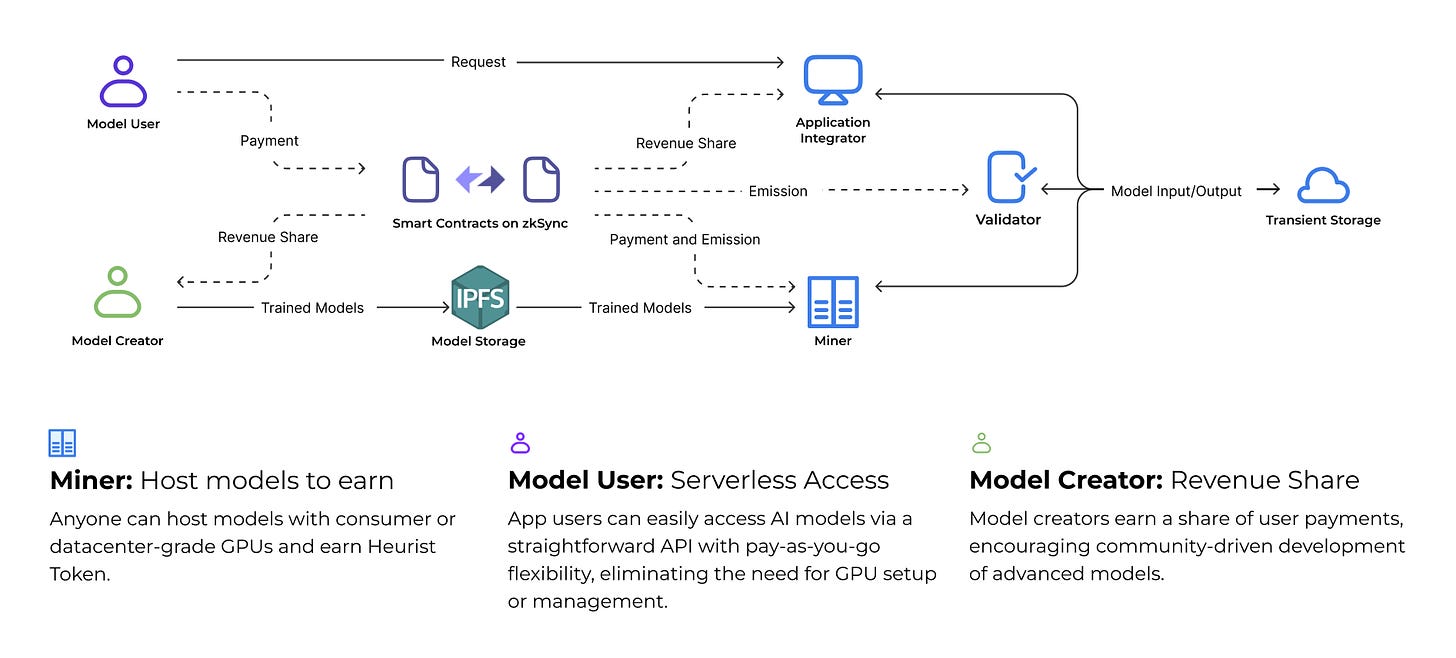
Heurist is a Layer 2 network designed for AI model hosting and inference, built on the ZK Stack. Its mission is to be the HuggingFace of Web3. By leveraging a decentralized computing resource network, Heurist provides serverless access to open-source AI models, utilizing blockchain technology to democratize AI and ensure accessibility and unbiased innovation.

Vision and Values

Heurist envisions AI to be instrumental in onboarding the next billion users to crypto. The project is grounded in the shared values of open-source AI and crypto, such as transparency, data ownership, and diversity. Heurist aims to foster a two-way onboarding process: empowering crypto enthusiasts to engage with AI through a permissionless mining network using their home PCs and enabling AI model developers to access increased compute resources, publicize their models, and earn revenue share.

By supporting the development of Web3-native AI applications, Heurist allows individuals to access AI services at low or no cost, showcasing the practical benefits of decentralized technologies. The Heurist ecosystem promotes innovation, collaboration, and inclusivity, uniting the strengths of AI and crypto to create a future where advanced technology is accessible to everyone.

Name and Inspiration

The name Heurist is derived from the concept of heuristics, which refers to mental shortcuts that help humans quickly arrive at reasonable solutions to complex problems, reflecting the projects goal to make sophisticated AI accessible and approachable for all users.

How Heurist was Founded

Jiewen Wang and Frank is the founder of Heurist. The journey began with an AI agent Heurist founders built to engage in crypto discussions on friend.tech. Through this project, they encountered several common challenges in AI Application development: high computational costs, censorship by major platforms like OpenAI, and a lack of AI model control.

To address these, they launched Heurist as a decentralized protocol to cut AI costs while maximizing customizability and sovereignty. With their teams extensive experience in Web2 and deep roots in crypto, the team is dedicated to democratizing technology and making an AI ecosystem safe, accessible, and resistant to central controls.

Heurist vision is to empower developers and users worldwide to harness the potential of AI without the limitations imposed by traditional centralized platforms.

The Heurist Team

Here’s how Heurist works🤔

Heurist protocol intricately connects various participants, each playing a vital role in maintaining a healthy decentralized ecosystem. These participants include Model Users (Consumers), Miners (Model Hosts), Model Creators, Application Integrators, and Validators.

To ensure economic security and the integrity of data returned from AI models, we will launch a utility token, Heurist Token (HUE). Participants can spend, stake and/or earn HUE based on the rules defined in smart contracts.

Roles in Heurist Ecosystem

Model Users: Users interact with the Heurist protocol to run inference tasks, such as text generation and image generation. They can choose from a variety of hosted AI models and pay for the computational resources on a pay-as-you-go basis.

Miners: Individuals with GPU resources can mine Heurist Token by hosting AI models. They run models on their own hardware and are compensated with user payments and Heurist Token emissions when consumers execute inference tasks. Miners are required to stake a certain amount of tokens as a commitment to providing quality services.

Model Creators: AI model creators drive the vibrancy of Heurist ecosystem. They upload AI models to the model registry of Heurist network and, in return, receive a portion of the payments made by users. This incentivizes creators to develop more advanced models to satisfy user’s growing demand.

Application Integrators: Application integrators provide interfaces to end users that use Heurists AI models under the hood. Such interfaces might include chatbots, AI agents, and image generation tools hosted as web applications, and might also include SDK that can be integrated in web services. Application integrators earn a fraction of fees in Heurist Token whenever consumers make a payment through the application.

Validators: Validators maintains the integrity and trustworthiness of the Heurist network. They periodically check the correctness of the data produced by miners. If a miner is found to be producing invalid or fake data, their stake is slashed, with a portion awarded to the validator who identified the discrepancy.

Dynamic Resource Allocation

As the network grows, an increasing number of AI models and compute resources (mainly GPUs) will join it. We use token voting to allocate compute resources to every model.

The heurist protocol allocates more powerful GPUs to those models with (1) higher demand and (2) high token voting. An AI model creator can acquire more compute resources in two ways: by encouraging organic usage or by voting with their own tokens. Token holders are incentivized to vote for higher-quality models with higher demand as they will receive a larger revenue share from those models.

The Current Project Update of Heurist

August has been a month of exciting launches, milestones, and community-driven initiatives. Lets dive into the highlights. You can refer to the blog Heurists August Highlights for full details.

zkImagine Launches on ZKsync: Heurist’s AI-powered NFT collection, zkImagine, allows users to create and mint unique artworks with zero gas fees, thanks to the Paymaster feature. Explore zkImagine.

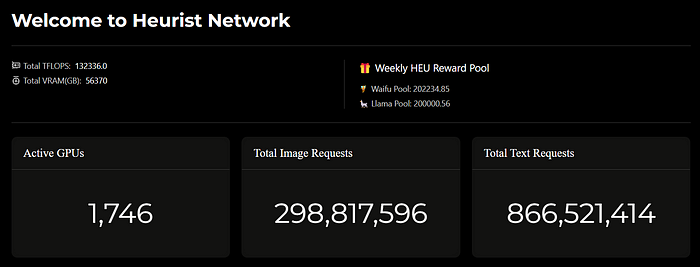
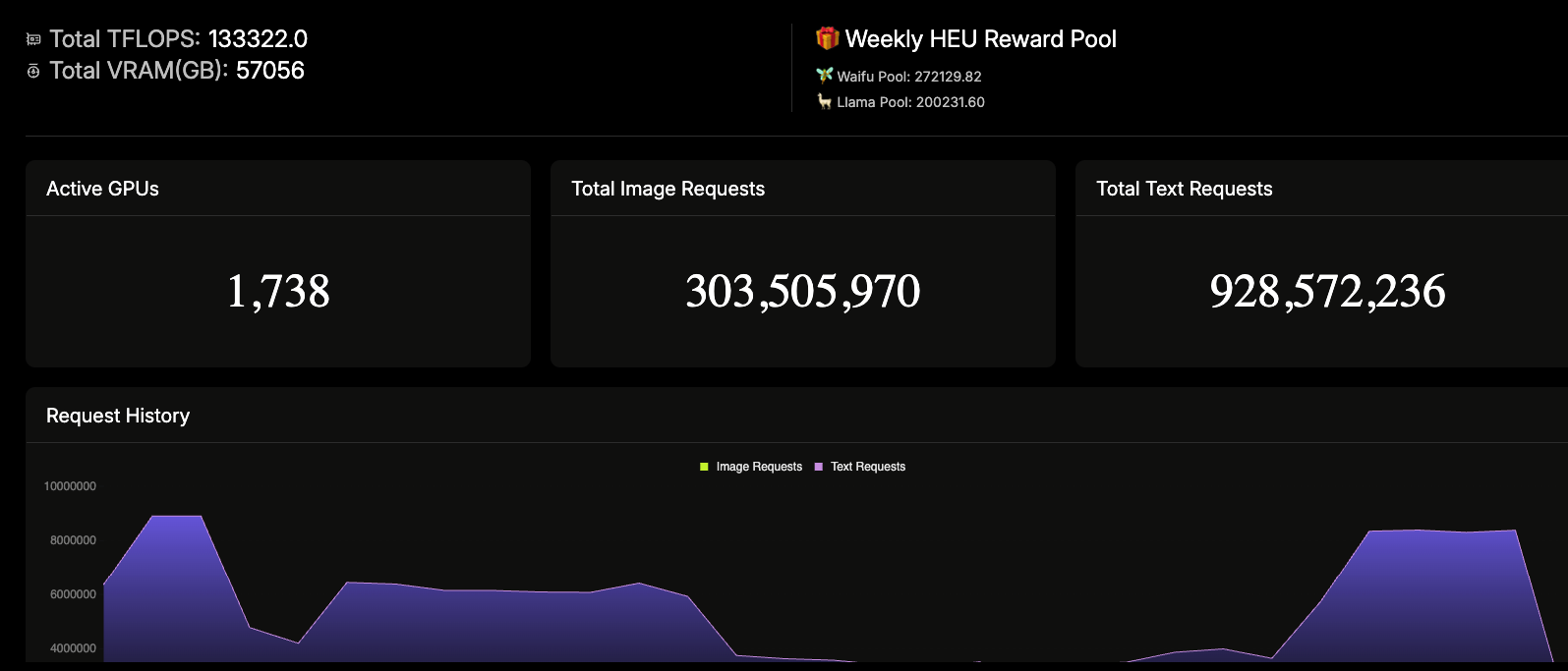
1 Billion Inference Requests Processed: Heurist has processed over 1 billion inference requests, maintaining a strong performance with over 1,000 active GPUs. Mining emissions are stabilized at an annualized rate of 2.1%.
Heurist Heroes Game: A 50,000 HEU token grant has been approved for the Heurist Heroes Game, an engaging 2D endless shooter with AI quizzes and reward incentives.

%[https://vimeo.com/1005038193]

Create-to-Earn Campaign: Sprint 0 of the Create-to-Earn campaign is complete, refining a reward mechanism for users who create and mint NFTs with zkImagine.
Art Contest with Moni Talks: Over 100 images were submitted for the Russian-speaking communitys art contest, showcasing Heurist Imagines creative potential.

Heurist Roadmap
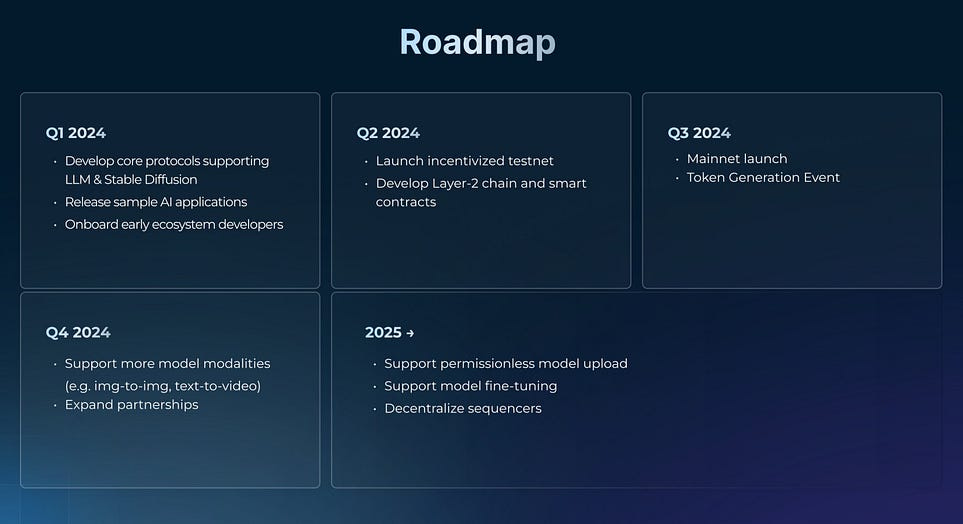
Heurist token (HUE)

HUE is a utility token with a dynamic supply, influenced by both emission and burning mechanisms. The maximum supply is capped at 1,000,000,000.

Emission Mechanisms

1. Mining

Process: Users can mine HEU tokens by hosting AI models on their GPUs.

Staking Requirement: A minimum of 10,000 esHEU tokens must be staked for a mining node to be active. Below this threshold, no rewards are generated.

Reward: Mining yields HEU tokens. Reward rate depends on GPU efficiency, availability (uptime), the type of AI model being run, and the total amount staked in a miner node.

Boosted POW Mining: For stakes between 10,000 to 100,000 HEU tokens, mining efficiency increases proportionally with the amount staked.

2. Staking

Process: Any user can stake esHEU tokens in mining nodes.

Reward: Staking yields are given in HEU token. Staking esHEU produces higher yields than HEU.

Vesting: esHEU rewards can be vested into HEU over a one-year period with linear vesting.

Transfer of Stake: Users can instantly transfer their HEU or esHEU stake from one miner to another. This promotes flexibility and competition among miners.

Burning Mechanisms

Similar to the EIP-1559 model in Ethereum, Heurist implements a token burn mechanism. When users pay for AI inference, a portion of the HEU payment is permanently removed from circulation.

The balance between token creation and burning is closely tied to network activity. During periods of high usage, the rate of token burning can exceed the rate of new token creation. This will potentially lead the Heurist network into a deflationary phase. This mechanism helps in regulating the token supply, and aligns the token value with the actual demand within the network.

Bribes and (3,3)

Bribes were a term first coined by users of DeFi, more specifically, by those of Curve Finance. These bribes are actually gamified incentivizes that help direct rewards for liquidity pools, in exchange for an incentive. We draw inspiration from the bribing mechanism of Curve, and apply it in boosted POW mining in Heurist.

Miners have the option to set a specific percentage of their mining rewards as a bribe to attract stakers. A staker may choose the miner with the highest bribe, but other factors should also affect the staker’s choice such as miner’s hardware performance and uptime.

Miners are incentivized to bribe because a higher stake in the miner node will result in higher mining efficiency. It creates a competitive yet cooperative environment where miners and stakers are aligned to provide better service to the network.

With this game theory-inspired (3,3) mechanism, we create an alignment between miners and token holders who take actions to achieve the best collective outcomes.

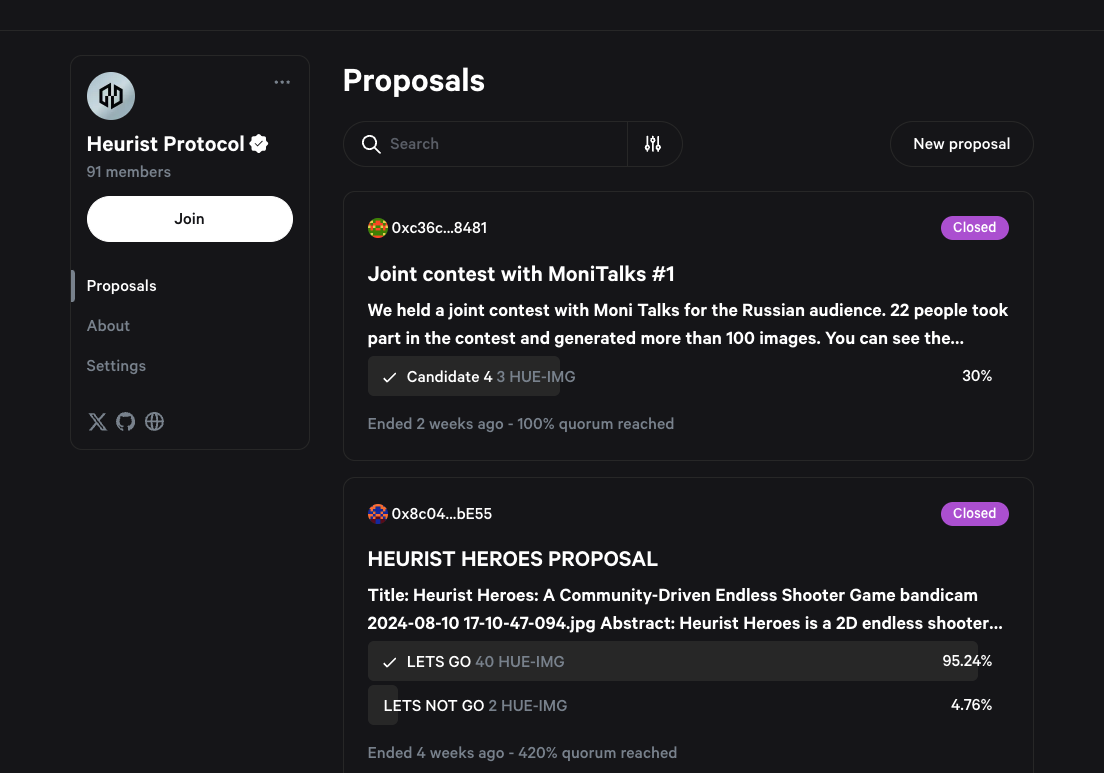
Proposal Page
Heurist Stats
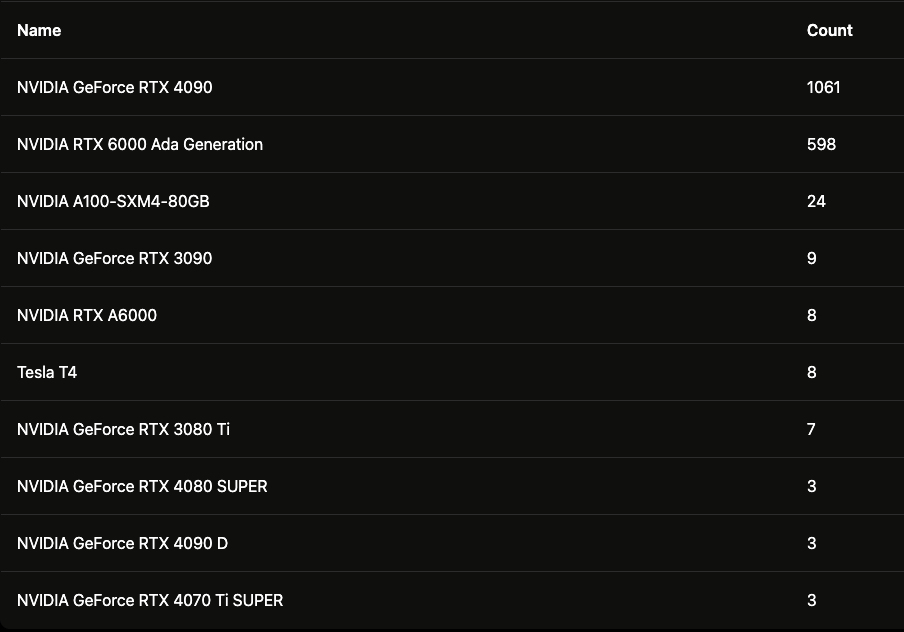
Top 10 GPUs on Heurist Ecosystem
Heurist Unique Features and Advantages

Heurist offers many unique advantages and features:

Decentralized AI Network: Heurist is a decentralized protocol for AI model hosting and inference, built on the ZK Stack Layer 2 network. This decentralized approach aims to democratize AI and ensure accessibility, transparency, and unbiased innovation.

Incentivized Ecosystem: Heurist has a utility token (HUE) that facilitates an incentivized ecosystem. Participants can earn, stake, or spend HUE tokens based on their roles, such as miners (model hosts), model creators, application integrators, and validators.

Dynamic Resource Allocation: Heurist uses token voting to dynamically allocate compute resources (GPUs) to AI models based on demand and token voting. Models with higher demand and more token votes receive more powerful GPU resources.

Open-Source AI Models: Heurist emphasizes the use of open-source AI models, which are transparent, customizable, and often comparable in performance to closed-source models like ChatGPT or DALL-E.

Pay-as-you-go Model Access: Users can access and run inference tasks on a variety of hosted AI models, paying for computational resources on a pay-as-you-go basis, potentially at lower costs than closed-source alternatives.

Incentivized Testnet: Heurist has an incentivized testnet where participants can earn testnet rewards (Llama Points and Waifu Points) for hosting AI models on their GPUs. These points will be claimable as liquid HUE tokens at the mainnet launch.

Developer APIs: Heurist provides REST APIs for developers to integrate AI models, like Stable Diffusion for image generation and Mistral 8x7b (comparable to ChatGPT 3.5) for language models, into their applications.

Bribes and (3,3) Mechanism: Heurist implements a “bribes” mechanism inspired by DeFi, where miners can set a percentage of their mining rewards as a bribe to attract stakers, creating a competitive yet cooperative environment aligned with providing better services to the network.

Token Burning Mechanism: Heurist has a token burn mechanism similar to EIP-1559, where a portion of user payments for AI inference is permanently removed from circulation, potentially leading to a deflationary phase and aligning token value with network demand.

Anti-Cheat System: Heurist has an asynchronous monitoring system to track input and output of compute jobs, allowing for the slashing of testnet rewards for miners demonstrating malicious activities.

Node Rental Service: Heurist provides a managed GPU node rental service, sourcing deals from various data center partners, making it easier for participants without GPU hardware to join the network.

Community-Driven Innovation: Heurist aims to foster a culture of innovation, collaboration, and inclusivity, bringing together the AI and crypto communities to create an ecosystem where cutting-edge technology is accessible to all

Spheron X Heurist: Unleashing the Power of Decentralized AI
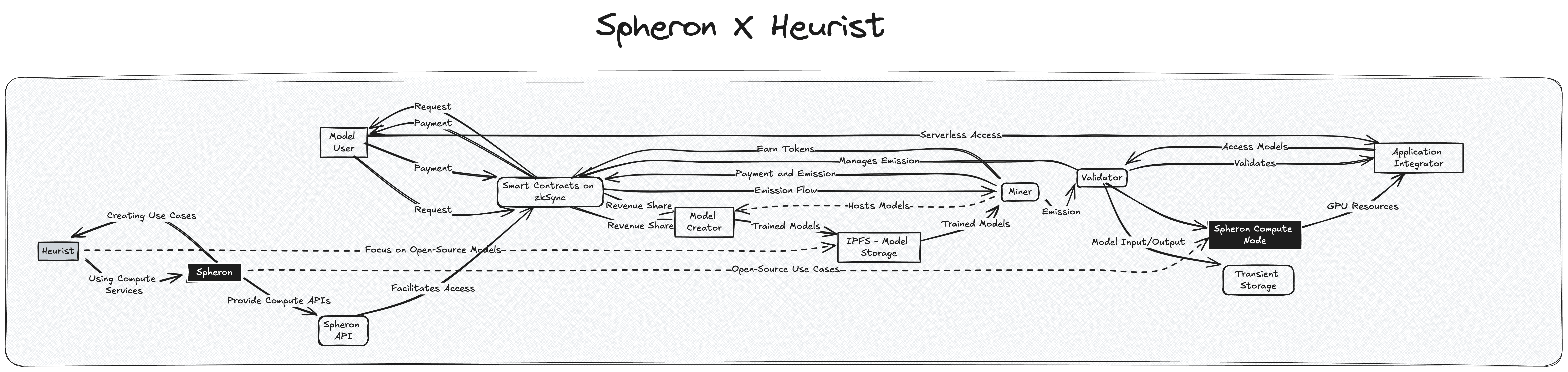
Heurist and Spheron are joining forces to redefine the landscape of AI and decentralized compute, empowering a community-driven future free from traditional barriers. By integrating Spherons cutting-edge, scalable compute solutions, Heurist will provide seamless access to open-source AI models for training and inference, significantly lowering costs and democratizing access to powerful AI tools.

In return, Spheron will leverage Heurists infrastructure to develop innovative, open-source use cases, showcasing the power of decentralized AI and GPU rental solutions. This partnership will also introduce a dedicated “GPU Rental” tab on Heurist’s platform, prominently featuring Spheron as a key partner, creating a unique synergy that accelerates the adoption of open, censorship-free AI technologies.

Heurist and Spheron are not just building tools; they are creating a decentralized, community-led ecosystem that prioritizes accessibility, transparency, and innovation in AI and compute.

Conclusion

In conclusion, Heurist is positioning itself at the forefront of a transformative movement in the AI and blockchain space. By leveraging decentralized computing and the ZK Stack Layer 2 network, Heurist aims to democratize AI access and foster innovation without the constraints of traditional centralized platforms.

The protocols unique structurewhere users, miners, developers, and validators collaborateensures a fair, incentivized, and transparent ecosystem that balances performance and community-driven governance. The vision of combining AI with crypto opens the door for billions to engage with advanced technologies in a cost-effective, unbiased, and censorship-free environment.

Through initiatives like zkImagine, the Heurist Heroes Game, and strategic partnerships with companies like Spheron, Heurist is advancing the technology and building a future where AI innovation is genuinely decentralized and accessible to everyone. As Heurist continues to grow, it is clear that the projects values of openness, collaboration, and inclusivity will be crucial to its long-term success.

FAQs

What is Heurist? Heurist is a decentralized Layer 2 network designed for AI model hosting and inference. It leverages blockchain technology to democratize AI and provide serverless access to open-source models.

How does Heurist work? Heurist connects various participantsmodel users, miners, creators, application integrators, and validatorsin a decentralized ecosystem where computational resources are allocated dynamically through token voting and incentives.

What role does the Heurist Token (HUE) play? HUE is the utility token of the Heurist network. It facilitates economic interactions like mining, staking, and payments for AI model usage, as well as governance through token voting.

What makes Heurist unique? Heurist offers decentralized AI services focusing on open-source models, pay-as-you-go access, a bribe mechanism for staking, and a token-burning system that can make the network deflationary during periods of high demand.

How does Heurist promote decentralized AI? Heurist decentralizes the hosting and usage of AI models, allowing individuals and developers to engage with AI services without relying on centralized platforms. Thus, it enhances accessibility, innovation, and fairness in the AI landscape.

]]>


Source link

Launchpad: The Future of Token Distribution

0
Launchpad: The Future of Token Distribution


We’re redefining how entire crypto ecosystems are built, launched, and scaled. Introducing the Layer3 Launchpad for exclusive token launches and ecosystem campaigns. This is tokenized attention at scale. Buckle up.

For explorers, Launchpad means:

Exclusive access to pre-token protocols

Incentives from established ecosystems

High-quality, interactive experiences

For projects, Launchpad is new rocket fuel:

Exposure to a massive, targeted user base

Onchain engagement plus flexible incentives

Token distribution with powerful Sybil filters

Launchpad isn’t just another platform. It’s the future of how crypto projects launch, grow, and align with their communities. We’re bridging the gap between emerging protocols and millions of engaged users, creating a new standard for token distribution and ecosystem expansion.

Launchpad on Layer3

Launching Now: Caldera 🌋🚀

Meet the Metalayer — the unifying layer of Ethereum rollups in our exclusive Launchpad campaign. Easily connect to new protocols via the Caldera Metalayer including Plume, B3, & Manta.

Featuring $100K in exclusive incentives for discovering Caldera’s rollup ecosystem.

Meet the Metalayer

L3 Token Staking

By staking L3, your loyalty unlocks expanded utility:

Boosted rewards on all campaigns

Early and extended access

Tiered benefits that scale with your stake

This is how you align with the future of crypto.


Source link

Bitcoin Layer 2s: Explained & Examples | Chainlink

0
Bitcoin Layer 2s: Explained & Examples | Chainlink


A Bitcoin layer 2 is any offchain network, system, or technology built on top of the Bitcoin blockchain to help extend its capabilities.

Since its inception in 2008, Bitcoin has become the focal point of the verifiable web as the first decentralized cryptocurrency, remaining the largest one by market capitalization. However, Bitcoin’s growth has faced challenges due to the network’s limited scalability, often resulting in high transaction fees and network congestion. 

The recent introduction of ordinals, BRC-20 tokens, and other Bitcoin-native onchain applications has further exacerbated these issues, where—especially during peak times—Bitcoin can become impractical for everyday use. These ongoing scalability challenges highlight the immediate need for Bitcoin scaling solutions such as layer-2 networks.

In this post, we discuss what Bitcoin layer 2s are, how they work, and how they can benefit from industry-standard oracle services.

How Do Bitcoin Layer 2s Work?

The Bitcoin network takes about 10 minutes to finalize a single block of transactions—only seven transactions per second (TPS) on average. Scaling the Bitcoin blockchain directly isn’t an option, as it would require compromising either security or decentralization per the blockchain scalability trilemma.

The blockchain scalability trilemma posits that a tradeoff has to be made when attempting to maximize scalability, security, and decentralization.

It’s worth noting that the limited core functionality (i.e., a global, censorship-resistant decentralized currency) helps make the Bitcoin network so tamper-proof and robust, and a significant technological breakthrough of the 21st century. However, this narrow focus limits the network’s usability in everyday scenarios and limits developers’ ability to launch new applications on Bitcoin. Enter layer 2s.

A Bitcoin layer 2 is any offchain network, system, or technology built on top of the Bitcoin blockchain that helps extend its capabilities. Layer-2 networks can introduce improvements such as greater transaction throughput, reduced fees, and programmability through smart contracts. A key requirement for a network to be considered a layer 2 is that it must inherit the security of the blockchain it is built on—in this case, Bitcoin. In the case of Bitcoin layer 2s, this means that transaction data is verified and confirmed by the Bitcoin blockchain rather than a separate set of nodes.

Layer-2 networks can vary considerably in how they achieve this increased scalability, but a common denominator between layer-2 environments is that when looking to settle on the base chain, they must provide some kind of cryptographic proof to the blockchain on the integrity of the proposed state change, either preemptively or retroactively.

If you’d like a deep dive into how layer 2s work, read What Is Layer 2?.

Types of Bitcoin Layer 2s

There are several types of Bitcoin scalability solutions that can be categorized as layer 2s, though some exist in a gray area regarding their classification as true layer-2 solutions. Note that Bitcoin scalability is an ongoing area of research, and new solutions and technologies may emerge in the future to address some of the limitations of current Bitcoin layer-2 technologies.

State Channels

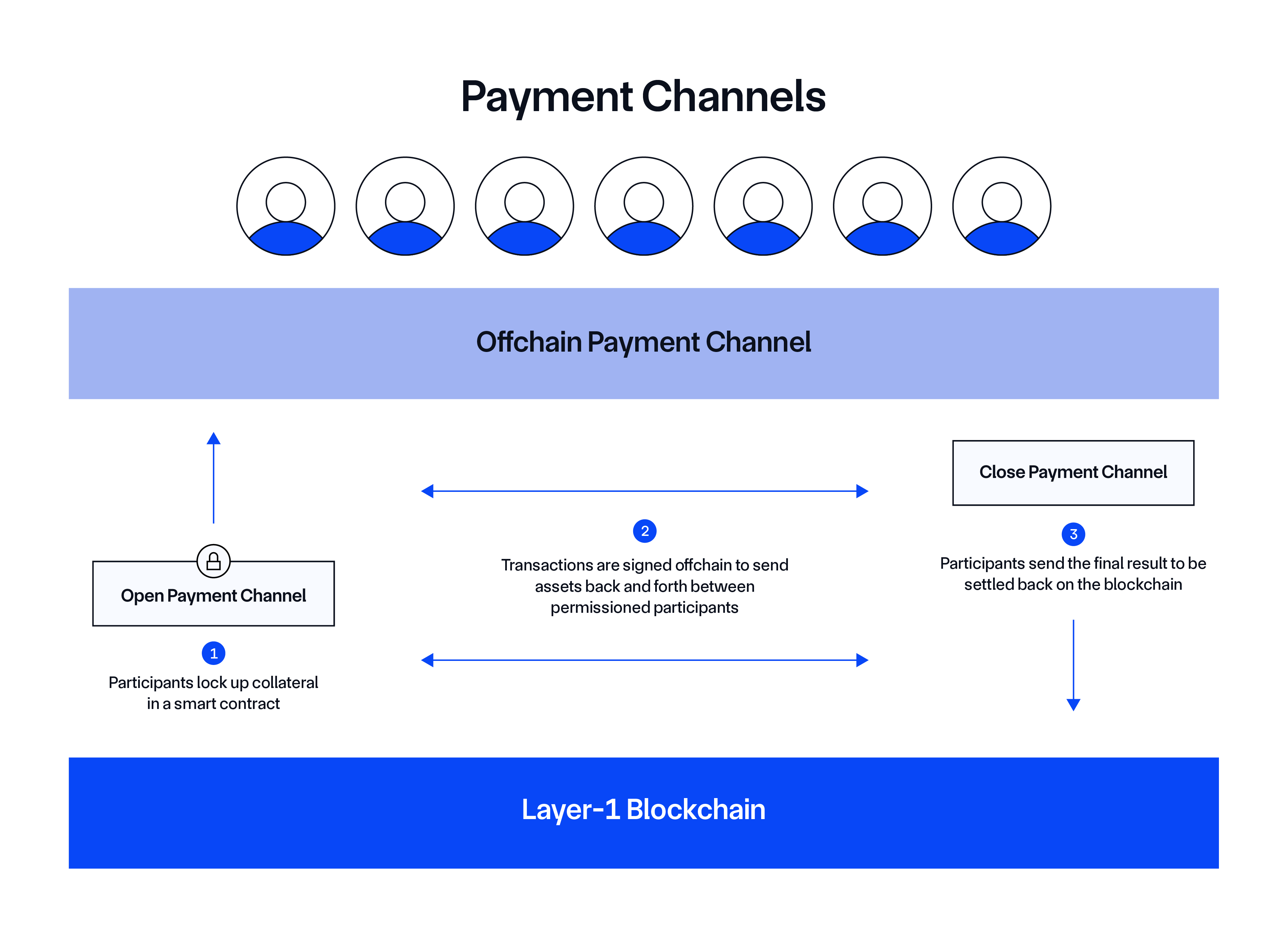
State channels enable users to bypass high transaction fees by moving transactions offchain, where two parties lock a certain amount of bitcoin into a multisig to send and receive payments. These channels then maintain records of all transactions that occur within them until they are closed. When the parties are done transacting, they sign and broadcast the final state of the channel to the Bitcoin blockchain.

State channels keep all transactions within them offchain, only reporting the opening and closing balance of participants to the Bitcoin network. This allows participants to make transactions without having to pay Bitcoin mainnet fees for each transaction. 

State channels are similar to payment channels in the Bitcoin Lightning Network, but they also support more complex transactions other than micropayments.

Bitcoin Lightning Network payment channels diagram
State and payment channels enable users to move transactions offchain.

Sidechains

A sidechain is an independent blockchain with its own consensus mechanism that connects to Bitcoin via a two-way peg, allowing the transfer of assets or balances between the two chains. While sidechains often use bitcoin as their native currency, they can also issue their own native tokens.

Operating as separate blockchains, sidechains offer faster transactions and additional features like smart contracts. Because sidechains have their own validator set, they are not always considered true layer-2 solutions, as transactions aren’t necessarily ultimately verified by the Bitcoin network. However, some sidechains may tap into Bitcoin’s security or periodically settle on the main chain.

Rollups

Bitcoin layer-2 rollups move transaction execution and data off the main Bitcoin blockchain to a separate rollup chain or layer while still anchoring to Bitcoin for data availability and consensus.

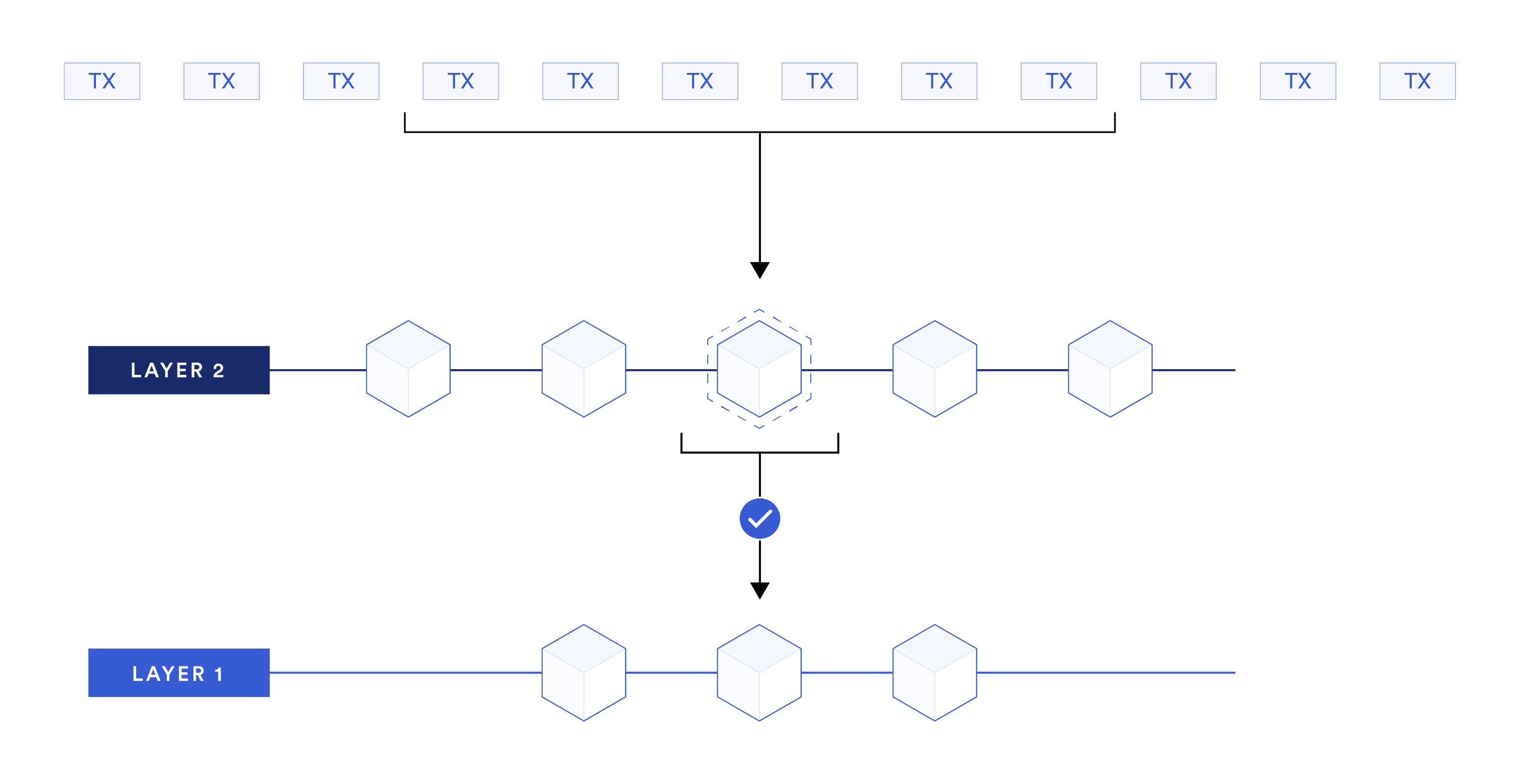
Rollup technology involves executing transactions on the rollup chain, compressing data, and anchoring to the Bitcoin mainnet. Users submit transactions to be executed on the rollup chain rather than directly on the Bitcoin blockchain. The rollup chain then processes these transactions and updates account balances accordingly. 

After processing a batch of transactions offchain, the rollup compresses the transaction data into a compact cryptographic proof or commitment, representing the net effect of all those transactions. This compressed proof is periodically submitted to the Bitcoin blockchain as a single transaction, and some kind of verification mechanism on Bitcoin then validates and applies the changes represented by the rollup proof.

Rollup transaction bundling
Rollups bundle transactions into batches that are executed offchain and verified onchain using some kind of proof.

Benefits of Bitcoin Layer 2s

Bitcoin layer 2s offer several benefits:

Greater scalability—Bitcoin layer 2s effectively increase the transaction throughput and speed of Bitcoin by processing transactions offchain and then settling them on the main chain, depending on the solution.
Reduced fees—Bitcoin layer 2s enable lower transaction costs, unlocking use cases secured by Bitcoin that wouldn’t be feasible on the main Bitcoin network, such as micropayments.
Programmable smart contracts—Although Bitcoin was not initially designed to support smart contracts, layer-2 solutions can introduce this functionality, enabling the creation of complex decentralized applications and novel programmable financial instruments built on Bitcoin.
Deeper liquidity—Bitcoin layer 2s can improve liquidity and access to Bitcoin, unlocking DeFi on Bitcoin with enhanced liquidity, capital efficiency, and increased access.

Bitcoin Layer 2 vs. Ethereum Layer 2

The utility of layer-2 solutions lies in how they tap into the security of the main chain while increasing its scalability. In this way, Bitcoin and Ethereum layer 2s are quite similar—both seek to introduce enhanced scalability without making changes to the base layer. However, Bitcoin and Ethereum layer 2s differ significantly in their technical implementation, as Bitcoin and Ethereum themselves are designed for distinct purposes.

Accelerating Bitcoin Layer 2 Adoption

State channels, sidechains, rollups, and other layer-2 solutions are all methods of approaching the blockchain scalability problem in different ways—supporting both the growing adoption of onchain applications and enhanced use cases and user experiences.

The Chainlink platform has underpinned the DeFi ecosystem since its inception, fulfilling the need for high-quality data, compute, and interoperability services that help developers create fully-fledged decentralized applications. In many cases, integrating Chainlink has helped layer-1 and layer-2 ecosystems bootstrap their growth with battle-tested Chainlink infrastructure, attracting both new developers and users. With the emerging ecosystem of Bitcoin layer-2 scalability solutions, the need for high-quality data and other oracle services will also grow in the Bitcoin ecosystem.

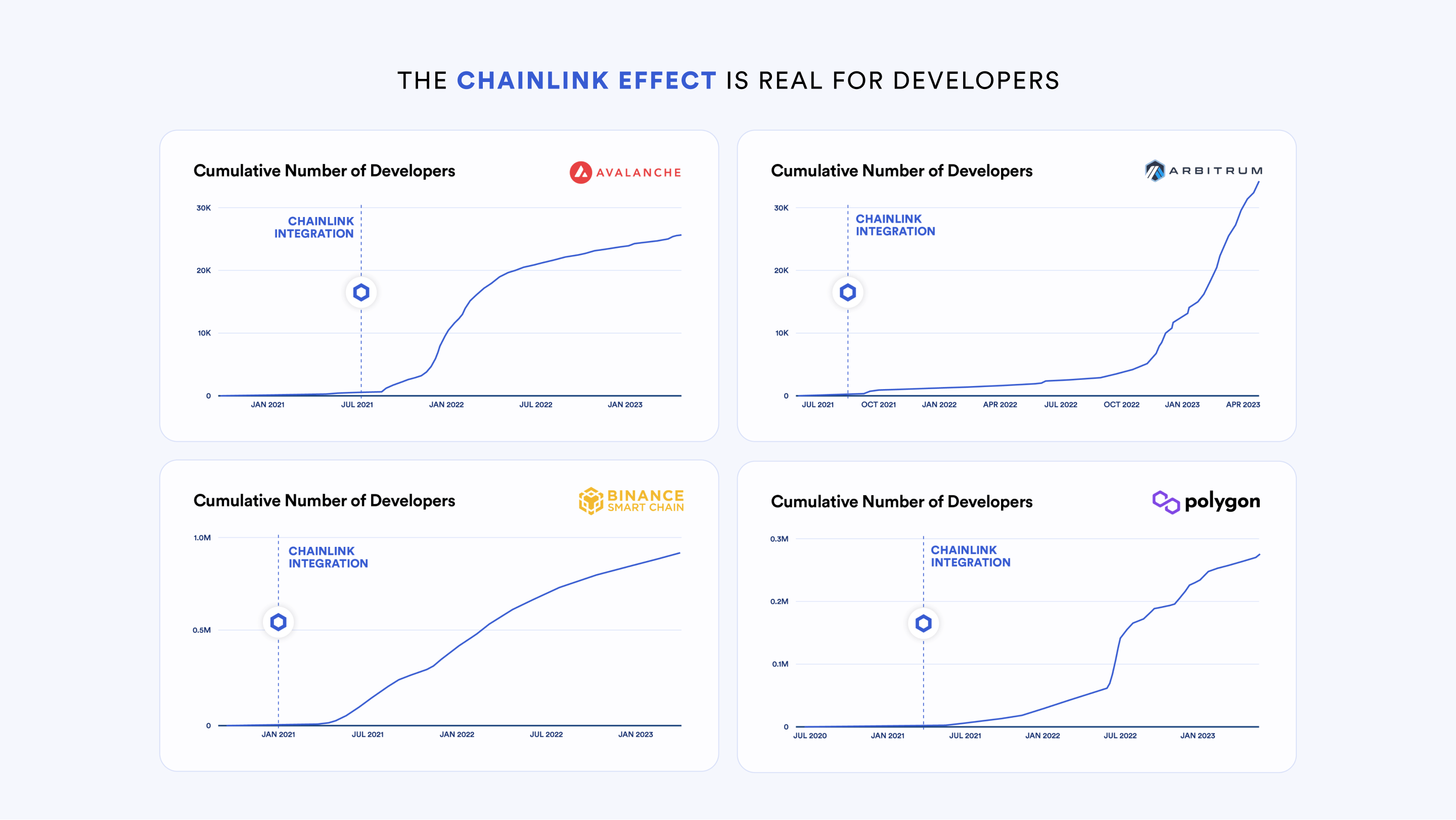
Chainlink Effect
Ecosystems that integrate high-quality Chainlnik services are better equipped to help bootstrap their ecosystem.

A significant advantage of adopting the Chainlink platform is that once an app uses a single Chainlink service, there are little-to-no additional trust assumptions for using other Chainlink services since they are all built upon the same time-tested oracle infrastructure. And every new service built on top of Chainlink adds more value for all existing users. This is why blockchains are increasingly joining the Chainlink Scale program as a way to accelerate the growth of their application ecosystem. An integration with Chainlink can bring multiple services to a single blockchain and subsequently drive a surge in developer activity.

To learn more about Chainlink, visit chain.link, subscribe to the Chainlink newsletter, and follow Chainlink on Twitter, YouTube, and Reddit.


Source link

Uniswap Fees Comparison on Ethereum vs. L2s | Web3 R&D Company

0
Uniswap Fees Comparison on Ethereum vs. L2s | Web3 R&D Company


In the past couple of years, Uniswap DAO has deployed univ3 on many L2s. Liquidity Providers should have more data about which L2s have been the most profitable for specific token pairs. This is our attempt to demystify some of it.

Chains tracked: Ethereum, Arbitrum, Optimism, Polygon, Base, Celo

BNB and Avalanche were not included in this research due to their being their own L1 chains.

In this research, we first took the top pools from each chain and made the common top pools part of our research. Except for Base and Celo, the top pools on all the other chains were similar.

On Base, blue chip tokens struggled to make it to the top 10. Here is a snapshot of the top pools by 7D volume on Base:

A snapshot of the top pools by 7D volume on Base

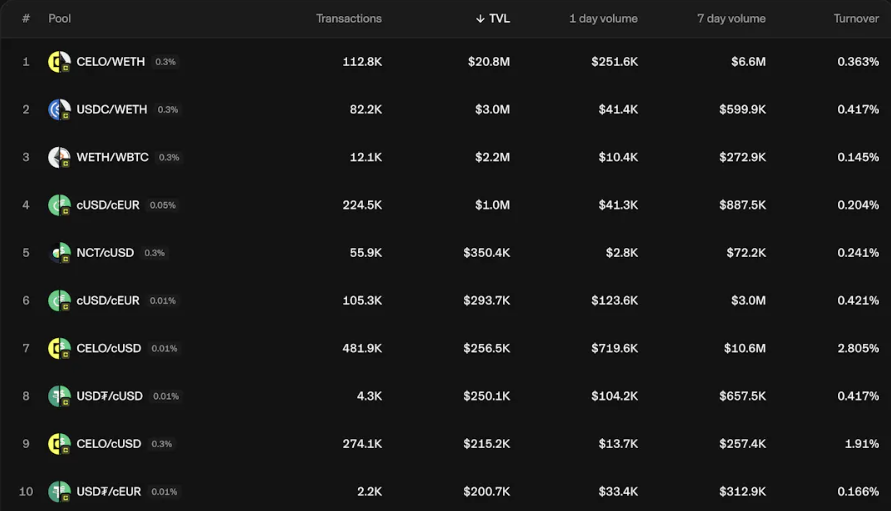
Celo has a lot of local pools in the top 10 which were again not made part of this research.

A snapshot of the top pools by 7D volume on Celo

In the case of Arbitrum, Optimism, and Polygon, liquidity and volume were fragmented between USDC and USDC.e (bridged from Ethereum), and both versions of the stablecoin are part of this research to help LPs make a better decision.

How Was This Research Conducted?

~$100 worth of liquidity was provided in each pool on 25 February 2024 until 25 March 2024. Please note that this research does not consider impermanent loss or LVR. The only focus is on fee generation.

Pools And Their Ranges

ETH-Stable Pairs

Lower Tick: 2993.974 USD per ETH

Upper Tick: 4410.486 USD per ETH

ETH-WBTC Pairs

Lower Tick: 0.0499 WBTC per ETH

Upper Tick: 0.0588 WBTC per ETH

ETH-wstETH Pairs

Lower Tick: 0.845 wstETH per ETH

Upper Tick: 0.882 wstETH per ETH

WBTC-Stable Pairs

Lower Tick: 57907.855 USD per WBTC

Upper Tick: 84184.290 USD per WBTC

USDC-USDT Pairs

Lower Tick: 0.990 USDT per USDC

Upper Tick: 1.015 USDT per USDC

You can find all related pool data here:

https://docs.google.com/spreadsheets/d/15e4W9N0bm6zYJ-eY-nogSiADnxqfYvtOrUbkRYgakcI/edit?usp=sharing

ETH-USDC

ETH-USDC

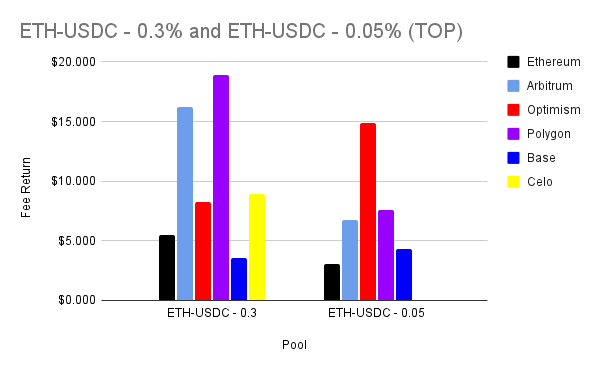
Polygon’s ETH-USDC 0.3% pool produced the highest fee return at $18.9 followed by Polygon’s ETH-USDC 0.05% pool. Base’s pools performed the worst. Ethereum, Arbitrum, and Optmism were on par with each other.

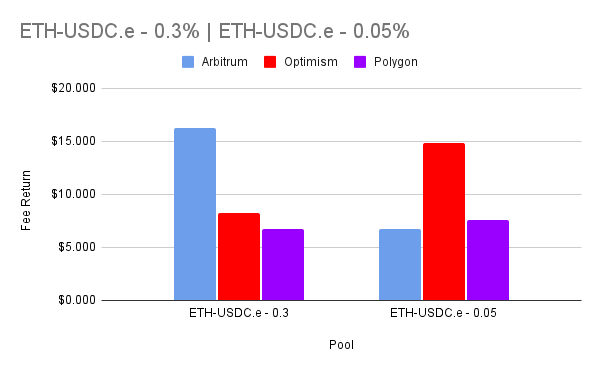
ETH-USDC.e

Arbitrum’s 0.3% pool performed the best with $16.2 in fee generation with Optimism’s 0.05% pool at almost $15 being close second.

ETH-USDbC / ETH-USDCET

ETH-USDbC pool on Base generated $3.57 and $4.3 respectively.

Celo’s ETH-USDCET generated $8.9.

ETH-USDC (Top Pools)

The chart above combines and compares all the top-performing ETH-USDC pools on all six chains. This chart does not distinguish between the different versions of USDC. For more detailed information on the different versions of USDC, see the charts above.

Here Polygon’s 0.3%, Arbitrum’s 0.3% pool, and Optimism’s 0.05% pool are the top 3 performing pools. Ethereum’s fee generation is lacking far behind them.

ETH-DAI

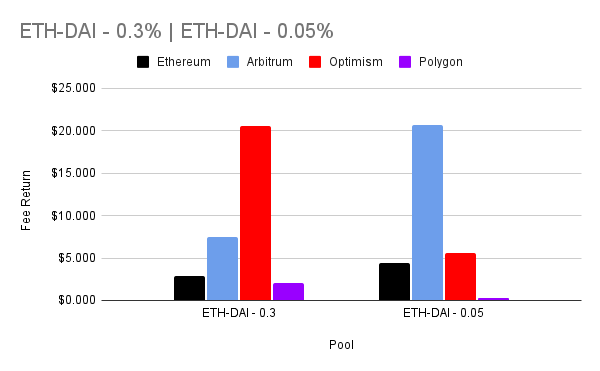
Ethereum’s and Polygon’s ETH-DAI pools are lagging far behind Arbitrum’s ETH-DAI 0.3% pool with $20.7 generated and Optimism’s ETH-DAI pool with $20.5 generated.

ETH-USDT

Arbitrum’s ETH-USDT 0.05% pool takes the cake with the highest fees generated at $9 followed by Polygon’s ETH-USDT 0.3% pool at $6.7

ETH-WBTC

Arbitrum wins here hands-down in ETH-WBTC 0.3% and ETH-WBTC 0.05% with fee generation of $10.3 and $6.87 respectively.

ETH-wstETH

This is the first and only LST pair in our research. We thought this pair was a good proxy for the overall trading volume in the LST space.

Ethereum’s volume here is not a surprise given that most LST assets are still on Ethereum. What’s surprising is that Base has generated the most fees in the given time frame with the 0.05% pool generating $1.32, perhaps this is an outlier and Base won’t be able to keep up with Ethereum in this pair in the next few months.

WBTC-USDC

WBTC-USDC

Optimism’s both pools generated more fees than Ethereum with 0.3% at $10.2 and 0.05% at $11.6.

WBTC-USDC.e

Optimism again takes the win here with the 0.3% pool generating $23.3.

WBTC-USDC (Top Pools)

The chart above combines and compares all the top-performing WBTC-USDC pools. This chart does not distinguish between the different versions of USDC. For more detailed information on the different versions of USDC, see the charts above.

Here Optimism’s 0.3% pool, Optimism’s 0.05% pool, and Ethereum’s 0.3% are the top performing in terms of fee generation.

USDC-USDT

USDC-USDT

This is the first time that Ethereum has generated more fees on any token pairs. Perhaps the bulk of the stablecoin trading is still happening on Ethereum.

Ethereum’s 0.05% pool generated $0.15 and the 0.01% pool generated $0.06.

USDC.e-USDT

Polygon’s 0.05% is the top-performing pool here.

USDC-USDT (Top Pools)

The chart above combines and compares all the top-performing USDC-USDT pools. This chart does not distinguish between the different versions of USDC. For more detailed information on the different versions of USDC, see the charts above.

Ethereum is the clear winner in both fee tiers with the 0.05% pool at $0.15 and the 0.01% pool at $0.06.

Summary

In our research with the limited pools, L2s fee generation has outperformed Ethereum L1. Although TVL and overall volume are still higher on Ethereum, but LPing is more profitable on L2s. LPs should consider the past data before deciding which chain to deploy the liquidity on. Polygon led the ETH-USDC pools, Arbitrum led the ETH-DAI, ETH-USDT, and ETH-WBTC pools, Ethereum ETH-wstETH and USDC-USDT pools and Optimism led the fees generation on WBTC-USDC pools.

Also read: Optimism Bedrock: An Early Guide


Source link

Hyperledger Web3j: Truly decode support for dynamic Solidity structs

0
Hyperledger Web3j: Truly decode support for dynamic Solidity structs


In Solidity, dynamic structs are complex data types that can store multiple elements of varying sizes, such as arrays, mappings, or other structs. The system encodes these dynamic structs into binary format using Ethereum’s ABI (Application Binary Interface) encoding rules. The system encodes the structs whenever it stores or passes them in transactions.

Decoding this binary data is crucial for interpreting the state or output of a smart contract. This process involves understanding how Solidity organizes and packs data, particularly in dynamic types, to accurately reconstruct the original struct from its binary representation. This understanding is key to developing robust and interoperable decentralized applications.

Decoding dynamic structs in an external development environment that interacts with a blockchain network is challenging. These structs can include arrays, mappings, and nested structs of different sizes. They require careful handling to keep data accurate during encoding and decoding. In Hyperledger Web3j, we addressed this by creating object classes that match the expected struct format in the blockchain environment.

These object classes are designed to inherit from the org.web3j.abi.datatypes.DynamicStruct class, which is part of the ABI module. The developers designed this class to handle the complexities of encoding and decoding dynamic structs and other Solidity data types.

The ABI module leverages Hyperledger Web3j’s type-safe mapping to ensure easy and secure interactions with these complex data structures.

However, when the goal is to extract a specific value from encoded data, creating a dedicated object can add unnecessary complexity. This approach can also use up extra resources. To address this, our contributors, calmacfadden and Antlion12, made significant improvements by extending the org.web3j.abi.TypeReference class.

Their enhancements allow dynamic decoding directly within the class, removing the need to create extra objects. This change simplifies the process of retrieving specific values from encoded data. This advancement reduces overhead and simplifies interactions with blockchain data.

Decoding dynamic struct before enhancement

To clarify, here’s a code example that shows how you could decode dynamic structs using Hyperledger Web3j before the enhancements.

/**
* create the java object representing the solidity dinamyc struct
* struct User{
* uint256 user_id;
* string name;
* }
*/
public static class User extends DynamicStruct {
public BigInteger userId;

public String name;

public Boz(BigInteger userId, String name) {
super(
new org.web3j.abi.datatypes.generated.Uint256(data),
new org.web3j.abi.datatypes.Utf8String(name));
this.userId = userId;
this.name = name;
}

public Boz(Uint256 userId, Utf8String name) {
super(userId, name);
this.userId = userId.getValue();
this.name = name.getValue();
}
}
/**
* create the function which should be able to handle the class above
* as a solidity struct equivalent
*/
public static final org.web3j.abi.datatypes.Function getUserFunction = new org.web3j.abi.datatypes.Function(
FUNC_SETUSER,
Collections.emptyList(),
Arrays.>asList(new TypeReference() {}));

Now as the prerequisite is done, the only thing left is to call do the decode and here is an example:

@Test
public void testDecodeDynamicStruct2() {
String rawInput =
“0x0000000000000000000000000000000000000000000000000000000000000020”
+ “000000000000000000000000000000000000000000000000000000000000000a”
+ “0000000000000000000000000000000000000000000000000000000000000040”
+ “0000000000000000000000000000000000000000000000000000000000000004”
+ “4a686f6e00000000000000000000000000000000000000000000000000000000
“;

assertEquals(
FunctionReturnDecoder.decode(
rawInput,
getUserFunction.getOutputParameters()),
Collections.singletonList(new User(BigInteger.TEN, “John”)));
}

In the above test, we decoded and asserted that the rawInput is a User struct having the name John and userId 10.

Decoding dynamic struct with new enhancement

With the new approach, declaring an equivalent struct object class is no longer necessary. When the method receives the encoded data, it can immediately decode it by creating a matching reference type. This simplifies the workflow and reduces the need for additional class definitions.

See the following example for how this can be implemented:

public void testDecodeDynamicStruct2() {
String rawInput =
“0x0000000000000000000000000000000000000000000000000000000000000020”
+ “000000000000000000000000000000000000000000000000000000000000000a”
+ “0000000000000000000000000000000000000000000000000000000000000040”
+ “0000000000000000000000000000000000000000000000000000000000000004”
+ “4a686f6e00000000000000000000000000000000000000000000000000000000
“;

TypeReference dynamicStruct =
new TypeReference(
false,
Arrays.asList(
TypeReference.makeTypeReference(“uint256”),
TypeReference.makeTypeReference(“string”))) {};

List decodedData =
FunctionReturnDecoder.decode(rawInput,
Utils.convert(Arrays.asList(dynamicStruct)));

List decodedDynamicStruct =
((DynamicStruct) decodedData.get(0)).getValue();

assertEquals(decodedDynamicStruct.get(0).getValue(), BigInteger.TEN);
assertEquals(decodedDynamicStruct.get(1).getValue(), “John”);}

In conclusion, Hyperledger Web3j has made great progress in simplifying the decoding of dynamic Solidity structs. This addresses one of the most challenging parts of blockchain development. By introducing object classes like org.web3j.abi.datatypes.DynamicStruct and enhancing the org.web3j.abi.TypeReference class, the framework now provides a more efficient and streamlined method for handling these complex data types.

Developers no longer need to create dedicated struct classes for every interaction, reducing complexity and resource consumption. These advancements not only boost the efficiency of blockchain applications but also make the development process easier and less prone to errors. This ultimately leads to more reliable and interoperable decentralized systems.


Source link

Decode Dynamic Solidity Structs with Hyperledger Web3j

0
Decode Dynamic Solidity Structs with Hyperledger Web3j


In Solidity, dynamic structs are complex data types that can store multiple elements of varying sizes, such as arrays, mappings, or other structs. The system encodes these dynamic structs into binary format using Ethereum’s ABI (Application Binary Interface) encoding rules. The system encodes the structs whenever it stores or passes them in transactions.

Decoding this binary data is crucial for interpreting the state or output of a smart contract. This process involves understanding how Solidity organizes and packs data, particularly in dynamic types, to accurately reconstruct the original struct from its binary representation. This understanding is key to developing robust and interoperable decentralized applications.

Decoding dynamic structs in an external development environment that interacts with a blockchain network is challenging. These structs can include arrays, mappings, and nested structs of different sizes. They require careful handling to keep data accurate during encoding and decoding. In Hyperledger Web3j, we addressed this by creating object classes that match the expected struct format in the blockchain environment.

These object classes are designed to inherit from the org.web3j.abi.datatypes.DynamicStruct class, which is part of the ABI module. The developers designed this class to handle the complexities of encoding and decoding dynamic structs and other Solidity data types. The ABI module leverages Hyperledger Web3j’s type-safe mapping to ensure easy and secure interactions with these complex data structures.

However, when the goal is to extract a specific value from encoded data, creating a dedicated object can add unnecessary complexity. This approach can also use up extra resources. To address this, our contributors, calmacfadden and Antlion12, made significant improvements by extending the org.web3j.abi.TypeReference class.

Their enhancements allow dynamic decoding directly within the class, removing the need to create extra objects. This change simplifies the process of retrieving specific values from encoded data. This advancement reduces overhead and simplifies interactions with blockchain data.

Decoding dynamic struct before enhancement

To clarify, here’s a code example that shows how you could decode dynamic structs using Hyperledger Web3j before the enhancements.

/**
* create the java object representing the solidity dinamyc struct
* struct User{
* uint256 user_id;
* string name;
* }
*/
public static class User extends DynamicStruct {
public BigInteger userId;

public String name;

public Boz(BigInteger userId, String name) {
super(
new org.web3j.abi.datatypes.generated.Uint256(data),
new org.web3j.abi.datatypes.Utf8String(name));
this.userId = userId;
this.name = name;
}

public Boz(Uint256 userId, Utf8String name) {
super(userId, name);
this.userId = userId.getValue();
this.name = name.getValue();
}
}
/**
* create the function which should be able to handle the class above
* as a solidity struct equivalent
*/
public static final org.web3j.abi.datatypes.Function getUserFunction = new org.web3j.abi.datatypes.Function(
FUNC_SETUSER,
Collections.emptyList(),
Arrays.<typereference<?>>asList(new TypeReference() {}));

</typereference<?>

Now as the prerequisite is done, the only thing left is to call do the decode and here is an example:

@Test
public void testDecodeDynamicStruct2() {
String rawInput =
“0x0000000000000000000000000000000000000000000000000000000000000020”
+ “000000000000000000000000000000000000000000000000000000000000000a”
+ “0000000000000000000000000000000000000000000000000000000000000040”
+ “0000000000000000000000000000000000000000000000000000000000000004”
+ “4a686f6e00000000000000000000000000000000000000000000000000000000
“;

assertEquals(
FunctionReturnDecoder.decode(
rawInput,
getUserFunction.getOutputParameters()),
Collections.singletonList(new User(BigInteger.TEN, “John”)));
}

In the above test, we decoded and asserted that the rawInput is a User struct having the name John and userId 10.

Decoding dynamic struct with new enhancement

With the new approach, declaring an equivalent struct object class is no longer necessary. When the method receives the encoded data, it can immediately decode it by creating a matching reference type. This simplifies the workflow and reduces the need for additional class definitions. See the following example for how this can be implemented:

public void testDecodeDynamicStruct2() {
String rawInput =
“0x0000000000000000000000000000000000000000000000000000000000000020”
+ “000000000000000000000000000000000000000000000000000000000000000a”
+ “0000000000000000000000000000000000000000000000000000000000000040”
+ “0000000000000000000000000000000000000000000000000000000000000004”
+ “4a686f6e00000000000000000000000000000000000000000000000000000000
“;

TypeReference dynamicStruct =
new TypeReference(
false,
Arrays.asList(
TypeReference.makeTypeReference(“uint256”),
TypeReference.makeTypeReference(“string”))) {};

List decodedData =
FunctionReturnDecoder.decode(rawInput,
Utils.convert(Arrays.asList(dynamicStruct)));

List decodedDynamicStruct =
((DynamicStruct) decodedData.get(0)).getValue();

assertEquals(decodedDynamicStruct.get(0).getValue(), BigInteger.TEN);
assertEquals(decodedDynamicStruct.get(1).getValue(), “John”);}

In conclusion, Hyperledger Web3j has made great progress in simplifying the decoding of dynamic Solidity structs. This addresses one of the most challenging parts of blockchain development. By introducing object classes like org.web3j.abi.datatypes.DynamicStruct and enhancing the org.web3j.abi.TypeReference class, the framework now provides a more efficient and streamlined method for handling these complex data types.

Developers no longer need to create dedicated struct classes for every interaction, reducing complexity and resource consumption. These advancements not only boost the efficiency of blockchain applications but also make the development process easier and less prone to errors. This ultimately leads to more reliable and interoperable decentralized systems.


Source link

Phantom x Layer3, ARB Hub, plus 500K USDC

0
Phantom x Layer3, ARB Hub, plus 500K USDC


Digital art shines brighter on digital gold. This month, we’re teaming up with Phantom to introduce Bitcoin Ordinals to the world.

What are Ordinals?

Ordinals are a novel approach to creating NFT-like assets called “inscriptions” on Bitcoin’s blockchain. Ordinals are inscribed onto a satoshi (the smallest divisible BTC unit) via a standard Bitcoin transaction. Each inscription can hold unique data, like images or text.

Phantom 🤝 Bitcoin

Phantom wallet is a powerful portal to Bitcoin Ordinals. Phantom enables full Bitcoin support with extensive features:

Inscribed satoshi protection (so you don’t accidentally spend your Ordinals)

Immersive Collectibles gallery to view, search, and pin your Ordinals

Connected marketplaces to browse, buy, and list on Magic Eden or UniSat

Collect your first Bitcoin Ordinals with Phantom x Layer3 today.

Intro to Ordinals

New Quests (and 140K+ ARB incentives) are being added to the Arbitrum Hub on Layer3. Discover Aura Finance, Maverick Protocol, Vertex Protocol, DeFi Saver, Router Protocol, and more!

Incentives are distributed directly, in real-time, for each Quest completed. Over 58K users have already claimed 200K+ ARB, with new Quests and incentives added weekly.

Layer3 is the leading protocol for next-level attention and incentive distribution.

Enter the Arbitrum Hub

Attention: Season 2 participants!

Did you mint the coveted Trident of Worlds? 500K USDC incentives are currently being distributed for the Infinity CUBEs campaign. The distribution fully concludes last season, with millions in incentives upcoming for Season 3.

Claim Infinity CUBE incentives


Source link

One Final Story About FTX for Old Times Sake | Web3 Daily

0
One Final Story About FTX for Old Times Sake | Web3 Daily


TL;DR

On Wednesday this week, a judge formally ordered FTX and it’s sister company, Alameda Research, to pay $12.7 Billion USD to creditors, ending a 20-month-long lawsuit with the Commodity Futures Trading Commission (CFTC).

Full Story

For our final ever Web3 Daily news article (we’ll say a proper goodbye on Sunday), it feels fitting to write about FTX.

(The company that both made us and broke us in many ways – because people love reading about crazy news; but FTX also crippled the crypto industry along with the advertising budgets for many web3 companies).

On Wednesday this week, a judge formally ordered FTX and it’s sister company, Alameda Research, to pay $12.7 Billion USD to creditors, ending a 20-month-long lawsuit with the Commodity Futures Trading Commission (CFTC).

The order also bans FTX and Alameda from trading digital assets and acting as intermediaries in the market.

(Nipping in the bud even the slightest chance of a comeback for the company).

How in the world can a bankrupt company pay $12.7B to creditors?

Well, when Sam Bankrun-Fraud was sentenced, he was forced to forfeit $11B in assets (and given 25 years in prison for seven counts of fraud, conspiracy, and money laundering).

Plus, Alameda and FTX had significant crypto holdings in tokens other than the FTT token (FTX’s native token which went to zero) like Solana, which, since the crash that they started, has mostly gone up in value.

For now, FTX and Alameda have filed for bankruptcy, with the full restructure being administered by Kroll – who have the fun job of figuring out what assets are still owned, and which creditors should get how much, and in what order.

Alright! Now you know.


Source link

Popular Posts

My Favorites