Web3

Home Web3 Page 170

Why Spheron Provided AI Base Model and BF16 Implementation

0
Why Spheron Provided AI Base Model and BF16 Implementation


In a significant advancement for the AI community, Spheron recently unveiled its DeepSeek-R1-Distill-Llama-70B Base model with BF16 precision—a development that promises to reshape how developers and researchers approach artificial intelligence applications. Despite their immense capabilities, base models have remained largely inaccessible to the broader tech community until now. Spheron’s latest offering provides unprecedented access to the raw power and creative potential that only base models can deliver, marking a crucial turning point in AI accessibility.

Understanding Base Models: The Unfiltered Powerhouses of AI

Base models represent the foundation of modern language AI—untamed, unfiltered systems containing the full spectrum of knowledge from their extensive training data. Unlike their instruction-tuned counterparts that have been optimized for specific tasks, base models maintain their original, unconstrained potential, making them extraordinarily versatile for developers seeking to build custom solutions from the ground up.

The significance of base models lies in their “uncollapsed” nature. When presented with a sequence of inputs, they can generate remarkably diverse variations for subsequent outputs with high entropy. This translates to significantly more creative and unpredictable results than instruction-tuned models designed to follow specific patterns and behaviors.

“Base models are like having a blank canvas with infinite possibilities,” explains Spheron in their recent announcement on X. “They retain more creativity and capabilities than instruction-tuned models, making them perfect for pushing AI boundaries.”

The BF16 Advantage: Balancing Performance and Precision

A critical innovation in Spheron’s offering is the implementation of the BF16 (bfloat16) floating-point format. This technical enhancement carefully calibrates the balance between processing speed and numerical precision, a crucial consideration when working with models containing hundreds of billions of parameters.

BF16 stands out as a floating-point format optimized explicitly for machine learning applications. By reducing the precision from 32 bits to 16 bits while maintaining the same exponent range as 32-bit formats, BF16 delivers substantial performance improvements without significantly compromising the model’s capabilities.

For developers working with massive AI systems, these efficiency gains translate to several tangible benefits:

Accelerated processing times: Operations complete more quickly, allowing for faster iteration and experimentation

Reduced memory requirements: The smaller data format means more efficient use of available hardware

Lower operational costs: Faster processing and reduced resource consumption lead to more economical deployment

Broader accessibility: The optimization makes powerful models viable on a wider range of hardware configurations

“When you’re running massive models, every millisecond counts,” notes Spheron. “BF16 lets you process information faster without sacrificing too much precision. It’s like having a sports car that’s also fuel-efficient!”

The Synergistic Power of Base Models and BF16

These two technological approaches—base models and BF16 precision—create a particularly powerful synergy. Developers gain access to both the unbounded creative potential of base models and the performance advantages of optimized numerical representation.
Image

This combination enables a range of applications that might otherwise be impractical or impossible:

Development of highly customized language models tailored to specific domains

Exploration of novel AI capabilities without the constraints of instruction tuning

Efficient processing of massive datasets for training specialized models

Implementation of AI solutions in resource-constrained environments

Rapid prototyping and iteration of new AI concepts

Comparing Base Models to Instruction-Tuned Models

To fully appreciate the significance of Spheron’s offering, it’s helpful to understand the key differences between base models and their instruction-tuned counterparts:

FeatureBase ModelsInstruction-Tuned Models

Creative PotentialExtremely high with unpredictable outputsMore constrained and predictable

CustomizationHighly flexible for custom applicationsPre-optimized for specific tasks

Raw CapabilitiesUnfiltered, maintaining full training capabilitiesCapabilities potentially reduced during tuning

Development FlexibilityMaximum freedom for developersLimited by pre-existing optimizations

Output VarietyHigh entropy with diverse possibilitiesLower entropy with more consistent outputs

Learning CurveSteeper requires more expertise to optimizeEasier to use out-of-the-box

Resource RequirementsHigher when used without optimizationOften more efficient for specific tasks

BF16 BenefitSubstantial performance gains while preserving capabilitiesLess impactful as models are already optimized

The Future of AI Development with Spheron

Spheron’s commitment to democratizing access to powerful AI tools represents a significant step toward a more open and collaborative AI ecosystem. By providing developers with access to their 405B Base model in BF16 format, they’re enabling a new generation of AI innovations that might otherwise never emerge.

“The hype around base models is not false—real capabilities back it,” asserts Spheron. “Whether you’re a developer, researcher, or AI enthusiast, having access to base models with BF16 precision is like having a supercomputer in your toolkit!”

This initiative aligns with Spheron’s mission as “the leading open-access AI cloud, building an open ecosystem and economy for AI.” Founded by award-winning Math and AI researchers from prestigious institutions, Spheron envisions a future where AI technology is universally accessible, empowering individuals and communities worldwide.

Conclusion: A New Frontier in AI Development

For serious AI developers and researchers, Spheron’s release of their 405B Base model with BF16 precision represents a significant opportunity to explore the boundaries of what’s possible with current technology. Combining unrestricted base model capabilities and optimized performance creates a powerful foundation for the next generation of AI applications.

As the technology continues to mature and more developers gain access to these tools, we can expect to see increasingly innovative applications emerge across industries. The democratization of high-performance AI models promises to accelerate the pace of innovation and potentially lead to breakthroughs that might otherwise remain undiscovered.

Those interested in exploring these capabilities can access Spheron’s platform through their console at console.spheron.network, joining a growing community of innovators pushing the boundaries of artificial intelligence.


Source link

Dogecoin, Solana Down by Double Digits as Ethereum Price Hits 15-Month Low – Decrypt

0
Dogecoin, Solana Down by Double Digits as Ethereum Price Hits 15-Month Low – Decrypt


Dogecoin (DOGE), Ethereum (ETH), and Solana (SOL) have all recorded double-digit declines in the past 24 hours, following surges after U.S. President Donald Trump announced a federal crypto reserve last Friday.

ETH is down 11.4% in the past 24 hours and down 13.9% week over week, according to CoinGecko, despite Trump saying it is set to be included in the U.S. crypto reserve in a post on Truth Social. It dropped to $2,035, its lowest level since November 2023, while its price ratio versus Bitcoin reached a historic low last month.

SOL fell 16.1% over the past 24 hours and is down 2.9% on the week, following Trump’s crypto reserve announcement. It’s trading at its lowest price since early September 2024, after hitting another three-month low just weeks ago, amid skepticism about the future of Solana-based meme coins.

Meanwhile, DOGE recorded losses of 12.4% in the past 24 hours and 6.6% week over week. It’s hovering at its lowest level since early November 2024. Despite not being named in Trump’s crypto reserve plans, it still spiked alongside the rest of the crypto market’s post-announcement surge.

Dr. Sean Dawson, head of research at options platform Derive.xyz, thinks the rapid price declines could be due to uncertainty around the details of Trump’s reserve plans.

“This market behavior highlights that while announcements like Trump’s strategic reserve can spark short-term excitement, the lack of clarity and follow-through can lead to rapid corrections,” Dawson said. He added that, “Volatility will likely remain high as traders navigate the uncertain year ahead.”

He pointed to the fact that high-profile figures from the crypto industry have criticized the inclusion of non-Bitcoin digital assets in the strategic reserve, among them Gemini co-founders Cameron and Tyler Winklevoss and Coinbase CEO Brian Armstrong. Investment firm Bernstein has also been skeptical of the move.

Cameron Winklevoss recently tweeted that “Bitcoin is the only asset that meets the bar for a store of value reserve asset,” adding, “Maybe Ethereum.”

Valentin Fournier, analyst at crypto research firm BRN, attributed the harsh declines to “Trump’s confirmation that 25% tariffs on Mexico and Canada will take effect on March 4th” which he said are “injecting uncertainty into the market” and creating a “risk-off sentiment.”

The total market cap of all cryptocurrencies is down 10.7%, according to CoinGecko. But it’s not just cryptocurrencies that have recorded poor performances in recent months; stocks are down across the board, particularly in the tech sector ahead of Trump’s tariffs.

The Nasdaq is down 2.64% at the time of writing, while the S&P 500 is down 1.76%, per data from Yahoo Finance.

Crypto research group QCP also highlighted other macroeconomic factors as being behind the crypto market’s price correction, such as falling yields of 10-year U.S. Treasury bills.

Daily Debrief Newsletter

Start every day with the top news stories right now, plus original features, a podcast, videos and more.


Source link

The Ultimate Web3 Backend Guide: Supercharge dApps with APIs – Nextrope – Your Trusted Partner for Blockchain Development and Advisory Services

0
The Ultimate Web3 Backend Guide: Supercharge dApps with APIs – Nextrope – Your Trusted Partner for Blockchain Development and Advisory Services


Introduction

Web3 backend development is essential for building scalable, efficient and decentralized applications (dApps) on EVM-compatible blockchains like Ethereum, Polygon, and Base. A robust Web3 backend enables off-chain computations, efficient data management and better security, ensuring seamless interaction between smart contracts, databases and frontend applications.

Unlike traditional Web2 applications that rely entirely on centralized servers, Web3 applications aim to minimize reliance on centralized entities. However, full decentralization isn’t always possible or practical, especially when it comes to high-performance requirements, user authentication or storing large datasets. A well-structured backend in Web3 ensures that these limitations are addressed, allowing for a seamless user experience while maintaining decentralization where it matters most.

Furthermore, dApps require efficient backend solutions to handle real-time data processing, reduce latency, and provide smooth user interactions. Without a well-integrated backend, users may experience delays in transactions, inconsistencies in data retrieval, and inefficiencies in accessing decentralized services. Consequently, Web3 backend development is a crucial component in ensuring a balance between decentralization, security, and functionality.

This article explores:

When and why Web3 dApps need a backend

Why not all applications should be fully on-chain

Architecture examples of hybrid dApps

A comparison between APIs and blockchain-based logic

This post kicks off a Web3 backend development series, where we focus on the technical aspects of implementing Web3 backend solutions for decentralized applications.

Why Do Some Web3 Projects Need a Backend?

Web3 applications seek to achieve decentralization, but real-world constraints often necessitate hybrid architectures that include both on-chain and off-chain components. While decentralized smart contracts provide trustless execution, they come with significant limitations, such as high gas fees, slow transaction finality, and the inability to store large amounts of data. A backend helps address these challenges by handling logic and data management more efficiently while still ensuring that core transactions remain secure and verifiable on-chain.

Moreover, Web3 applications must consider user experience. Fully decentralized applications often struggle with slow transaction speeds, which can negatively impact usability. A hybrid backend allows for pre-processing operations off-chain while committing final results to the blockchain. This ensures that users experience fast and responsive interactions without compromising security and transparency.

While decentralization is a core principle of blockchain technology, many dApps still rely on a Web2-style backend for practical reasons:

1. Performance & Scalability in Web3 Backend Development

Smart contracts are expensive to execute and require gas fees for every interaction.

Offloading non-essential computations to a backend reduces costs and improves performance.

Caching and load balancing mechanisms in traditional backends ensure smooth dApp performance and improve response times for dApp users.

Event-driven architectures using tools like Redis or Kafka can help manage asynchronous data processing efficiently.

2. Web3 APIs for Data Storage and Off-Chain Access

Storing large amounts of data on-chain is impractical due to high costs.

APIs allow dApps to store & fetch off-chain data (e.g. user profiles, transaction history).

Decentralized storage solutions like IPFS, Arweave and Filecoin can be used for storing immutable data (e.g. NFT metadata), but a Web2 backend helps with indexing and querying structured data efficiently.

3. Advanced Logic & Data Aggregation in Web3 Backend

Some dApps need complex business logic that is inefficient or impossible to implement in a smart contract.

Backend APIs allow for data aggregation from multiple sources, including oracles (e.g. Chainlink) and off-chain databases.

Middleware solutions like The Graph help in indexing blockchain data efficiently, reducing the need for on-chain computation.

4. User Authentication & Role Management in Web3 dApps

Many applications require user logins, permissions or KYC compliance.

Blockchain does not natively support session-based authentication, requiring a backend for handling this logic.

Tools like Firebase Auth, Auth0 or Web3Auth can be used to integrate seamless authentication for Web3 applications.

5. Cost Optimization with Web3 APIs

Every change in a smart contract requires a new audit, costing tens of thousands of dollars.

By handling logic off-chain where possible, projects can minimize expensive redeployments.

Using layer 2 solutions like Optimism, Arbitrum and zkSync can significantly reduce gas costs.

Web3 Backend Development: Tools and Technologies

A modern Web3 backend integrates multiple tools to handle smart contract interactions, data storage, and security. Understanding these tools is crucial to developing a scalable and efficient backend for dApps. Without the right stack, developers may face inefficiencies, security risks, and scaling challenges that limit the adoption of their Web3 applications.

Building a Web3 backend requires integrating various technologies to handle blockchain interactions, data storage, and security. Unlike traditional backend development, Web3 requires additional considerations, such as decentralized authentication, smart contract integration, and secure data management across both on-chain and off-chain environments.

Here’s an overview of the essential Web3 backend tech stack:

1. API Development for Web3 Backend Services

Node.js is the go-to backend runtime good for Web3 applications due to its asynchronous event-driven architecture.

NestJS is a framework built on top of Node.js, providing modular architecture and TypeScript support for structured backend development.

2. Smart Contract Interaction Libraries for Web3 Backend

Ethers.js and Web3.js are TypeScript/JavaScript libraries used for interacting with Ethereum-compatible blockchains.

3. Database Solutions for Web3 Backend

PostgreSQL: Structured database used for storing off-chain transactional data.

MongoDB: NoSQL database for flexible schema data storage.

Firebase: Cloud database commonly used for storing authentication records.

The Graph: Decentralized indexing protocol used to query blockchain data efficiently.

4. Cloud Services and Hosting for Web3 APIs

When It Doesn’t Make Sense to Go Fully On-Chain

Decentralization is valuable, but it comes at a cost. Fully on-chain applications suffer from performance limitations, high costs and slow execution speeds. For many use cases, a hybrid Web3 architecture that utilizes a mix of blockchain-based and off-chain components provides a more scalable and cost-effective solution.

In some cases, forcing full decentralization is unnecessary and inefficient. A hybrid Web3 architecture balances decentralization and practicality by allowing non-essential logic and data storage to be handled off-chain while maintaining trustless and verifiable interactions on-chain.

The key challenge when designing a hybrid Web3 backend is ensuring that off-chain computations remain auditable and transparent. This can be achieved through cryptographic proofs, hash commitments and off-chain data attestations that anchor trust into the blockchain while improving efficiency.

For example, Optimistic Rollups and ZK-Rollups allow computations to happen off-chain while only submitting finalized data to Ethereum, reducing fees and increasing throughput. Similarly, state channels enable fast, low-cost transactions that only require occasional settlement on-chain.

A well-balanced Web3 backend architecture ensures that critical dApp functionalities remain decentralized while offloading resource-intensive tasks to off-chain systems. This makes applications cheaper, faster and more user-friendly while still adhering to blockchain’s principles of transparency and security.

Example: NFT-based Game with Off-Chain Logic

Imagine a Web3 game where users buy, trade and battle NFT-based characters. While asset ownership should be on-chain, other elements like:

Game logic (e.g., matchmaking, leaderboard calculations)

User profiles & stats

Off-chain notifications

can be handled off-chain to improve speed and cost-effectiveness.

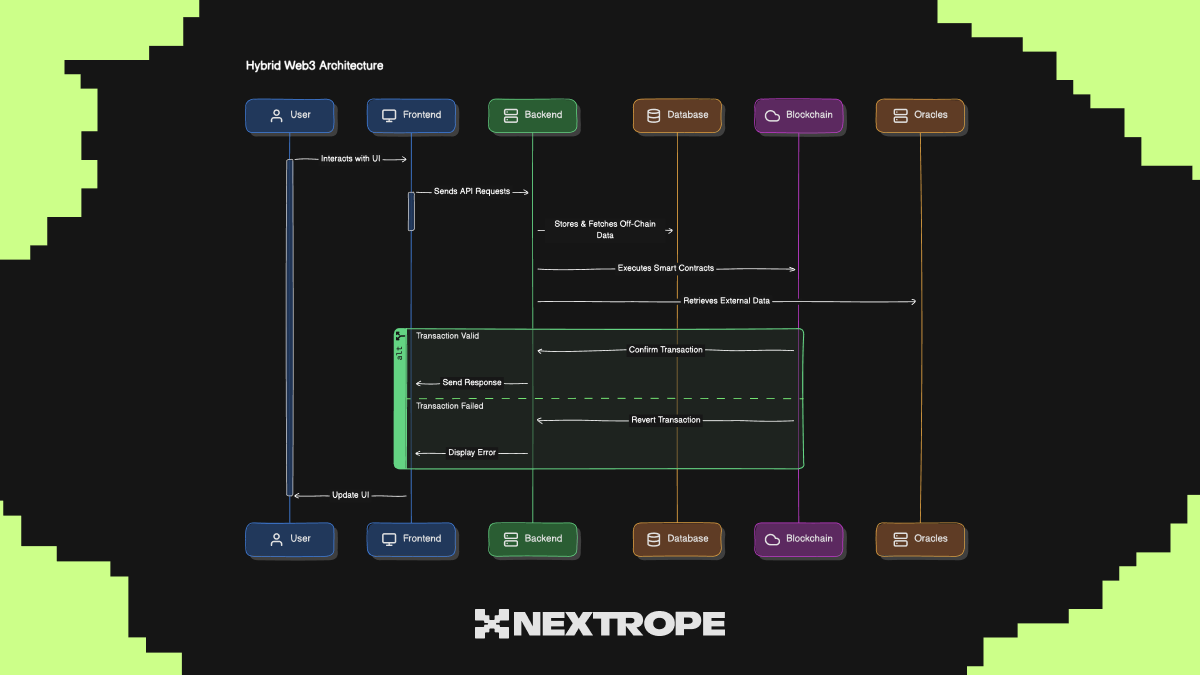
Architecture Diagram

Below is an example diagram showing how a hybrid Web3 application splits responsibilities between backend and blockchain components.

Hybrid Web3 Architecture

Comparing Web3 Backend APIs vs. Blockchain-Based Logic

FeatureWeb3 Backend (API)Blockchain (Smart Contracts)Change ManagementCan be updated easilyEvery change requires a new contract deploymentCostTraditional hosting feesHigh gas fees + costly auditsData StorageCan store large datasetsLimited and expensive storageSecuritySecure but relies on centralized infrastructureFully decentralized & trustlessPerformanceFast response timesLimited by blockchain throughput

Reducing Web3 Costs with AI Smart Contract Audit

One of the biggest pain points in Web3 development is the cost of smart contract audits. Each change to the contract code requires a new audit, often costing tens of thousands of dollars.

To address this issue, Nextrope is developing an AI-powered smart contract auditing tool, which:

Reduces audit costs by automating code analysis.

Speeds up development cycles by catching vulnerabilities early.

Improves security by providing quick feedback.

This AI-powered solution will be a game-changer for the industry, making smart contract development more cost-effective and accessible.

Conclusion

Web3 backend development plays a crucial role in scalable and efficient dApps. While full decentralization is ideal in some cases, many projects benefit from a hybrid architecture, where off-chain components optimize performance, reduce costs and improve user experience.

In future posts in this Web3 backend series, we’ll explore specific implementation details, including:

How to design a Web3 API for dApps

Best practices for integrating backend services

Security challenges and solutions

Stay tuned for the next article in this series!


Source link

Endless Secures $110M to Bridge AI and Web3 as the Ultimate Connector – Web3oclock

0
Endless Secures 0M to Bridge AI and Web3 as the Ultimate Connector – Web3oclock


Revolutionizing Web3 Development:

Backed by Industry Leaders:

Leadership with Deep Expertise in AI and Web3:

Xiong Yu, Co-President: Serving as Associate Vice-President at the University of Surrey, Xiong also leads the Institute of Blockchain and Artificial Intelligence. His research in AI and blockchain has been instrumental in developing efficient large language models and real-time AI-generated imaging. Additionally, he has held visiting positions at esteemed institutions such as Cambridge and Oxford.

Amit Kumar Jaiswal, Chief Technology Officer: An academic chair at the Indian Institute of Technology’s School of Computer Science, Amit is also a researcher at the University of Surrey. He specializes in machine learning, generative AI, decentralized finance (DeFi), and Web3. Previously, he co-founded Quanonblocks LLP and served as its Chief Technology Officer.

Ned, Chief Token Economist: With more than a decade of experience in quantitative finance and blockchain, Ned has worked on pioneering projects in DeFi, blockchain infrastructure, and Web3 innovation. His research at Oxford and Cambridge has focused on distributed systems and token economics, contributing to groundbreaking advancements in the space.

Shaping the Future of AI and Web3:

About Endless Web3 Genesis Cloud:


Source link

AI Optimization and Orchestration Market Poised for Rapid Growth, Expected to Reach USD 44 Billion by 2031 | Web3Wire

0
AI Optimization and Orchestration Market Poised for Rapid Growth, Expected to Reach USD 44 Billion by 2031 | Web3Wire


AI Optimization and Orchestration Market

Latest Study on Growth of AI Optimization and Orchestration Market 2024-2031. A detailed study was accumulated to offer the latest insights about the acute features of the AI optimization and orchestration market. The report contains different market predictions related to revenue size, production, CAGR, Consumption, gross margin, price, and other substantial factors.

According to HTF MI, the AI Optimization and Orchestration Market is estimated to reach USD 44 Billion by 2031, currently pegged at USD 12.8 Billion. In 2020 the market size was ~ USD 3.9 Billion since then a growth rate of 28 % was witnessed in the market.

The Major Players Covered in this Report: VMware, Cisco, IBM, Red Hat, Microsoft, Datadog, Splunk, ServiceNow, Oracle, BMC Software, CloudBolt, Turbonomic, Trend Micro, AppDynamics, NetApp, Elastic, Dynatrace, Nagios

Get Access to Statistical Data, Charts & Key Players’ Strategies 👉 https://www.htfmarketreport.com/sample-report/4344706-global-ai-optimization-and-orchestration-market-growth?utm_source=Krati_OpenPR&utm_id=Krati

Definition:AI optimization and orchestration involves the use of artificial intelligence to manage and optimize IT infrastructure and business processes. It integrates AI with traditional orchestration frameworks to automate decision-making, optimize resources, and improve operational efficiency. AI-based orchestration enables businesses to run multi-cloud environments efficiently, enhancing performance and minimizing downtime by predicting resource demands, automating tasks, and providing real-time insights.

Market DynamicsMarket Trends:Emergence of AI-driven orchestration, autonomous systems, real-time decision-making

Market Drivers:Rising demand for intelligent IT management, multi-cloud environments, and automation

Market Challenges:Integration complexity, scaling challenges, need for cross-platform compatibility

Read Detailed Index of full Research Study at 👉 https://www.htfmarketreport.com/reports/4344706-global-ai-optimization-and-orchestration-market-growth

The titled segments and sub-sections of the market are illuminated below:In-depth analysis of AI Optimization and Orchestration market segments by Types: Cloud-based, IT Automation, Orchestration, Machine Learning-based, HybridDetailed analysis of AI Optimization and Orchestration market segments by Applications: IT Operations, Cloud Infrastructure, Network Management, Real-time Monitoring, Business Process Automation

Regional Analysis of AI Optimization and Orchestration Market:By region, North America has shown clear dominance in AI Optimization and Orchestration market sizing, and the APAC region has witnessed the fastest growth and will continue at the same pace till 2031.

Furthermore, the years considered for the study are as follows:Historical year – 2020-2024Base year – 2024Forecast period** – 2024 to 2031 [** unless otherwise stated]

**Moreover, it will also include the opportunities available in micro markets for stakeholders to invest, a detailed analysis of the competitive landscape, and product services of key players.

Buy Our Latest Edition 👉 https://www.htfmarketreport.com/buy-now?format=1&report=4344706-global-ai-optimization-and-orchestration-market-growth?utm_source=Krati_OpenPR&utm_id=Krati

Key takeaways from the AI Optimization and Orchestration market report:– Detailed consideration of AI Optimization and Orchestration market particular drivers, Trends, constraints, Restraints, Opportunities, and major micro markets.– Comprehensive valuation of all prospects and threats in the– In-depth study of industry strategies for growth of the AI Optimization and Orchestration market-leading players.– AI Optimization and Orchestration market latest innovations and major procedures.– Favorable dip inside Vigorous high-tech and market latest trends remarkable the Market.– Conclusive study about the growth conspiracy of the AI Optimization and Orchestration market for forthcoming years.

What to Expect from this Report On AI Optimization and Orchestration Market:1. A comprehensive summary of several area distributions and the summary types of popular products in the AI Optimization and Orchestration Market.2. You can fix up the growing databases for your industry when you have info on the cost of the production, cost of the products, and cost of the production for the next years.3. Thorough Evaluation of the break-in for new companies who want to enter the AI Optimization and Orchestration Market.4. Exactly how do the most important companies and mid-level companies make income within the Market?5. Complete research on the overall development within the AI Optimization and Orchestration Market that helps you select the product launch and overhaul growths.

Reach Our Experts For Any Question 👉 https://www.htfmarketreport.com/enquiry-before-buy/4344706-global-ai-optimization-and-orchestration-market-growth?utm_source=Krati_OpenPR&utm_id=Krati

Detailed TOC of AI Optimization and Orchestration Market Research Report-– AI Optimization and Orchestration Introduction and Market Overview– AI Optimization and Orchestration Market, by Application [IT Operations, Cloud Infrastructure, Network Management, Real-time Monitoring, Business Process Automation]– AI Optimization and Orchestration Industry Chain Analysis– AI Optimization and Orchestration Market, by Type [Cloud-based, IT Automation, Orchestration, Machine Learning-based, Hybrid]– Industry Manufacture, Consumption, Export, Import by Regions (2020-2023E)– Industry Value ($) by Region (2020-2023E)– AI Optimization and Orchestration Market Status and SWOT Analysis by Regions

– Major Region of AI Optimization and Orchestration Marketi) AI Optimization and Orchestration Salesii) AI Optimization and Orchestration Revenue & market share– Major Companies List– Conclusion

Thanks for reading this article; you can also get individual chapter-wise sections or region-wise report versions like North America, MINT, BRICS, G7, Western / Eastern Europe, or Southeast Asia. Also, we can serve you with customized research services as HTF MI holds a database repository that includes public organizations and Millions of Privately held companies with expertise across various Industry domains.

Nidhi Bhawsar (PR & Marketing Manager)HTF Market Intelligence Consulting Private LimitedPhone: +15075562445sales@htfmarketreport.com

About Author:HTF Market Intelligence Consulting is uniquely positioned to empower and inspire with research and consulting services to empower businesses with growth strategies, by offering services with extraordinary depth and breadth of thought leadership, research, tools, events, and experience that assist in decision-making.

This release was published on openPR.

About Web3Wire Web3Wire – Information, news, press releases, events and research articles about Web3, Metaverse, Blockchain, Artificial Intelligence, Cryptocurrencies, Decentralized Finance, NFTs and Gaming. Visit Web3Wire for Web3 News and Events, Block3Wire for the latest Blockchain news and Meta3Wire to stay updated with Metaverse News.


Source link

TRON DAO Fuels Web3 Growth at ETH Denver 2025, Golden Sponsor of CUBE Summit

0
TRON DAO Fuels Web3 Growth at ETH Denver 2025, Golden Sponsor of CUBE Summit


Disclosure: This is a sponsored post. Readers should conduct further research prior to taking any actions. Learn more ›

Geneva, Switzerland , March 3 2025TRON DAO made its way to ETH Denver 2025, one of the most talked about blockchain conferences in the industry. While attending ETH Denver, TRON DAO came in as a Golden Sponsor for the highly anticipated CUBE Summit.The CUBE Summit, led by BuidlerDAO —short for the Collaborative University Blockchain Ecosystem Summit—marked the first-ever collaboration among twelve distinguished university blockchain clubs, including Cambridge, Columbia, Cornell, Harvard, MIT, NYU, Oxford, Princeton, Stanford, UC Berkeley, UPenn, and Yale. The CUBE summit aims to cultivate emerging talent and foster innovative projects, paving the way for the next generation of crypto leaders.

Day 2 of ETH Denver started off with Sam Elfarra, Community Spokesperson of TRON DAO engaging in a keynote session with a packed crowd, holding discussions around stablecoins and payments, showcasing the growing interest in blockchain-based financial solutions. Elfarra was also a judge for CUBE Summit’s Pitch Sessions — a platform for innovative projects to be built, showcased and pitched. Elfarra also presented a TRON award for the most outstanding project pitched that evening. Accelerating groundbreaking ideas that have the potential to shape the future of decentralized finance and Web3 applications.

TRON DAO also co-hosted CUBE Talent Night alongside BuidlerDAO and Blockchain at Berkeley which was held on 28th February. The networking session started off with a short welcome speech from TRON DAO touching on the latest updates happening on TRON, DeFi, and the broader Web3 ecosystem. TRON DAO’s participation highlighted its mission to empower a decentralized internet and promote real-world blockchain adoption to the next generation of rising talents.

“ETH Denver represented a hub for blockchain innovation, and TRON DAO was excited to be part of this gathering of bright minds and cutting-edge projects,” said Sam Elfarra, Community Spokesperson at TRON DAO. “Through our participation with the community over at CUBE Talent Night, we hope to have provided valuable insights and opportunities for developers and entrepreneurs who are shaping the future of the Web3 ecosystem. Let’s continue to build.”ETH Denver was the second major conference since the launch of TRON Builders League (TBL) that happened on February 19, 2025. This incubator program is designed to empower blockchain developers which offers mentorship, ecosystem integration and a funding pool of up to $10 million that has caught the eyes of many. TBL provides high-potential projects with the sustained support they need within the TRON ecosystem. For more information, visit TRON Builders League’s official page

TRON DAO’s participation at ETH Denver and the sponsorship of the CUBE Summit highlights its continued support for blockchain innovation which ties in well with the mission of TRON Builders League. All in efforts to foster talent and drive the next wave of Web3 development.

About TRON DAO

TRON DAO is a community-governed DAO dedicated to accelerating the decentralization of the internet via blockchain technology and dApps.

Founded in September 2017 by H.E. Justin Sun, the TRON blockchain has experienced significant growth since its MainNet launch in May 2018. Until recently, TRON hosted the largest circulating supply of USD Tether (USDT) stablecoin, exceeding $60 billion. As of March 2025, the TRON blockchain has recorded over 290 million in total user accounts, more than 9.6 billion in total transactions, and over $21 billion in total value locked (TVL), based on TRONSCAN.

TRONNetwork | TRONDAO | X | YouTube | Telegram | Discord | Reddit | GitHub | Medium | Forum

Media ContactYeweon Park[email protected]

Mentioned in this article


Source link

Crypto.com CRO faces backlash amid 70 billion burned token restore, 87% early voters say ‘no’

0
Crypto.com CRO faces backlash amid 70 billion burned token restore, 87% early voters say ‘no’


Cronos, the Layer 1 blockchain linked to Crypto.com, faces strong opposition over a proposal to restore 70 billion CRO tokens burned in 2021.

Early voting results on Mintscan show that 87% of participants have rejected the plan.

Cronos’ strategic reserve proposal

The proposal states reinstating the burned tokens will create a Cronos Strategic Reserve.

Crypto.com’s CEO Kris Marszalek said:

“Cronos allocates a $5 billion stockpile to make America the World Capital of Crypto.”

Cronos developers argue that this aligns with Cronos’ long-term vision and supports its growth strategy. If approved, the total supply of CRO would return to 100 billion, with the tokens held in an escrow wallet.

The reserve would be subject to strict control measures, including a new five-year lockup period. This would extend the vesting timeline to 10 years, incorporating a linear vesting mechanism that distributes monthly tokens via the Cosmos SDK on Cronos POS Chain.

Additionally, adjustments to CRO emission parameters would ensure validator rewards remain unchanged despite the increase in circulating supply.

The voting process is scheduled between March 3 and March 17, 2025, with implementation expected to follow shortly after.

Meanwhile, Cronos’ move is part of its broader strategy to position itself as the leading blockchain for AI-driven applications. The project also aims to secure a spot exchange-traded fund (ETF) listing and plans to launch a stablecoin in Q3 2025, followed by an ETF application submission in Q4.

Community pushback

Despite Cronos’ strategic goals, the proposal has sparked controversy.

Mintscan data shows that more than 500 million CRO tokens have been used in the vote, with 490 million—87%—opposing the move. Only 4%, or around 25.5 million CROs, have supported it.

The backlash has been evident across social media, where Wyll Bilderberg, a CRO advocate, said:

“A burn is a burn, burnt tokens shouldn’t be brought back to life. I’m almost never against anything happening on Cronos, but today, I’m against it, big time! If this pass, it’s will just be a confirmation that Cronos is heavily centralized, and so can’t be trusted.”

However, the proposal has unexpectedly impacted CRO’s market performance. According to CryptoSlate data, the token surged 15% during the reporting period, reaching $0.08434 as of press time.

Mentioned in this article


Source link

Ex-Football Star Ronaldinho’s Token Dips 18% on Debut Amid Insider Trading Allegations – Decrypt

0
Ex-Football Star Ronaldinho’s Token Dips 18% on Debut Amid Insider Trading Allegations – Decrypt


Football legend Ronaldinho Gaúcho’s new official token debuted to a rocky start Sunday, amid concerns around “early snipers” and a “serious security risk.”

Launched Sunday exclusively on the BNB chain, Ronaldinho Coin (STAR10) made its debut to fanfare, promising the footballer’s massive global following access to “exclusive experiences, real benefits, signed collectibles, and an AI Agent.”

The enthusiasm quickly soured, as the retired footballer’s token saw significant volatility on its launch, dropping by over 25% from its peak at $0.387 to its current price of $0.289, per data from CoinGecko.

Its rocky launch trajectory mirrors that of other high profile tokens, such as the Argentine President Javier Milei-endorsed LIBRA token.

The token’s distribution allocates 20% of the total supply to Ronaldinho—significantly higher than typical allocations in most crypto projects. For most projects, the founder’s share generally hovers around 5-10%.

One blockchain analytics firm, Onchainlens, flagged  that one wallet profited nearly $5 million after spending just $29,247 to buy tokens, while crypto copy-trading platform lmk.fun highlighted that the token launch was “filled with ‘early snipers’.”

GoPlus Security, a Web3 security platform, tweeted a security alert after discovering a critical vulnerability, revealing that STAR10’s owner could burn any holder’s tokens at will since ownership had not been renounced.

The alert led to Binance founder Changpeng Zhao (“CZ”), warning traders to “Please beware!”

Ronaldinho responded to CZ’s tweet, saying that, “Ownership was not renounced? Now it is! Tokens cannot be destroyed without warning,” which was subsequently confirmed by GoPlus.

Ronaldinho’s crypto history

Brazilian football legend Ronaldinho has been linked to a number of crypto ventures.

The footballer launched his first token, RON, on the P00LS platform in 2022, but the project failed to generate significant traction. That same year, he promoted the World Cup Inu token—a meme coin launched ahead of the 2022 FIFA World Cup in Qatar. Like many celebrity-backed crypto projects, the token saw an initial surge in value, followed by a dramatic crash.

In 2023, he appeared in court to deny any involvement in the “18kRonaldinho” crypto pyramid scheme, claiming that his likeness had been used without his consent. The scheme promised daily returns of 2% but ultimately collapsed, leading to a $61 million lawsuit.

Edited by Stacy Elliott.

Daily Debrief Newsletter

Start every day with the top news stories right now, plus original features, a podcast, videos and more.


Source link

Nextrope Launches “AI-Powered Smart Contract Auditing” Project – Nextrope – Your Trusted Partner for Blockchain Development and Advisory Services

0
Nextrope Launches “AI-Powered Smart Contract Auditing” Project – Nextrope – Your Trusted Partner for Blockchain Development and Advisory Services


Decentralized systems are reshaping how we interact, conduct transactions, and govern online communities. As Web3 continues to advance, the necessity for effective and fair voting mechanisms becomes apparent. Traditional voting systems, such as the one-token-one-vote model, often fall short in capturing the intensity of individual preferences, which can result in centralization. Quadratic Voting (QV) addresses this challenge by enabling individuals to express not only their choices but also the strength of their preferences.

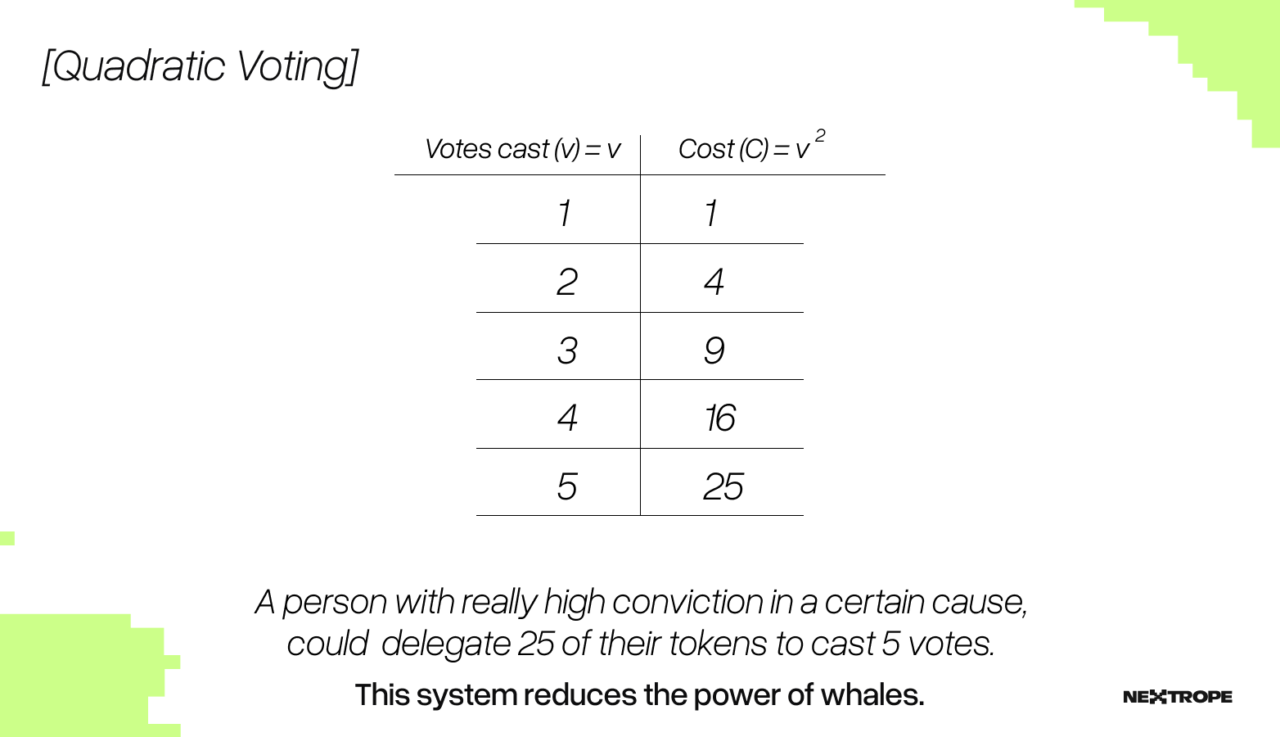
In QV, voters are allocated a budget of credits that they can spend to cast votes on various issues. The cost of casting multiple votes on a single issue increases quadratically, meaning that each additional vote costs more than the last. This system allows for a more precise expression of preferences, as individuals can invest more heavily in issues they care deeply about while conserving credits on matters of lesser importance.

Understanding Quadratic Voting

Quadratic Voting (QV) is a voting system designed to capture not only the choices of individuals but also the strength of their preferences. In most DAO voting mechanisms, each person typically has one vote per token, which limits the ability to express how strongly they feel about a particular matter. Furthermore, QV limits the power of whales and founding team who typically have large token allocations. These problems are adressed by making the cost of each additional vote increase quadratically.

In QV, each voter is given a budget of credits or tokens that they can spend to cast votes on various issues. The key principle is that the cost to cast n votes on a single issue is proportional to the square of n. This quadratic cost function ensures that while voters can express stronger preferences, doing so requires a disproportionately higher expenditure of their voting credits. This mechanism discourages voters from concentrating all their influence on a single issue unless they feel very strongly about it. In the context of DAOs, it means that large holders will have a hard-time pushing through with a proposal if they’ll try to do it on their own.

Practical Example

Consider a voter who has been allocated 25 voting credits to spend on several proposals. The voter has varying degrees of interest in three proposals: Proposal A, Proposal B, and Proposal C.

Proposal A: High interest.

Proposal B: Moderate interest.

Proposal C: Low interest.

The voter might allocate their credits as follows:

Proposal A:

Votes cast: 3

Cost: 9 delegated tokens

Proposal B:

Votes cast: 2

Cost: 4 delegated tokens

Proposal C:

Votes cast: 1

Cost: 1 delegated token

Total delegated tokens: 14Remaining tokens: 11

With the remaining tokens, the voter can choose to allocate additional votes to the proposals based on their preferences or save for future proposals. If they feel particularly strong about Proposal A, they might decide to cast one more vote:

Additional vote on Proposal A:

New total votes: 4

New cost: 16 delegated tokens

Additional cost: 16−9 = 7 delegated tokens

Updated total delegated tokens: 14+7 = 21

Updated remaining tokens: 25−21 = 425 – 21 = 4

This additional vote on Proposal A costs 7 credits, significantly more than the previous vote, illustrating how the quadratic cost discourages excessive influence on a single issue without strong conviction.

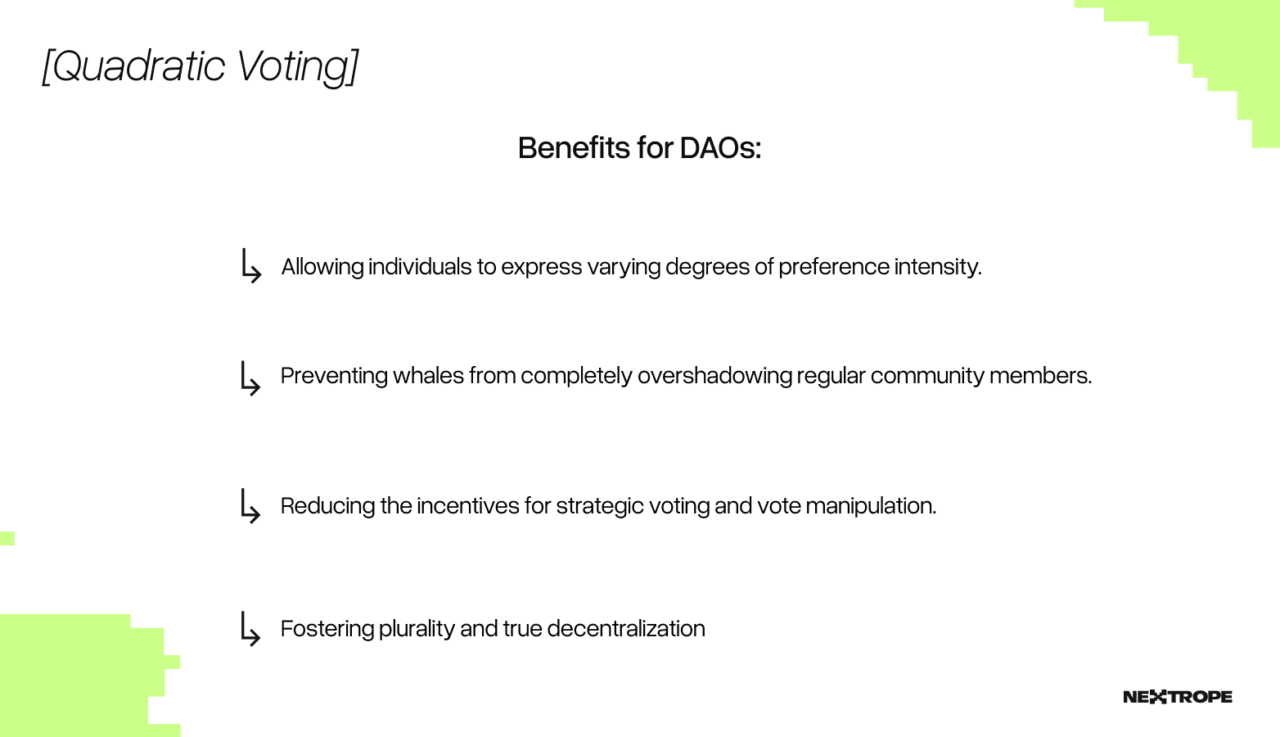
Benefits of Implementing Quadratic Voting

Key Characteristics of the Quadratic Cost Function

Marginal Cost Increases Linearly: The marginal cost of each additional vote increases linearly. The cost difference between casting n and n−1 votes is 2n−1.

Total Cost Increases Quadratically: The total cost to cast multiple votes rises steeply, discouraging voters from concentrating too many votes on a single issue without significant reason.

Promotes Egalitarian Voting: Small voters are encouraged to participate, because relatively they have a much higher impact.

Advantages Over Traditional Voting Systems

Quadratic Voting offers several benefits compared to traditional one-person-one-vote systems:

Captures Preference Intensity: By allowing voters to express how strongly they feel about an issue, QV leads to outcomes that better reflect the collective welfare.

Reduces Majority Domination: The quadratic cost makes it costly for majority groups to overpower minority interests on every issue.

Encourages Honest Voting: Voters are incentivized to allocate votes in proportion to their true preferences, reducing manipulation.

By understanding the foundation of Quadratic Voting, stakeholders in Web3 communities can appreciate how this system supports more representative governance.

Conclusion

Quadratic voting is a novel voting system that may be used within DAOs to foster decentralization. The key idea is to make the cost of voting on a certain issue increase quadratically. The leading player that makes use of this mechanism is Optimism. If you’re pondering about the design of your DAO, we highly recommend taking a look at their research on quadratic funding.

If you’re looking to create a robust governance model and go through institutional-grade testing please reach out to contact@nextrope.com. Our team is ready to help you with the token engineering process and ensure that your DAO will stand out as a beacon of innovation and resilience in the long term.


Source link

Smart Electronic License Plate Market Hits New High | Major Giants HELLA, Si2, Perceptics, Motorola Solutions, Q-Free ASA | Web3Wire

0
Smart Electronic License Plate Market Hits New High | Major Giants HELLA, Si2, Perceptics, Motorola Solutions, Q-Free ASA | Web3Wire


Smart Electronic License Plate Market

HTF Market Intelligence just released the Global Smart Electronic License Plate Market Study, a comprehensive analysis of the market that spans more than 143+ pages and describes the product and industry scope as well as the market prognosis and status for 2025-2032. The marketization process is being accelerated by the market study’s segmentation by important regions. The market is currently expanding its reach.

Major companies in Smart Electronic License Plate Market are: 3M, Global Tags, TransCore, American Highway Technologies, HELLA, Si2, Perceptics, Motorola Solutions, Q-Free ASA, Datamax-O’Neil, ParkMobile, Hella, Kapsch TrafficCom, SICE, NTT Data Corporation, Smartrak, IMEX Systems, Perceptics, Teledyne Technologies others.

Request PDF Sample Copy of Report: (Including Full TOC, List of Tables & Figures, Chart) @👉 https://www.htfmarketreport.com/sample-report/3916459-smart-electronic-license-plate-market?utm_source=Sonali_Openpr&utm_id=Sonali

HTF Market Intelligence projects that the global Smart Electronic License Plate market will expand at a compound annual growth rate (CAGR) of 25.3% from 2025 to 2032, from 1.2 billion in 2025 to 5 billion by 2032.

The following Key Segments Are Covered in Our Report

By TypeSmart Plates, RFID Tags, Camera Integrated Plates, Digital Plates, GPS Integrated Plates

By ApplicationAutomotive, Transport, Security, Law Enforcement, Smart Cities

Definition:The Smart Electronic License Plate Market includes digital, GPS-enabled, and RFID-integrated plates that offer vehicle identification, tracking, and monitoring. These plates can provide real-time data for law enforcement, toll collection, and vehicle management, supporting the development of smart cities and intelligent transportation systems. They are increasingly used for vehicle theft prevention, traffic monitoring, and enhanced security.Market Trends:• Integration with IoT, vehicle tracking, real-time data managementMarket Drivers:• Increase in demand for vehicle identification, government regulations, growth in smart city initiativesMarket Challenges:• Privacy concerns, high production costs, security risks

Dominating Region:• North America, Europe, Asia Pacific

Fastest-Growing Region:• Latin America, Africa

Buy Now Latest Edition of Smart Electronic License Plate Market Report 👉 https://www.htfmarketreport.com/buy-now?format=1&report=3916459?utm_source=Sonali_Openpr&utm_id=Sonali

The titled segments and sub-section of the market are illuminated below:In-depth analysis of Smart Electronic License Plate market segments by Types: Smart Plates, RFID Tags, Camera Integrated Plates, Digital Plates, GPS Integrated PlatesDetailed analysis of Smart Electronic License Plate market segments by Applications: Automotive, Transport, Security, Law Enforcement, Smart Cities

Global Smart Electronic License Plate Market -Regional Analysis

• North America: United States of America (US), Canada, and Mexico.• South & Central America: Argentina, Chile, Colombia, and Brazil.• Middle East & Africa: Kingdom of Saudi Arabia, United Arab Emirates, Turkey, Israel, Egypt, and South Africa.• Europe: the UK, France, Italy, Germany, Spain, Nordics, BALTIC Countries, Russia, Austria, and the Rest of Europe.• Asia: India, China, Japan, South Korea, Taiwan, Southeast Asia (Singapore, Thailand, Malaysia, Indonesia, Philippines & Vietnam, etc) & Rest• Oceania: Australia & New Zealand

To Review Full Table of Content Click Here 👉https://www.htfmarketreport.com/reports/3916459-smart-electronic-license-plate-market

Smart Electronic License Plate Market Research Objectives:– Focuses on the key manufacturers, to define, pronounce and examine the value, sales volume, market share, market competition landscape, SWOT analysis, and development plans in the next few years.– To share comprehensive information about the key factors influencing the growth of the market (opportunities, drivers, growth potential, industry-specific challenges and risks).– To analyze the with respect to individual future prospects, growth trends and their involvement to the total market.– To analyze reasonable developments such as agreements, expansions new product launches, and acquisitions in the market.– To deliberately profile the key players and systematically examine their growth strategies.

FIVE FORCES & PESTLE ANALYSIS:In order to better understand market conditions five forces analysis is conducted that includes the Bargaining power of buyers, Bargaining power of suppliers, Threat of new entrants, Threat of substitutes, and Threat of rivalry.• Political (Political policy and stability as well as trade, fiscal, and taxation policies)• Economical (Interest rates, employment or unemployment rates, raw material costs, and foreign exchange rates)• Social (Changing family demographics, education levels, cultural trends, attitude changes, and changes in lifestyles)• Technological (Changes in digital or mobile technology, automation, research, and development)• Legal (Employment legislation, consumer law, health, and safety, international as well as trade regulation and restrictions)• Environmental (Climate, recycling procedures, carbon footprint, waste disposal, and sustainability)

Have different Market Scope & Business Objectives; Enquire for customized study https://www.htfmarketreport.com/enquiry-before-buy/3916459-smart-electronic-license-plate-market?utm_source=Sonali_Openpr&utm_id=Sonali

Points Covered in Table of Content of Global Smart Electronic License Plate Market:Chapter 01 – Smart Electronic License Plate Executive SummaryChapter 02 – Market OverviewChapter 03 – Key Success FactorsChapter 04 – Global Smart Electronic License Plate Market – Pricing AnalysisChapter 05 – Global Smart Electronic License Plate Market Background or HistoryChapter 06 – Global Smart Electronic License Plate Market Segmentation (e.g. Type, Application)Chapter 07 – Key and Emerging Countries Analysis Worldwide Smart Electronic License Plate MarketChapter 08 – Global Smart Electronic License Plate Market Structure & worth AnalysisChapter 09 – Global Smart Electronic License Plate Market Competitive Analysis & ChallengesChapter 10 – Assumptions and AcronymsChapter 11 – Smart Electronic License Plate Market Research Methodology

Thanks for reading this article; you can also get individual chapter-wise sections or region-wise report versions like North America, LATAM, Europe, Japan, Australia or Southeast Asia.

Contact Us :Nidhi Bhavsar (PR & Marketing Manager)HTF Market Intelligence Consulting Private LimitedPhone: +15075562445sales@htfmarketintelligence.com

About Author:HTF Market Intelligence Consulting is uniquely positioned to empower and inspire with research and consulting services to empower businesses with growth strategies, by offering services with extraordinary depth and breadth of thought leadership, research, tools, events, and experience that assist in decision-making.

This release was published on openPR.

About Web3Wire Web3Wire – Information, news, press releases, events and research articles about Web3, Metaverse, Blockchain, Artificial Intelligence, Cryptocurrencies, Decentralized Finance, NFTs and Gaming. Visit Web3Wire for Web3 News and Events, Block3Wire for the latest Blockchain news and Meta3Wire to stay updated with Metaverse News.


Source link

Popular Posts

My Favorites