MONACO, June 02, 2026 (GLOBE NEWSWIRE) — Crypto market news is turning toward AlphaPepe as the project’s presale continues to gather pace ahead of its planned Q2 2026 exchange debut. The presale has now crossed $1.45 million in total capital raised, Stage 17 is live at $0.01822, and holder growth has climbed past 9,200 while AlphaSwap demo traction and audit completion continue to support the project’s pre-listing profile.
The $1.45 million milestone gives AlphaPepe a clear company update as Bitcoin price prediction headlines focus on the $50,000 support zone, with Standard Chartered previously warning that BTC could slide toward $50,000 before any sustained recovery if weak momentum, ETF outflows, and macro pressure continue.
AlphaPepe Presale Gathers Pace as Stage 17 Advances
AlphaPepe crossing $1.45 million marks another important milestone in the project’s presale trajectory. Stage 17 is active at $0.01822, and the holder count has now passed 9,200 before public trading begins. That continued growth shows the presale is moving through stage progression, community expansion, and product development ahead of the planned Q2 2026 exchange debut.
The stage-based structure gives participants a visible path as the launch window tightens. Each stage transition brings the next scheduled pricing step closer, while token delivery remains instant with no vesting and no claim delay. That removes one of the most common friction points seen across early-stage launches.
AlphaPepe’s product layer continues to support the presale momentum. AlphaSwap, the project’s AI-powered decentralized exchange, has already surpassed 5,000 active demo users. That gives the project a working product environment before its exchange debut, separating it from many presales that enter public markets with only a roadmap.
AlphaSwap includes AI contract screening, whale wallet tracking, and cross-chain execution on BSC. The contract screening layer is designed to detect risky token behavior before users interact with a smart contract. The whale tracking layer gives traders visibility into large wallet movements as they happen. The cross-chain execution layer is being built to make meme coin trading faster and less fragmented.
The 10/10 BlockSAFU audit adds another layer of credibility before the token reaches exchanges. Combined with 9,200+ holders, over $1.45 million raised, Stage 17 momentum, 5,000 demo users, and instant token delivery, AlphaPepe is building a stronger pre-listing profile than many early-stage meme projects in the current cycle.
Bitcoin Price Prediction Targets $50,000 Support
The Bitcoin price prediction debate has shifted toward the $50,000 support zone after Standard Chartered warned that BTC could fall toward that level before recovery. The bank cited ETF outflows, weak momentum, and a challenging macro backdrop as pressure points for the market.
The $50,000 Bitcoin price prediction remains a bearish support scenario, not a guaranteed outcome. For AlphaPepe, the nearer story is internal execution, with Stage 17 active at $0.01822, over $1.45 million raised, 9,200+ holders, AlphaSwap already tested by more than 5,000 demo users, and the Q2 2026 exchange debut still moving closer.
Conclusion
AlphaPepe’s latest update gives the project a defined company milestone while broader crypto traders continue watching Bitcoin price prediction targets. The presale has crossed $1.45 million, Stage 17 is live at $0.01822, the holder count has passed 9,200, and AlphaSwap has already surpassed 5,000 active demo users.
The $50,000 Bitcoin price prediction shows how defensive market narratives can return when ETF flows, liquidity, and macro sentiment weaken. But AlphaPepe’s roadmap is unfolding on a shorter timeline, with presale progression, product testing, audit completion, and exchange preparation all converging in the same quarter.
For participants tracking early-stage crypto opportunities, the current setup is clear. AlphaPepe has capital raised, holder growth, working product traction, audit credibility, instant token delivery, and Q2 exchange timing moving together. Stage 17 remains active at $0.01822, with the next visible milestones tied to AlphaSwap’s full launch and public exchange access.
CLICK TO VISIT ALPHAPEPE OFFICIAL WEBSITE
FAQs
What is AlphaPepe’s current presale status?AlphaPepe has raised over $1.45 million, Stage 17 is live at $0.01822, and the holder count has passed 9,200. The AlphaSwap AI DEX demo has also surpassed 5,000 active users, and the project has completed a full 10/10 BlockSAFU audit ahead of its planned Q2 2026 exchange debut.
What is the $50,000 Bitcoin price prediction?The $50,000 Bitcoin price prediction refers to a bearish support scenario where BTC could fall toward $50,000 before recovering if ETF outflows, weak momentum, and macro pressure continue. It remains a forecast scenario, not a guaranteed outcome.
About AlphaPepeAlphaPepe is building AlphaSwap, an AI-powered decentralized exchange designed to make on-chain meme coin trading safer, faster, and more transparent. The platform includes AI contract screening, whale wallet tracking, and cross-chain execution on BSC, giving traders additional tools before interacting with early-stage tokens.
AlphaPepe has raised over $1.45 million in its presale, passed 9,200 holders, surpassed 5,000 active AlphaSwap demo users, and completed a full 10/10 BlockSAFU security audit. Stage 17 is live at $0.01822, with instant token delivery, no vesting, no claim delay, and a planned Q2 2026 exchange debut.
Contact:Jack Duffycontact@alphapepe.io
Disclaimer: This content is provided by AlphaPepe. The statements, views, and opinions expressed in this content are solely those of the content provider and do not necessarily reflect the views of this media platform or its publisher. We do not endorse, verify, or guarantee the accuracy, completeness, or reliability of any information presented. We do not guarantee any claims, statements, or promises made in this article. This content is for informational purposes only and should not be considered financial, investment, or trading advice. Investing in crypto and mining-related opportunities involves significant risks, including the potential loss of capital. It is possible to lose all your capital. These products may not be suitable for everyone, and you should ensure that you understand the risks involved. Seek independent advice if necessary. Speculate only with funds that you can afford to lose. Readers are strongly encouraged to conduct their own research and consult with a qualified financial advisor before making any investment decisions. However, due to the inherently speculative nature of the blockchain sector—including cryptocurrency, NFTs, and mining—complete accuracy cannot always be guaranteed. Neither the media platform nor the publisher shall be held responsible for any fraudulent activities, misrepresentations, or financial losses arising from the content of this press release. In the event of any legal claims or charges against this article, we accept no liability or responsibility. Globenewswire does not endorse any content on this page.
Legal Disclaimer: This media platform provides the content of this article on an “as-is” basis, without any warranties or representations of any kind, express or implied. We assume no responsibility for any inaccuracies, errors, or omissions. We do not assume any responsibility or liability for the accuracy, content, images, videos, licenses, completeness, legality, or reliability of the information presented herein. Any concerns, complaints, or copyright issues related to this article should be directed to the content provider mentioned above.
A photo accompanying this announcement is available at https://www.globenewswire.com/NewsRoom/AttachmentNg/06ace189-aebd-47a3-944c-f7dc7ff2f777
About Web3Wire Web3Wire – Information, news, press releases, events and research articles about Web3, Metaverse, Blockchain, Artificial Intelligence, Cryptocurrencies, Decentralized Finance, NFTs and Gaming. Visit Web3Wire for Web3 News and Events, Block3Wire for the latest Blockchain news and Meta3Wire to stay updated with Metaverse News.
The U.S. Treasury Department’s Office of Foreign Assets Control designated four Iranian cryptocurrency exchanges for sanctions violations.
Nobitex, Iran’s largest digital asset exchange, was among the sanctioned platforms alongside Wallex, Bitpin, and Ramzinex.
The Treasury alleged that the platforms facilitated terrorist financing, sanctions evasion, and ransomware payments.
The U.S. Treasury Department’s Office of Foreign Assets Control designated Nobitex, Iran’s largest digital asset exchange, along with three other Iranian cryptocurrency platforms for allegedly facilitating terrorist financing and sanctions evasion.
The Treasury Department alleges Nobitex processed more than 50% of all Iranian digital asset inflows in 2025 and facilitated payments tied to Iran’s terrorist activities, sanctions evasion efforts, and Islamic Revolutionary Guard Corps-linked transactions, including IRGC-affiliated ransomware actors.
The exchange also helped the Central Bank of Iran access hundreds of millions of dollars in stablecoins used to prop up the plummeting value of the Iranian rial, the Treasury alleged in the sanctions announcement.
Wallex, Iran’s second-largest digital asset exchange by volume, received 12% of Iranian digital asset inflows in 2025. Bitpin, which accounts for 10% of such inflows, faced sanctions for having investors reportedly linked to Iranian sanctions evasion efforts. Ramzinex, a Tehran-based digital asset exchange founded in 2018, processed over $2.45 billion in transactions.
The Treasury Department also sanctioned four individuals connected to Nobitex, including chairman and co-founder Amir Hossein Rad, who helped reconstitute operations following a $90 million hack in June 2025. Two co-founders, Seyed Mohammad Ali Aghamir and Seyed Mohammad Aghamir Mohammad Ali, are members of the Kharrazi family, part of Supreme Leader Khamenei’s inner circle. Current Nobitex CEO Seyed Ali Khoee, who previously served as director of product and marketing, was also designated.
Monday’s sanctions mark the latest enforcement action in the Treasury’s campaign against Iranian crypto assets.
Treasury Secretary Scott Bessent said last week that his department had seized around $1 billion in cryptocurrency from Iranian exchanges and wallets since the beginning of its enforcement campaign against Iran. In April, Tether froze $344.2 million in stablecoins held across two wallets attributed to the Central Bank of Iran.
“As promised, Treasury will continue to follow the money in support of Economic Fury, whether it is through the banking system or through digital assets, to prevent the regime from developing a nuclear weapon,” Bessent said in the Treasury statement.
Daily Debrief Newsletter
Start every day with the top news stories right now, plus original features, a podcast, videos and more.
Proven vertical healthcare SaaS and AI operator joins to accelerate Enterprise Health’s growth and scale its workforce health platform across the enterprise market.
FORT WAYNE, IN / ACCESS Newswire / June 2, 2026 / Enterprise Health today announced the appointment of Rick Pharr as Chief Executive Officer. Rick, a proven vertical healthcare SaaS and AI operator known for scaling category-leading companies through periods of rapid growth and operational expansion, joins Enterprise Health at a pivotal growth moment, as demand accelerates for centralized, intelligent and clinically credible workforce health and performance infrastructure.
The workforce health category is undergoing a structural shift as operational continuity, regulatory readiness, clinical governance and workforce availability become enterprise priorities for large employers, including health systems, corporations, government agencies, universities and international organizations. Enterprise Health is purpose-built for this moment, and Rick’s appointment positions the company to capture the opportunity ahead.
Rick’s background is closely aligned with Enterprise Health’s growth stage. He has spent his career taking specialized clinical and operational software companies from founder-led growth to enterprise scale, with a consistent focus on customer experience, retention and operational discipline. That experience aligns directly with what Enterprise Health needs to expand its enterprise customer base and deliver greater value to customers while scaling the impact of its platform.
“We are thrilled that Rick is joining our team to catalyze the next stage of our growth,” said Jeff Donnell, President of Enterprise Health. “Rick shares my commitment to crafting and delivering a superior client experience at every point of interaction, and this client-first outlook coupled with demonstrated healthcare and EHS success makes him the right leader at the right time.”
Leadership at a Growth Inflection
Jeff Donnell will continue as President of Enterprise Health, partnering closely with Rick to build customer relationships, drive market expansion and reinforce the company’s thought leadership position. Doug Horner, founder of Enterprise Health, remains actively engaged in driving innovation. Together, the leadership team is focused on accelerating growth and scaling the impact of the Enterprise Health platform for customers.
“Enterprise Health exists because of the people who trusted us to solve a hard problem in workforce health,” said Doug Horner, founder of Enterprise Health. “Bringing Rick in as CEO is about making sure we honor that trust at scale. He knows how to scale platforms like this into category leaders. I’m staying engaged on the innovation that makes this platform special, and I couldn’t be more excited about what we build together from here.”
About Rick Pharr
He joins Enterprise Health from Kipu Health, where he served as Chief Operating Officer of a category-leading behavioral health EHR used across behavioral health and addiction treatment facilities. Prior to Kipu, Rick served as Senior Vice President of Operations at WebPT, a market-leading rehabilitation therapy EHR, and previously as Chief Customer and Operating Officer at SmartVault Corporation. Across these roles, Rick scaled high-growth vertical SaaS companies to market leadership, with deep expertise in customer success, operational scale and revenue execution. He also helped operationalize AI-driven workflows and automation to improve customer experience, operational scale and clinical efficiency.
“Workforce health is at an inflection point, and Enterprise Health is purpose-built for it with deep clinical credibility, a loyal enterprise customer base and AI woven into the platform long before it became an industry conversation,” said Rick Pharr, Chief Executive Officer of Enterprise Health. “This team has been building real innovation for clinicians for years, and what’s coming next makes that even more exciting. My immediate focus is on our customers, earning their trust, delivering on our commitments and building on the strong foundation that Doug, Jeff and this team have created.”
About Enterprise Health
Enterprise Health is the workforce health platform built for the operational, clinical and regulatory demands of complex enterprises. The platform combines occupational and employee health, compliance and surveillance, clinical documentation, immunizations and absence management on an ONC-certified electronic health record foundation. Enterprise Health serves leading health systems, corporations, government agencies and universities.
Learn more at enterprisehealth.com
Media Contact
Mike ImpellusoChief Marketing Officer, Enterprise Health[email protected]
SOURCE: Enterprise Health
About Web3Wire Web3Wire – Information, news, press releases, events and research articles about Web3, Metaverse, Blockchain, Artificial Intelligence, Cryptocurrencies, Decentralized Finance, NFTs and Gaming. Visit Web3Wire for Web3 News and Events, Block3Wire for the latest Blockchain news and Meta3Wire to stay updated with Metaverse News.
ROG G1000 Edition 20 gaming desktop wins the prestigious Golden Award in the Gaming and Immersive Tech categoryASUS ExpertBook Ultra receives a Sustainable Tech Special Award for leadership in sustainable commercial computingASUS and ROG earn eight additional Category Awards for products spanning gaming, AI computing, creative tools, and networking
TORONTO, June 01, 2026 (GLOBE NEWSWIRE) — ASUS today announced that it has received a total of 10 Best Choice Awards at Computex 2026, including the prestigious Golden Award for the ROG G1000 Edition 20 gaming desktop and a Sustainable Tech Special Award for the ASUS ExpertBook Ultra. These accolades underscore the company’s continued leadership in innovation, product excellence, and commitment to sustainable technology solutions.
In addition to the top honors, ASUS and ROG received eight Category Awards for standout products, including the ASUS Ascent GX10 in the AI Computing and Tech category, the ROG Zephyrus Duo (2026), the ROG Flow Z13-KJP (2026), and the ROG Rapture GT-BN98 Pro in the Gaming and Immersive Tech category. The ASUS Zenbook DUO (UX8407), ASUS ProArt GoPro Edition (PX13), and ROG Thor 3000W Titanium III Edition 20 were recognized in the Computer and System category, and the ROG Cetra Open Wireless in the Other Applications category.
ROG G1000 Edition 20
The ROG G1000 Edition 20, the winner of the Golden Award, features an exclusive black and gold colorway that blends matte textures with gold accents for ultimate collectability. The world’s first prebuilt gaming PC to feature the AniMe Holo holographic fan system, it allows users to showcase ROG icons or custom animations via Sync, Fusion, and Solo modes. The Tri-zone airflow design isolates airflow to the CPU, GPU, and PSU. The ROG Thermal Atrium with a 420mm AIO cooler draws fresh air directly, reducing intake temperatures by up to 16°C. Powered by AMD Ryzen™ 9 9950X3D and ROG Astral RTX 5090, with 128GB DDR5, it delivers uncompromised performance. The chassis features geometric aesthetics and energy-guide lighting. With a physical Fan Key and total dust protection, it’s a masterpiece of tech and luxury.
ASUS ExpertBook Ultra
The ASUS ExpertBook Ultra, the winner of the Sustainable Tech Special Award, redefines business performance with precision and without compromise. With a chassis crafted from 90% PIR recycled magnesium-aluminum alloy, complemented by 30% PCR plastics and 100% recycled rare-earth magnets, merging high-end aesthetics with deep circular responsibility, it weighs just 0.99kg yet achieves 9H durability— leveraging Nano Ceramic Technology. Powered by Intel Core™ Ultra X9 Series 3 processors, Intel Arc™ Pro graphics, and Intel vPro®, it delivers effortless power and AI-optimized productivity. ASUS ExpertCool Pro cooling system delivers up to 50W TDP performance, while ASUS ExpertGuardian and its NIST SP 800-193 resiliency ensure enterprise-grade protection. The ExpertBook Ultra is leading the industry by adopting the Digital Product Passport (DPP) and Product Environmental Footprint (PEF) to ensure total lifecycle transparency. Elegant, intelligent, and refined — it defines the new pinnacle of premium business laptops.
Glimpse the Future
The ROG G1000 Edition 20 and ASUS ExpertBook Ultra, along with all other winners, such as the ASUS Ascent GX10, ROG Zephyrus Duo (2026), ROG Flow Z13-KJP (2026), and ASUS ProArt GoPro Edition (PX13), can be seen firsthand at the ASUS and ROG booths at Computex 2026. Visitors are invited to explore innovative technology and glimpse the future, with leading innovations from both brands showcased. The booths are located at Nangang Exhibition Center, Hall 1 (ASUS booth #M0820 / ROG booth #M0504) and can be visited from June 2 to June 4, 2026, 9:30 a.m. to 5:30 p.m., and on June 5, 2026, 9:30 a.m. to 3:30 p.m.
PRESS CONTACTS
Redoine TaoussiSenior Public Relations ManagerRedoine_Taoussi@asus.com
ASUS Ascent GX10: https://www.asus.com/ca-en/networking-iot-servers/desktop-ai-supercomputer/ultra-small-ai-supercomputers/asus-ascent-gx10/
ASUS Computex 2026: https://www.asus.com/event/computex/
ASUS Homepage: https://www.asus.com/ca-en/
ROG Homepage: https://rog.asus.com/ca-en/
ASUS Pressroom: http://press.asus.com
ASUS Global Facebook: https://www.facebook.com/asus
ASUS Global X (Twitter): https://www.x.com/asus
About ASUS
ASUS is a global technology leader that provides the world’s most innovative and intuitive devices, components, and solutions to deliver incredible experiences that enhance the lives of people everywhere. With its team of 5,000 in-house R&D experts, the company is world-renowned for continuously reimagining today’s technologies. Consistently ranked as one of Fortune’s World’s Most Admired Companies, ASUS is also committed to sustaining an incredible future. The goal is to create a net zero enterprise that helps drive the shift towards a circular economy, with a responsible supply chain creating shared value for every one of us.
A photo accompanying this announcement is available at https://www.globenewswire.com/NewsRoom/AttachmentNg/5a440bd6-3bbd-4cb9-8fb1-fa68397f502a
About Web3Wire Web3Wire – Information, news, press releases, events and research articles about Web3, Metaverse, Blockchain, Artificial Intelligence, Cryptocurrencies, Decentralized Finance, NFTs and Gaming. Visit Web3Wire for Web3 News and Events, Block3Wire for the latest Blockchain news and Meta3Wire to stay updated with Metaverse News.
NVIDIA unveiled Nemotron 3 Ultra at Computex on June 1, a 550-billion-parameter open-weight model.
The model delivers over 300 tokens per second on a pre-release DeepInfra endpoint, running three to six times faster than Chinese rivals
But Kimi K2.6 from Moonshot AI still leads the open-weight intelligence ranking.
Jensen Huang walked onto the Computex stage in Taipei on Sunday, leather jacket on, and unveiled Nemotron 3 Ultra—Nvidia’s largest open AI model ever and, at least for now, the smartest open-weight model built in America. It’s good. It’s just not good enough to beat China.
The model packs roughly 550 billion total parameters but runs on only 55 billion active ones at any given moment, using a design called mixture-of-experts. Parameters are what determine an AI model’s breadth of knowledge, with a greater number generally meaning more powerful.
To understand how a mixture-of-experts model works, think of it like a hospital with hundreds of specialists: When a patient comes in, only the relevant doctors actually show up—not everyone on staff. That approach keeps the cost of running the model far lower than its headline parameter count would suggest, which is exactly why Nvidia can claim 5x faster inference and costs 30% lower than comparable open-weight alternatives.
Independent evaluator Artificial Analysis, which partnered with Nvidia on the pre-release assessment, put Nemotron 3 Ultra at 48 on its Intelligence Index—a composite benchmark that aggregates 10 evaluations spanning reasoning, coding, general knowledge, and agentic performance, scored on a numbered scale where higher means smarter.
That makes it the top U.S. open-weight model by a comfortable margin. The next closest American options are Gemma 4 31B from Google at 39, Nemotron 3 Super at 36, and OpenAI’s gpt-oss-120b at 33.
NVIDIA just announced the release of Nemotron 3 Ultra in Jensen Huang’s Computex keynote: at 550B parameters (55B active), this is the largest Nemotron 3 model to date, and it is the most intelligent US open weights model
We partnered with @nvidia to evaluate this model for… pic.twitter.com/WPXZGLBOn8
— Artificial Analysis (@ArtificialAnlys) June 1, 2026
The gap over its own predecessor is striking. Nemotron 3 Super, released in March 2026 at 120 billion parameters, was already considered a solid open model for autonomous agents. Ultra jumps 12 index points above it, which in this benchmarking landscape is a big leap.
What the Nemotron family is
Nvidia has been in the model business longer than most people realize. The first Nemotron-branded model dropped in November 2023, with the third generation announced in December 2025.
The family comes in three sizes: Nano for lightweight tasks, Super for mid-range enterprise applications, and Ultra for complex reasoning workloads. All three share the same hybrid architecture combining Mamba-2 layers, standard Transformer attention, and mixture-of-experts routing.
Mamba-2 is an alternative to standard attention that processes long sequences at a fraction of the cost—relevant when you want a model capable of holding a million tokens in memory at once. Nemotron 3 Ultra supports a 1-million-token context window, meaning an agent can, in theory, have an entire large codebase or hundreds of research documents in view simultaneously.
The Ultra model also includes a technique called multi-token prediction (MTP), which lets the model predict several future tokens at once rather than one at a time, speeding up generation. All three Nemotron 3 models were post-trained using reinforcement learning across multiple interactive environments, teaching them to plan and execute multi-step tasks rather than just answer questions.
The Ultra’s weights are public and its training recipes are being released. Do you need a supercomputer to run it? Essentially, yes—a 550-billion-parameter model lives in datacenter territory. But you can access it through Nvidia’s API or cloud providers without owning the hardware yourself, the same way anyone already uses GPT or Claude through a browser.
Fast model, slower brain
The speed story is where Nemotron 3 Ultra genuinely stands out. On a pre-release DeepInfra endpoint, the model served over 300 output tokens per second. Chinese models in its intelligence class—DeepSeek V4 Pro and Kimi K2.6—are served at 50–100 tokens per second through their commercial APIs today. That speed gap matters for real-world deployments, particularly for autonomous agents executing long multi-step tasks where waiting for each step compounds quickly.
But raw speed doesn’t settle the intelligence contest. The chart Artificial Analysis published tells the actual story plainly. On the vertical axis—intelligence—Nemotron 3 Ultra sits at 48 which is nice, but China’s Kimi K2.6 from Moonshot AI sits at 54. That six-point gap on the index represents a meaningful difference: Kimi K2.6 was released in April 2026 and currently ranks fourth among all AI models globally, closed or open, sitting only three points behind Anthropic, Google, and OpenAI’s proprietary flagships—all tied at 57.
The U.S. open-weight situation isn’t new. Chinese labs have been flooding the open ecosystem with strong models while American companies—OpenAI, Anthropic, Google—keep their best systems behind APIs. As Decrypt reported in March, Chinese open-source models jumped from roughly 1.2% of global open-model usage in late 2024 to around 30% by end of 2025. Nvidia is the biggest American name actively trying to reverse that trend, with a publicly disclosed five-year plan to spend $26 billion on open-weight AI development.
Nemotron 3 Ultra is the most visible result of that bet so far. Nvidia also announced it is already working on Nemotron 4—the next generation—developed through the Nemotron Coalition, a group of eight AI labs including Mistral AI and Perplexity that Nvidia assembled in March 2026 to co-develop open frontier models on DGX Cloud infrastructure. Nemotron 3 Ultra ships June 4.
Daily Debrief Newsletter
Start every day with the top news stories right now, plus original features, a podcast, videos and more.
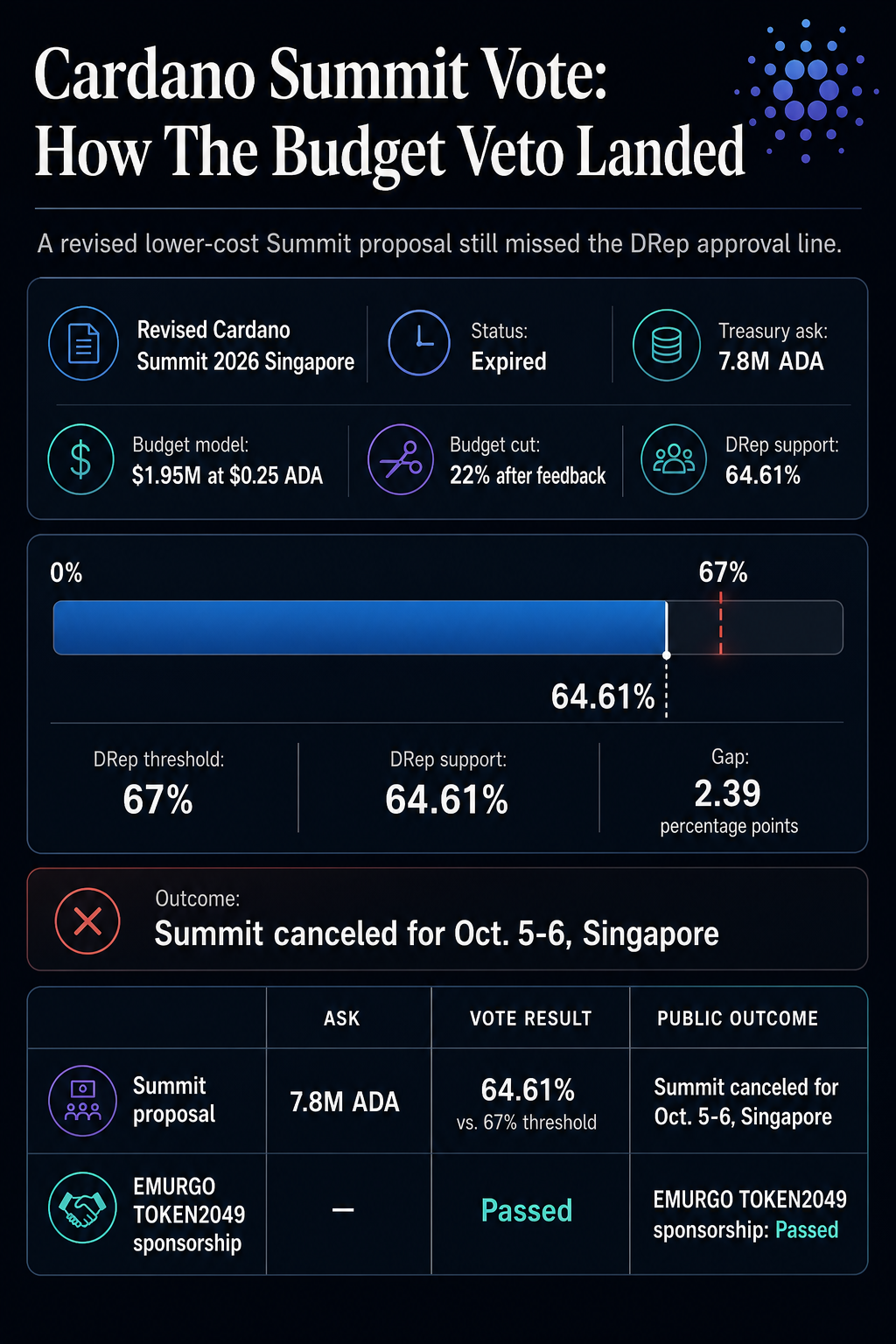
Cardano’s 2026 Summit in Singapore is off after the network’s treasury governance process failed to approve funding for it.
The official event page now says the Summit will not take place on Oct. 5-6 as previously announced. The cause is governance: Cardano Foundation said treasury-funded initiatives are subject to community vote, and the community decided not to proceed with the proposal.
A governance abstraction has turned into a public budget veto. A revised 7.8 million ADA request from the Cardano Foundation, already cut from an earlier bundled proposal, expired below the Delegated Representative threshold.
The proposal recorded 64.61% DRep yes support against a 0.67 treasury-withdrawal threshold. A related Singapore presence still survived the vote, as EMURGO’s separate TOKEN2049 sponsorship proposal passed.
The result is more specific, and more revealing: DReps blocked the dedicated Summit while allowing a related Singapore sponsorship to continue.
A Budget Veto With A Calendar Attached
The revised governance action had a defined business and community scope. It asked for 7.8 million ADA, based on a $0.25 ADA assumption, to fund a $1.95 million Summit budget.
It described a two-day event in Singapore with one Ecosystem Day for builders, DReps, governance sessions, and workshops. That would be followed by an Industry Day aimed at enterprise, institutional, and regulatory audiences.
The Foundation had already revised the ask after community feedback. The proposal said the budget was reduced by 22%, or $550,000, and separated from EMURGO’s TOKEN2049 sponsorship.
It also increased the Foundation’s expected internal resource contribution to reduce external vendor costs. The proposal’s targets show the work the cancellation now affects.
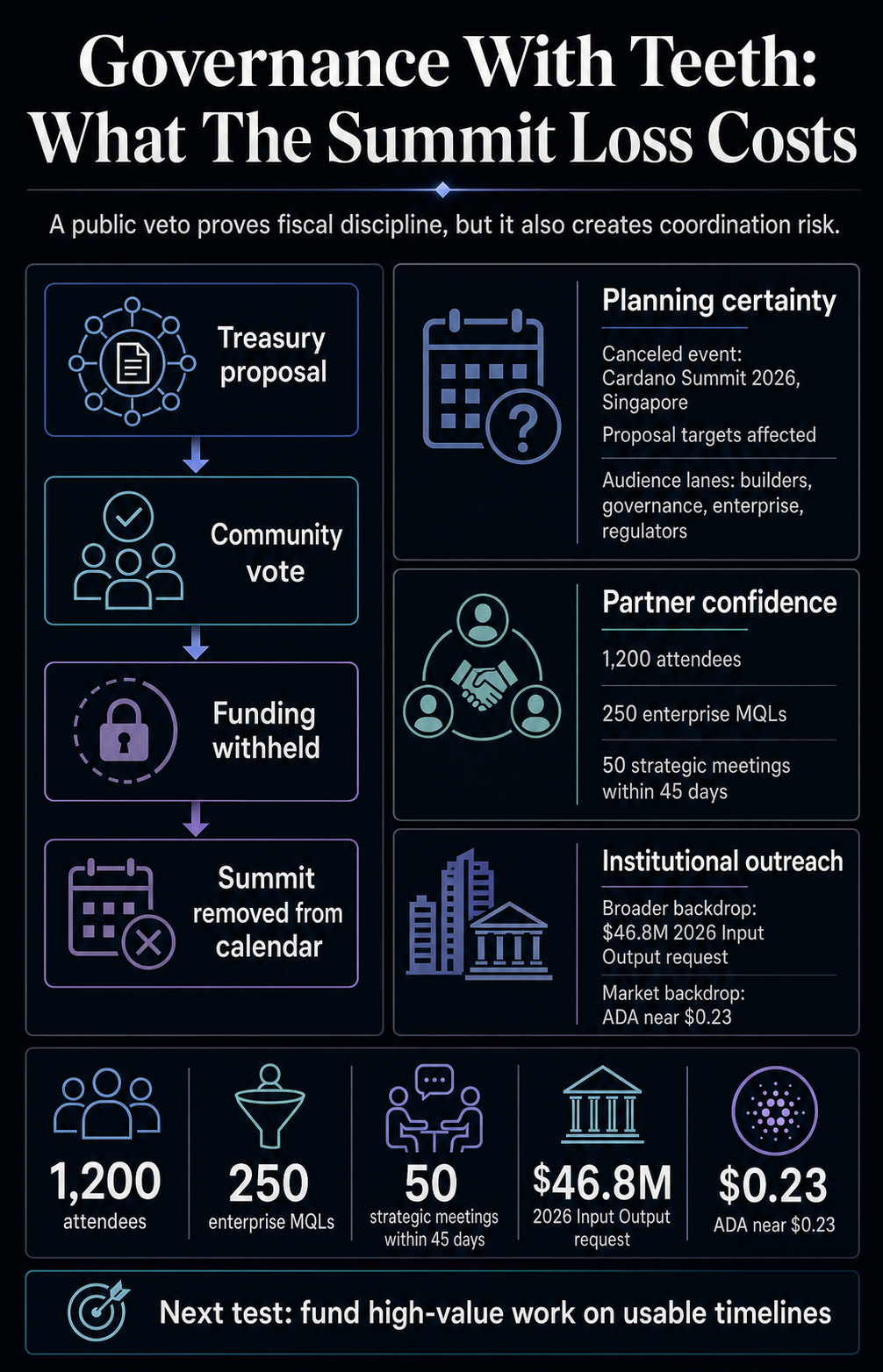
The Summit was pitched as a funnel for 1,200 attendees, 250 enterprise marketing-qualified leads, and 50 strategic meetings within 45 days after the event.
Those numbers were proposal goals rather than delivered results. They positioned the Summit as both a community event and a business-development vehicle at the edge of Cardano’s wider Singapore conference push.
ItemFunding AskStatusSignalRevised Cardano Summit 2026 Singapore7.8 million ADAExpired below DRep thresholdDReps blocked the dedicated event budgetEMURGO TOKEN2049 sponsorshipSeparate sponsorship proposalPassedDReps distinguished the sponsorship from the Summit budget
The threshold mechanics explain why a majority-support figure still failed. Cardano treasury withdrawals require Constitutional Committee and DRep approval, with DRep approval set at 0.67 and no stake pool operator threshold for that action type.
Related Reading
Cardano opens treasury for Bitcoin liquidity drive in high-stakes push to scale DeFi by 2030
The treasury vote gives Cardano a live new test: can it turn Bitcoin’s idle capital into sticky DeFi liquidity?
Apr 8, 2026·Oluwapelumi Adejumo
The same 67% DRep pass threshold also appears in GovTool’s treasury withdrawal documentation. That design gave DReps the power to stop the withdrawal even after 64.61% yes support.
A funding action can draw majority support and still expire when the required delegated-stake threshold sits above the final vote total.
For Cardano, that is the point of the system and the source of the problem. Treasury governance is supposed to impose discipline on spending.
It is supposed to make institutions justify requests, split bundled asks, respond to feedback, and accept a result when the threshold is missed. This vote shows that machinery working.
It also converts budget discipline into an operational outcome: the Summit disappeared from the 2026 calendar.
Related Reading
Cardano just paused the program that funded $150M in crypto projects
Over $150 million has flowed through Catalyst, but the pipeline stopped as governance oversight gets rebuilt.
Mar 3, 2026·Gino Matos
The Governance Win Comes With Coordination Risk
Cardano’s broader 2026 funding fight has already been building. Input Output had reduced its annual treasury funding request to $46.8 million as the ecosystem moved away from single-entity dominance and toward community-controlled funding approval.
A later vote brought DRep resistance, abstentions, and concern that proposals tied to Cardano’s technical roadmap were struggling around the same 67% approval area.
CryptoSlate Daily Brief
Daily signals, zero noise.
Market-moving headlines and context delivered every morning in one tight read.
5-minute digest 100k+ readers
Free. No spam. Unsubscribe any time.
Whoops, looks like there was a problem. Please try again.
You’re subscribed. Welcome aboard.
Related Reading
Cardano founder warns network could lose its scientists in Input Output’s 33M ADA funding vote fails
Input Output faces an unprecedented funding crisis as decentralized governance members hesitate to approve the 2026 development roadmap.
May 22, 2026·Oluwapelumi Adejumo
The Summit cancellation turns that funding tension into a calendar outcome ecosystem participants can see. The proposal itself targeted builders, governance participants, enterprise leads, and strategic meetings.
Those audiences can now observe a planned event being removed by the same treasury system that Cardano is asking them to trust.
So it cuts both ways. On one side, it strengthens Cardano’s claim that on-chain governance has teeth.
The Foundation proposed, revised, and still had to accept that the treasury would withhold funding. The constraint is meaningful precisely because it applied to a request from one of the ecosystem’s central institutions.
On the other side, a governance system that can stop spending also has to prove it can fund high-value work on usable timelines.
If major initiatives repeatedly miss thresholds after late revisions, Cardano may gain budget discipline while losing execution speed. For events, that risk can appear as calendar uncertainty, weaker partner confidence, and fewer clear chances to use large industry gatherings as distribution moments.
The failed Summit vote also complicates Cardano’s institutional narrative. The revised proposal argued that Singapore would put Cardano in front of enterprise, financial, and regulatory audiences during TOKEN2049 week.
DReps could treat that strategic goal and the budget request as separate questions. Outside the governance process, the visible outcome is simpler: Cardano goes into 2026 without its dedicated Singapore Summit.
ADA’s market context gives the story a financial backdrop. On June 1, ADA traded near $0.23, a little more than 2% lower over 24 hours, with market capitalization around $8.4 billion and 24-hour volume around $360 million.
The vote shows how treasury scrutiny can shape the ecosystem’s public calendar as well as its balance sheet.
The next test is whether Cardano can turn this veto into a clearer funding process instead of another source of institutional drag. Future treasury proposals may face pressure to show tighter budgets, cleaner separation from adjacent sponsorships, and stronger evidence that spending creates measurable ecosystem value.
The Summit vote makes decentralization operational. DReps can now restrain core institutions in public.
The question is whether Cardano can pair that restraint with enough coordination to keep building, selling, and showing up where the next wave of users and institutions are making decisions.
ETH treasury firm BitMine Immersion Technologies added another $52 million in Ethereum.
Meanwhile, its Bitcoin counterpart Strategy sold $2.5 million worth of BTC to fund its dividend-paying preferred stock.
BitMine now holds around 4.48% of the Ethereum circulating supply, valued at more than $10.6 billion.
Publicly traded Ethereum treasury firm BitMine Immersion Technologies once more added to its ETH position last week, even as its Bitcoin-centric counterpart Strategy sold BTC for the first time since 2022.
BitMine purchased another 26,497 ETH or around $52 million worth as Ethereum trades at $1,967 on Monday, dipping below $2,000 for the first time since March 29, according to data from CoinGecko.
“In our view, ETH prices are not reflecting the strengthening of Ethereum fundamentals, but then again, this is not surprising given we are in the early stages of crypto spring,” said BitMine Chairman Tom Lee in a statement. (Disclaimer: Tom Lee is an investor in Dastan, Decrypt’s parent company.)
BitMine’s latest purchase is a big step down from last week’s buy of nearly 112,000 ETH, its largest of 2026. Last month, Lee said the firm might slow its aggressive acquisition pace as it didn’t want to reach its goal of 5% of the token supply too quickly, saying “there’s other things to be doing in crypto right now.”
BitMine now holds 5,416,901 ETH in total, or about 4.48% of the circulating Ethereum supply. In addition to its $10.6 billion ETH treasury, it also boasts around $446 million in cash and 203 BTC valued at $14.5 million.
Shares in the firm (BMNR) have fallen around 1.3% on Monday, recently changing hands around $19.02. At that mark, shares are now down more than 34% in the last six months of trading and 88% off their 52-week high of $161.
Meanwhile, Ethereum’s slide below $2,000 comes following a nearly 15% decline in the last month of trading, and a more than 60% fall from its August all-time high of $4,946.
Predictors on Myriad, the prediction market from Decrypt’s parent company, increasingly favor a drop to $1,500 before ETH rebounds to $3,000. The market, which asks predictors to forecast Ethereum’s next price stop, makes odds of hitting $1,500 first about 67%.
Strategy, the largest overall crypto treasury firm with about $60 billion of Bitcoin, said Monday that it sold BTC for the first time since last 2022, selling off about $2.5 million worth of BTC. Bitcoin fell to its lowest price in nearly two months following the announcement, while Strategy (MSTR) shares dropped to a 45-day low after the opening bell Monday.
Daily Debrief Newsletter
Start every day with the top news stories right now, plus original features, a podcast, videos and more.
NEW YORK, June 01, 2026 (GLOBE NEWSWIRE) — PageUp, a global leader in talent acquisition software, recently announced the addition of three new strategic partners, Flockity, Vouch, and Certn, to its growing technology ecosystem.
These integrations expand the already extensive PageUp marketplace, giving organizations additional flexibility to build a personalized hiring process that works the way their teams do. These new partnerships also reflect PageUp’s commitment to building a collaborative, best-in-class ecosystem where teams can use their favorite tools to create a seamless candidate experience.
“Enabling our customers to build the system that works specifically for their team and their processes is PageUp’s primary goal. By integrating best-in-class tools, we are removing friction from the hiring journey and helping talent teams deliver a more engaging, human-centric experience,” said Fiona Moreton, senior vice president, Global Partners, PageUp.
By using these integrations, PageUp customers can attract, engage, and verify top talent with greater efficiency and confidence:
Flockity: Influencer marketing for jobs
Flockity integrates with PageUp Clinch to help organizations reach beyond active job seekers. By using internal and external brand advocates as influencers, this integration drives high-quality candidate traffic to the top of the funnel, tapping into the 89 percent of the workforce who are not actively looking for a new role.
“Being part of the Clinch ecosystem makes it easy for companies to expand into the influencer space with Flockity and open the top of the funnel to the 89% of passive talent not actively searching,” commented Tracey Parsons, CEO, Flockity.
Vouch: AI-powered video platform for talent teams
Vouch has joined the PageUp network to help organizations build, activate, and scale their employer brand through video. As a video-first content platform, Vouch enables talent teams to create authentic employee content, power advocacy campaigns, and equip recruiters with high-impact assets that engage candidates at every stage of the hiring journey. Integrating with PageUp Clinch, Vouch amplifies employee voices through content creation and advocacy reach while providing the insights needed to measure the direct impact on hiring.
“By pairing Clinch with Vouch, our customers can create, distribute, and measure authentic employee-driven content at scale. This partnership enables talent teams to bring their employer brand to life while directly connecting content performance to hiring conversions,” observed Gary Zurnamer, co-founder & CEO, Vouch.
Certn: Integrated global background screening
Certn brings enterprise-grade screening and identity verification directly into the PageUp ATS, eliminating the need to switch between platforms. Recruiters can order checks and track status updates in real time without leaving PageUp, while candidates benefit from a mobile-first, AI-driven experience that keeps the process moving quickly. With coverage across 200+ countries and territories, and built-in compliance and audit readiness, Certn supports global hiring at scale.
“We’re excited to join the PageUp partner ecosystem. As you’ve invested in a modern ATS, Certn complements that with a fast, seamless background screening experience – turning the final step in hiring into one that truly reflects your brand,” said Brian Coe, vice president, APAC & Global Sales and Customer, Certn.
These integrations are now available to PageUp customers globally, further providing a unified, high-performance platform to manage the modern talent lifecycle.
About PageUp
PageUp believes the most powerful talent acquisition technology is built on one simple principle: human connection. As the chosen talent acquisition partner for the world’s most trusted brands, PageUp delivers a world-class customer experience by building deep, lasting partnerships. This commitment is reflected in PageUp’s intelligent talent acquisition platform, an intuitive, AI-powered system that’s easy to use, adaptable to your unique hiring needs and always innovating. We strip away complexity so talent teams can focus on what matters—creating the strong, human connections that forge a resilient workforce.
For more information, visit http://www.pageuppeople.com.
About Web3Wire Web3Wire – Information, news, press releases, events and research articles about Web3, Metaverse, Blockchain, Artificial Intelligence, Cryptocurrencies, Decentralized Finance, NFTs and Gaming. Visit Web3Wire for Web3 News and Events, Block3Wire for the latest Blockchain news and Meta3Wire to stay updated with Metaverse News.
New York City, NY, May 31, 2026 (GLOBE NEWSWIRE) — As awareness of metabolic health continues to rise worldwide, consumers are increasingly searching for products that can help support healthy blood sugar levels, improve overall wellness, and complement healthy lifestyle choices.
Learn what’s inside Glyco Harmony with our in-depth ingredient guide
Among the names attracting growing attention in the health and wellness sector is Glyco Harmony, a supplement that has generated discussion among consumers interested in maintaining balanced glucose levels and supporting metabolic function.
The growing interest in blood sugar management is not surprising. Health experts have long emphasized the importance of maintaining stable glucose levels as part of a comprehensive wellness strategy. Poor dietary habits, sedentary lifestyles, stress, and other modern-day factors have contributed to increasing concerns about metabolic health across many populations.
Explore Glyco Harmony ingredients, benefits, and science. Learn how chromium, berberine, cinnamon, and other nutrients support metabolic health.
Against this backdrop, products such as Glyco Harmony have emerged to meet consumer demand for nutritional support. While healthcare professionals consistently stress that supplements should not replace medical advice, diagnosis, or treatment, the popularity of products aimed at supporting healthy blood sugar levels reflects a broader shift toward preventive health and wellness.
The Rising Focus on Metabolic Wellness
Over the past decade, metabolic health has become a major topic of discussion among researchers, healthcare providers, policymakers, and consumers. Increased access to health information has encouraged people to become more proactive about understanding how lifestyle choices affect long-term well-being.
Experts note that maintaining healthy blood sugar levels is not only important for individuals with metabolic concerns but can also play a role in supporting energy levels, cardiovascular health, cognitive function, and overall quality of life.
Many consumers now routinely monitor nutritional intake, physical activity, sleep quality, and stress management practices. This holistic approach to wellness has created an environment in which nutritional supplements designed to complement healthy habits have become increasingly common.
Glyco Harmony enters this market as one of several products positioned to support individuals seeking additional nutritional assistance in their wellness journey.
Understanding Blood Sugar Balance
Blood sugar, also known as blood glucose, serves as the body’s primary source of energy. Glucose is obtained from foods, particularly carbohydrates, and is transported through the bloodstream to provide fuel for cells throughout the body.
The body uses complex biological processes to regulate blood sugar levels. Hormones such as insulin play critical roles in ensuring that glucose is properly utilized and stored when necessary.
When blood sugar levels fluctuate significantly, individuals may experience changes in energy, concentration, mood, and physical performance. As a result, maintaining healthy glucose regulation has become a key focus of modern wellness strategies.
Nutrition specialists emphasize that balanced meals, regular physical activity, adequate hydration, and sufficient sleep remain foundational elements of blood sugar management. Supplements are generally viewed as complementary tools rather than primary solutions.
What Is Glyco Harmony?
Glyco Harmony is marketed as a dietary supplement intended to support healthy blood sugar management and metabolic wellness. The product has attracted interest among consumers looking for nutritional options that may assist in maintaining glucose balance alongside healthy lifestyle practices.
Like many wellness products in the metabolic support category, Glyco Harmony is typically promoted as part of a broader health regimen that includes dietary awareness and physical activity.
Consumers evaluating any supplement are encouraged to review ingredient information carefully, understand product claims, and consult healthcare professionals when appropriate.
Industry analysts note that transparency regarding ingredients, manufacturing standards, and scientific rationale has become increasingly important as consumers become more informed and selective in their purchasing decisions.
Growing Consumer Demand
The popularity of metabolic health products reflects broader trends within the global wellness industry. Consumers today are seeking personalized approaches to health management and are increasingly interested in preventive strategies.
Market researchers report sustained growth in nutritional supplement categories associated with blood sugar support, weight management, energy enhancement, and overall wellness optimization.
Several factors are driving this demand:
Increased health awarenessAging populationsGreater access to health informationInterest in preventive wellnessRising focus on nutrition and fitnessGrowing popularity of natural health products
Glyco Harmony’s emergence within this competitive landscape highlights the expanding opportunities for brands that can effectively communicate their value to health-conscious consumers.
The Role of Nutritional Ingredients
One of the most important considerations for consumers evaluating supplements is the ingredient profile. Nutrition experts recommend examining both the active ingredients and the scientific evidence supporting their use.
Various supplements aimed at blood sugar support often contain plant-based compounds, vitamins, minerals, antioxidants, and botanical extracts that have been studied for their potential role in metabolic health.
Researchers continue to investigate how certain nutrients may interact with biological pathways associated with glucose metabolism, insulin sensitivity, and energy production.
However, experts caution that scientific evidence can vary significantly between ingredients, formulations, and study designs. Consumers are encouraged to rely on credible information sources and professional guidance when making health decisions.
Expert Perspectives on Supplement Use
Healthcare professionals generally agree that nutritional supplements can play supportive roles under specific circumstances. However, they emphasize that no supplement should be viewed as a substitute for healthy living practices.
Dietitians often recommend focusing first on:
Balanced nutritionRegular exerciseWeight managementStress reductionAdequate sleepRoutine medical care
Supplements may then be considered as part of a broader wellness strategy when appropriate.
Medical experts also stress the importance of realistic expectations. Sustainable health improvements typically result from consistent lifestyle habits rather than single interventions.
This perspective has shaped consumer education efforts throughout the wellness industry and continues to influence how products such as Glyco Harmony are discussed within health-focused communities.
Understanding the ingredients in Glyco Harmony is essential for evaluating how the formula may support blood sugar balance, metabolic health, energy production, and overall wellness. Each ingredient is selected for a specific purpose and contributes to the formula’s intended benefits.
While ingredient lists may vary depending on the manufacturer and formulation version, blood sugar support supplements commonly contain a combination of minerals, botanical extracts, antioxidants, and metabolic-support compounds.
Below is a detailed explanation of the most frequently used ingredients in products like Glyco Harmony and the roles they may play in supporting healthy glucose metabolism.
Chromium
What Is Chromium?
Chromium is an essential trace mineral naturally found in small amounts in foods such as broccoli, whole grains, potatoes, and meat.
The body requires chromium for normal carbohydrate, fat, and protein metabolism.
How It Works
Chromium helps support insulin activity.
Insulin acts as a key that allows glucose to move from the bloodstream into cells where it can be used for energy.
Adequate chromium levels may assist the body’s ability to process carbohydrates efficiently.
Potential Benefits
Supports glucose metabolismAssists insulin functionSupports energy productionHelps maintain healthy blood sugar levels already within the normal range
Why It’s Included
Chromium is one of the most widely used ingredients in blood sugar support formulas because of its established role in carbohydrate metabolism.
Cinnamon Bark Extract
What Is Cinnamon Extract?
Cinnamon is a spice derived from the bark of trees belonging to the Cinnamomum family.
For centuries, it has been used in traditional wellness practices around the world.
How It Works
Researchers believe cinnamon contains bioactive compounds that may influence glucose metabolism and insulin signaling pathways.
It also contains antioxidant compounds that help protect cells from oxidative stress.
Potential Benefits
Supports metabolic wellnessProvides antioxidant protectionMay help support healthy glucose regulationSupports overall wellness
Why It’s Included
Cinnamon remains one of the most recognized natural ingredients used in blood sugar support supplements.
Berberine
What Is Berberine?
Berberine is a naturally occurring compound found in several plants, including barberry, goldenseal, and Oregon grape.
It has been extensively studied in the field of metabolic health.
How It Works
Berberine appears to influence multiple biological pathways involved in:
Glucose metabolismCellular energy productionInsulin activityFat metabolism
Researchers continue investigating its effects on metabolic function.
Rather than relying on a single ingredient, Glyco Harmony-style formulations often use a multi-ingredient approach.
This strategy aims to support multiple aspects of metabolic wellness simultaneously, including:
Glucose Support
Ingredients such as chromium, cinnamon, berberine, and bitter melon may support healthy glucose metabolism.
Energy Production
Alpha-lipoic acid, magnesium, and biotin support cellular energy pathways.
Antioxidant Protection
Plant extracts and antioxidants help combat oxidative stress.
Overall Metabolic Wellness
The combination of vitamins, minerals, and botanical compounds provides comprehensive nutritional support.
Consumer Experiences and Market Reception
Consumer interest in Glyco Harmony appears to reflect broader enthusiasm for wellness solutions that support healthy daily routines.
Many individuals report being motivated by goals such as:
Improved energy levelsBetter nutritional balanceIncreased wellness awarenessEnhanced lifestyle consistencyLong-term health maintenance
Industry observers note that consumer reviews and personal experiences often influence purchasing decisions, although anecdotal reports should not be considered equivalent to scientific evidence.
As with any wellness product, individual experiences may vary depending on numerous factors including diet, activity level, age, health status, and overall lifestyle habits.
Industry Trends Driving Innovation
The nutritional supplement industry has undergone significant transformation in recent years.
Several trends are shaping product development:
Transparency
Consumers increasingly demand detailed information about ingredients, sourcing practices, and manufacturing standards.
Scientific Validation
Brands face growing pressure to support claims with credible research and evidence-based explanations.
Natural Ingredients
Many consumers prefer products containing botanical extracts and naturally derived compounds.
Personalized Wellness
Technology and health data are contributing to more individualized approaches to nutrition and supplementation.
Digital Health Integration
Mobile applications, wearable devices, and online health communities are influencing purchasing behavior and consumer engagement.
These trends continue to shape competitive dynamics within the metabolic health sector.
Regulatory Considerations
Health authorities around the world maintain regulations governing dietary supplements and wellness products. Manufacturers are generally responsible for ensuring product safety, labeling accuracy, and compliance with applicable regulations.
Consumers are encouraged to:
Read labels carefullyVerify ingredient informationReview usage instructionsConsult healthcare professionals when neededPurchase from reputable sources
Regulatory frameworks vary by country, making consumer education an important component of responsible supplement use.
The Science of Lifestyle Support
Researchers continue exploring the complex relationship between nutrition, physical activity, metabolism, and long-term health outcomes.
Studies suggest that healthy lifestyle practices can contribute to improved metabolic function and overall well-being. Key areas of focus include:
Nutrition
Whole foods, fiber-rich meals, and balanced dietary patterns remain central recommendations.
Exercise
Regular movement supports cardiovascular fitness, weight management, and metabolic health.
Sleep
Adequate sleep plays an important role in hormonal regulation and energy balance.
Stress Management
Chronic stress can influence metabolic processes and wellness outcomes.
Experts consistently emphasize that sustainable results are often achieved through comprehensive lifestyle approaches rather than isolated interventions.
Consumer Education Remains Essential
As interest in metabolic wellness grows, healthcare organizations continue emphasizing the importance of informed decision-making.
Consumers evaluating products such as Glyco Harmony are encouraged to ask several questions:
What ingredients are included?What evidence supports the formulation?Are claims realistic and transparent?Is the product manufactured according to quality standards?Have healthcare professionals been consulted?
These considerations can help individuals make more informed choices aligned with their personal health goals.
Market Outlook
Industry analysts expect continued growth in the blood sugar support and metabolic wellness categories over the coming years.
Several factors support this outlook:
Expanding health awarenessPreventive wellness adoptionGrowing supplement acceptanceTechnological innovationConsumer demand for personalized solutions
Products positioned within these categories may continue attracting attention as consumers seek practical ways to complement healthy lifestyle choices.
Companies that prioritize transparency, quality assurance, and consumer education are likely to remain competitive in an increasingly sophisticated marketplace.
Challenges and Opportunities
While the wellness industry presents significant opportunities, it also faces challenges.
Successfully addressing these concerns requires ongoing commitment to quality, education, and responsible marketing practices.
For products like GlycoHarmony, building trust may depend on maintaining transparency and helping consumers understand both the potential benefits and limitations of supplementation.
Looking Ahead
The future of metabolic wellness appears closely tied to broader trends in preventive healthcare and consumer empowerment.
As research advances and public awareness grows, individuals are likely to become increasingly engaged in managing their health proactively.
Supplements designed to support blood sugar balance will continue attracting interest, particularly among consumers seeking comprehensive wellness solutions that align with healthy lifestyle habits.
Whether GlycoHarmony becomes a long-term leader within this category remains to be seen. However, its growing visibility reflects a larger movement toward greater health awareness and proactive wellness management.
Glyco Harmony – Frequently Asked Questions (FAQ) Deep Explained
1. What is Glyco Harmony?
GlycoHarmony is a dietary supplement marketed to support healthy blood sugar management, metabolic function, and overall wellness. It is generally designed for adults who wish to maintain balanced glucose levels as part of a healthy lifestyle.
The product is not intended to diagnose, treat, cure, or prevent any disease. Instead, it is positioned as a nutritional support formula that may complement healthy eating habits, physical activity, and regular healthcare guidance.
Many people become interested in blood sugar support supplements because modern lifestyles often include factors such as poor dietary choices, sedentary behavior, stress, and inconsistent sleep patterns, all of which can affect metabolic health.
2. How does Glyco Harmony work?
The exact mechanism depends on the ingredients included in the formula. In general, blood sugar support supplements aim to:
Support healthy glucose metabolismHelp maintain normal insulin functionPromote steady energy levelsSupport carbohydrate utilizationProvide antioxidant supportAssist overall metabolic wellness
When the body processes carbohydrates, they are converted into glucose and released into the bloodstream. Healthy metabolic function helps regulate how glucose is used and stored. Nutritional ingredients found in blood sugar support formulas are often selected because they have been studied for their potential roles in these biological processes.
However, results can vary significantly among individuals depending on age, lifestyle, diet, genetics, and overall health status.
3. Who should consider using Glyco Harmony?
GlycoHarmony may appeal to adults who:
Want to support healthy blood sugar levels already within the normal rangeAre interested in metabolic wellnessSeek nutritional support alongside healthy habitsWant to improve overall wellness awarenessFollow preventive health strategies
It may be particularly attractive to individuals who understand that supplements are intended to complement—not replace—a balanced lifestyle.
People with diagnosed medical conditions should consult a healthcare professional before beginning any supplement regimen.
4. Can Glyco Harmony cure diabetes?
No.
Dietary supplements are not cures for diabetes.
Individuals diagnosed with diabetes should continue following the treatment plan recommended by their healthcare provider, including medications, dietary guidance, exercise recommendations, and monitoring routines.
Any supplement should be discussed with a physician before use because some ingredients may interact with medications or influence blood sugar levels.
5. Is Glyco Harmony a medicine?
No.
Glyco Harmony is marketed as a dietary supplement rather than a pharmaceutical drug.
The primary differences include:
Medicines
Undergo extensive clinical testingRequire regulatory approvalIntended to diagnose, treat, or prevent disease
Supplements
Intended to support health and nutritionGenerally contain vitamins, minerals, herbs, or plant extractsAre not approved as disease treatments
6. How long does it take to see results?
Results vary widely from person to person.
Several factors influence outcomes:
Diet qualityPhysical activity levelsSleep habitsStress managementExisting metabolic healthConsistency of supplement use
Some users report noticing changes in energy or wellness within weeks, while others may require longer periods of consistent use.
7. What ingredients are commonly found in blood sugar support supplements?
Although formulations differ, ingredients frequently used in this category include:
Chromium
Chromium is a trace mineral involved in carbohydrate metabolism and insulin function.
Researchers have studied chromium for its potential role in helping the body process glucose more efficiently.
Cinnamon Extract
Cinnamon has been widely researched for possible effects on blood sugar regulation and metabolic support.
Alpha-Lipoic Acid
An antioxidant that may help combat oxidative stress and support cellular energy production.
Berberine
A plant-derived compound frequently discussed in metabolic health research.
Bitter Melon
A traditional botanical ingredient often associated with glucose support.
Gymnema Sylvestre
An herb used in traditional wellness systems and studied for potential effects on sugar metabolism.
Consumers should always review the actual product label to determine the specific ingredients included in Glyco Harmony.
8. Why is blood sugar balance important?
Blood sugar serves as the body’s primary energy source.
Healthy glucose regulation contributes to:
Consistent energyMental clarityPhysical performanceHormonal balanceCardiovascular wellnessLong-term metabolic health
Large fluctuations in blood sugar may contribute to feelings of fatigue, hunger, irritability, and reduced concentration.
Maintaining balance is therefore an important component of overall health.
9. Can Glyco Harmony replace a healthy diet?
No.
No supplement can replace healthy eating habits.
A nutritious diet remains the foundation of metabolic health.
However, GlycoHarmony should not be considered a weight-loss product unless specifically marketed for that purpose.
Sustainable weight management primarily depends on nutrition and physical activity.
18. Why do consumers choose blood sugar support supplements?
Common motivations include:
Preventive wellnessEnergy supportMetabolic health awarenessHealthy aging goalsLifestyle optimization
Modern consumers increasingly seek proactive approaches to maintaining long-term health.
19. What should consumers look for before purchasing Glyco Harmony?
Important considerations include:
Ingredient Transparency
Consumers should understand exactly what is included.
Manufacturing Quality
Products should ideally be manufactured according to recognized quality standards.
Scientific Support
Research supporting ingredient selection can help consumers make informed decisions.
Brand Reputation
Reliable customer service and transparent business practices are valuable indicators.
Realistic Claims
Avoid products promising miraculous or guaranteed results.
20. What is the most important thing to remember about Glyco Harmony?
The most important point is that GlycoHarmony should be viewed as a supplement to a healthy lifestyle—not a substitute for one.
Long-term metabolic wellness is best supported through:
Nutritious eatingRegular exerciseHealthy body weightQuality sleepStress managementRoutine medical care
Supplements may provide additional nutritional support, but they work best when incorporated into a comprehensive wellness strategy.
Conclusion
Glyco Harmony has emerged amid rising consumer interest in blood sugar support and metabolic health. While healthcare experts continue emphasizing the importance of diet, exercise, sleep, and medical guidance, nutritional supplements remain a significant part of the wellness conversation.
As consumers become more informed and health-conscious, demand for transparent, evidence-based products is expected to increase. The evolving landscape presents both opportunities and responsibilities for manufacturers, healthcare professionals, and consumers alike.
Ultimately, the discussion surrounding Glyco Harmony highlights a broader trend: a growing commitment among individuals to take active roles in supporting their health and well-being through informed lifestyle choices and responsible wellness practices.
About Web3Wire Web3Wire – Information, news, press releases, events and research articles about Web3, Metaverse, Blockchain, Artificial Intelligence, Cryptocurrencies, Decentralized Finance, NFTs and Gaming. Visit Web3Wire for Web3 News and Events, Block3Wire for the latest Blockchain news and Meta3Wire to stay updated with Metaverse News.
A new executive order tasks federal regulators with tightening fraud screening and limiting credit lines for undocumented immigrants.
Experts say the policy mirrors an alleged plot under the Biden administration to choke crypto firms—and the driving force behind the creation of World Liberty Financial.
Critics warn that freezing millions out of the traditional banking system could backfire by benefiting organized crime or provoking future retaliation.
When President Donald Trump’s family faced growing pressure from banks, it embraced crypto. Now, immigrants who are in the U.S. illegally face a similar choice under what policy experts describe as a move that could force people out of the traditional banking system.
On May 19, the president issued an executive order “to restore integrity to America’s financial system.” In the name of national security, the directive tasked federal regulators such as the Treasury Department with considering rules that would tighten oversight on fraud screening and risk mitigation associated with extending services to immigrants who are undocumented.
Under President Joe Biden’s administration, “debanking” emerged as a rallying cry for the crypto industry, fueled by an alleged plot referred to as “Operation Chokepoint 2.0.” The suspected scheme centered on perceived risks tied to doing business with the sector, eventually prompting congressional investigations and the release of internal regulatory documents.
Trump’s executive order exposes tension between measures meant to safeguard American banks from unverified risks and the crypto industry’s high-profile battle against debanking, while creating parallels between supposed Biden-era tactics and the genesis of a crypto empire.
The administration maintains that tightening protocols is long overdue.
“Gaps in customer identification practices have allowed terrorists, drug traffickers, money launderers, and other criminal networks to exploit U.S. financial institutions to move illicit funds and evade law enforcement,” the White House stated in an accompanying fact sheet.
Since World Liberty Financial was established in 2024, Eric Trump and Donald Trump Jr. have cited challenges posed by banks as a driving force behind the family crypto venture. Last year, Trump Jr. said at a conference, “We got into crypto because—out of necessity—we were debanked.”
Under Operation Chokepoint 2.0, regulators allegedly pressured banks behind closed doors to sever ties with crypto firms, labeling the industry as a “reputational risk.” The term was popularized by Nic Carter, founding partner of investment firm Castle Island Ventures, who told Decrypt that even though the circumstances are different, he opposes the new policy.
“It’s pretty cruel to deprive someone of access to financial infrastructure entirely, or force them to utilize cash, shadow banks, or fringe infrastructure, which might not be safe or credible,” he said. “And that extends to folks that are here in the country illegally.”
‘Escape hatch’
The crypto industry has positioned itself as a middleman-free alternative for anyone with a smartphone to store and transfer wealth, but some policy experts caution that any adoption amid the current political climate would be driven by duress—not preference.
Nicholas Anthony, a research fellow at the Cato Institute, a prominent libertarian think tank, told Decrypt that Trump’s executive order is effectively “deputizing banks as immigration enforcement officers,” while encouraging a Big Brother-like atmosphere.
Anthony added that some undocumented immigrants will turn to crypto as an alternative lifeline, while others are likely to use organized crime groups such as cartels as a way to remit money home, because those enterprises offer a deeply rooted system that’s commonly known.
“People are going to have their accounts shut down, but many more people are likely going to view the financial system with fear or hostility, and they’re going to see alternatives as a lifeline or an escape hatch,” he said. “It’s basically painting the banking system as a hostile place.”
Testifying before the House Financial Services Committee last week, Anthony argued that the Bank Secrecy Act represents a costly, broken financial surveillance system.
Similar concerns have long been shared by influential conservatives, such as Rep. Tom Emmer (R-MN), who has said financial surveillance erodes civil liberties. The stance was echoed at the hearing by Rep. Juan Vargas (D-CA), who said, “The government is surveilling too much.”
‘Shadow banking system’
Stablecoins, which are often pegged to the U.S. dollar, may soon fall under that scope. The recently issued executive order directed the Treasury to craft guidance that specifically looks at the use of “peer-to-peer payments platforms to facilitate ‘off-the-books’ wage payments.”
But undocumented immigrants have other tools at their disposal, including Bitcoin ATMs that allow customers to exchange cash for crypto. Notably, Bitcoin Depot pulled the plug on 9,000 kiosks in the U.S. when filing for Chapter 11 bankruptcy earlier this month.
Tom Feltner, associate director of consumer policy at Americans for Financial Reform, a nonprofit that advocates for tighter rules on Wall Street, told Decrypt that stablecoins and Bitcoin ATMs lack safeguards required by remittance providers under federal law. That includes the ability to reverse payments within a 30-minute window, no questions asked.
“There’s no uniform set of protections,” he said. “This is exactly the kind of shadow banking system that we’ve designed remittances to stay out of, rather than pushing people into.”
Even if crypto can easily flow across borders, converting digital assets into local currency represents a real barrier, Dilip Ratha, a former economist at the World Bank who has studied remittances for decades, told Decrypt. He noted that stablecoins have still seen notable adoption in corridors where banking access isn’t dependable, including Sudan and Nigeria.
Since the events of September 11, 2001, Ratha said banking rules have tightened significantly, and a lot of immigrants have either found proper documentation or lost access.
“The number of people who have an irregular immigration status and bank accounts must be small,” he said. “Do you really want to waste so much resources going after a few people?”
The executive order comes as banking regulators turn the page. Last month, agencies such as the Office of the Comptroller of the Currency eliminated reputation risk as a supervisory tool. During President Barack Obama’s administration, the original Operation Chokepoint targeted politically disfavored industries, including gun dealers and payday lenders.
Although Castle Island Ventures’ Carter is hesitant to label Trump’s immigration crackdown as “Operation Chokepoint 3.0”—because it’s aimed at individuals, not lawful businesses—he warned that expanding government oversight establishes a dangerous blueprint.
“I think conservatives should worry about this as well, even if it seems like it’s sort of serving our short-term goals,” he said. “Trump is going after illegal immigrants today, but what happens in a Democratic administration?”
Daily Debrief Newsletter
Start every day with the top news stories right now, plus original features, a podcast, videos and more.
The following is a guest post from Anurag Arjun, Co-Founder of Avail.Modern tech platforms succeed because they break complex operations into specialized components....








![Glyco Harmony Drops [URGENT REPORT 2026] GlycoHarmony Shocking Complete Scientific Breakdown of Benefits Everyone Is Talking | Web3Wire](https://i2.wp.com/web3wire.org/wp-content/uploads/2026/06/2-frascosglycoharmony.png?w=640&resize=640,0&ssl=1 "Glyco Harmony Drops [URGENT REPORT 2026] GlycoHarmony Shocking Complete Scientific Breakdown of Benefits Everyone Is Talking | Web3Wire")


