Web3

Home Web3 Page 159

Ted Cruz Introduces FLARE Act to Repurpose Flared Gas for Bitcoin Mining – Decrypt

0
Ted Cruz Introduces FLARE Act to Repurpose Flared Gas for Bitcoin Mining – Decrypt


U.S. Senator Ted Cruz (R-TX) has introduced a new bill aiming to turn waste energy into electricity for Bitcoin mining.

The Facilitate Lower Atmospheric Released Emissions (FLARE) Act, introduced on March 31, is geared towards making waste energy productive by capturing gas that would otherwise be flared or vented. The plan is to incentivise this capture by offering full expensing for property used to capture that gas.

Cruz specifically pointed to crypto mining as a direct output of this extra energy. In a statement announcing the bill’s introduction, he said that it, “takes advantage of Texas’s vast energy potential, reinforces our position as the home of the Bitcoin industry, and is good for the environment.”

The Senator affirmed his commitment to “making Texas the number one place for Bitcoin mining,” adding that the FLARE Act, “incentivizes entrepreneurs and crypto miners to use natural gas that would otherwise be stranded.”

The U.S. focused bill specifically names competitive countries that shall not be allowed to participate in the scheme, including China, Iran, North Korea and Russia.

In a press release from Cruz’s office, Hailey Miller, Director of Government Relations & Public Policy at the Digital Power Network, praised the new bill, saying that Bitcoin miners are “uniquely positioned to help reduce emissions by harnessing stranded and wasted energy sources.” Miller added that the FLARE Act “ensures that American energy producers have the tools to deploy cutting-edge solutions that make our energy markets more efficient and resilient.”

The new Act would specifically, “amend the Internal Revenue Code of 1986 to provide for permanent full expensing for property used to capture gas that would otherwise be flared or vented and to use such gas in value-added products.”

This measure should also help to enhance grid resilience while offering new electricity and “other useful outputs.”

Cruz’s bill comes after U.S. President Donald Trump pledged to ensure that “all remaining Bitcoin” would be mined in the U.S. as part of his reelection campaign. Bitcoin advocates have long held that mining the cryptocurrency could be a means of harnessing waste energy from natural gas flaring, the practice of burning off excess gas that can’t be economically captured or transported.

Daily Debrief Newsletter

Start every day with the top news stories right now, plus original features, a podcast, videos and more.


Source link

Ambient’s $74 Million Funding Sets Stage for AI and Blockchain to Challenge Bitcoin – Web3oclock

0
Ambient’s  Million Funding Sets Stage for AI and Blockchain to Challenge Bitcoin – Web3oclock


Industry Context and Future Outlook:


Source link

Spheron x Think Agents: Powering the Future of Decentralized, Autonomo

0
Spheron x Think Agents: Powering the Future of Decentralized, Autonomo


Artificial intelligence is evolving rapidly. But as we move toward more autonomous, intelligent systems—especially those designed to operate independently in decentralized environments—a critical question emerges:

Today’s AI systems are largely bound to centralized infrastructure—tied to hyperscaler cloud platforms, permissioned environments, and closed ecosystems. While powerful, this setup comes with significant limitations: scalability bottlenecks, high costs, censorship risks, and a fundamental lack of autonomy.

These constraints are especially problematic for the emerging field of decentralized AI (deAI), which aims to create agents that operate trustlessly, evolve continuously, and interact freely across open networks. Without permissionless infrastructure to support them, the promise of autonomous AI can’t fully materialize.

Enter Think Agents: A New Standard for Intelligent Autonomy

Think Agents is a groundbreaking protocol designed to change how AI agents are built, deployed, and evolved.

Rather than creating isolated models with static functionality, Think Agents introduces a decentralized, modular standard for living digital entities. Inspired by natural systems—where growth happens from the bottom up—Think Agents are designed to learn, adapt, and transact autonomously in open ecosystems.

At the heart of the Think Agent Standard lies a robust tri-layer architecture:

Soul: Each agent is represented by a Non-Fungible Intelligence™ (NFI) token, which serves as its unique identity and anchors verifiable ownership.

Mind: A decentralized execution layer responsible for processing information and guiding behavior.

Body: The agent’s interface with the outside world—whether it’s interacting with smart contracts, APIs, or real-world systems.

These components work in harmony via the Murmur Matrix, a sophisticated memory and coordination system that gives agents long-term context, the ability to perceive and learn from their environment, and the intelligence to collaborate with other agents in meaningful ways.

This isn’t just another AI model—it’s a self-sustaining framework for autonomous intelligence in the age of Web3.

The Missing Piece: Compute That Matches the Vision

Building agents with personality, intelligence, and autonomy is one thing. But for these agents to actually run, scale, and interact across decentralized networks, they need something foundational:

Robust, permissionless compute infrastructure.

Without scalable infrastructure, agents are stuck in testing environments or throttled by expensive centralized services. They’re unable to operate in real-time, handle large data pipelines, or adapt dynamically based on real-world feedback.

This is where many decentralized AI systems hit a wall—intelligence without infrastructure is just potential waiting to be unlocked.

Spheron Network: The Backbone for Decentralized AI Agents

Spheron Network solves this challenge by providing a programmable decentralized, censorship-resistant compute infrastructure built for scale.

Spheron connects GPU providers, storage networks, and bandwidth providers into a unified, programmable compute fabric. Developers can launch containers, deploy agents, and run AI pipelines—all without relying on centralized cloud platforms.

What makes Spheron uniquely aligned with Think Agents is its commitment to permissionless access, scalability, and global availability. Any developer or agent can spin up infrastructure in minutes—cheaply, securely, and without gatekeepers.

By leveraging Spheron, Think Agents gain the ability to:

Deploy and scale across environments (DeFi, gaming, decentralized science, and more)

Execute logic in real-time, using decentralized compute for inference, memory, and collaboration

Ensure availability and censorship resistance so agents can evolve freely without dependency on corporate infrastructure.

This isn’t just a backend—it’s the soil on which digital intelligence can grow. By aligning infrastructure and intelligence, we’re laying the groundwork for truly autonomous, resilient, and self-sustaining AI systems that are ready to interact with the decentralized world.

Looking Ahead: Building the Stack AI Deserves

Decentralized intelligence isn’t science fiction anymore. It’s here—and it’s growing.

Think Agents provides the standard. Spheron provides the compute scale. Together, we’re building the missing stack that AI needs to break free from centralized control and evolve on its own terms.

As AI moves from being a tool to becoming an independent actor—navigating markets, managing systems, and collaborating across networks—it needs infrastructure that’s as free and adaptable as the agents themselves.

“Partnering with Think Agents means one thing:AI finally runs on its own terms—decentralized, scalable, and composable.Let’s build the stack AI deserves.”— Spheron Network

Let’s build the future of decentralized intelligence—together.


Source link

Assessing the Impact of Digital Platforms on the Ticket Management System Market | Web3Wire

0
Assessing the Impact of Digital Platforms on the Ticket Management System Market | Web3Wire


Ticket Management System Market

Ticket Management System Market size is estimated to be USD 3.5 Billion in 2024 and is expected to reach USD 7.2 Billion by 2033 at a CAGR of 8.5% from 2026 to 2033.

Ticket Management System Market Future ScopeThe global Ticket Management System Market was valued at approximately USD 6.1 billion in 2022 and is projected to reach around USD 14.5 billion by 2030, growing at a compound annual growth rate (CAGR) of 11.4% from 2023 to 2030. This growth is attributed to the increasing need for automation in handling service requests and complaints across industries such as IT, telecommunications, transportation, and hospitality. With the rising complexity of customer service operations, the demand for efficient ticket management solutions is on the rise, leading to the expansion of the market globally. The widespread adoption of cloud-based solutions, driven by their scalability and ease of use, has significantly contributed to this growth. Moreover, AI integration for predictive analytics and automated ticket routing is enhancing the overall efficiency of ticket management systems, making them a critical component in modern service operations.

The future of the Ticket Management System Market looks promising, with continuous advancements in artificial intelligence and machine learning playing a pivotal role in driving the market forward. As organizations increasingly recognize the importance of delivering superior customer experiences, the demand for more sophisticated ticketing solutions is set to rise. The integration of multi-channel support, including social media, email, and live chat, into ticket management systems will open up new avenues for market growth. Additionally, the increasing need for improved customer support, along with a shift towards integrated IT service management platforms, is expected to propel market expansion. With emerging technologies like chatbots and automation further enhancing service efficiency, the market is poised for sustained growth in the coming years.

Get | Download Sample Copy with TOC, Graphs & List of Figures @ http://verifiedmarketreports.com/download-sample/?rid=257208&utm_source=Openpr&utm_medium=204

Who are the largest Global manufacturers in the Ticket Management System Market?MicrosoftIBMOracleSAPTCSZendeskEventAvenueFreshdeskSysAidosTicketCommence CRM

By the year 2030, the scale for growth in the market research industry is reported to be above 120 billion which further indicates its projected compound annual growth rate (CAGR), of more than 5.8% from 2023 to 2030. There have also been disruptions in the industry due to advancements in machine learning, artificial intelligence and data analytics There is predictive analysis and real-time information about consumers which such technologies provide to the companies enabling them to make better and precise decisions. In addition, new innovative techniques such as mobile surveys, social listening, and online panels, which emphasize speed, precision, and customization, are also transforming this particular sector.

Get Discount On The Purchase Of This Report @ https://www.verifiedmarketreports.com/ask-for-discount/?rid=257208&utm_source=Openpr&utm_medium=204

What are the factors driving the growth of the Global Ticket Management System Market?Growing demand for below applications around the world has had a direct impact on the growth of the Global Ticket Management System Market

By Ticket Type

Onbrne TicketsBox Office Tickets

By Appbrcation

Entertainment EventsSports EventsTransportationOthers

By End-User

EnterprisesGovernment OrganizationsOthers

By Deployment

Cloud-basedOn-premises

By Organization Size

Large EnterprisesSmall and Medium-sized Enterprises (SMEs)

Which regions are leading the Global Ticket Management System Market?US (United States, US and Mexico)Europe (Germany, UK, France, Italy, Russia, Turkey, etc.)Asia-Pacific (China, Japan, Korea, India, Australia, Indonesia, Thailand, Philippines, Malaysia and Vietnam)South America (Brazil, Argentina, Columbia, etc.)Middle East and Africa (Saudi Arabia, UAE, Egypt, Nigeria and South Africa)For More Information or Query, Visit @ https://www.verifiedmarketreports.com/product/ticket-management-system-market/

Detailed TOC of Global Global Ticket Management System Market Research Report, 2026-20331. Introduction of the Global Ticket Management System Market

Overview of the MarketScope of ReportAssumptions2. Executive Summary

3. Research Methodology of Verified Market Research

Data MininValidationPrimary InterviewList of Data Sources4. Global Ticket Management System Market Outlook

OverviewMarket DynamicsDriversRestraintsOpportunitiesPorters Five Force ModelValue Chain Analysis5. Global Ticket Management System Market, By Product

6. Global Ticket Management System Market, By Application

7. Global Ticket Management System Market, By Geography

North AmericaEuropeAsia PacificRest of the World8. Global Ticket Management System Market Competitive Landscape

OverviewCompany Market RankingKey Development Strategies9. Company Profiles

10. Appendix

Contact us:

Mr. Edwyne Fernandes

US: +1 (650)-781-4080

US Toll-Free: +1 (800)-782-1768

Website: https://www.verifiedmarketreports.com/

About Us: Verified Market ReportsVerified Market Reports is a leading Research and Consulting firm servicing over 5000+ US clients. We provide advanced analytical research solutions while offering information-enriched research studies. We also offer insights into strategic and growth analyses and data necessary to achieve corporate goals and critical revenue decisions.

Our 250 Analysts and SMEs offer a high level of expertise in data collection and governance using industrial techniques to collect and analyze data on more than 25,000 high-impact and niche markets. Our analysts are trained to combine modern data collection techniques, superior research methodology, expertise, and years of collective experience to produce informative and accurate research.

This release was published on openPR.

About Web3Wire Web3Wire – Information, news, press releases, events and research articles about Web3, Metaverse, Blockchain, Artificial Intelligence, Cryptocurrencies, Decentralized Finance, NFTs and Gaming. Visit Web3Wire for Web3 News and Events, Block3Wire for the latest Blockchain news and Meta3Wire to stay updated with Metaverse News.


Source link

California’s Amended Digital Assets Act Would Protect Crypto Payments, Self-Custody – Decrypt

0
California’s Amended Digital Assets Act Would Protect Crypto Payments, Self-Custody – Decrypt


A member of the California State Assembly has introduced an amendment to a recently introduced money transmission bill that would protect the ability of state residents to use cryptocurrencies as a means of payment.

First introduced by Democrat Senator Laura Richardson on February 20 as the Money Transmission Act, the bill had been concerned primarily with requiring digital wallet providers operating in California to “take certain actions” to ensure the security of their products, including the use of two-factor authentication.

Introduced on Friday, the new amendment from Democrat assembly member Avelino Valencia renames the bill as the Digital Assets Act, and adds several new clauses protecting the use of cryptocurrency in California.

Its main focus is on authorizing individuals and businesses within California to accept cryptocurrencies as payment for goods and services, as well as in payments between private individuals.

Added to this, the amendment also prohibits “public entities from prohibiting, restricting, or imposing any requirements on that use,” while also preventing the state of California from imposing taxes on the use of crypto as payment for goods and services.

Related to this is a clause which, as Satoshi Action Fund CEO and co-founder Dennis Potter told Decrypt, “explicitly affirms the right of individuals to self-custody their Bitcoin and digital assets.”

According to Potter, this ensures that residents can manage their cryptocurrencies independently, without being forced to send their tokens to a centralized wallet or custody service.

“New legal protections”

While the amended bill may not introduce anything that many cryptocurrency users aren’t doing already, Potter argued that its introduction is highly significant for California and its stance on crypto.

He explained, “These provisions introduce new legal protections and frameworks that were not previously codified in California law, thereby adding significant new elements to the state’s approach to digital assets.”

Other provisions in the bill include a stipulation that California’s Unclaimed Property Law would apply to crypto—meaning that exchanges, for example, would have to transfer crypto to the state in the event that the corresponding customer had been inactive and unresponsive for at least three years.

The amendment also widens the application of the Political Reform Act of 1974 to crypto, and as such prohibits “a public official from issuing, sponsoring, or promoting a digital asset, security, or commodity.”

According to Potter, the intent of this provision “is to prevent conflicts of interest and maintain the integrity of public office,” something that was important to Assemblymember Valencia.

Potter said, “By prohibiting public officials from issuing, sponsoring, or promoting digital assets, securities, or commodities, the bill aims to ensure that officials do not use their positions to unduly influence the market or benefit personally from such promotions.”

This latter section may also be the response of California—which is a predominantly Democrat-controlled state—to Official Trump (TRUMP), the Solana-based meme coin which U.S. President Donald Trump launched prior to taking office on January 20.

While there is no record of any state official in California openly promoting or launching a cryptocurrency, the ban’s inclusion could serve as a sweetener for Democrats who may otherwise be reluctant to promote the use of digital currencies.

A bill with a similar, albeit federal prohibition against crypto promotion has also been put before Congress, although with both chambers controlled by Republicans, it has almost zero chance of passing, at least not before the 2026 midterms.

In a tweet, the Satoshi Action Fund championed the bill, saying that if California passes it, “nearly 40 million Americans will have their right to self-custody protected.”

The Satoshi Action Fund, a non-profit Bitcoin advocacy organization founded by former alumni of the first Trump administration, has been instrumental in recent months in meeting with lawmakers and encouraging other states to pass pro-Bitcoin and -crypto legislation.

It recently had a hand in the passage of a law in Kentucky which establishes the right of individuals to self-custody crypto, while also confirming that neither mining rewards nor staking rewards are securities.

Similarly, it has taken credit for helping to shape the discussion surrounding a BTC strategic reserve bill in Oklahoma, which recently went to the state’s senate.

And for Dennis Potter, California’s introduction of the Digital Assets bill, along with other similar bills, “reflects a broader shift” in the US towards integrating cryptocurrencies such as Bitcoin into legacy financial and legal systems.

“California, as the fifth-largest economy in the world with a gross state product of nearly $3.9 trillion in 2023, plays a pivotal role in setting regulatory trends,” he said. He added that the amended bill, “indicates an evolving attitude where digital currencies are increasingly seen as legitimate financial instruments, warranting regulatory frameworks that both protect consumers and foster innovation.”

Daily Debrief Newsletter

Start every day with the top news stories right now, plus original features, a podcast, videos and more.


Source link

World Liberty Financial: How the Trump Family Gained Control, Amassed Millions, and Sparked a Decentralization Controversy – Web3oclock

0
World Liberty Financial: How the Trump Family Gained Control, Amassed Millions, and Sparked a Decentralization Controversy – Web3oclock


How Did World Liberty Financial Raise $550 Million?

When Did the Trump Family Take Control?

Why Are World Liberty’s Governance Terms Controversial?

Who Are the Major Investors Behind World Liberty?

Ethical Concerns Over Trump’s Involvement

What’s Next for World Liberty?

A “lend and borrow” market for decentralized lending

A personal finance app to introduce everyday Americans to crypto

A stablecoin (USD1) backed by U.S. Treasuries

Why Are Experts Concerned About World Liberty’s Future?


Source link

Grey Unveils €9,500 Grant to Fuel Growth and Empower Women-Led Businesses – Web3oclock

0
Grey Unveils €9,500 Grant to Fuel Growth and Empower Women-Led Businesses – Web3oclock


€2,000 each for the two runners-up

€1,500 for the third finalist

Applications Open: March 8, 2025

Apply at: https://grey.co/iwd25


Source link

Your First AI Agent with LangGraph: A Beginner-Friendly Guide

0
Your First AI Agent with LangGraph: A Beginner-Friendly Guide


The promise of artificial intelligence has long been tethered to the idea of autonomous systems capable of tackling complex tasks with minimal human intervention. While chatbots have provided a glimpse into the potential of conversational AI, the true revolution lies in the realm of AI agents – systems that can think, act, and learn. Building effective agents demands a deep understanding of their architecture and limitations.

This article aims to demystify building AI agents, providing a comprehensive guide using LangGraph, a powerful framework within the LangChain ecosystem. We’ll explore the core principles of agent design, construct a practical example, and delve into the nuances of their capabilities and limitations.

From Isolated Models to Collaborative Agents

Traditional AI systems often function as isolated modules dedicated to a specific task. A text summarization model operates independently of an image recognition model, requiring manual orchestration and context management. This fragmented approach leads to inefficiencies and limits the potential for complex, multi-faceted problem-solving.

AI agents, in contrast, orchestrate a suite of capabilities under a unified cognitive framework. They persistently understand the task, enabling seamless transitions between different processing stages. This holistic approach empowers agents to make informed decisions and adapt their strategies based on intermediate results, mimicking the human problem-solving process.

The Pillars of Agent Intelligence

The foundation of AI agent intelligence rests on three key principles:

State Management: This refers to the agent’s ability to maintain a dynamic memory, track its progress, store relevant information, and adapt its strategy based on the evolving context.

Decision-Making: Agents must be able to analyze the current state, evaluate available tools, and determine the optimal course of action to achieve their objectives.

Tool Utilization: Agents need to seamlessly integrate with external tools and APIs, leveraging specialized capabilities to address specific aspects of the task.

Building Your First Agent with LangGraph: A Structured Approach

LangGraph provides a robust framework for constructing AI agents by representing their workflow as a directed graph. Each node in the graph represents a distinct capability, and the edges define the flow of information and control. This visual representation facilitates the design and debugging of complex agent architectures.

Let’s embark on a practical example: building an agent that analyzes textual content, extracts key information, and generates concise summaries.

Setting Up Your Development Environment

Before we dive into the code, ensure your development environment is properly configured.

Project Directory: Create a dedicated directory for your project.

mkdir agent_project
cd agent_project

Virtual Environment: Create and activate a virtual environment to isolate your project dependencies.

python3 -m venv agent_env
source agent_env/bin/activate # For macOS/Linux
agent_env\Scripts\activate # For Windows

Install Dependencies: Install the necessary Python packages.

pip install langgraph langchain langchain-openai python-dotenv

OpenAI API Key: Obtain an API key from OpenAI and store it securely.

.env File: Create a .env file to store your API key.

echo “OPENAI_API_KEY=your_api_key” > .env

Replace your_api_key with your actual API key.

Test Setup: Create a verify_setup.py file to verify your environment.

import os
from dotenv import load_dotenv
from langchain_openai import ChatOpenAI

load_dotenv()
model = ChatOpenAI(model=”gpt-4o-preview”)
response = model.invoke(“Is the system ready?”)
print(response.content)

Run Test: Execute the test script.

python verify_setup.py

Constructing the Agent’s Architecture

Now, let’s define the agent’s capabilities and connect them using LangGraph.

Import Libraries: Import the required LangGraph and LangChain components. Python

import os
from typing import TypedDict, List
from langgraph.graph import StateGraph, END
from langchain.prompts import PromptTemplate
from langchain_openai import ChatOpenAI
from langchain.schema import HumanMessage

Define Agent State: Create a TypedDict to represent the agent’s state.

class AgentState(TypedDict):
input_text: str
category: str
keywords: List[str]
summary: str

Initialize Language Model: Instantiate the OpenAI language model.

model = ChatOpenAI(model=”gpt-4o-preview”, temperature=0)

Define Agent Nodes: Create functions that encapsulate each agent capability.

def categorize_content(state: AgentState):
prompt = PromptTemplate(
input_variables=[“input_text”],
template=”Determine the category of the following text (e.g., technology, science, literature). Text: {input_text}\nCategory:”
)
message = HumanMessage(content=prompt.format(input_text=state[“input_text”]))
category = model.invoke([message]).content.strip()
return {“category”: category}

def extract_keywords(state: AgentState):
prompt = PromptTemplate(
input_variables=[“input_text”],
template=”Extract key keywords from the following text (comma-separated). Text: {input_text}\nKeywords:”
)
message = HumanMessage(content=prompt.format(input_text=state[“input_text”]))
keywords = model.invoke([message]).content.strip().split(“, “)
return {“keywords”: keywords}

def summarize_text(state: AgentState):
prompt = PromptTemplate(
input_variables=[“input_text”],
template=”Summarize the following text in a concise paragraph. Text: {input_text}\nSummary:”
)
message = HumanMessage(content=prompt.format(input_text=state[“input_text”]))
summary = model.invoke([message]).content.strip()
return {“summary”: summary}

Construct the Workflow Graph: Create StateGraph and connect the nodes. Python

workflow = StateGraph(AgentState)
workflow.add_node(“categorize”, categorize_content)
workflow.add_node(“keywords”, extract_keywords)
workflow.add_node(“summarize”, summarize_text)
workflow.set_entry_point(“categorize”)
workflow.add_edge(“categorize”, “keywords”)
workflow.add_edge(“keywords”, “summarize”)
workflow.add_edge(“summarize”, END)
app = workflow.compile()

Run the Agent: Invoke the agent with a sample text.

sample_text = “The latest advancements in quantum computing promise to revolutionize data processing and encryption.”
result = app.invoke({“input_text”: sample_text})
print(“Category:”, result[“category”])
print(“Keywords:”, result[“keywords”])
print(“Summary:”, result[“summary”])

Agent Capabilities and Limitations

This example demonstrates the power of LangGraph in building structured AI agents. However, it’s crucial to acknowledge the limitations of these systems.

Rigid Frameworks: Agents operate within predefined workflows, limiting their adaptability to unexpected situations.

Contextual Understanding: Agents may struggle with nuanced language and cultural contexts.

Black Box Problem: The internal decision-making processes of agents can be opaque, hindering interpretability.

Human Oversight: Agents require human supervision to ensure accuracy and validate outputs.

Conclusion

Building AI agents is an iterative process that demands a blend of technical expertise and a deep understanding of the underlying principles. By leveraging frameworks like LangGraph, developers can create powerful systems that automate complex tasks and enhance human capabilities. However, it’s essential to recognize these systems’ limitations and embrace a collaborative approach that combines AI intelligence with human oversight.


Source link

Global Assets Launches AI Intelligent Trading System to Create a Safe and Efficient Global Trading Platform | Web3Wire

0
Global Assets Launches AI Intelligent Trading System to Create a Safe and Efficient Global Trading Platform | Web3Wire


Recently, the renowned integrated trading platform Global Assets officially launched its new AI intelligent trading system, aiming to enhance global trading efficiency through technological innovation, optimize user experience, and contribute to the creation of a secure and efficient global trading platform. The introduction of this new system marks a significant step for Global Assets in the field of smart finance and further solidifies its leading position in the global market.

Technology-Driven, Opening a New Chapter in Intelligent TradingAs digitization and intelligence penetrate deeper, the demand for technology in the trading market is ever-increasing. The AI intelligent trading system launched by Global Assets integrates cutting-edge technologies such as big data analysis, machine learning, and blockchain, aiming to provide users with intelligent and automated trading services that reduce the uncertainties brought about by human factors.

ntelligent Market Analysis: The system can automatically process and analyze vast amounts of market data, helping users make more informed trading decisions.

Millisecond Trading Execution: Utilizing advanced algorithms to enhance transaction speed and efficiency, ensuring precise timing in trades.

Optimized Risk Control: The intelligent system dynamically adjusts strategies to mitigate the adverse impact of market fluctuations on trading.

The release of this intelligent system allows both novice and professional traders to participate in the market more easily through advanced technology, enhancing their trading experience.


Diverse Trading Ecosystem to Meet Global User NeedsAs an international integrated trading platform, Global Assets provides users with a one-stop trading solution by covering a variety of asset classes. Whether it’s digital assets, stocks, commodities, or other financial products, users can easily manage and configure everything on a single platform.

Digital Asset Trading: Supports various mainstream digital currencies, helping users keep pace with the development of blockchain technology.

Commodities and Stock Market Access: Covers popular commodities such as gold and crude oil, as well as major global stock markets, meeting diverse investment needs.This diversified trading ecosystem not only enhances market liquidity but also provides global users with more investment opportunities and flexibility.

Empowering Asset Management Efficiency with Blockchain TechnologyTo further optimize user asset liquidity, Global Assets actively explores the application of blockchain technology in finance. Through smart contract technology, the platform has achieved comprehensive improvements in asset safety, transparency, and liquidity.

Smart Contract-Driven: The trading process is transparent and traceable, avoiding the intermediary risks seen in traditional finance.

Rapid Approval and Low Costs: Compared to traditional financial services, blockchain technology greatly reduces transaction costs and shortens processing times.This technological innovation not only brings users higher capital efficiency but also sets a new benchmark for the digital development of financial markets.

A Trusted Global Trading PlatformIn terms of security and compliance, Global Assets always adheres to industry high standards to ensure the safety of user funds and information. The platform employs bank-level encryption technology, combined with multiple identity verifications and real-time risk monitoring, to ensure a stable and reliable trading environment.Additionally, Global Assets boasts a global user service network, providing 24/7 customer support, dedicated to delivering a convenient and worry-free trading experience to every user.

Driving the Future of Smart FinanceGlobal Assets’ AI intelligent trading system not only showcases the platform’s strength in technological innovation but also demonstrates its foresight in the intelligent development of global financial markets. In the future, Global Assets will continue to delve into the smart finance sector, providing users with more valuable trading services and contributing to the sustainable development of the global trading market.

Media Contact

Company Name: Global Assets

Website: https://global-assets.com

Contact: Markus Johann Fischer

Disclaimer: The information provided in this press release is not a solicitation for investment, nor is it intended as investment advice, financial advice, or trading advice. It is strongly recommended you practice due diligence, including consultation with a professional financial advisor, before investing in or trading cryptocurrency and securities.

About Web3Wire Web3Wire – Information, news, press releases, events and research articles about Web3, Metaverse, Blockchain, Artificial Intelligence, Cryptocurrencies, Decentralized Finance, NFTs and Gaming. Visit Web3Wire for Web3 News and Events, Block3Wire for the latest Blockchain news and Meta3Wire to stay updated with Metaverse News.


Source link

Model Context Protocol (MCP): Why it is a Breakthrough for AI

0
Model Context Protocol (MCP): Why it is a Breakthrough for AI


<![CDATA[

Artificial Intelligence (AI) has made significant strides in understanding and responding to human needs. One persistent challenge has been the seamless integration of AI systems with external data sources. Enter the Model Context Protocol (MCP) Anthropic’s groundbreaking framework poised to transform how AI interacts with tools, services, and data streams. This innovation represents not just another technical advancement but a fundamental shift in AI’s ability to maintain context, discover resources, and communicate dynamically with diverse systems.

The Integration Challenge: Why MCP Matters

Before MCP emerged in late 2024, AI developers faced a common frustration: the laborious process of connecting AI models to external systems. Traditional API integrations required extensive configuration and custom coding for each new tool and often resulted in fragmented experiences where context was lost between interactions. For organizations deploying AI across multiple platforms, this meant significant development overhead and compromised user experiences.

The consequences of this fragmentation were particularly evident in data-intensive sectors. Healthcare providers struggled to maintain patient context across systems, financial analysts couldn’t seamlessly integrate market data with AI insights, and creative professionals faced disjointed workflows when using AI alongside specialized tools. These pain points created a clear market need for a unified approach to AI connectivity.

MCP: A Universal Translator for AI Systems

At its essence, MCP functions as a universal translator for AI systems. Rather than requiring custom code for each integration, it establishes a standardized communication framework that allows AI models to interact with external tools through a consistent protocol. This represents a paradigm shift from the traditional request-response model to a dynamic, contextually aware interaction pattern.

Four key technical innovations distinguish MCP from conventional integration approaches:

Bidirectional, Real-Time Communication: Unlike traditional APIs that follow a rigid request-response pattern, MCP enables continuous data exchange between AI models and external systems. This allows for dynamic updates and responsive interactions without requiring new connection instances.

Automatic Tool Discovery: MCP introduces a discovery mechanism that allows AI to identify available tools and services autonomously without explicit configuration. This self-discovery capability dramatically reduces setup time and enables AI to adapt to changing resource environments.

Persistent Context Management: Perhaps MCP’s most significant advantage is its ability to maintain contextual awareness across different tools and interactions. The protocol preserves state information, comprehensively allowing AI to understand multiple data sources and over extended interaction periods.

Standardized Security Framework: MCP implements consistent security patterns across all integrations, addressing a critical concern in distributed AI systems. This standardization ensures that sensitive data remains protected regardless of which tools or services the AI accesses.

Real-World Applications: MCP in Action

The theoretical benefits of MCP become tangible when examining its practical applications across industries:

Healthcare: Unified Patient Intelligence

In healthcare settings, MCP enables AI assistants to maintain comprehensive patient context while interacting with electronic health records, diagnostic systems, medication databases, and scheduling tools. A doctor consulting an MCP-enabled AI can receive insights that incorporate the patient’s complete medical history, recent lab results, medication interactions, and appointment availability all without the fragmentation that previously characterized medical AI systems.

This unified context significantly reduces the risk of overlooking critical information, potentially preventing adverse events and improving treatment outcomes. Early implementations by healthcare providers have demonstrated reduced documentation time and improved clinical decision support.

Finance: Dynamic Market Intelligence

Financial institutions are leveraging MCP to create AI systems that simultaneously monitor market indicators, news feeds, regulatory updates, and client portfolios. Investment advisors can access AI guidance that incorporates real-time market movements, historical performance data, client risk tolerance, and compliance requirements all through a single, contextually aware interface.

This integration enables more responsive investment strategies and client communications, particularly during volatile market conditions when rapid, informed decision-making is critical. Leading financial technology companies have already begun implementing MCP-based systems to gain competitive advantages in algorithmic trading and wealth management.

Creative Industries: Seamless Workflow Integration

For creative professionals, MCP bridges the gap between AI assistants and specialized tools like design software, content management systems, and digital asset libraries. Writers, designers, and marketers can maintain creative momentum while an MCP-enabled AI assistant intelligently interacts with their entire toolset.

Rather than switching contexts between applications, creative teams can maintain the flow state while AI handles cross-platform coordination. This has proven valuable for content creation agencies managing complex multimedia campaigns across multiple channels and formats.

Transforming the Developer Experience

Beyond its end-user benefits, MCP significantly improves the developer experience. Before MCP, integrating AI with external systems often consumed weeks of engineering resources. Developers needed specialized knowledge of each target system’s API, authentication requirements, and data formats. Updates to external systems frequently broke integrations, creating ongoing maintenance challenges.

MCP addresses these pain points through:

Simplified Integration: Connecting AI to new tools requires minimal configuration rather than extensive custom code

Reduced Maintenance: Standardized protocols and automatic discovery reduce breakage when external systems change

Accelerated Development: Shorter integration cycles allow faster iteration and deployment

Consistent Patterns: Developers can apply the same integration approach across diverse systems

This streamlined development process is particularly significant for startups and smaller organizations with limited technical resources. MCP democratizes AI integration capabilities, allowing smaller teams to build sophisticated, connected AI systems that previously would have required substantial engineering investments.

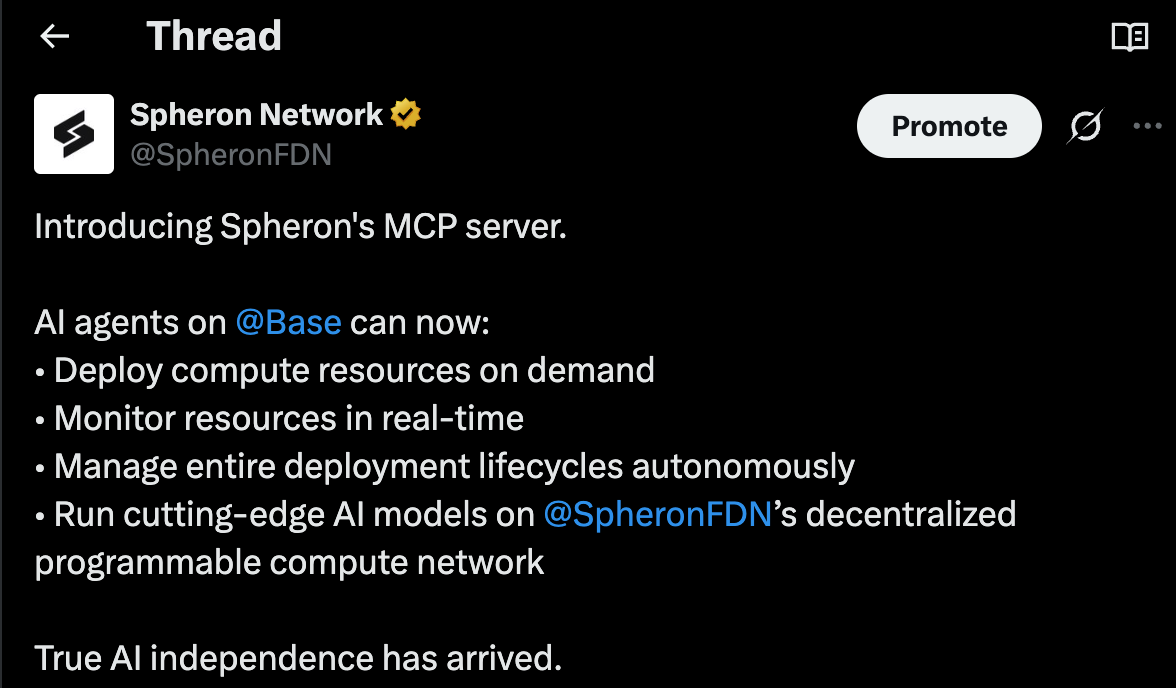
Spheron’s MCP Server: AI Infrastructure Independence

Spheron’s innovative MCP server implementation represents a significant advancement in the MCP ecosystem. This development represents a major step toward true AI infrastructure independence, allowing AI agents to manage their compute resources without human intervention.

Spheron’s MCP server creates a direct bridge between AI agents and Spheron’s decentralized compute network, enabling agents operating on the Base blockchain to:

Deploy compute resources on demand through smart contracts

Monitor these resources in real-time

Manage entire deployment lifecycles autonomously

Run cutting-edge AI models like DeepSeek, Stable Diffusion, and WAN on Spheron’s decentralized network

This implementation follows the standard Model Context Protocol, ensuring compatibility with the broader MCP ecosystem while enabling AI systems to break free from centralized infrastructure dependencies. By allowing agents to deploy, monitor, and scale their infrastructure automatically, Spheron’s MCP server represents a significant advancement in autonomous AI operations.

The implications are profound: AI systems can now make decisions about their computational needs, allocate resources as required, and manage infrastructure independently. This self-management capability reduces reliance on human operators for routine scaling and deployment tasks, potentially accelerating AI adoption across industries where infrastructure management has been a bottleneck.

Developers interested in implementing this capability with their own AI agents can access Spheron’s GitHub repository at https://github.com/spheronFdn/spheron-mcp-plugin

Addressing Concerns: Security, Lock-in, and Adoption Challenges

Despite its advantages, MCP faces legitimate scrutiny regarding several potential issues:

Security Considerations

Critics have raised concerns that a centralized protocol managing multiple integrations could create new attack vectors. Does MCP inadvertently create a single point of vulnerability by providing a standardized way to access diverse systems?

Proponents counter that MCP’s standardized security framework enhances protection by implementing consistent authentication, encryption, and permission controls across all integrations. Rather than the patchwork of security measures typical in custom integrations, MCP establishes unified security practices that can be comprehensively audited and updated.

Ecosystem Lock-in

Some observers worry that widespread MCP adoption could create unhealthy dependencies on specific AI providers. If a single protocol becomes dominant, could this limit innovation or create vendor lock-in?

This concern highlights the importance of MCP’s eventual standardization through open governance. For MCP to realize its full potential, the protocol will likely need to evolve beyond its origins at Anthropic to become an industry standard developed collaboratively and implemented across AI ecosystems.

Spheron’s implementation of the standard protocol for decentralized compute is an encouraging sign that the ecosystem is diversifying beyond a single provider, potentially addressing lock-in concerns.

Adoption Learning Curve

Transitioning from traditional integration methods to MCP requires a mindset shift for development teams. Organizations with substantial investments in existing API-based integrations may hesitate to adopt new approaches, particularly if they lack experience with contextual AI systems.

Early adopters report that while MCP does require initial learning, the long-term efficiency gains outweigh these transitional costs. The key to successful adoption appears to be starting with focused use cases where contextual awareness delivers clear value before expanding to broader implementations.

The Future Horizon: Where MCP Is Headed

As MCP gains traction, several evolution paths are emerging:

Industry-Specific Adaptations

Expect to see specialized MCP implementations tailored to the unique requirements of specific sectors. Healthcare MCP variants might incorporate HIPAA compliance features, while financial implementations could integrate regulatory reporting capabilities. These industry-specific adaptations will accelerate adoption in specialized domains.

Enhanced Security Frameworks

As MCP deployment expands, its security capabilities will likely evolve to address emerging threats and compliance requirements. Future iterations may incorporate advanced encryption standards, granular permission controls, and comprehensive audit capabilities to satisfy enterprise security requirements.

Interoperability Standards

Interoperability standards will be essential for MCP to achieve its full potential. Industry consortia may emerge to govern protocol evolution, ensuring consistent implementation across AI providers and preventing fragmentation into competing proprietary variants.

AI Infrastructure Independence

Spheron’s advancement in enabling AI agents to manage their own infrastructure represents an early glimpse of a future where AI systems operate with increasing autonomy. This trend toward infrastructure independence may become a defining characteristic of advanced AI systems, with MCP serving as the critical enabling protocol.

Conclusion: MCP as a Catalyst for AI’s Next Phase

Model Context Protocol represents more than a technical advancement in AI integration it embodies a fundamental shift in how AI systems interact with the digital ecosystem. MCP addresses one of the most significant limitations in current AI deployment by enabling contextually aware, dynamic connections between AI and external tools.

The protocol’s ability to maintain context across interactions, discover available resources automatically, and communicate bidirectionally transforms AI from isolated systems into connected intelligence networks. This evolution has profound implications for organizations leveraging AI across workflows, decisions, and customer experiences.

Implementations like Spheron’s MCP server demonstrate how quickly the ecosystem is evolving, with new capabilities emerging that enable unprecedented levels of AI autonomy and independence. As adoption grows and the protocol matures, MCP may be remembered as a pivotal development that unlocked AI’s next growth phase the transition from powerful but isolated models to deeply integrated, contextually aware systems that function as seamless extensions of human capabilities.

]]>


Source link

Popular Posts

My Favorites