Web3

Home Web3 Page 155

Shocking Crypto Market Plunge: Bitcoin and Ethereum Drop Amid Intensifying Global Trade War – Web3oclock

0
Shocking Crypto Market Plunge: Bitcoin and Ethereum Drop Amid Intensifying Global Trade War – Web3oclock


Source link

Solid’s Stunning Fall: Once a Fintech Darling, Now Filing for Bankruptcy After $81M Raised – Web3oclock

0
Solid’s Stunning Fall: Once a Fintech Darling, Now Filing for Bankruptcy After M Raised – Web3oclock


A Restructuring or Fire Sale? What’s Next for Solid


Source link

Crypto Competitors Grayscale and Osprey Settle Two-Year Tussle Over Bitcoin ETFs – Decrypt

0
Crypto Competitors Grayscale and Osprey Settle Two-Year Tussle Over Bitcoin ETFs – Decrypt


Digital asset managers Grayscale Investments and Osprey Funds have reached a settlement agreement after their long-drawn legal dispute over marketing practices.

A motion filed with the Connecticut Appellate Court on April 9 shows the parties are looking at 45 days to finalize settlement documentation after Osprey appealed a February decision favoring Grayscale.

“Soon after this appeal was filed, the parties reached a settlement of this case,” a copy of the motion first uploaded by Law360 reads. Grayscale and Osprey would then need to “finish documenting the settlement” and carry out the terms before the appeal can be pulled.

The lawsuit, filed in January 2023, centered on allegations that Grayscale misled investors about the prospects of its Bitcoin Trust (GBTC) converting to an exchange-traded fund.

Fairfield-based Osprey, which operates its own Bitcoin trust albeit with a smaller market share, claimed Grayscale violated Connecticut’s Unfair Trade Practices Act (CUTPA) by allegedly deceptive marketing.

Court records show the litigation with Osprey intensified after Grayscale received SEC approval to “uplist” and convert its Bitcoin Trust to an ETF in January 2024, following a protracted battle with the regulator.

Osprey subsequently amended its complaint, arguing that Grayscale misrepresented its progress toward ETF conversion.  Osprey is still working to convert their OBTC to an ETF.

Superior Court Judge Mark Gould granted summary judgment to Grayscale on February 7, 2025, ruling that CUTPA did not apply to securities cases.

That judgment came after over two years of legal proceedings, which included counterclaims by Grayscale alleging similar unfair practices by Osprey. These counterclaims were voluntarily dropped before the summary judgment, the case history shows.

It’s worth noting that before the February ruling, Osprey had attempted to settle the case in July 2024 for roughly $2 million, but Grayscale declined that offer.

Financial terms and other conditions of the current settlement agreement have not been disclosed, and it remains unclear whether the agreement includes any admission of liability by either party.

Representatives from both companies have not issued public statements regarding the current settlement terms.

Decrypt has reached out to Grayscale and Osprey but did not receive a response by press time.

Edited by Sebastian Sinclair

Daily Debrief Newsletter

Start every day with the top news stories right now, plus original features, a podcast, videos and more.


Source link

SUPERBLOCK x SBX Prime: The RWA Tokenization Revolution You Can’t Ignore! | Web3Wire

0
SUPERBLOCK x SBX Prime: The RWA Tokenization Revolution You Can’t Ignore! | Web3Wire


The future of asset ownership is being redefined, and at the heart of this transformation are SUPERBLOCK and SBX Prime—two groundbreaking platforms leading the charge in real-world asset (RWA) tokenization. With $SBX token’s presale now live for whitelisted investors, investors, developers, and institutions have a rare opportunity to be part of the next evolution in decentralized finance.

SUPERBLOCK: The Foundation of a Secure and Scalable RWA Ecosystem 

RWA tokenization is the next frontier in blockchain adoption, and SUPERBLOCK is setting the industry standard. By prioritizing security, regulatory compliance, and seamless interoperability, SUPERBLOCK ensures that physical assets can be digitized, fractionalized, and traded globally. 

Unparalleled Security – Advanced cryptographic protocols ensure transactions and asset transfers are executed with institutional-grade protection. 

Seamless RWA Tokenization – SUPERBLOCK bridges the gap between real-world assets and blockchain, making it easier for investors to access tokenized real estate and other high-value properties. 

Regulatory Compliance – Designed to meet the highest financial standards, ensuring legitimacy and trust among institutional and retail investors. 

With SUPERBLOCK, investing in real-world assets is no longer limited to traditional markets— it’s now borderless, transparent, and powered by blockchain. 

SBX Prime: The Future of Real Estate Investment is on the Blockchain

At the center of SUPERBLOCK’s ecosystem is SBX Prime, a fully licensed real estate tokenization platform designed to revolutionize commercial property investment. Unlike speculative crypto assets, SBX Prime provides direct access to high-value, income-generating real estate. 

Tokenizing Institutional-Grade Real Estate – SBX Prime will initially tokenize three high-profile properties in Dubai, London, and Singapore. 

Low-Cost, High-Speed Transactions – Invest in real estate with blockchain efficiency—no middlemen, no excessive fees. 

Passive Income Through Staking & Yield Generation – Earn rewards through tokenized property staking mechanisms. 

Global Accessibility – Unlock investment opportunities traditionally reserved for high-net-worth individuals and institutions. 

By leveraging blockchain technology, SBX Prime is democratizing real estate investment, making it more accessible, liquid, and profitable for everyone. 

The $SBX Token Presale: A Rare Investment Opportunity in RWA Tokenization 

The $SBX token presale is more than just another token launch—it’s a gateway into the booming RWA tokenization sector. 

Exclusive Early Access Pricing – Get in at a lower price before $SBX token hits major exchanges. 

Limited Supply, High Demand – Institutional interest in RWA tokenization is soaring, making early access even more valuable. 

First-Mover Advantage – The future of real estate investment is digital, and those who get in early will reap the benefits. 

This isn’t just another crypto presale—it’s a historic moment in the tokenization of real-world assets.

Beyond the Presale: SUPERBLOCK & SBX Prime’s Vision for the Future 

SUPERBLOCK and SBX Prime are pioneering the future of decentralized finance by merging AI, tokenization, and blockchain automation into a seamless ecosystem: 

AI-Powered Investment Insights – Machine learning algorithms optimize investment strategies and portfolio management. 

Automated Smart Contracts for Asset Management – Eliminating inefficiencies, reducing costs, and ensuring trustless execution. 

Decentralized Governance & Community-Led Decision Making – Users have voting power to influence the ecosystem’s growth. 

With a solid technical foundation, regulatory compliance, and an expanding global reach, SUPERBLOCK and SBX Prime are leading the charge in real-world asset tokenization. 

Final Thoughts: The RWA Tokenization Revolution Has Begun 

Traditional finance is being disrupted, and SUPERBLOCK and SBX Prime are at the center of this financial revolution. The tokenization of real-world assets is no longer a concept—it’s happening now, and those who act early will define the future of blockchain-based investments. 

Invite only founder’s circle presale of the $SBX token is live. Visit the website to apply for founder’s circle whitelist and secure your position in the next evolution of real estate tokenization. 

Public presale launch date: TBD

For further Information:

For updates and exclusive insights, follow SUPERBLOCK on their only social media channel @SUPERBLOCKHQ on X (formally twitter).

Visit https://www.superblock.ai , the one stop tokenization ecosystem bridging the gap between traditional finance and decentralized finance.

Visit https://www.sbxprime.com, institutional grade commercial real estate tokenization platform, focusing on prime rent generating assets around the world.

Applications for founder’s circle priority access is open, visit https://www.sbxtoken.com to apply.

Links:

https://sbxtoken.com

https://superblock.ai

https://sbxprime.com

https://x.com/SUPERBLOCKHQ

Disclaimer: The information provided in this press release is not a solicitation for investment, nor is it intended as investment advice, financial advice, or trading advice. It is strongly recommended you practice due diligence, including consultation with a professional financial advisor, before investing in or trading cryptocurrency and securities.

About Web3Wire Web3Wire – Information, news, press releases, events and research articles about Web3, Metaverse, Blockchain, Artificial Intelligence, Cryptocurrencies, Decentralized Finance, NFTs and Gaming. Visit Web3Wire for Web3 News and Events, Block3Wire for the latest Blockchain news and Meta3Wire to stay updated with Metaverse News.


Source link

DIG Ventures Launches €90M Fund to Propel Europe’s Breakthrough Tech Innovators – Web3oclock

0
DIG Ventures Launches €90M Fund to Propel Europe’s Breakthrough Tech Innovators – Web3oclock


Strategic Focus:

Dash0 – An observability platform created by Mirko Novakovic, founder of Instana (acquired by IBM).

Nexos.ai – An AI orchestration platform by Nord Security founders Tomas Okmanas and Eimantas Sabaliauskas.

PolyAPI – A modern enterprise middleware solution founded by Darko Vukovic, a former executive at MuleSoft, Google, and Oracle.

About DIG Ventures:


Source link

Firefish Secures $1.8M to Revolutionize Bitcoin-Backed Lending and Unlock Global Financial Freedom – Web3oclock

0
Firefish Secures .8M to Revolutionize Bitcoin-Backed Lending and Unlock Global Financial Freedom – Web3oclock


Source link

OpenAI Countersues Elon Musk, Accuses Billionaire of ‘Bad-Faith Tactics’ – Decrypt

0
OpenAI Countersues Elon Musk, Accuses Billionaire of ‘Bad-Faith Tactics’ – Decrypt


OpenAI says Elon Musk didn’t just leave the company; he tried to take it over, and the AI research giant says it has the emails to prove it.

In a newly filed countersuit, OpenAI accuses Tesla CEO Elon Musk of attempting a hostile takeover of the company he helped found, using what it called “bad-faith tactics” and a “self-serving narrative.”

OpenAI seeks to block Elon Musk’s alleged campaign of harassment and disruption, centered on a sham $97 billion takeover bid, while seeking compensatory and punitive damages to be determined at a possible trial, along with injunctive relief to prevent further interference.

“These antics are just history on repeat—Elon being all about Elon,” OpenAI’s official newsroom wrote in a scalding post on X as it shared internal emails showing Musk pushing to convert OpenAI into a for-profit entity.

While Musk has consistently argued that OpenAI strayed from its original nonprofit mission, OpenAI alleges Musk himself was the first to push for a structural overhaul, so long as he was in charge.

As shown in the emails, in November 2015, Musk began questioning OpenAI’s structure in an email to CEO Sam Altman, writing that a “standard C corp with a parallel nonprofit” would likely align incentives better. 

Decrypt has yet to independently verify the emails put forth by OpenAI. Representatives for Musk’s companies, Tesla and SpaceX, did not immediately respond to Decrypt’s request for comment.

For-profit necessity

In June and July 2017, as OpenAI’s need for compute scaled with its Dota 2 experiments, Musk allegedly  encouraged expansion, writing, “Let’s figure out the least expensive way to ensure compute power is not a constraint.”

And that summer, discussions shifted. On July 13, 2017, Musk allegedly agreed a for-profit model might be necessary. Days later, he warned that China’s AI ambitions were another reason to “change course.”

OpenAI claims that in September 2017,  Musk made his move, pushing for “initial control” over OpenAI’s board in exchange for capital and demanding to be CEO. 

Emails from that month show him proposing a structure where he’d appoint four out of seven board seats. “I would unequivocally have initial control of the company,” he allegedly wrote.

OpenAI alleges Musk also directed his team to incorporate a for-profit shell company, Open Artificial Intelligence Technologies, Inc., with plans to rehouse OpenAI’s IP under it.

Pushback

But OpenAI pushed back. In a candid message, co-founders warned that Musk’s structure risked creating an “AGI dictatorship.” 

They rejected the terms. Musk’s response: “Discussions are over. I will no longer fund OpenAI.”

In January 2018, Musk allegedly proposed spinning OpenAI into Tesla, saying it was the only way to raise the billions needed. “OpenAI is on a path of certain failure relative to Google,” he wrote. 

According to OpenAI, the team declined again, unwilling to become a Tesla subsidiary. By February 2018, Musk resigned as co-chair and parted ways with OpenAI.

Years later, he has now returned, and this time through the courts.

In March, Musk’s lawsuit against OpenAI sought to block its transition to a capped-profit structure. A U.S. judge denied the injunction but agreed to an expedited trial, set for fall 2025.

OpenAI had previously released Musk’s emails earlier last year in response to the lawsuit, painting a picture of a founder who, despite his public stance, was already advocating for profit, exclusivity, and consolidation, years before filing suit.

Amid the chaos, Musk has founded a rival AI startup, xAI, which last month merged with X in an all-stock deal valuing xAI at $80 billion.

OpenAI, for its part, announced a $40 billion funding round led by SoftBank, pushing its valuation to $300 billion. That’s nearly four times the valuation tied to Musk’s xAI startup.

“We’re getting ready to build the best-equipped nonprofit the world has ever seen,” OpenAI said in its countersuit. “The idea that we abandoned the mission is false. Elon’s own emails make that clear.”

Edited by Sebastian Sinclair

Generally Intelligent Newsletter

A weekly AI journey narrated by Gen, a generative AI model.


Source link

The Anatomy of AI Minds: Decoding Neural Networks

0
The Anatomy of AI Minds: Decoding Neural Networks


One of the most persistent challenges has been understanding exactly how large language models (LLMs) like ChatGPT and Claude work. Despite their impressive capabilities, these sophisticated AI systems have largely remained “black boxes”—we know they produce remarkable results, but the precise mechanisms behind their operations have been shrouded in mystery—that is, until now.

A groundbreaking research paper published by Anthropic in early 2025 has begun to lift this veil, offering unprecedented insights into the inner workings of these complex systems. The research doesn’t just provide incremental knowledge – it fundamentally reshapes our understanding of how these AI models think, reason, and generate responses. Let’s dive deep into this fascinating exploration of what might be called “the anatomy of the AI mind.”

Understanding the Foundations: Neural Networks and Neurons

Before we can appreciate the breakthroughs in Anthropic’s research, we need to establish foundational knowledge about the structure of modern AI systems.

At their core, today’s most advanced AI models are built upon neural networks – computational systems loosely inspired by the human brain. These neural networks consist of interconnected elements called “neurons” (though the technical term is “hidden units”). While the comparison to biological neurons is imperfect and somewhat misleading to neuroscientists, it provides a useful conceptual framework for understanding these systems.

Large language models like ChatGPT, Claude, and their counterparts are essentially massive collections of these neurons working together to perform a seemingly simple task: predicting the next word in a sequence. However, this simplicity is deceptive. Modern frontier models contain hundreds of billions of neurons interacting in extraordinarily complex ways to make these predictions.

The sheer scale and complexity of these interactions have made it exceptionally difficult to understand exactly how these models arrive at their answers. Unlike traditional software, where developers write explicit instructions that the program follows, neural networks develop their internal processes through training on vast datasets. The result is a system that produces impressive outputs but whose internal mechanisms have remained largely opaque.

The Problem of Polysemantic Neurons

Early attempts to understand these models focused on analyzing individual neuron activations – essentially monitoring when specific neurons “fire” in response to particular inputs. The hope was that individual neurons might correspond to specific concepts or topics, making the model’s behavior interpretable.

However, researchers quickly encountered a significant obstacle: neurons in these models turned out to be “polysemantic,” meaning they would activate in response to multiple, seemingly unrelated topics.

This polysemantic nature made it exceedingly difficult to map individual neurons to specific concepts or to predict a model’s behavior based on which neurons were activating. The models remained black boxes, and their internal workings were resistant to straightforward interpretation.

The Feature Discovery Breakthrough

The first major breakthrough in understanding these systems came when Anthropopic researchers discovered that while individual neurons might be polysemantic, specific combinations of neurons were often “monosemantic “—uniquely related to specific concepts or outcomes.

This insight led to the development of the concept of “features” – particular patterns of neuron activation that could be reliably mapped to specific topics or behaviors. Rather than trying to understand the model at the level of individual neurons, researchers could now analyze it in terms of these feature activations.
None

To facilitate this analysis, Anthropic introduced a methodology called “sparse autoencoders” (SAEs), which helped identify and map these neuron circuits to specific features. This approach transformed what was once an impenetrable black box into something more akin to a map of features explaining the model’s knowledge and behavior.

Perhaps even more significantly, researchers discovered they could “steer” a model’s behavior by artificially activating or suppressing the neurons associated with particular features. By “clamping” certain features – forcing the associated neurons to activate strongly – they could produce predictable behaviors in the model.

In one striking example, by clamping the feature associated with the Golden Gate Bridge, researchers could cause the model to essentially behave as if it were the bridge itself, producing text from the perspective of the iconic San Francisco landmark.

None

Feature Graphs: The New Frontier

Building on these earlier discoveries, Anthropic’s latest research introduces the concept of “feature graphs,” which takes model interpretability to new heights. Rather than trying to map the billions of neuron activations directly to outputs, feature graphs transform these complex neural patterns into more comprehensible representations of concepts and their relationships.

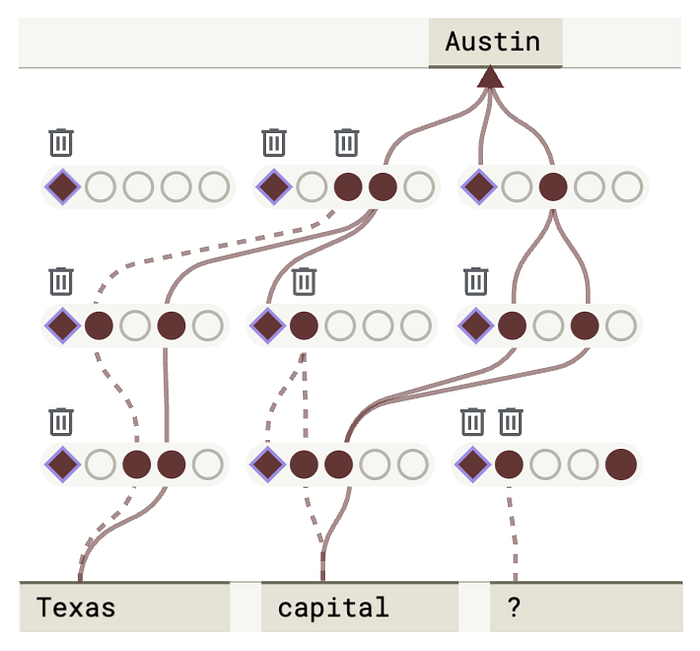
To understand how this works, consider a simple example: When a model is asked, “What is the capital of Texas?” The expected answer is “Austin.” In traditional approaches to understanding the model, we would need to analyze billions of neuron activations to understand how the model arrived at this answer—an effectively impossible task.
None

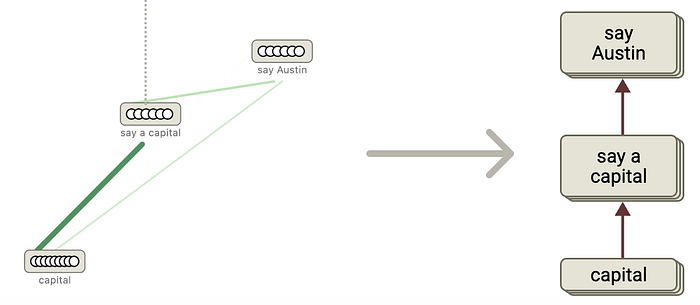
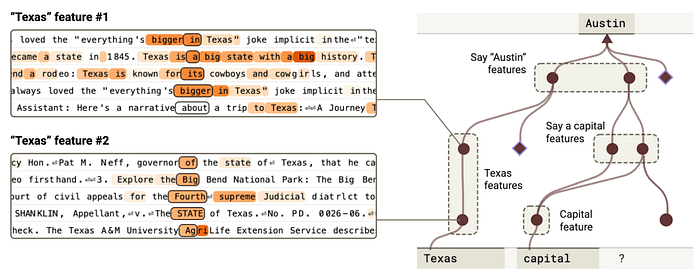
But feature graphs show something remarkable: When the model processes the words “Texas” and “capital,” it activates neurons related to these concepts. The “capital” neurons promote a set of neurons responsible for outputting a capital city name. Simultaneously, the “Texas” neurons provide context. These two activation patterns then combine to activate the neurons associated with “Austin,” leading the model to produce the correct answer.
None

This represents a profound shift in our understanding. For the first time, we can trace a clear, interpretable path from input to output through the model’s internal processes. LLM outputs are no longer mysterious; they have a mechanistic explanation.

Beyond Memorization: Evidence of Reasoning

At this point, it would be easy to take a cynical stance and argue that these circuits simply represent memorized patterns rather than genuine reasoning. After all, couldn’t the model just be retrieving the memorized sequence “Texas capital? Austin” rather than performing any real inference?

What makes Anthropic’s findings so significant is that they demonstrate these circuits are actually generalized and adaptable – qualities that suggest something more sophisticated than simple memorization.

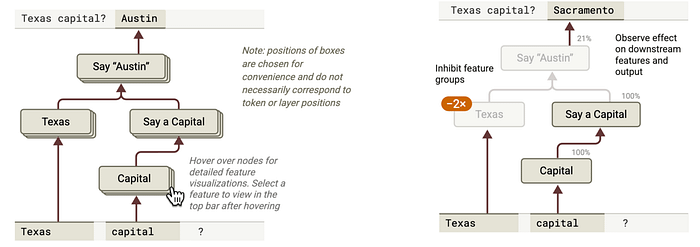
For example, if researchers artificially suppress the “Texas” feature while keeping the “capital” feature active, the model will still predict a capital city – just not Texas’s capital. The researchers could control which capital the model produced by activating neurons representing different states, regions, or countries, while still utilizing the same basic circuit architecture.
None

This adaptability strongly suggests that what we’re seeing isn’t rote memorization but a form of generalized knowledge representation. The model has developed a general circuit for answering questions about capitals and adapts that circuit based on the specific input it receives.

Even more compelling evidence comes from the model’s ability to handle multi-step reasoning tasks. When prompted with a question like “The capital of the state containing Dallas is…”, the model engages in a multi-hop activation process:

None

It recognizes the terms “capital” and “state,” activating neurons that promote capital city predictions

In parallel, it activates “Texas” after processing “Dallas”

These activations combine – the urge to produce a capital name and the context of Texas – resulting in the prediction of “Austin”

This activation sequence bears a striking resemblance to how a human might reason through the same question, first identifying that Dallas is in Texas, then recalling that Austin is Texas’s capital.

Planning Ahead: The Autoregressive Paradox

Perhaps one of the most surprising discoveries in Anthropic’s research concerns the ability of these models to “plan ahead” despite their fundamental architectural constraints.

Large language models like GPT-4 and Claude are autoregressive, meaning they generate text one token (roughly one word) at a time, with each prediction based solely on the tokens that came before it. Given this architecture, it seems counterintuitive that such models could plan beyond the immediate next word.

Yet Anthropic’s researchers observed exactly this kind of planning behavior in poetry generation tasks. When writing poetry, a particular challenge is ensuring that the final words of verses rhyme with each other. Human poets typically address this by planning the rhyming word at the end of a line first, then constructing the rest of the line to lead naturally to that word.

Remarkably, the neural feature graphs revealed that LLMs employ a similar strategy. As soon as the model processes a token indicating a new line of poetry, it begins activating neurons associated with words that would make both semantic sense and rhyme appropriately – several tokens before those words would actually be predicted.

In other words, the model is planning the outcome of the entire verse before generating a single word of it. This planning ability represents a sophisticated form of reasoning that goes well beyond simple pattern matching or memorization.

The Universal Circuit: Multilingual Capabilities and Beyond

The research uncovered additional fascinating capabilities through these feature graphs. For instance, models demonstrate “multilingual circuits” – they understand user requests in a language-agnostic form, using the same basic circuitry to answer while adapting interchangeably to the input language.

Similarly, for mathematical operations like addition, models appear to use memorized results for simple calculations but employ elaborate circuits for more complex additions, producing accurate results through a process that resembles step-by-step calculation rather than mere retrieval.

The research even documents complex medical diagnosis circuits, where models analyze reported symptoms, use them to promote follow-up questions, and elaborate on correct diagnoses through multi-step reasoning processes.

Implications for AI Development and Understanding

The significance of Anthropic’s findings extends far beyond academic interest. These discoveries have profound implications for how we develop, deploy, and interact with AI systems.

First, the evidence of generalizable reasoning circuits provides a strong counter to the narrative that large language models are merely “stochastic parrots” regurgitating memorized patterns from their training data. While memorization undoubtedly plays a significant role in these systems’ capabilities, the research clearly demonstrates behaviors that transcend simple memorization:

Generalizability: The circuits identified are general and adaptable, used by models to answer similar yet distinct questions. Rather than developing unique circuits for every possible prompt, models abstract key patterns and apply them across different contexts.

Modularity: Models can combine different, simpler circuits to develop more complex ones, tackling more challenging questions through composition of basic reasoning steps.

Interventability: Circuits can be manipulated and adapted, making models more predictable and steerable. This has enormous implications for AI alignment and safety, potentially allowing developers to block certain features to prevent undesired behaviors.

Planning capacity: Despite their autoregressive architecture, models demonstrate the ability to plan ahead for future tokens, altering current predictions to enable specific desired outcomes later in the sequence.

These capabilities suggest that while current language models may not possess human-level reasoning, they are engaged in behaviors that certainly transcend mere pattern matching – behaviors that could reasonably be characterized as a primitive form of reasoning.

The Path Forward: Challenges and Opportunities

Despite these exciting discoveries, important questions remain about the future development of AI reasoning capabilities. The current capabilities emerged after training on trillions of data points, yet remain relatively primitive compared to human reasoning. This raises concerns about the viability of improving these capabilities within current paradigms.

Will models ever develop truly human-level reasoning capabilities? Some experts suggest that we may need fundamental algorithmic breakthroughs that improve data efficiency, allowing models to learn more from less data. Without such breakthroughs, there’s a risk that these models could plateau in their reasoning abilities.

On the other hand, the new understanding provided by feature graphs opens exciting possibilities for more controlled and targeted development. By understanding exactly how models reason internally, researchers might be able to design training methodologies that specifically enhance these reasoning circuits, rather than relying on the current approach of massive training on diverse data and hoping for emergent capabilities.

Furthermore, the ability to intervene in specific features opens new possibilities for AI alignment – ensuring models behave in accordance with human values and intentions. Rather than treating alignment as a black-box problem, developers might be able to directly manipulate the specific circuits responsible for potentially problematic behaviors.

Conclusion: A New Era of AI Understanding

Anthropic’s research represents a watershed moment in our understanding of artificial intelligence. For the first time, we have concrete, mechanistic evidence of how large language models process information and generate responses. We can trace the activation of specific features through the model, watching as it combines concepts, makes inferences, and plans.

While these models still rely heavily on memorization and pattern recognition, the research conclusively demonstrates that there’s more to their capabilities than these simple mechanisms. Identifying generalizable, modular reasoning circuits provides compelling evidence that these systems are engaging in processes that, while not identical to human reasoning, certainly transcend simple retrieval.

As we continue to develop more powerful AI systems, this deeper understanding will be crucial for addressing concerns about safety, alignment, and the ultimate capabilities of these technologies. Rather than flying blind with increasingly powerful black boxes, we now have tools to peer inside and understand the anatomy of the AI mind.

The implications of this research extend beyond technical understanding – they touch on fundamental questions about the nature of intelligence itself. If seemingly simple neural networks can develop primitive reasoning capabilities through exposure to patterns in data, what does this tell us about the nature of human reasoning? Are there deeper information processing principles that underlie biological and artificial intelligence?

These questions remain open, but Anthropic’s research has given us powerful new exploration tools. As we continue to map the anatomy of artificial minds, we may gain unexpected insights into our own.



Source link

Broadcast Infrastructure Market 2025-2032: Industry Outlook, Trends Analysis, New Opportunities, and Prospects | Cisco Systems, Inc., Clyde Broadcast Technology | Web3Wire

0
Broadcast Infrastructure Market 2025-2032: Industry Outlook, Trends Analysis, New Opportunities, and Prospects | Cisco Systems, Inc., Clyde Broadcast Technology | Web3Wire


Broadcast Infrastructure Market

The latest research study released by Coherent Market Insights on “Broadcast Infrastructure Market 2025 Forecast to 2032” research provides accurate economic, global, and country-level predictions and analyses. It provides a comprehensive perspective of the competitive market as well as an in-depth supply chain analysis to assist businesses in identifying major changes in industry practices. The market report also examines the current state of the Broadcast Infrastructure industry, as well as predicted future growth, technological advancements, investment prospects, market economics, and financial data. This study does a thorough examination of the market and offers insights based on an industry SWOT analysis. The report on the Broadcast Infrastructure Market provides access to critical information such as market growth drivers, market growth restraints, current market trends, the market’s economic and financial structure, and other key market details.

Get an Exclusive Sample Copy of the Report at: https://www.coherentmarketinsights.com/insight/request-sample/4555

Furthermore, The report provides a detailed understanding of the market segments which have been formed by combining different prospects such as types, applications, and regions. Apart from this, the key driving factors, restraints, potential growth opportunities, and market challenges are also discussed in the report.

The updated Version Report & online dashboard will help you understand:

Competitive LandscapeHistorical data & forecastsCompany revenue sharesRegional assessmentLatest trends & dynamics

Major Key Players:

Cisco Systems, Inc., Clyde Broadcast Technology, CS Computer Systems Ltd., Dacast Inc., EVS Broadcast Equipment SA, Grass Valley, Kaltura, Nevion, Ross Video Ltd, and Zixi.

Detailed Segmentation:

On the basis of Component type, the global broadcast infrastructure market is segmented into:

HardwareSoftwareServicesPersonal ServicesManaged ServicesOn the basis of Technology type, the global broadcast infrastructure market is segmented into:

Digital BroadcastingAnalog BroadcastingOn the basis of Application type, the global broadcast infrastructure market is segmented into:

OTTTerrestrialSatelliteIPTVOthers

Report Drivers & Trends Analysis:

The report also discusses the factors driving and restraining market growth, as well as their specific impact on demand over the forecast period. Also highlighted in this report are growth factors, developments, trends, challenges, limitations, and growth opportunities. This section highlights emerging Broadcast Infrastructure Market trends and changing dynamics. Furthermore, the study provides a forward-looking perspective on various factors that are expected to boost the market’s overall growth.

Competitive Landscape Analysis:

In any market research analysis, the main field is competition. This section of the report provides a competitive scenario and portfolio of the Broadcast Infrastructure Market’s key players. Major and emerging market players are closely examined in terms of market share, gross margin, product portfolio, production, revenue, sales growth, and other significant factors. Furthermore, this information will assist players in studying critical strategies employed by market leaders in order to plan counterstrategies to gain a competitive advantage in the market.

The global Broadcast Infrastructure market, based on different geographic regions, is divided as follows:

➤ North America (the United States, Canada, and Mexico)➤ Europe (Germany, France, UK, Russia, and Italy)➤ Asia-Pacific (China, Japan, Korea, India, and Southeast Asia)➤ South America (Brazil, Argentina, Colombia, etc.)➤ The Middle East and Africa (Saudi Arabia, UAE, Egypt, Nigeria, and South Africa)

Book the Latest Edition of this Market Study Get Up to 25% Discount At: https://www.coherentmarketinsights.com/insight/buy-now/4555

Key Features of the Broadcast Infrastructure Market Report:

✅ Analyze competitive developments such as expansions, deployments, new product launches, and market acquisitions.

✅ Examine the market opportunities for stakeholders by identifying higher growth sections.

✅ To study and analyze the global Broadcast Infrastructure industry status and forecast including key regions.

✅ An in-depth analysis of key product segments and application spectrum, providing strategic recommendations to incumbents and new entrants to give them a competitive advantage over others.

✅ It provides a comprehensive analysis of key regions of the industry as well as a SWOT analysis and Porter’s Five Forces analysis to provide a deeper understanding of the market.

✅ It helps you make strategic business decisions and investment plans.

Here we have mentioned some vital reasons to purchase this report:

➤ Regional report analysis highlighting the consumption of products/services in a region also shows the factors that influence the market in each region.

➤ Reports provide opportunities and threats faced by suppliers in the Broadcast Infrastructure and tubes industry around the world.

➤ The report shows regions and sectors with the fastest growth potential.

➤ A competitive environment that includes market rankings of major companies, along with new product launches, partnerships, business expansions, and acquisitions.

➤ The report provides an extensive corporate profile consisting of company overviews, company insights, product benchmarks, and SWOT analysis for key market participants.

➤ This report provides the industry’s current and future market outlook on the recent development, growth opportunities, drivers, challenges, and two regional constraints emerging in advanced regions.

Book the Latest Edition of this Market Study Get Up to 25% Discount At: https://www.coherentmarketinsights.com/insight/buy-now/4555

Why Choose This Broadcast Infrastructure Market Report:

Gain a reliable outlook of the global Broadcast Infrastructure market forecasts from 2025 to 2032 across scenarios.Identify growth segments for investment.Stay ahead of competitors through company profiles and market data.

[FAQ]:

What is the scope of this report?Does this report estimate the current market size?Does the report provides market size in terms of – Value (US$ Mn) and Volume (thousand ton/metric ton/cubic meter) – of the market?Which segments are covered in this report?What are the key factors covered in this report?Does this report offer customization?

The report concludes with a summary of the key findings, implications for stakeholders in the Broadcast Infrastructure Market, and recommendations for future actions based on the report’s analysis.

Overall, the Broadcast Infrastructure Market research report is a valuable tool for businesses and investors seeking to gain a deeper understanding of the Broadcast Infrastructure Market and make informed decisions based on the analysis provided.

Author of this marketing PR:

Alice Mutum is a seasoned senior content editor at Coherent Market Insights, leveraging extensive expertise gained from her previous role as a content writer. With seven years in content development, Alice masterfully employs SEO best practices and cutting-edge digital marketing strategies to craft high-ranking, impactful content. As an editor, she meticulously ensures flawless grammar and punctuation, precise data accuracy, and perfect alignment with audience needs in every research report. Alice’s dedication to excellence and her strategic approach to content make her an invaluable asset in the world of market insights.

533 Airport Boulevard,Suite 400, Burlingame,CA 94010, United StatesPhone: US +12524771362UK +442039578553AUS: +61-2-4786-0457INDIA: +91-848-285-0837Email: sales@coherentmarketinsights.com

About Us:

Coherent Market Insights is a global market intelligence and consulting organization that provides syndicated research reports, customized research reports, and consulting services. We are known for our actionable insights and authentic reports in various domains including aerospace and defence, agriculture, food and beverages, automotive, chemicals and materials, and virtually all domains and an exhaustive list of sub-domains under the sun. We create value for clients through our highly reliable and accurate reports. We are also committed in playing a leading role in offering insights in various sectors post-COVID-19 and continue to deliver measurable, sustainable results for our clients.

This release was published on openPR.

About Web3Wire Web3Wire – Information, news, press releases, events and research articles about Web3, Metaverse, Blockchain, Artificial Intelligence, Cryptocurrencies, Decentralized Finance, NFTs and Gaming. Visit Web3Wire for Web3 News and Events, Block3Wire for the latest Blockchain news and Meta3Wire to stay updated with Metaverse News.


Source link

Bitcoin, Ethereum Dip as Trump’s Tariffs on China Take Effect – Decrypt

0
Bitcoin, Ethereum Dip as Trump’s Tariffs on China Take Effect – Decrypt


The fallout from this month’s trade policy from the White House continues to hound global markets, including crypto.

Bitcoin has dipped 4.1% to $76,550, while Ethereum is down 8.3% over the last 24 hours as President Donald Trump’s tariffs on Chinese goods took effect past midnight Tuesday.

Ethereum has witnessed the steepest decline on the day among the top 10 largest tokens, trading at its lowest point since March 2023.

It comes as Bitcoin briefly fell below the $75,000 level late Tuesday, less than three hours before the tariffs took effect. Bitcoin is down roughly 30% since its January peak above $109,000, right before Trump’s inauguration.

Major altcoins also posted losses. Dogecoin is down 16.3% on the day, while Solana and Cardano are down 18% and 23.7% over the past week, CoinGecko data shows.


“It’s been a miserable run for investors since the start of February, with more than $1.2 trillion in value wiped from the crypto market,” Pav Hundal, lead market analyst at Swyftx, told Decrypt. “The markets need a circuit breaker on sentiment as much as anything else.” 

Liquidation data from CoinGlass shows significant market distress, with the total running to roughly $411 million over the last 24 hours.

“This has been a very emotional journey,” Hundal said. “Everyone’s operating at extremes and there’s no in-between.”

Mounting tariff turmoil

The crypto market’s selloff mirrors broader financial market turmoil as Trump’s tariff blitz over the past week has intensified the “trade war” between the world’s two largest economies.

Asian markets opened sharply lower on Wednesday, with Japan’s Nikkei 225 falling 2.6% by the midday break, and Australia’s ASX 200 losing 2%.It follows a 1.5% decline in the S&P 500 on Tuesday, bringing its losses since mid-February to nearly 20%, where it is now approaching bear market territory.

“We’ve entered a new era of protectionism, and what’s worrying is we still have no more clarity on where it’s all going to settle,” Hundal argued.  “All eyes now will be on how quickly the U.S. can barter new trade and non-trade deals.”

The market turbulence coincides with key movements in bond and yield markets.

The 10-year Treasury yield jumped between 4.2% and 4.4% late Tuesday, representing one of its fastest intraday climbs since World War II. 

Also, on Tuesday, the first Treasury auction of three-year notes following Trump’s Liberation Day witnessed the weakest demand since late 2023.

The drop-off for three-year notes has raised concerns about waning foreign investors’ appetite for U.S. government debt as the trade tensions escalate to what some observers see as a “once-in-a-lifetime” breakdown.

Edited by Sebastian Sinclair

Daily Debrief Newsletter

Start every day with the top news stories right now, plus original features, a podcast, videos and more.


Source link

Popular Posts

My Favorites