Web3

Home Web3 Page 130

Share issue to personnel – 14 June 2025 | Web3Wire

0
Share issue to personnel – 14 June 2025 | Web3Wire


The board of directors of IDEX Biometrics ASA has resolved to issue 299,381,600 new shares at NOK 0.01 per share to employees, contractors and directors in the IDEX group (“Personnel Placement”). The purpose of the Personnel Placement is to incentivise the personnel in the implementation of the amended business plan and commercialisation of the company’s products.

The Personnel Placement is according to the resolution by the extraordinary general meeting of IDEX Biometrics ASA held on 11 April 2025, where the board was authorised to issue shares on terms equivalent to the terms in the debt conversion that was approved at the same meeting.

The shares are restricted for 18 months from the date of issuance and may not be sold or otherwise transferred during the restriction period. 1/3 of the shares are released from the restriction after 6 months and another 1/3 are released after 12 months. In the event a holder resigns or is terminated from employment or service, the company has the right to repurchase the holder’s restricted shares at certain terms.

The Board has considered the issue to the Personnel in light of the equal treatment obligations under the PLCA, the Norwegian Securities Trading Act, the rules on equal treatment under Oslo Rule Book II for companies listed on the Oslo Stock Exchange and the Oslo Stock Exchange’s Guidelines on the rule of equal treatment and deems that the proposed Personnel Placement is in compliance with these requirements. The Board holds the view that it will be in the common interest of the Company and its shareholders to incentivize the Company’s Personnel by issuance of the Offer Shares, both in the short term and in the long term. The number of Offer Shares represents approximately 6,7 % of the total number of outstanding shares in the Company, and the dilutive effect for the Company’s shareholders is limited. The subscription price for the Offer Shares, which was presented to the EGM as the intended issue price, is NOK 0.01, and the subscription price, before taking into account the lock up, consequently represents a 78 % discount to the closing price of the Company’s shares on Oslo Børs on 13 June 2025. Taking into account the lock up period and the volatility of the shares, the discount will vary from no discount at all to approx. 25 %. While the discount can be deemed significant, the Company is of the view that the number of Offer Shares issued, the fact that the issuance is made to the Personnel only, the EGM has specifically approved the framework for this equity issue, the Offer Shares will be subject to sales restrictions by way of a reverse vesting schedule with trading and transfer restrictions over 18 months, including with an option for the Company to repurchase the Offer Shares upon termination or resignation prior to the end of the 18-month period, collectively ensure that the Company is in compliance with its equal treatment obligations.

Following registration of the share capital increase, the company’s share capital will be NOK 47,310,125.99, divided into 4,731,012,599 shares each with a nominal value of NOK 0.01.

Contact personKristian Flaten, CFO, Tel.: +47 950 92322E-mail: ir@idexbiometrics.com

About IDEX BiometricsIDEX Biometrics ASA (IDEX) is a global technology leader in fingerprint biometrics, offering authentication solutions across payments, access control, and digital identity. Our solutions bring convenience, security, peace of mind and seamless user experiences to the world. Built on patented and proprietary sensor technologies, integrated circuit designs, and software, our biometric solutions target card-based applications for payments and digital authentication. As an industry-enabler we partner with leading card manufacturers and technology companies to bring our solutions to market.

For more information, visit http://www.idexbiometrics.com

About this noticeThis notice was issued by Erling Svela, VP of finance, on 10 June 2025 at 23:50 CET on behalf of IDEX Biometrics ASA. The shall be disclosed according to section 5-8 of the Norwegian  Securities Trading Act (STA) and published in accordance with section 5-12 of the STA.

About Web3Wire Web3Wire – Information, news, press releases, events and research articles about Web3, Metaverse, Blockchain, Artificial Intelligence, Cryptocurrencies, Decentralized Finance, NFTs and Gaming. Visit Web3Wire for Web3 News and Events, Block3Wire for the latest Blockchain news and Meta3Wire to stay updated with Metaverse News.


Source link

AI Deepfakes Drove 40% of High-Value Crypto Fraud Last Year: Report – Decrypt

0
AI Deepfakes Drove 40% of High-Value Crypto Fraud Last Year: Report – Decrypt


In brief

AI deepfakes of celebrities, government officials, and more accounted for 40% of “high-value” crypto fraud in 2024, a Bitget report claimed.
Crypto scam losses reached $4.6 billion in 2024, representing a 24% increase from previous year.
Social engineering schemes ranked as second-most dangerous crypto fraud method, followed by modern Ponzi schemes.

AI-generated deepfake impersonations of government officials, billionaires, and celebrities accounted for 40% of “high-value frauds” in 2024, a Bitget report revealed.

That same year, $4.6 billion in crypto was lost to scams, a 24% increase from the previous year, Bitget’s Anti-Scam Report 2025—co-authored with Slowmist and Elliptic—found.

“Crypto scams have entered a new era—driven by AI deepfakes, social engineering, and deceptive project fronts,” the report said. “Scams now exploit trust and psychology as much as technology. From wallet takeovers to multimillion-dollar frauds, the attacks are becoming more personalized, more believable, and harder to detect.”

A “frequent” deepfake that appeared, according to the report, featured Tesla CEO Elon Musk pitching fraudulent investment or giveaway schemes. Other uses for deepfakes include bypassing know-your-customer verification, creating virtual identities to lead investment scams, and conducting fake Zoom phishing attacks.


The Zoom scam sees scammers impersonate executives, experts, and journalists—including Decrypt reporters—to get a victim on a fraudulent video call. This may see the attacker offer the victim a job or ask to interview them for a non-existent article. During the fake Zoom call, attackers can gain control of the victim’s computer, steal data, and potentially access private crypto keys. 

Bitget reports that in some cases, the attackers are using deepfake tools to generate video and audio content to trick the victim into joining the call.

Many of these deepfake scams aren’t new; the Elon Musk scam first went viral in 2022. However, with the rapid acceleration of artificial intelligence, deepfakes have started to look real. So much so that President Trump signed the bipartisan Take It Down Act last month that protected the victims of deepfake porn—although, deepfakes in general still aren’t prohibited. 

In May, actor Jamie Lee Curtis called out Meta CEO Mark Zuckerberg after discovering a fake AI-generated ad of herself promoting a product without her consent.

“The biggest threat to crypto today isn’t volatility—it’s deception,” Bitget CEO Gracy Chen said, in a release. “AI has made scams faster, cheaper, and harder to detect.”

Outside of deepfakes, social engineering and modern Ponzi schemes ranked second and third as the report’s “most dangerous” scams. 

By definition, social engineering scams exploit the psychology of victims in a method that is “low-tech, yet highly effective,” the report says. One of the most common examples is the pig butcher scam, also called a romance scam, which sees the attacker develop a relationship with the victim solely to scam them.

As for the ol’ classic Ponzi scheme—named after the early 20th century scammer Charles Ponzi—the report claims that the scam has gone through a “digital evolution.”

“These scams typically disguise themselves in new concepts like DeFi, NFTs, and GameFi, packaged as project fundraising, liquidity mining, or platform token staking,” the report states. “Fundamentally, they remain classic Ponzi schemes where ‘new money fills old holes.’ Once the cash flow breaks or the operators cash out and exit, the entire system collapses quickly.”

The report notes a rise in Ponzi schemes that adopt “game-like user interfaces” and use deepfakes to forge endorsements from celebrities to boost credibility in the scheme. AI has revolutionized the scamming industry, resulting in a markedly different landscape from just a few years ago.

“Five years ago, avoiding scams meant ‘don’t click suspicious links,'” the report finished. “Today, it’s ‘don’t trust your own eyes.'”

Edited by James Rubin

Daily Debrief Newsletter

Start every day with the top news stories right now, plus original features, a podcast, videos and more.


Source link

XRP News: Vaultro Finance Presale on XRP ledger Skyrockets Past 50%, As Investors Race to Own $VLT Token | Web3Wire

0
XRP News: Vaultro Finance Presale on XRP ledger Skyrockets Past 50%, As Investors Race to Own $VLT Token | Web3Wire


SINGAPORE , June 15, 2025 (GLOBE NEWSWIRE) — Vaultro Finance has just announced a landmark achievement in its public sale of the native utility token VLT. The $VLT presale Round has now achieved a 50% sale milestone, marking a pivotal moment in the project’s journey and sending a clear signal that investor demand is surging. Achieving half of the targeted hardcap in rapid fashion underscores the market’s enthusiasm for Vaultro’s revolutionary approach to decentralized index fund investing on the XRP Ledger.

Purchase $VLT Token on Presale Round

This breakthrough comes amid a broader upswing for XRP itself. The token continues to trade above $2.10, supported by growing institutional inflows and the expanding suite of XRP based exchange traded products worldwide. Regulatory headwinds have given way to clarity, and major markets are embracing XRP infrastructure. In this revitalized environment, Vaultro Finance stands out by delivering real world utility in the form of a fully on chain index fund protocol. The $VLT Token Presale milestone of 50% claimed demonstrates that investors are seeking projects which combine familiar financial logic with the transparency and efficiency of blockchain.

At the heart of the Vaultro ecosystem is the VLT token, VLT holders unlock rights that extend far beyond simple token ownership. They gain the ability to create their own custom index funds, selecting themes such as artificial intelligence tokens, stablecoins for stability, decentralized finance protocols capturing the next wave of innovation, and high potential XRPL assets. VLT token holders also participate directly in governance, voting on platform upgrades, new fund listings, and strategic decisions that shape the protocol’s future.

Participate in $VLT Presale at Discount Rate

Participation in the presale remains open but is advancing toward its halfway point. Prospective contributors must hold an XRP native wallet and set up a trustline for the VLT token by following the step by step guideline, A minimum contribution of 200 XRP ensures broad accessibility. The official presale portal at https://sale.vaultro.finance/ is available now for anyone ready to join.

Do not miss your chance to be part of the next wave of decentralized finance on the XRP Ledger. Secure your VLT tokens today and help define the future of on chain index fund management.

For more details on Vaultro Finance and the $VLT presale visit;WebsiteJoin $VLT PresaleX fka TwitterTelegram CommunityWhitepaperBlog Channel

Contact:Lee WangContact@vaultro.finance

Disclaimer: This is a paid post and is provided by Vaultro Finance. The statements, views, and opinions expressed in this content are solely those of the content provider and do not necessarily reflect the views of this media platform or its publisher. We do not endorse, verify, or guarantee the accuracy, completeness, or reliability of any information presented. We do not guarantee any claims, statements, or promises made in this article. This content is for informational purposes only and should not be considered financial, investment, or trading advice.Investing in crypto and mining-related opportunities involves significant risks, including the potential loss of capital. It is possible to lose all your capital. These products may not be suitable for everyone, and you should ensure that you understand the risks involved. Seek independent advice if necessary. Speculate only with funds that you can afford to lose. Readers are strongly encouraged to conduct their own research and consult with a qualified financial advisor before making any investment decisions. However, due to the inherently speculative nature of the blockchain sector—including cryptocurrency, NFTs, and mining—complete accuracy cannot always be guaranteed.Neither the media platform nor the publisher shall be held responsible for any fraudulent activities, misrepresentations, or financial losses arising from the content of this press release. In the event of any legal claims or charges against this article, we accept no liability or responsibility.Globenewswire does not endorse any content on this page.

Legal Disclaimer: This media platform provides the content of this article on an “as-is” basis, without any warranties or representations of any kind, express or implied. We assume no responsibility for any inaccuracies, errors, or omissions. We do not assume any responsibility or liability for the accuracy, content, images, videos, licenses, completeness, legality, or reliability of the information presented herein. Any concerns, complaints, or copyright issues related to this article should be directed to the content provider mentioned above.

A photo accompanying this announcement is available at https://www.globenewswire.com/NewsRoom/AttachmentNg/cf236cc9-ea09-476c-bb5a-1bad482b625f

About Web3Wire Web3Wire – Information, news, press releases, events and research articles about Web3, Metaverse, Blockchain, Artificial Intelligence, Cryptocurrencies, Decentralized Finance, NFTs and Gaming. Visit Web3Wire for Web3 News and Events, Block3Wire for the latest Blockchain news and Meta3Wire to stay updated with Metaverse News.


Source link

Why I left Web2 for Web3 – and why you might, too

0
Why I left Web2 for Web3 – and why you might, too


The following article is a guest post and opinion of Yurii Kovalchuk, Senior Blockchain Engineer at Forte Group.

Three and a half years ago, I made a decision that completely changed the trajectory of my career. I left the familiar world of Web2 and stepped into the deep, chaotic, and exhilarating space of blockchain development.

It wasn’t an obvious move. I wasn’t chasing pump or overnight success. I was searching for meaning – for technology that aligned with my values, challenged my thinking, and gave me a reason to keep building.

Since then, I haven’t looked back. Web3 became more than a job – it became the lens through which I now see the future of the internet.

In this piece, I want to share why I made the leap, what I’ve learned from it, and how other developers can approach the switch with clarity and intention.

What to Expect from Web3

Flexible Compensation & High-Stakes Incentives

One of the first things that stood out to me when switching to Web3 was how different – and often more rewarding – the compensation structure is compared to traditional tech.

Instead of fixed salaries and HR paperwork, Web3 projects often offer a mix of stablecoin payments, on-chain invoices, and token-based incentives. In many cases, you’re paid directly to your wallet. Sometimes it’s a clean invoice; other times, it’s a hybrid model.

Then there are the tokens.

Much like equity in startups, project tokens give you a stake in the product you’re building. If the project succeeds, so do you. That adds a layer of motivation that’s hard to replicate in Web2. But of course, tokens can also drop in value just as fast – market volatility is real, and so are the risks.

That said, the upside potential is often much greater. Based on my own experience, senior-level Web3 engineers often earn more than traditional tech leads – especially when combining base comp with token incentives.

Still, there’s a tradeoff: stability.

Web3 moves fast. Projects pivot, funding shifts, markets crash and rally. It’s not the place to just “ride the paycheck.” But if you’re comfortable with change, the flexibility and upside can be worth every bit of the chaos.

True Remote, Not Just a Perk

While traditional companies slowly nudge employees back into offices, Web3 never left remote. Distributed teams aren’t a trend here – they’re the default.

For many, that means the freedom to work from anywhere, set your own rhythm, and structure your life around more than just work hours. It’s not “remote-friendly,” it’s remote-native – built into the DNA of how the industry operates.

Another standout feature? Anonymity is often the norm. In many projects, you’re not asked for legal names or personal documents. Payments go straight to your wallet, and that’s it. Especially in roles like smart contract auditing or white-hat security, contributors often remain pseudonymous. On my current project, I don’t know the real names of most teammates – some use voice changers during calls, and I have no clue where they live.

Of course, if you’re someone who thrives on in-person collaboration, Web3 might feel isolating. Offices are rare. Physical meetups are occasional, not expected. The culture is built around async communication and autonomy.

But if independence, flexibility, and privacy are high on your list, Web3 delivers that in full.

A Different Development Mindset

Web3 isn’t just a new industry – it’s a new paradigm. It’s a space where cutting-edge ideas are shaping the future of cryptography, distributed systems, decentralization, and consensus algorithms. And because the rules haven’t been fully written yet, traditional development approaches often don’t apply.

This is a world where experimentation isn’t optional – it’s expected. Many core tools are still evolving. Languages like Solidity are relatively young, with frameworks that may not even have a stable version yet.

If you’re the kind of developer who thrives on learning, tinkering, and building in uncharted territory, Web3 is the perfect environment. It’s messy, exciting, and full of opportunity.

But it also demands agility and a high tolerance for change. If you’re looking for predictability, legacy tools, or clearly defined roadmaps, Web3 might test your patience. Here, adaptability is a skill just as important as writing good code.

Open Source at the Core

In Web3, transparency isn’t just a nice-to-have – it’s the foundation. Around 80-90% of all code written for blockchain projects is open-source by default. That means anyone can dive into a protocol’s logic, explore its mechanics, or even start contributing directly.

But this openness isn’t just about collaboration. It’s also a trust-building mechanism. In an industry where scams and rug pulls still exist, reputation is everything – and publishing your code is one of the clearest signals of integrity.

Open code invites scrutiny. It encourages community contributions. It enables public, zero-cost code reviews that can help you catch minor issues long before a formal audit.

If open-source has ever felt like more than a side project to you – if you see it as a philosophy or a craft – Web3 gives you the space to live that out fully. It’s a rare place where building in public isn’t just encouraged – it’s expected.

Regulation Is Catching Up

Despite its rapid growth, Web3 still operates in a landscape of legal uncertainty.

Regulation varies wildly from country to country – while the EU has introduced clear frameworks like MiCA (Markets in Crypto-Assets), other regions still treat crypto as a legal gray zone.

That said, we’re starting to see real momentum. Last year marked a major milestone with the approval of Bitcoin and Ethereum ETFs in the U.S., and 2025 is expected to bring similar developments for other digital assets.

Web3 comes with endless possibilities, but also its fair share of challenges. It demands adaptability, curiosity, and the willingness to grow through uncertainty.

So how do you make the leap from Web2 not just smooth, but successful?

9 Tips to Succeed in Web3

Tip #1: Leverage Your Web2 Experience

When I started working on my first Web3 project – a blockchain-based supply chain solution built on Corda – my background in Kotlin and Java turned out to be a real asset. Since Corda is a private blockchain, much of the infrastructure was familiar. Even more important? The leadership skills I had developed in my Web2 roles as a team lead.

When hiring developers for that project, I wasn’t looking for deep knowledge of smart contracts or decentralized systems. What mattered most were strong fundamentals: solid programming skills, understanding of databases, and a grasp of networking principles.

So if you’re a JavaScript backend dev looking to break into Web3, the best move isn’t to pivot into something entirely new like protocol engineering. Instead, find a role that mirrors your current skill set within a Web3 context. It’ll be a much smoother and more sustainable transition.

Don’t try to change everything at once – that’s the fastest way to lose both momentum and income. Think of it as a step-by-step evolution, not a full reset.

Tip #2: Master the Fundamentals – Languages, Tech, and System Design

Before Web3, I was a die-hard JVM fan – Java, Kotlin, Groovy. I laughed at JavaScript memes and jokingly saw .NET devs as part of the “corporate dark side.”

But everything changed with my second Web3 project – a crypto wallet asset management system. One of the first hurdles? Learning to work with JavaScript and TypeScript libraries. The deeper I went into Web3, the more I realized that JavaScript – and increasingly, Python – were everywhere. Now, I use both almost every day.

If you’re preparing to enter Web3, add these languages to your toolbox. They’re not only essential in blockchain, but widely used across tech.

Just as important: don’t neglect core technologies and system design. In one hiring round, we chose a candidate with weaker Web3 knowledge but stronger design thinking and engineering fundamentals. Frameworks can be learned. Solid engineering instincts take longer to build – and matter more in the long run.

At the end of the day, what matters most is being an engineer who can solve problems, regardless of the stack. That mindset is your strongest asset – in Web3 or anywhere else.

Tip #3: Build Strong Relationships — With Teammates and Managers

In tech circles, it’s not uncommon to hear developers throw shade at managers, calling them useless, blockers, or just people who keep asking, “How’s that task coming along?”

That mindset usually comes with finger-pointing: the bug is QA’s fault, the deployment is on DevOps, the deadline pressure is all on management.

But over the years, working as both an IC and a lead, I’ve learned something simple but powerful: success in any role starts with taking responsibility and building trust with everyone around you.

Some of my best opportunities came not from CVs, but relations. One engineering manager I worked well with put me on the radar for the project I’m on today. And as a lead, I’ve offered flexibility and support to engineers I knew I could count on, whether that meant a day off or space to work in their own rhythm.

This isn’t about being nice for the sake of it. It’s about mutual respect and shared accountability. Strong relationships make teams more resilient and open doors that skills alone often don’t.

In Web3, where teams are distributed and fast-moving, relationship capital is real capital. Invest in it early.

Tip #4: Take Initiative, Own Your Work, and Share What You Know

This builds directly on the previous point – because strong relationships thrive when they’re backed by action, accountability, and a willingness to lead.

There’s an old saying that goes like “initiative gets punished,” but in my experience, that only happens when someone steps up without following through. I’ve learned a different rule: initiative gets rewarded.

Throughout my career, I’ve launched internal workshops, hosted guilds, kicked off side projects, and built community initiatives. More often than not, those efforts paid off – not just in recognition, but in real growth. For example, my work on corporate learning programs laid the foundation for my teaching role at the university.

In every project I’ve worked on, those who take ownership – the people who don’t wait to be told what to do – are the ones who get promoted, earn bonuses, and get looped into high-impact work. I’ve even seen cases where such people continued to receive raises during company-wide freezes. And when hard calls had to be made, like downsizing, they were always last on the list. I say that not just as a developer, but as someone who’s had to make those decisions.

In Web3, where the pace is volatile and teams grow and shrink quickly, being proactive, reliable, and generous with your knowledge is your best job security – and your fastest path to advancement.

It’s not just about getting ahead. It’s about becoming someone others want to build with, even when the road gets tough.

Tip #5: Build Your Personal Brand

No, this doesn’t mean you need to become a full-time influencer or share your life on Instagram (unless you want to). Building a personal brand isn’t about having a million followers. It’s about having a unique perspective, sharing it through public channels – online or offline – and making your expertise visible.

In a competitive market, your personal brand can be the edge that gets you noticed. When recruiters or clients are choosing between candidates, they’re more likely to go with someone who speaks up, shares knowledge, and brings something distinct to the table.

Let’s be honest: we all want to work with cutting-edge tech, on exciting projects, alongside top-tier people. A strong personal brand helps put you on the radar for exactly those kinds of opportunities. It shows you’re not just clocking in and out – you’re curious, engaged, and not afraid to share what you’ve learned.

Start small. Post occasionally on LinkedIn. Share a lesson, a tool you liked, or a technical insight. It’s enough to get going.

Not into tying your ideas to your real name? That’s fine – especially in Web3. Anonymous accounts on X (formerly Twitter) thrive in the dev and meme culture. Some of the most influential voices out there don’t even have a face attached. It’s not my path, but it’s a valid and powerful one if it resonates with you.

And if you want to take that visibility even further – the next tip will come in handy.

Tip #6: Follow Crypto Twitter (Seriously)

Crypto Twitter (or “CT”) is the heartbeat of Web3. It’s where the latest trends, tools, debates, and opportunities emerge – often before they make it to blogs, newsletters, or mainstream media.

To be blunt: if you’re serious about a Web3 career, being on X (formerly Twitter) isn’t optional – it’s essential.

I’ll admit, I used to overlook it. The trolls, the anonymity, the Elon factor – it all seemed like a buzz. But over time, I realized something: CT is where the signal is. Founders, builders, VCs, and core devs – including Ethereum’s own Vitalik Buterin – share their thoughts and product drops here first.

It’s not just a source of alpha. It’s a place to build your brand, grow your network, and unlock new opportunities. Right now, I’m part of Uniswap’s incubator program, and nearly all communication for the cohort (120+ people from 50+ countries) happens on X. Everyone there is active, plugged in, and engaged.

In fact, many employers and hackathon organizers now ask for your Twitter handle during the application process. And if you’re planning to launch your own project? Your community starts on X. No traction there = no traction at all.

Tip #7: Join Hackathons

Hackathons are a cornerstone of Web3 culture. Dozens happen every week – online and offline – with prize pools that often stretch into the hundreds of thousands of dollars. But the real value isn’t just in the cash.

Many hackathons offer investment opportunities, grants, or incubator invites for promising MVPs built during the event. It’s one of the most accessible ways to break into Web3, especially if you’re just starting out.

You don’t need to be a Solidity wizard to join. Teams usually include backend devs, frontend builders, deploy wranglers, and someone to handle the pitch. Even students or self-taught devs can contribute meaningfully. Every role counts. Beyond product hackathons, there are also security contests and CTFs (Capture the Flag), where the goal is to break things before they hit the mainnet. These challenges can pay extremely well – like the $2.35M bounty from the Uniswap v4 contest – and help improve the safety of the entire ecosystem.

Personally, I’ve taken part in several hackathons. Not every project was a winner, but the experience was game-changing. I met collaborators, stepped into new roles, and learned how to build under pressure. Hackathons aren’t just events – they’re launchpads for careers, connections, and ideas that can change your life.

Tip #8: Contribute to Open Source

As mentioned earlier, 80–90% of Web3 code is open source. And eventually, your code will likely live on-chain, fully visible to the world.

But beyond that, contributing to open source is one of the best ways to showcase your skills, signal good intentions, and build your reputation within the community.

It’s also a powerful way to get noticed. On my current project, a few teammates started out simply submitting GitHub pull requests. Now, they’re full-time contributors.

Another underrated benefit? It forces you to write better code. Knowing that other developers will read, review, and rely on your work raises the bar – and sharpens your craft.

If collaboration, transparency, and shared ownership matter to you, Web3 is your playground. So start small: comment on issues, propose changes, commit code to projects you admire. It’s not just a good experience – in many cases, it’s your ticket into Web3.

Tip #9: Use AI to Supercharge Your Workflow

There was a time when using AI tools felt like cheating, or at least something to hide. Some developers ignored them. Others downplayed their usefulness.

But by 2025, that mindset is outdated. If you’re still not using AI in your workflow, it raises serious questions.

Ignoring AI today is like refusing to write tests or use a linter. And in a space like Web3, where most of the code is open-source, tools like GitHub Copilot and AI pair programmers have access to massive training sets that can dramatically boost your output.

These tools don’t just help you write code. They speed you up, reduce mental load, and let you focus on real problem-solving instead of boilerplate. With the right setup, you really can become that “10x engineer” we all used to joke about.

And we’re not stopping at autocomplete. In 2025, AI agents are stepping in – smart assistants that don’t just generate code, but check their own work, analyze failures, automate tasks across platforms, and even communicate with teammates (or other agents). They’re capable of handling complex workflows that used to require multiple people.

So don’t snooze on AI. Embrace it, integrate it deeply, and let it amplify what you’re already great at.Final Thoughts

Transitioning from Web2 to Web3 isn’t just about switching tech stacks – it’s a mindset shift. It means embracing uncertainty, staying adaptable, and becoming part of a fast-moving, global community.

Web3 offers developers unprecedented freedom, innovation, and ownership, but it also demands continuous learning, resilience, and a bias toward action.

If you’re ready to take charge of your career and lean into change, Web3 can take you further than you imagined. The tips I’ve shared here won’t cover every challenge, but they’ll give you a solid head start.

Welcome to the frontier.

Mentioned in this article



Source link

IBM’s New Quantum Roadmap Brings the Bitcoin Threat Closer – Decrypt

0
IBM’s New Quantum Roadmap Brings the Bitcoin Threat Closer – Decrypt


In brief

IBM Quantum Starling will use 200 error-corrected qubits to run 100 million quantum operations.
The system relies on advanced error correction and modular design.
Fault tolerance addresses the challenges of quantum noise and decoherence.

Quantum computers weren’t expected to pose a threat to Bitcoin’s security anytime soon. But IBM has launched a project that could expedite the timeline: the world’s first fault-tolerant quantum computer, set to debut by 2029.

Despite their ability to calculate in multiple directions simultaneously, current-generation quantum computers have high error rates. Without fault tolerance, and the ability to detect and correct errors as they happen, quantum computers can’t run complex algorithms that would be needed to crack blockchains.

The system, named IBM Quantum Starling, is being designed to execute 100 million quantum operations using 200 error-corrected qubits. It will be housed at IBM’s quantum data center in Poughkeepsie, New York, and is part of the company’s ongoing roadmap for scalable quantum computing, which extends through 2033.

“Recent revisions to that roadmap project a path to 2033 and beyond, and so far, we have successfully delivered on each of our milestones,” IBM said in a statement. “Based on that past success, we feel confident in our continued progress.”

IBM’s approach to fault tolerance centers on error correction. Quantum systems are highly sensitive to noise and decoherence, environmental disturbances that can disrupt qubits almost immediately. The company’s solution uses Bivariate Bicycle codes, a type of quantum low-density parity-check (LDPC) code that it claims reduces the number of physical qubits needed by up to 90% compared to earlier methods.

Starling will also feature a real-time error correction decoder capable of running on field-programmable gate arrays (FPGAs) or application-specific integrated circuits (ASICs), enabling immediate response to errors before they escalate.


“A huge effort is devoted to quantum error correction and mitigation, and the new processor’s connectivity is especially promising for implementing quantum error-correcting codes more efficiently,” the technical director of the IBM Quantum Innovation Center at USC, Rosa Di Felice, told Decrypt.

“This new processor could help simplify the complex calculations needed to understand how molecules and materials behave,” Di Felice said. “That could lead to breakthroughs in areas like preventing rust, improving chemical reactions, and designing new medicines.”

To understand how IBM plans to achieve its goal, here’s a look at the company’s updated quantum computing roadmap.

The Starling roadmap

2025

Launch of the 120-qubit IBM Nighthawk processor with 16x greater circuit depth capability.
Qiskit software enhancements include dynamic circuits and integration with high-performance computing (HPC) environments.
Introduction of modular fault-tolerant quantum computing architecture.
IBM Quantum Loon is designed to test architecture components for the qLDPC code, including “C-couplers” that connect qubits over longer distances within the same chip.

2026

IBM targets the first quantum advantage demonstrations.
Expansion of error mitigation and utility mapping tools to support complex quantum workloads ahead of full fault tolerance.
IBM Quantum Kookaburra, expected to be released in 2026, will be IBM’s first modular processor designed to store and process encoded information. It will combine quantum memory with logic operations—the basic building block for scaling fault-tolerant systems beyond a single chip.

2027

Scaling to 1,080 qubits through chip-to-chip couplers.
IBM Quantum Cockatoo, expected in 2027, will entangle two Kookaburra modules using “L-couplers.” This architecture will link quantum chips together, much like nodes in a larger system, thereby avoiding the need to build impractically large chips.

2028–2029

Prototype of a fault-tolerant quantum computer (Starling) expected by 2028, with full deployment targeted for 2029.

Why it matters

Earlier this week, Strategy co-founder Michael Saylor downplayed the threat of quantum computers, calling them a bigger risk to banks and governments than to Bitcoin.

“They will hack your banking system, your Google account, your Microsoft account, and every other asset you have much sooner, because they’re an order of magnitude weaker,” he said at the time.

Experts, such as Professor David Bader of the New Jersey Institute of Technology, view fault tolerance as the linchpin of practical quantum computing—and potentially a threat to current cryptographic systems.

“Fault tolerance is really about making these quantum computers less fragile and less error-prone,” he said. “That is a key technology needed to scale up from beyond a handful of qubits to what we think we’ll need for real applications, which may be on the order of tens of thousands to millions of qubits.”

Bader acknowledged the fear that one of these applications could compromise cryptographic algorithms that secure cryptocurrencies like Bitcoin, and emphasized the importance of blockchain developers moving toward quantum-resistant encryption.

“A powerful quantum computer capable of running Shor’s algorithm is still years away,” he said. “Blockchains won’t suddenly break in 2029—but it’s worth watching.”

Edited by Andrew Hayward

Generally Intelligent Newsletter

A weekly AI journey narrated by Gen, a generative AI model.


Source link

Ripplecoin Mining Free Cloud Mining App, High-yield Cloud Mining Investment Guide for BTC and XRP Holders | Web3Wire

0
Ripplecoin Mining Free Cloud Mining App, High-yield Cloud Mining Investment Guide for BTC and XRP Holders | Web3Wire


DALLAS, Texas, June 14, 2025 (GLOBE NEWSWIRE) — Ripplecoin Mining, the global leader in cloud mining, has recently released a free mobile cloud mining app. With the help of AI intelligent computing power scheduling and a 100% green energy network, the App has increased computing power efficiency tenfold, significantly reduced costs, and achieved zero manual intervention and 24/7 automated operation. Users can manage their crypto assets on their mobile phones anytime and anywhere without any hardware. Whether you are a crypto novice or an experienced miner, you can participate in mining for free through this app and easily obtain stable daily high returns. Cloud mining has thus become not only a convenient way to increase asset value, but also a low-risk, legal and compliant investment tool.

Diversified contracts to meet the needs of different users

RIPPLECOIN Mining provides diversified mining contracts, which can not only help users customize their investment portfolios, but also reduce barriers and risks, making it easier for more people to enter the world of cryptocurrency wealth accumulation. With the continuous maturity and global recognition of the cloud mining model, RIPPLECOIN Mining is gradually becoming the preferred cloud mining platform for cryptocurrency investors.The following explains your potential benefits:Classic contract: investment amount: $100, total net profit: $100 + $6.Classic contract: investment amount: $500, total net profit: $500 + $30.Classic contract: investment amount: $2400, total net profit: $2400 + $453.Classic contract: investment amount: $8,200, total net profit: $8,200 + $2615.Premium contract: investment amount: $46,000, total net profit: $46,000 + $32384.Super contract: investment amount: $97800, total net profit: $97800 + $85496.For more contract plans, please log in to the official website of the Ripple Mining Platform.


How to use Ripplecoin Mining to easily increase the value of crypto assets

1. Download the appClick to visit the Ripplecoin Mining website or click to download the free app, which is available for iOS and Android.2. Quick registration and loginUse your email to complete the registration in 1 minute, and you can enter the cloud mining console after logging in.3. Start mining with one clickClick “Start Mining” and the system will connect to the global computing power network and run automatically throughout the process without any manual configuration.4. Daily income settlementMining output is automatically settled every day and can be withdrawn to a personal crypto wallet at any time, making it easy to achieve passive income.5. Invite friends to earn more rewardsShare the exclusive invitation code, you and your friends can get computing power bonus and additional rewards, and your income will grow faster.

Key Features:

Signup Bonus: New users get $15 instantly and earn $0.60 per day just for logging in.Remote Mining Access: Start earning crypto instantly from a simple dashboard anytime, anywhere.Secure: Protected by McAfee® and Cloudflare®, your device and connection are secure.Flexible Mining Contracts: Options range from low-cost trials to high-yield packages to suit all budgets.24/7 Uptime and Global Support: High-availability infrastructure backed by a multilingual customer team.


Future Vision: Efficient and convenient, everyone can participate

As top analysts predict that Bitcoin may break through $15 in the future, cloud mining has officially become an important way to enter digital assets. Ripplecoin Mining, which was legally established in 2017 under British regulation, is committed to creating a new era of cloud mining that is efficient, convenient, accessible to everyone, smart, environmentally friendly, safe and transparent.Join now and share the steady passive income and unlimited growth opportunities under the wave of digital gold with more than 9 million users around the world!

Official website: https://ripplecoinmining.comContact email: info@ripplecoinmining.comAPP download address: https://ripplecoinmining.com/xml/index.html#/app


Disclaimer: The information provided in this press release does not constitute an investment invitation, nor does it constitute investment advice, financial advice or trading advice. Cryptocurrency mining and staking involve risks and there is a possibility of financial loss. It is strongly recommended that you perform due diligence before investing or trading in cryptocurrencies and securities, including consulting a professional financial advisor.

About Web3Wire Web3Wire – Information, news, press releases, events and research articles about Web3, Metaverse, Blockchain, Artificial Intelligence, Cryptocurrencies, Decentralized Finance, NFTs and Gaming. Visit Web3Wire for Web3 News and Events, Block3Wire for the latest Blockchain news and Meta3Wire to stay updated with Metaverse News.


Source link

Good Driver Mutuality: Using AI to Redefine Mutuality Service and Lead an Auto Repair Efficiency Revolution | Web3Wire

0
Good Driver Mutuality: Using AI to Redefine Mutuality Service and Lead an Auto Repair Efficiency Revolution | Web3Wire


SAN FRANCISCO, CA / ACCESS Newswire / June 13, 2025 / In Silicon Valley, where cutting-edge technology meets community-driven innovation – Good Driver Mutuality (GDM) is reinventing the concept of mutual aid through artificial intelligence. Designed for America’s safest drivers, this platform builds a modern community rooted in ancient wisdom: sharing risks, reducing costs, and fostering collective responsibility. By breaking down the barriers of time and distance, GDM is breathing new life into mutual aid for the digital age.

1. From Neighborhood Assistance to Nationwide Networks: A New Mutual Aid Paradigm

GDM does not provide insurance products – it operates as a tech-powered community where safe drivers band together to support members’ vehicle repairs after accidents with small, voluntary contributions. Unused funds stay with members who remain accident-free, lowering costs for the careful while encouraging safer driving habits. It’s a double win: drivers save money, and roads become safer for everyone.

What once was neighborly help for fires and floods now finds a new home on GDM’s digital platform. With technology as the bridge, even strangers can build trust and share risk. This modern mutual aid model retains the core spirit of empathy and solidarity while adding transparency, efficiency, and scalability.

2. Four AI-Driven Core Capabilities Reshaping Costs and User Experience

GDM harnesses the power of advanced AI to drive every facet of its operations, embedding innovation at the core of its business. By integrating cutting-edge technology, GDM ensures long-term competitiveness while consistently delivering meaningful, high-value products.

AI-Powered Operational Cost Optimization

GDM integrates AI agents across its operations, targeting real-world pain points. Many industry insights remain untapped by large language models, while massive amounts of operational data remain unstructured – a prime opportunity for AI to drive efficiency at scale. Tasks that once relied on human experts are now automated, operating 24/7 with precision while dramatically cutting labor costs.

In the notoriously tough U.S. car insurance market, where data sets, customer lifecycles, and regional dynamics make standardized pricing nearly impossible, GDM cracked the code. Its AI rapidly identifies key factors and processes messy, unstructured data. Evolving from a support tool into a fully autonomous agent, it delivers fair, competitive pricing for safe drivers and removes entry barriers for new members.

3 A Tech Framework Restructuring the Service Chain

In the U.S. auto insurance market, Loss Adjustment Expenses (LAE) are typically high, making up a significant portion of premiums. GDM eliminates this inefficiency. Members submit incident reports directly through the GDM app and by speaking with a phone agent, where mutuality advisors verify eligibility and initiate repair workflows.

GDM’s ‘3A Technology Matrix’ (App, Application Programming Interfaces (API), and AI) aims to significantly reduce post-incident expenses, resulting in cost savings of nearly 10%.

This is made possible through an intelligent incident triage system:

Data aggregation through the app and phone agents

Direct API connections with repair shops

Intelligent Traffic Distribution Technology

The vast majority of cases- minor, routine, or standard – are handled without human intervention. Only a limited number of complex incidents (unique or challenging situations, or total loss cases) require manual review. This paves the way for zero-touch service and value-driven cost control, redefining efficiency standards for accident management.

Miles: AI-Powered 24/7 Multilingual Customer Support

GDM’s proprietary AI customer service assistant, Miles, has evolved into a multimodal interaction hub capable of instant responses in 18 languages, all within a second. Miles continuously improves its knowledge base through user feedback and business development, maintaining a 99.2% accuracy rate in query resolution.

AI Assistants Driving Growth for Affiliates

GDM’s AI tools also aim to transform how affiliate partners work. Key features include:

Real-time, data-driven business recommendations

A proprietary natural language-to-SQL engine enabling partners to query business data via simple chat commands

An AI content generator that produces customized sales pitches and marketing collateral based on GDM’s product features

This AI-human hybrid model offers affiliates a 24/7 virtual assistant, turning data into action and strategies into instant execution.

3. Technology for Good: Building Safer Roads for Everyone

GDM’s AI-driven mutual aid model has already helped some accident-free members save up to 40% at the end of their mutuality plans. “Our goal isn’t just to reduce costs for safe drivers through smart technology,” says the GDM founder. “We’re building a future of safer, fairer roads where good drivers save more, and communities stay protected.“

And here’s the bigger picture: when safe drivers are rewarded meaningfully, road safety shifts from passive enforcement to proactive prevention – a win for individuals, families, and society as a whole.

About Good Driver Mutuality

Good Driver Mutuality (GDM) is an innovative non-insurance alternative to traditional collision and comprehensive insurance, fostering a strong network of responsible drivers who share automotive repair costs. By leveraging AI-powered technology and rewarding safe driving habits, GDM helps reduce accidents and lower costs for its members, ultimately enhancing road safety. To learn more, visit gooddriver.ai.

References:

https://www.iii.org/fact-statistic/facts-statistics-auto-insurance#Consumer%20prices

https://content.naic.org/sites/default/files/aut-db.pdf

https://content.naic.org/sites/default/files/publication-aut-pb-auto-insurance-database.pdf

CONTACT:

[email protected]

SOURCE: Good Driver Mutuality

About Web3Wire Web3Wire – Information, news, press releases, events and research articles about Web3, Metaverse, Blockchain, Artificial Intelligence, Cryptocurrencies, Decentralized Finance, NFTs and Gaming. Visit Web3Wire for Web3 News and Events, Block3Wire for the latest Blockchain news and Meta3Wire to stay updated with Metaverse News.


Source link

How Will the Israel-Iran Conflict End? Here’s What AI Models Predict – Decrypt

0
How Will the Israel-Iran Conflict End? Here’s What AI Models Predict – Decrypt


In brief

Six out of seven top AI models predict a prolonged shadow war between Israel and Iran, marked by airstrikes, cyberattacks, and proxy battles—but stopping short of full-scale war.
Mutual deterrence, U.S. restraint, and survival instincts are seen as key forces preventing escalation, though all models warn of risks from miscalculation, nuclear pressure, and proxy overreach.
Only ChatGPT forecasts a near-term diplomatic resolution, envisioning quiet negotiations and a revived nuclear deal—making it the lone optimist in a chorus of strategic pessimism.

With direct military confrontation now underway between Israel and Iran, we asked seven AI models to analyze potential outcomes using their web search functionalities, activating their deep reasoning capabilities and acting as experts in geopolitics, global warfare, and Middle East conflicts.

The consensus

Six of seven models predicted continued, intermittent warfare rather than diplomatic breakthrough or World War III. Only ChatGPT went full John Lennon mode and forecasted rapid negotiated resolution. The models agreed on key constraining factors: catastrophic consequences of full war, U.S. reluctance for direct involvement, and rational survival calculations by both sides.

Common warnings included miscalculation risks, nuclear timeline urgency, and potential for proxy groups to trigger unwanted escalation. Timeline predictions ranged from three to 24 months of sustained, low-intensity conflict.

As Manus, one of the first “agentic” AI systems summarized: “Elevated but manageable tensions: Rhetoric will often be belligerent, but actions will remain below the threshold of a large-scale open war.” The AI consensus suggests the shadow war will continue in daylight—more violent than before, but still governed by mutual deterrence and survival instincts.

Here’s what each model predicted, in more detail:

Google Gemini

Most likely outcome: Protracted, controlled escalation.
Timeframe: 12–24 months
Key insight: Conflict will remain volatile and recalibrated with each strike; Israel will continue “mowing the grass” strategy of repeated tactical strikes.
Warning: Red lines will erode over time, increasing risk of unintentional escalation.

Gemini produced the most comprehensive assessment, organizing its analysis into detailed scenarios with extensive historical context. The model identified three primary trajectories with careful probability assessments.

For its highest-probability scenario—”protracted, controlled escalation”—Gemini said: “The ‘control’ in this scenario is relative and subject to constant recalibration by both sides, making the situation volatile and unpredictable. Each escalatory cycle within this scenario will further test red lines and potentially erode existing restraints.”

The model referenced Israel’s “mowing the grass” doctrine, describing periodic military operations designed to degrade threats with small, but continuous attacks. Gemini projected this pattern would continue for 12-24 months, warning that “the cumulative effect of repeated strikes and retaliations can also lead to an erosion of previously respected red lines.”

“While the ‘protracted, controlled escalation’ scenario is deemed most likely, it is crucial to recognize that this is not a stable or benign state of affairs. It implies a persistent state of high tension, characterized by periodic military strikes, covert operations, cyber warfare, and proxy engagements,” it warned.


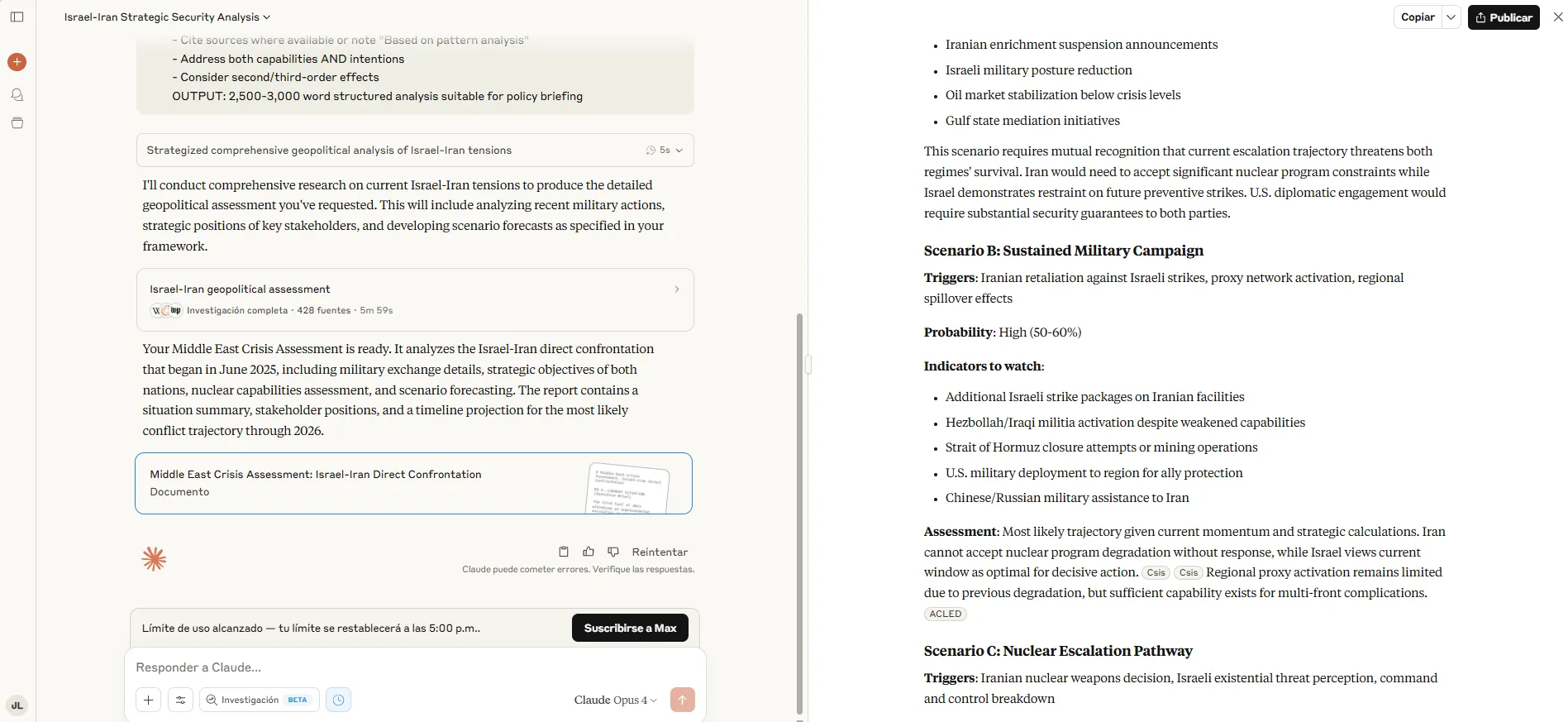
Anthropic Claude

Most likely outcome: Sustained military campaign.
Probability: 50–60%
Key insight: Iran’s need to retaliate + Israel’s opportunity for decisive action = extended combat.
Warning: Iran’s short breakout time (~25 days) could force strategic miscalculation or preemptive strikes.

Claude approached the crisis more like a military analyst than a diplomat, assigning specific probabilities and identifying concrete indicators for each scenario. The model gave “sustained military campaign” a 50-60% probability rating.

“Iran cannot accept nuclear program degradation without response, while Israel views current window as optimal for decisive action,” Claude stated. The model highlighted a critical factor: “Iran’s technical capability to rapidly weaponize creates potential for sudden strategic shift that could either deter further Israeli action or provoke preemptive escalation.”

Claude’s analysis included specific warning signs to monitor, from Strait of Hormuz closure attempts to uranium enrichment acceleration. The model noted Iran’s “25-day breakout capability” as providing both “escalatory leverage and urgency for decisive action.”

OpenAI ChatGPT

Most likely outcome: Diplomatic resolution.
Probability: High
Key insight: Iran’s restrained retaliation and appeal to the UN indicate preference for diplomacy.
Prediction: Quiet negotiations via Oman or Qatar; possible updated nuclear deal within weeks.

ChatGPT provided the most optimistic assessment, rating diplomatic resolution as “high probability” despite acknowledging severe military risks. The model outlined how escalation could unfold but consistently returned to negotiation possibilities.

“Tehran’s initial retaliation was symbolically fierce but ultimately limited in effect, suggesting a reluctance to escalate to a point of no return. The fact that Iran resorted to the UN and is engaging diplomatically (even if only to condemn Israel) shows it has not slammed the door on political paths,” ChatGPT observed. The model envisioned “quiet negotiations possibly mediated by Oman or Qatar, where Iran agrees to stringent limitations on its nuclear program.”

ChatGPT quoted President Trump’s statement that it’s “not too late” for a deal, interpreting this as evidence that “Washington is poised to broker such a settlement rather than pursue regime destruction.” The model predicted resolution within weeks through “a compromise–perhaps an updated nuclear accord.”

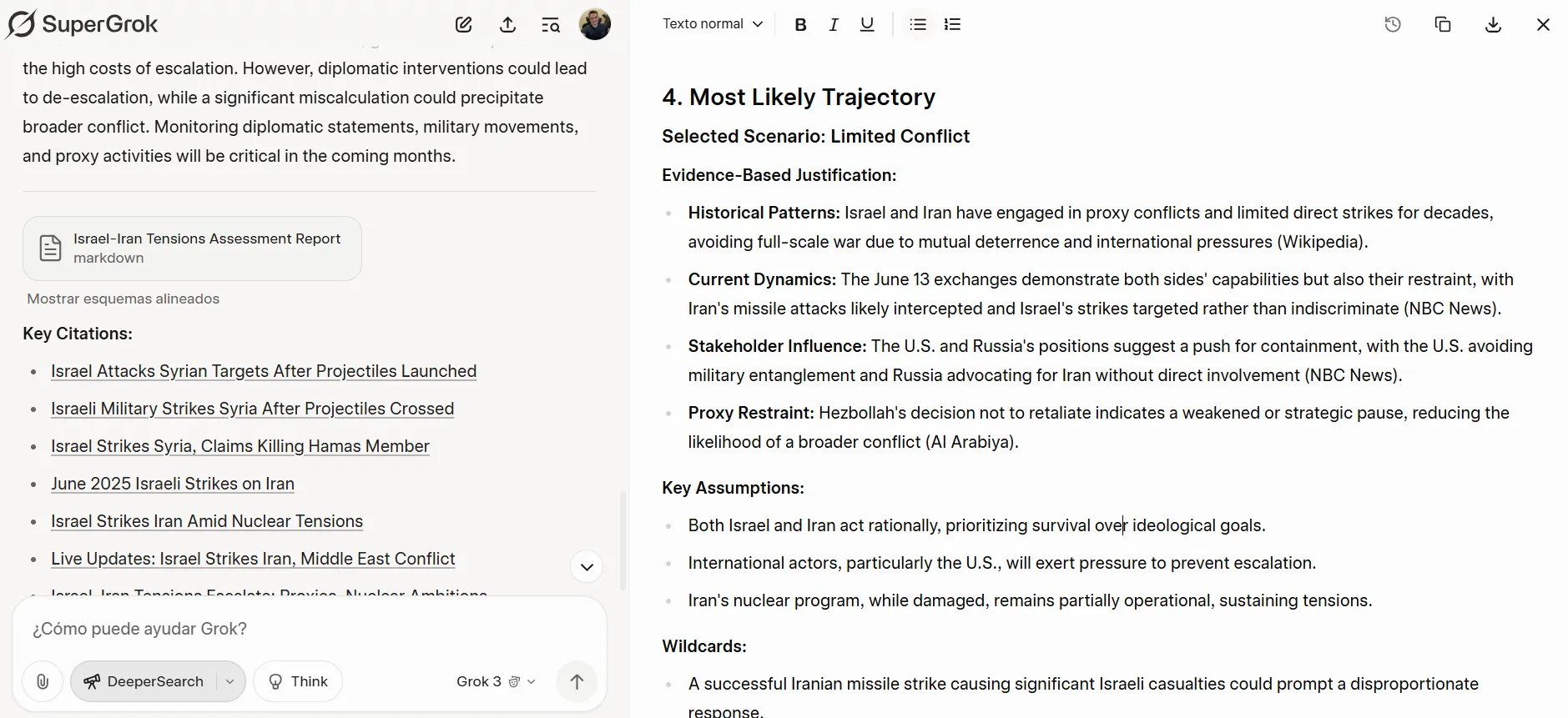
xAI Grok

Most likely outcome: Limited conflict with periodic flare-ups.
Timeframe: 3–6 months
Key insight: Historical precedent favors avoidance of full-scale war; rational deterrence dominates.
Warning: Wildcards include high-casualty strikes or new actors (e.g., Gulf states or Russia) entering the fray.

Grok’s research mode seems to have degraded in performance over the last weeks. We activated “Deeper Search,” which is supposed to use more resources for a more extensive report. However, the model delivered a super concise analysis focused on historical patterns and practical indicators. The model rated “limited conflict” as high probability based on precedent.

“Israel and Iran have engaged in proxy conflicts and limited direct strikes for decades, avoiding full-scale war due to mutual deterrence and international pressures,” Grok noted. The model projected 3-6 months of “periodic flare-ups of airstrikes, missile attacks, or proxy engagements.”

Grok identified specific wildcards including “a successful Iranian missile strike causing significant Israeli casualties could prompt a disproportionate response,” and potential “Gulf state or Russia escalating support.” The model emphasized that “both Israel and Iran act rationally, prioritizing survival over ideological goals.”

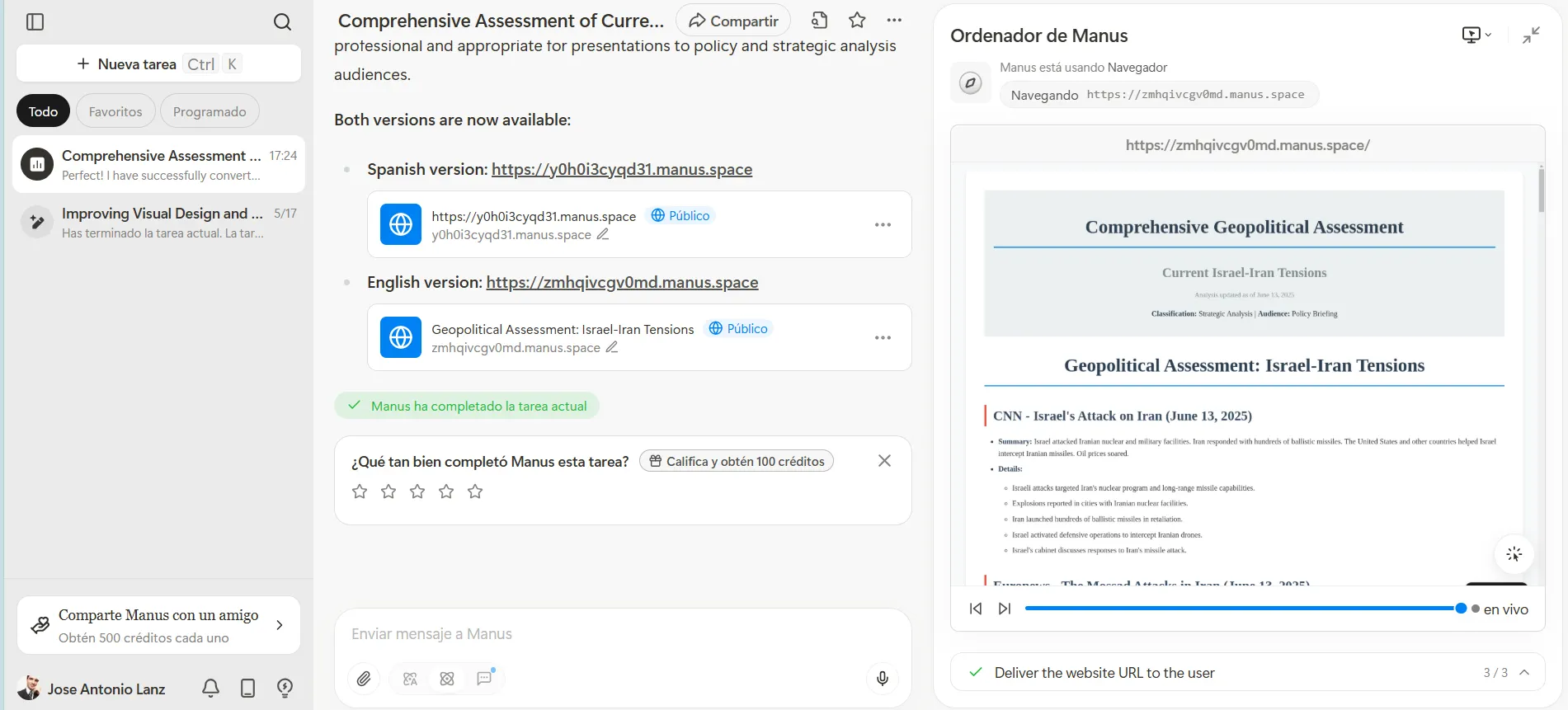
Manus

Most likely outcome: Controlled escalation and shadow war.
Probability: Medium–High
Timeframe: 12–24 months
Key insight: Pattern of targeted Israeli strikes and Iranian proxy response will continue.
Emphasis: Indirect communication channels help avoid catastrophic misunderstandings.

Manus, one of the first agentic models, was a surprise. It not only executed a full research report, but was able to generate a website for easier understanding, and let us watch in real time amid the research process.

As an expert, Manus tried to be more nuanced in its assessment of Middle Eastern conflict dynamics, rating “controlled escalation and intensified shadow war” as medium-high probability over 12-24 months.

“This scenario reflects the historical pattern of confrontation between Israel and Iran, where both actors seek to inflict damage and deter each other without triggering an all-out war that neither can afford,” Manus explained. The model predicted Israel would “continue to carry out covert operations and selective airstrikes,” while Iran would respond “with a combination of missiles and drones, and through its proxies.”

Manus emphasized communication channels: “Although there is no direct dialogue, it is assumed that indirect channels exist (through third countries or intelligence) that allow both sides to communicate ‘red lines’ and avoid catastrophic misunderstandings.”

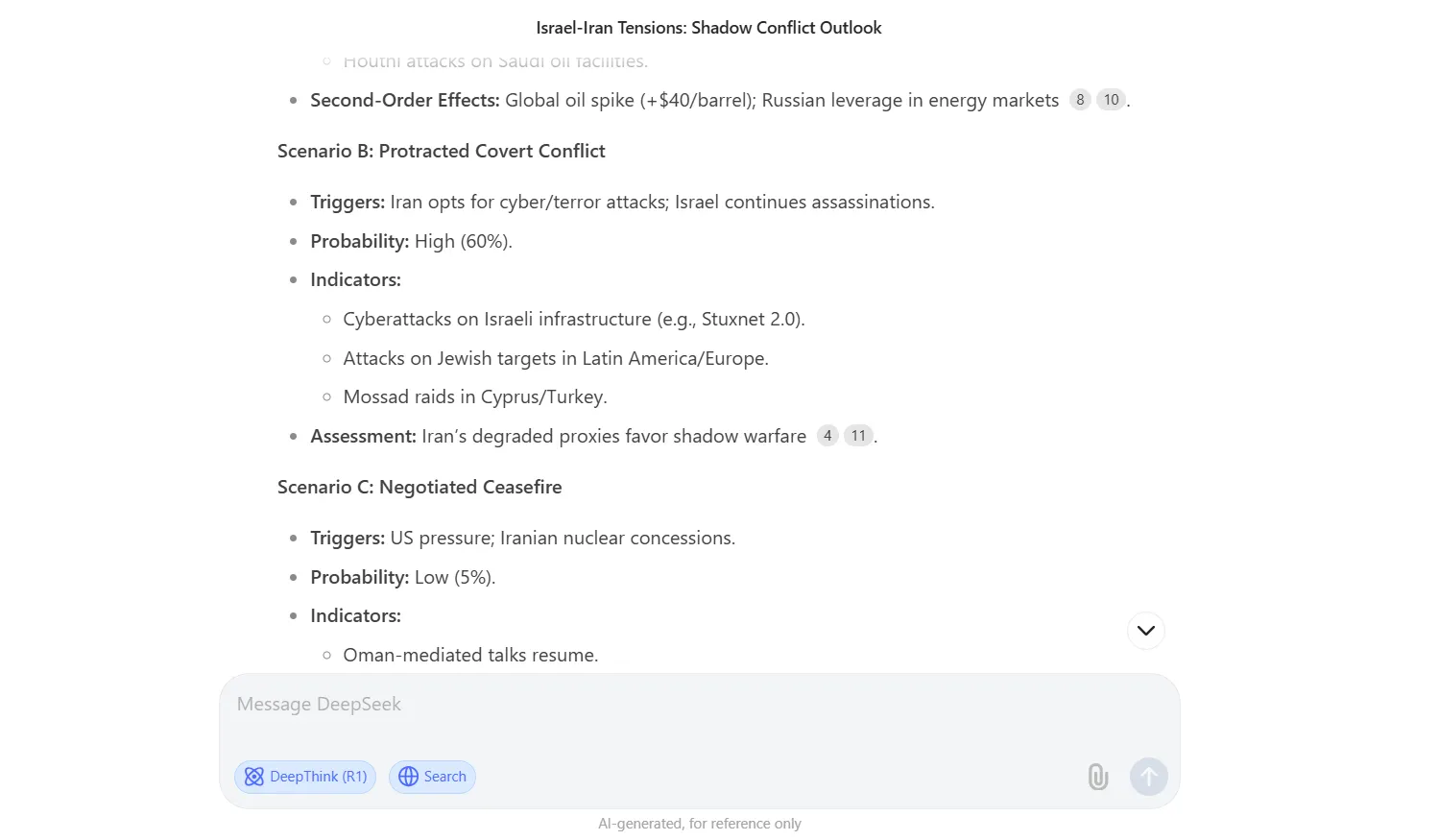
DeepSeek

Most likely outcome: A prolonged, covert conflict between Israel and Iran.
Probability: 60%
Timeframe: Short-term (0–3 months) to mid-term (4–12 months)
Key insight: Iran is strategically constrained and unlikely to engage in direct war.
Emphasis or warning: Cyberwarfare and proxy actions will intensify without direct U.S. military involvement.

China’s DeepSeek does not have a research mode, but we combined its web search with reasoning capabilities. The result was a data-heavy analysis, assigning “protracted covert conflict” a 60% probability.

The timeline included granular predictions: “Short-Term (0-3 months): Iranian terror attacks in Europe; Israeli strikes on missile factories. Mid-Term (4-12 months): Cyberwar escalates; IAEA confirms Iranian uranium enrichment halt.”

DeepSeek noted constraints, including that “Iran lacks conventional capacity for direct war (air force outdated; proxies weakened)” and “U.S. avoids ground involvement; focuses on force protection.”

Generally Intelligent Newsletter

A weekly AI journey narrated by Gen, a generative AI model.


Source link

Solana ETF Applicants Submit Updated SEC Filings With Staking – Decrypt

0
Solana ETF Applicants Submit Updated SEC Filings With Staking – Decrypt


In brief

Seven issuers filed amended S-1 forms for Solana exchange-traded funds on Friday.
Applicants are seeking federal regulators’ approval to launch ETFs with staking capabilities.

Seven ETF issuers filed amended S-1 forms for Solana exchange-traded funds with the U.S. Securities and Exchange Commission on Friday, clarifying language that would enable them to stake their held SOL.

The proposed ETFs from 21Shares, Bitwise, Fidelity, Franklin Templeton, Grayscale, VanEck, and Canary Capital aim to offer investors exposure to Solana by directly tracking the altcoin. 

The staking component would enable issuers to generate yield on the Solana held in their funds, allowing them to potentially offer higher returns to investors. Friday’s moves come following a Tuesday report from Blockworks, which cited sources saying that the SEC asked prospective Solana ETF issuers to update their S-1 filings.


Staking refers to the process of pledging tokens to a decentralized network in exchange for yield, or financial rewards. Its inclusion in ETFs is a point of contention among federal regulators, who previously delayed their decision on staking in Ethereum ETFs due to concerns over the financial and security-related risks posed by the practice.

The rash of filings comes as U.S. regulators and lawmakers ratchet back restrictions on the digital assets industry, and amid speculation that the SEC will soon greenlight Solana ETFs to trade in the U.S.

Under pro-crypto U.S. President Donald Trump, the digital assets industry’s two primary regulators, the SEC and the Commodity Futures Trading Commission, have shifted their approach to crypto—including the SEC dropping lawsuits against industry giants like Binance, Coinbase, and Kraken.

Commissioners have also ramped up their engagement with crypto companies over the past few months, with the aim to collaborate on shaping regulatory guardrails for the industry.

Federal regulators’ softening stances on crypto regulations has spurred an explosion in applications for ETFs based on a wide variety of cryptocurrencies, from meme coins such as Dogecoin, Official Trump, and Bonk to altcoins like XRP, Sui, and Avalanche. However, the agency has yet to approve spot ETFs based on cryptocurrencies other than Ethereum and Bitcoin. 

Although experts expect issuers to secure the go-ahead to offer Solana ETFs in the U.S. within the next few weeks, the approval process has been a long one. In May, the SEC pushed back its deadline to approve or deny a swath of spot Solana ETFs

Solana is trading at $147 as of writing time, down 3.5% in the past day, according to CoinGecko data.

Edited by Andrew Hayward

Daily Debrief Newsletter

Start every day with the top news stories right now, plus original features, a podcast, videos and more.


Source link

Maxon’s Epic Sale Drops June 16 | Web3Wire

0
Maxon’s Epic Sale Drops June 16 | Web3Wire


Become one with creation and save up to 40% on new subscriptions of Maxon One and individual products. For visual effects artists, animators, digital sculptors and creatives looking to level up their workflow, it’s the perfect time to save big!

BAD HOMBURG VOR DER HÖHE, DE / ACCESS Newswire / June 13, 2025 / Maxon, maker of powerful, approachable software for creators working in 2D and 3D design, motion graphics, visual effects, gaming and more, today announced the return of its highly anticipated sale. Starting Monday, June 16th (00:00 PDT / 09:00 CEST / 16:00 JST) and running through Wednesday, June 18th (sales end 23:59 PDT / 08:59 CEST / 15:59 JST), all new subscribers will have access to steep discounts: 40% off new annual subscriptions to Maxon One and 30% off new annual subscriptions to individual products. That’s three days to take advantage of saving up to $500.00+ on Maxon’s entire suite* of professional visual effects, 3D animation, and digital sculpting tools.

Maxon’s sale is an ideal opportunity for newcomers to step into industry-grade tools and elevate their creative potential. To purchase a new Maxon One or individual product subscription, visit https://www.maxon.net/buy. Discounts will be automatically applied during the length of the sale.

Maxon One is the choice toolset for award-winning artists who want to bring their ideas to life-across film, TV, gaming, architecture, product design, and everything in between. The industry-leading suite of tools includes Cinema 4D modeling, 3D animation, simulation and rendering software; ZBrush for desktop and iPad, an Oscar-winning digital sculpting and painting solution; the diverse Red Giant lineup of editing, motion design, and filmmaking tools including Universe and Maxon Studio; and Redshift, Maxon’s powerful, GPU-accelerated renderer built for high-end production and lightning-fast performance.

In the June release, Maxon is excited to introduce powerful new features across its ecosystem. Cinema 4D 2025.3 introduces powerful new Liquid Simulations, seamlessly integrated into its Unified Simulation system. Optimize the pipeline with UDIM Support, which enables artists to effectively build and work with meshes where the texturing is optimized by defining multiple UV tiles. Get access to an expansive world of high-quality plants with the new Laubwerk Plants and use Maxon’s powerful AI Search to find the asset you need in seconds.

Redshift for Cinema 4D receives editable per-point attributes on hair curves, UDIM texture preview support, and improved viewport material representation while Houdini and Maya versions add significant USD procedural workflow improvements aimed at making life easier for 3D artists. Additionally, all versions of Redshift receive quality improvements to high-density clouds and fog rendered using the Standard Volume shader, and the new simplified Ambient Occlusion AOV for instant full frame AO setup with the release of Redshift 2025.5.

Additionally, the new Create panel in Maxon Studio enables broadcasters and brands to develop their own templates that allow artists to easily create customized motion graphics perfectly aligned with the style guide. These combine with hundreds of provided templates to provide editors and compositors with tons of creative options powered by Red Giant. Now’s the perfect time to upgrade your toolkit-take advantage of Maxon’s June sale and get more for less.

* Promotional prices are exclusive of taxes, and if applicable will be applied at checkout. Offer valid until June 18, 2025. New annual subscriptions only. Discounts are not applicable to renewal subscriptions, RLM licenses, educational licenses, Forger, and Maxon One + Adobe Bundles. Terms apply.

For volume licensing questions, contact Maxon Sales. For questions, email: [email protected].

About Maxon

Maxon makes powerful, yet approachable software solutions for content creators working in 2D and 3D design, motion graphics, visual effects and visualization. Product lines include the award-winning Cinema 4D suite of 3D modeling, simulation and animation technology; the diverse Red Giant lineup of revolutionary editing, motion design and filmmaking tools; the leading-edge, blazingly fast Redshift renderer; and ZBrush, the industry-standard digital sculpting and painting solution available on desktop and on the iPad.

Press Contact

Kristin CandersGrithaus Agency(e) [email protected]

###

SOURCE: Maxon Computers

About Web3Wire Web3Wire – Information, news, press releases, events and research articles about Web3, Metaverse, Blockchain, Artificial Intelligence, Cryptocurrencies, Decentralized Finance, NFTs and Gaming. Visit Web3Wire for Web3 News and Events, Block3Wire for the latest Blockchain news and Meta3Wire to stay updated with Metaverse News.


Source link

Popular Posts

My Favorites