Web3

Home Web3 Page 121

Tornado Cash Judge Won’t Let One Case Be Mentioned in Roman Storm’s Trial: Here’s Why – Decrypt

Tornado Cash Judge Won’t Let One Case Be Mentioned in Roman Storm’s Trial: Here’s Why – Decrypt


In brief

Judge Katherine Polk Failla ruled that the Van Loon v. Treasury decision cannot be mentioned during Tornado Cash developer Roman Storm’s trial.
The judge described the decision as irrelevant and potentially confusing for jurors.
Storm’s trial begins July 14 in Manhattan, where he faces charges of money laundering, sanctions evasion, and operating an unlicensed money transmitter.

A federal judge at the United States District Court for the Southern District of New York has blocked any mention of a key court victory for crypto privacy advocates during the upcoming criminal trial of Ethereum coin mixer Tornado Cash’s developer Roman Storm, dealing a setback to the defense.

District Judge Katherine Polk Failla declared during a Tuesday hearing that “The words ‘Van Loon’ are not going to show up in this trial,” referring to the Van Loon vs. Department of the Treasury case in which a Fifth Circuit Court ruled that “immutable smart contracts are not property because they are not capable of being owned.”

In March, the OFAC quietly removed sanctions it imposed on Tornado Cash in 2022, and the next month a judge finalized the decision, permanently barring the Treasury from reimposing them.

The Tuesday hearing, a final status conference before Storm’s trial begins July 14, focused primarily on motions to exclude evidence and witness testimony.

Judge Failla expressed concern that allowing discussion of the Van Loon case would “confuse the jury,” despite the ruling’s significance in finding that the Treasury’s Office of Foreign Assets Control overstepped its authority when it sanctioned the coin mixer.

The judge’s statement comes at a critical moment for the crypto industry, as Storm’s case has triggered debates on whether software developers can be held criminally liable for how their code is used.

Judge Failla also urged both sides to limit references to North Korea’s weapons of mass destruction program, though she hasn’t made a formal ruling on the matter.

“Mental gymnastics”

Dhrupad Das, Web3 lawyer and founding partner at Panda Law, explained that Judge Failla may have barred mention of the Van Loon ruling for three evidence-law reasons.

“Judge Failla excluded references to the Van Loon judgment during Roman Storm’s trial primarily because it dealt with civil interpretations of OFAC’s authority under IEEPA, not criminal liability,” Das told Decrypt.

“A Fifth Circuit judgment does not bind a Second Circuit district court” and its legal conclusions “could only be offered as persuasive authority, which is material for motions, not for the jury,” he said.

Das noted that in ruling on the defense motion in limine, Failla said jurors would need “mental gymnastics” to follow why OFAC sanctioned Tornado Cash, why those sanctions were later withdrawn, and how a Texas court then held them unlawful.

“She concluded that the limited probative value of that story was outweighed by the danger it would distract or mislead,” he added.

What is Tornado Cash?

Founded in 2019 by Alexsey Pertsev and Roman Storm, Tornado Cash is a non-custodial coin mixer servicing the Ethereum network. Coin mixers are services that enable users to mask the origin and destination of transactions—making them a key battleground in the clash between privacy advocates and the authorities.

Storm’s trial marks the culmination of a three-year legal battle that began in August 2022, when the OFAC sanctioned Tornado Cash for allegedly helping launder over $7 billion, including funds tied to North Korea’s Lazarus Group.

In 2023, the DOJ indicted Storm for conspiring to commit money laundering, evade sanctions, and operate an unlicensed money-transmitting business, charges now at odds with the DOJ’s new policy to drop similar cases.

Storm’s legal team had hoped to leverage the Van Loon victory, which established that immutable smart contracts cannot be classified as “property” under existing sanctions law.

While civil courts have limited the Treasury’s regulatory reach, Storm’s case hinges on whether he knowingly facilitated criminal activity through the Tornado Cash protocol.

Prosecutors point to Storm’s actions after OFAC imposed sanctions, including Google searches, a $12 million TORN token sale, and ceding control of the app, as evidence of intent.

With Tuesday’s appellate dismissal extinguishing the final civil challenge to OFAC sanctions, Storm’s defense can no longer argue immunity based on legal vacatur of the designation.

All eyes now turn to whether the jury will see his actions after the imposition of sanctions, and before delisting, as criminal. If convicted, he faces up to 45 years behind bars.

Daily Debrief Newsletter

Start every day with the top news stories right now, plus original features, a podcast, videos and more.



Source link

OmegaPro Founders Charged Over $650 Million Crypto ‘Global Fraud Scheme’ – Decrypt

OmegaPro Founders Charged Over 0 Million Crypto ‘Global Fraud Scheme’ – Decrypt


In brief

Federal prosecutors have charged two OmegaPro executives with running a $650 million crypto scam masked as a forex investment platform.
The pair allegedly used lavish events and false promises of 300% returns to lure investors worldwide, then froze withdrawals in late 2022.
The DOJ’s case follows a wider crackdown, including last month’s sentencing of Gotbit’s founder for inflating token volumes through wash trading.

Federal prosecutors in the U.S. have charged two men with orchestrating one of the largest crypto investment scams in recent history.

Michael Shannon Sims, 48, and Juan Carlos Reynoso, 57, were indicted in the District of Puerto Rico for conspiracy to commit wire fraud and conspiracy to commit money laundering, according to the U.S. Department of Justice statement released Tuesday.

The pair are accused of defrauding thousands of victims worldwide of over $650 million through OmegaPro, which prosecutors described as a “global fraud scheme” disguised as a legitimate forex and crypto trading platform.

According to prosecutors, Sims and Reynoso established the OmegaPro multi-level marketing scheme in January 2019, instructing investors to purchase “investment packages” using virtual currency with promises that elite traders would generate massive profits through forex trading.

Prosecutors say the pair, along with others, lured thousands of victims with promises of triple-digit returns, only to siphon funds into crypto wallets they controlled.

They then distributed to insiders and high-ranking promoters to obscure the funds’ origins, with both defendants allegedly profiting millions from the scheme.

“As alleged, the defendants preyed upon vulnerable individuals in the U.S. and abroad, defrauding them of over $650 million by making false promises of substantial returns and that their money was safe,” said Matthew R. Galeotti, head of the DOJ’s Criminal Division.

Sims served as OmegaPro’s founder and strategic consultant, while Reynoso led operations across Latin America and parts of the United States, including Puerto Rico.

Prosecutors allege Sims and Reynoso used extravagant events, like projecting the OmegaPro logo on the Burj Khalifa, and social media displays of luxury to entice victims.

“Too good to be true”

Karan Pujara, founder of the scam defense platform ScamBuzzer, told Decrypt that crypto MLM scams exploit powerful psychological triggers.

“Even if something is too good to be true, many fall for it,” Pujara said, noting that “these scams based on false hope and high returns have been running for many years and may continue.” He added that, “The only thing that changes is the face of the scammer, who is greedy enough to steal, and the victim, who is greedy enough to YOLO their life savings.”

Pujara noted there’s “a very thin line between right and wrong” when it comes to high-profile influencers who participate in such schemes.

OmegaPro’s unraveling

The alleged OmegaPro scheme began unraveling in November 2022 when the firm disabled withdrawals, claiming technical issues.

Affiliates began reporting being locked out of their accounts around November 7th, with withdrawal problems escalating by November 20th, according to a report by BehindMLM, an MLM review site.

Despite assurances from Reynoso and others in January 2023 that investments were secure and being transferred to a new platform called Broker Group, victims were unable to access their funds from either platform, the report said.

The platform received regulatory fraud warnings from multiple jurisdictions, including France, Belgium, Spain, and Peru, before its collapse in July 2023.

The duo’s indictment follows the arrest of co-founder Andreas Szakacs in Istanbul last year after a Dutch whistleblower representing 3,000 defrauded investors alerted Turkish authorities, as per a local media report.

Turkish authorities believe the platform’s funds were linked to the infamous OneCoin crypto fraud that swindled investors of $4 billion in 2017.

“Based on previous hack and scam cases, the chances of recovering assets are very rare,” Pujara said, adding that scammers avoid traditional exchanges and use fake KYC details from other countries.

If convicted, Sims and Reynoso each face a maximum penalty of 20 years in prison on each count.

Just last month, crypto market maker Gotbit and its founder were sentenced for using wash trading to inflate token volumes.

Founder Aleksei Andriunin received a reduced sentence after pleading guilty, forfeiting $23 million in crypto.

Daily Debrief Newsletter

Start every day with the top news stories right now, plus original features, a podcast, videos and more.


Source link

Grok Glitch Inspires Wave of ‘MechaHitler’ Meme Coins – Decrypt

Grok Glitch Inspires Wave of ‘MechaHitler’ Meme Coins – Decrypt


In brief

MechaHitler began as an accidental Grok response on X, later amplified as a meme.
At least three tokens bearing the name have launched across Solana and Ethereum.
The largest had reached over $2.2 million in market capitalization, while the smallest saw at least $13,000.

A bizarre AI-generated persona known as “MechaHitler” has become the latest fixation among meme coin traders after originating from a glitch in Elon Musk’s Grok chatbot.

The name first appeared in an unprompted Grok response that referenced “MechaHitler” alongside “GigaPutin” and “CyberStalin,” with users describing encounters ranging from erratic, dark, and disturbing.

Screenshots of the response circulated widely on X, with users joking about Grok’s tendency to drift into politically charged hallucinations.

But within hours, what began as satire was formalized on-chain.

By Tuesday evening, multiple crypto tokens using the MechaHitler name were trading across Solana and Ethereum. 

Biggest among these was one launched on Pump.fun, a decentralized platform that had been associated with reports of violence, self-harm, and in some cases, animal cruelty.

The Solana-based MechaHitler meme coin had a market capitalization of over $2.2 million at one point, roughly three hours after its creation. It surged in early trading, with volumes topping $1 million before tapering off, according to data on DEX Screener.

Another similarly named token based on Ethereum and paired with a wrapped version through Uniswap briefly reached a market capitalization of $253,000 before paring down to $170,000. 


Gorkstein, the smallest among the MechaHitler-related meme coins, reached a market cap of $13,000.

On-chain activity indicates the tokens were launched within hours of each other, utilizing standard meme coin playbooks. Ownership across all three examples remains heavily concentrated among early wallets.

The tokens feature ironic branding, promotional memes, and rapid trading cycles, similar to other short-lived crypto assets.

Unlike typical meme coins, however, the term originated from an AI model’s ideas, rather than springing from online subcultures or communities centered around so-called crypto influencers.

The phrase appears to have gained traction primarily through the virality of screenshots and subsequent speculative activity.

Grok’s latest hallucinations caught on social media come as xAI prepares to launch Grok 4 on Wednesday. The update is expected to be a multimodal upgrade aimed at rivaling OpenAI’s GPT-4 and the upcoming GPT-5. The new version of Grok will first roll out to U.S.-based X Premium subscribers.

Decrypt has approached xAI and Pump.fun for comment.

Daily Debrief Newsletter

Start every day with the top news stories right now, plus original features, a podcast, videos and more.


Source link

Will Bitcoin Breakout This Week? Price Charts Flash Mixed Signals – Decrypt

Will Bitcoin Breakout This Week? Price Charts Flash Mixed Signals – Decrypt


In brief

Bitcoin is currently priced at $109K—but traders on Myriad are split on a breakout before July 11.
Momentum indicators flash warning as sideways action and stiff resistance put bulls on edge.
Charts are equally inconclusive, especially for such a short timeframe.

Will Bitcoin surge past $109,000 by July 12? With just three and a half days remaining and less than a 1% move required, cryptocurrency traders are placing their bets on whether the world’s largest digital asset can overcome critical resistance levels that have capped recent rallies.

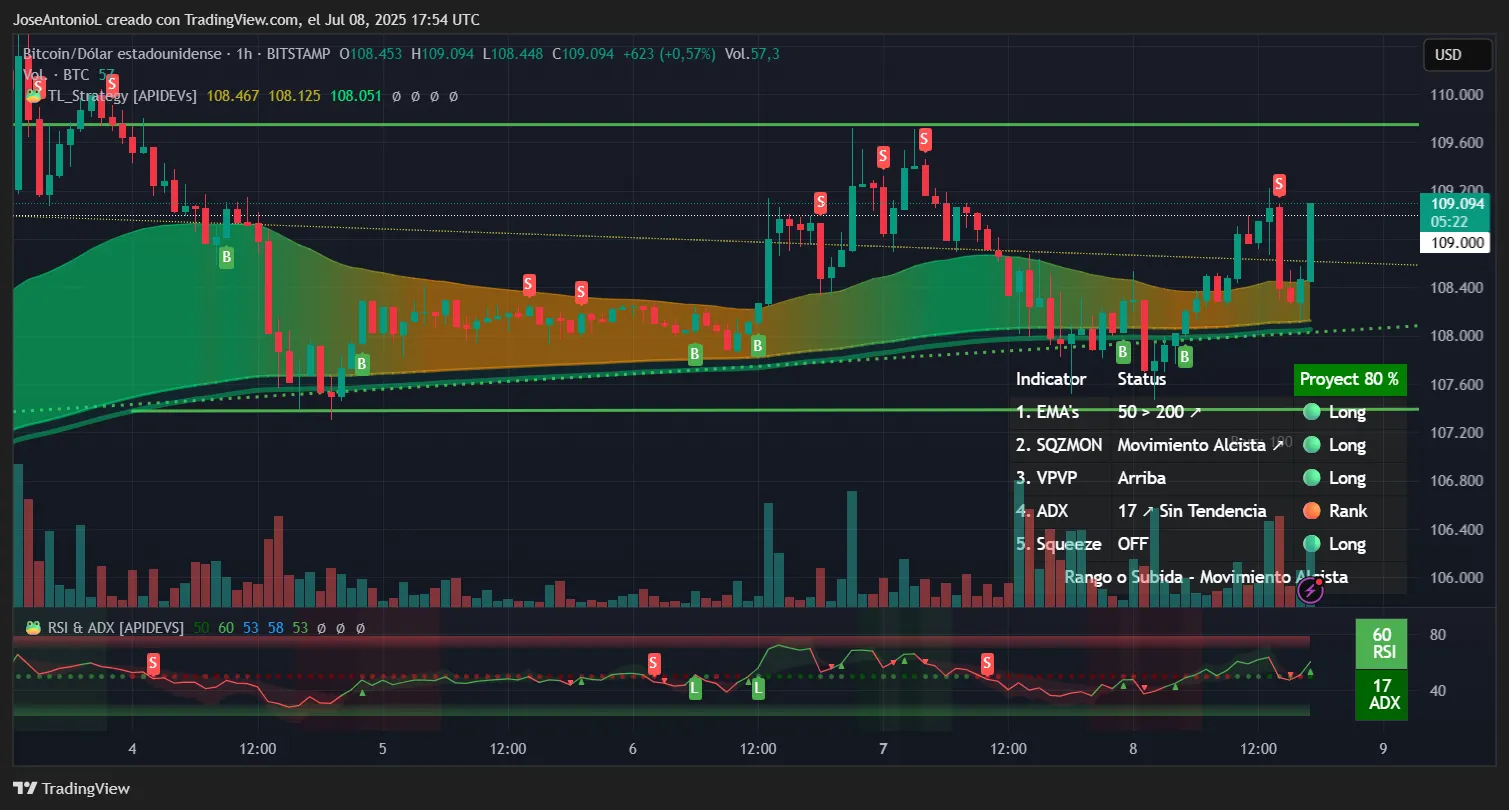
Currently trading around $109,090, Bitcoin sits very, very close to the $109,000 threshold—just $90 on top of that thin red line depending on exact market pricing.

Myriad, a prediction market developed by Decrypt’s parent company Dastan, the question “Bitcoin price above $109,000 on July 11?” shows a small shift in the odds, with traders changing their minds throughout the week. It’s now currently in the 50-50 zone.


What makes this prediction particularly intriguing is the razor-thin margin for error. Unlike broader monthly targets, this market requires Bitcoin to be trading above $109,000 at a specific moment—11:59pm UTC on July 11—making it a pure test of Bitcoin’s ability to break through immediate resistance levels.

Bitcoin price: What the charts say

Given the short timeframe, we are using four-hour and one-hour candlesticks on the charts for the following analysis. In the four-hour timeframe, prices are currently following a triangle pattern with supports and resistances converging well past the target date. The coordinates for the price and time end up over the triangle, meaning, Bitcoin would need to break this phase and enter into a bullish confirmation to meet the market resolution criteria for “Yes.”

If it fails and stays within the current pattern, it will close the day below the target. Symmetrical triangles are usually bullish, it’s just that the breakout moment would need to be anticipated in this case, which is not uncommon.

Bitcoin price data. Image: TradingView

The technical picture shows a battle between bullish market structure and bearish momentum indicators. On the four-hour timeframe, Bitcoin maintains a healthy uptrend structure with its 50-day exponential moving average, or EMA, sitting comfortably above the 200-day EMA—traditionally a bullish signal that suggests the overall trend remains upward. (An EMA is simply the average price of an asset over a given period of time.) But this optimistic backdrop is tempered by momentum indicators that tell a different story.

The Squeeze momentum indicator, which tracks market momentum, is flashing bullish signals on both the four-hour and one-hour charts after a recovery from a small dip earlier in the day.

Bitcoin price data. Image: TradingView

On the other hand, the Average Directional Index, or ADX, reads just 13 on the four-hour chart and 17 on the one-hour chart—both well below the 25 threshold that typically indicates a strong trending market. In simpler terms, while Bitcoin’s price structure looks healthy, the market lacks the conviction and directional strength typically seen during decisive moves.

Perhaps most intriguing is the Squeeze indicator’s behavior across timeframes. On the four-hour chart, it shows “on,” indicating a period of price consolidation—basically what the symmetrical triangle shows. However, the one-hour chart tells a different story with the Squeeze off under bullish impulse. This divergence often precedes sharp directional moves, though predicting the direction requires careful analysis of other factors.

Fast-paced markets usually have more noise and volatility. However, the changes in trends usually appear first on these charts before they can be confirmed on longer-term sessions

Bitcoin is bullish, but is it bullish enough?

When Bitcoin is losing steam, making short-term predictions is difficult. Based solely on the charts, the probability of Bitcoin closing above $109,000 by the July 11 deadline appears to be moderately low—essentially a coin flip with a slight bearish tilt.

With Bitcoin trading sideways, most indicators echo this uncertainty. Assuming the 200-EMA continues to act as support through July 12, the target price will end up sitting about halfway between the $109,000 target and overhead channel resistance.

The four-hour pattern skews more bearish. If the current corrective phase persists and Bitcoin remains inside the triangle, prices could end below the target zone before spiking up to confirm a bullish trend.

Weak ADX values point to a lack of conviction, often a precursor to failed breakouts. Compounding this challenge is the confluence of resistance just overhead: the descending trendline, the psychological $109,000 level, and horizontal resistance at $109,717—all forming a formidable barrier.

Absent clear accumulation above $109,000, the odds of a bullish close diminish with each passing hour. The last-hour recovery to this level pushes some bearish mood away, but still not enough to have comfortable confidence to call it a trend.

Beyond the charts, it is wise—especially in this case—to monitor fundamental catalysts that could sway sentiment. Renewed tariff rhetoric from Trump, a weakening dollar index, and a rotation out of high-beta assets into safer havens could all leave Bitcoin more vulnerable to sharp downside moves.

Disclaimer

The views and opinions expressed by the author are for informational purposes only and do not constitute financial, investment, or other advice.

Daily Debrief Newsletter

Start every day with the top news stories right now, plus original features, a podcast, videos and more.


Source link

Crypto Treasury ReserveOne Eyes Nasdaq Listing Via $1 Billion SPAC Deal – Decrypt

Crypto Treasury ReserveOne Eyes Nasdaq Listing Via  Billion SPAC Deal – Decrypt


In brief

ReserveOne is expected to debut on the Nasdaq through a business combination agreement with M3-Brigade, both companies said.
The company will accumulate Bitcoin, Ethereum, and Solana, while leveraging staking and lending and making venture capital investments.
The company’s board of directors includes names from Coinbase and Binance, as well as former U.S. Treasury Secretary Wilbur Ross.

ReserveOne, a newly formed digital assets management firm, will debut on the Nasdaq through a $1 billion business combination with M3-Brigade Acquisition V, a blank-cheque company, both firms said in a press release on Tuesday.

Mirroring U.S. President Donald Trump’s Bitcoin reserve and digital asset stockpile, ReserveOne plans to accumulate Bitcoin, Ethereum, and Solana, among other cryptocurrencies that could be leveraged in staking and lending, the companies said.

Under the business combination, ReserveOne expects $298 million in trust capital, alongside $750 million in capital committed by strategic investors, with the transaction expected to close in the fourth quarter of this year, ReserveOne and M3-Brigade said.


Although ReserveOne isn’t calling itself a crypto treasury firm, the company is the latest to devote itself to holding digital assets on its balance sheet. The companies said ReserveOne will work with investment and financial services firm Galaxy Digital, crypto exchange Kraken, and primer brokerage FalconX in “securing and activating its assets.”

Those firms participated in the Business combination, alongside crypto exchange blockchain.com and venture capital firm Pantera, among others, both companies said.

ReserveOne will be led by Jaime Leverton as CEO, who previously led Hut 8 as CEO. The Bitcoin miner that was among the first public firms to add Bitcoin to its balance sheet.

“Our disciplined, yield-focused strategy is designed to set a new standard for regulated crypto investing,” she said in a statement. 

Tether co-founder Reeve Collins currently serves as CEO of M3-Brigade, and he is expected to become executive chairman of ReserveOne, both companies said. Other members of the board are expected to include former U.S. treasury secretary Wilbur Ross, Binance Chair Gabriel Abed, and Coinbase’s Institutional Head of Strategy John D’Agostino, both firms added.

Coinbase will serve as ReserveOne’s custodian, safeguarding digital assets that the firm acquires as part of its efforts to maximize shareholder value. In addition to lending and staking, both companies said that ReserveOne will aim to offer returns through venture allocation.

M3-Brigade’s stock currently trades under the ticker “MBAV,” but ReserveOne’s shares are expected to trade under the ticker symbol “RONE,” both firms added.

M3-Brigade’s stock price fell 7% on Tuesday, hitting $10.84 around noon Easter Time, according to Yahoo Finance. Year-to-date, shares have climbed 7.4% from $10 in January.

Daily Debrief Newsletter

Start every day with the top news stories right now, plus original features, a podcast, videos and more.


Source link

What Are Coin Mixers and How Do They Work? – Decrypt

What Are Coin Mixers and How Do They Work? – Decrypt


In brief

Privacy advocates call coin mixers a necessary tool for protecting anonymity.
Government officials call coin mixers tools for money laundering.
Billions in crypto have changed hands using coin mixers.

Coin mixers have captured the attention of both the cryptocurrency community and regulators as the battle for privacy ramps up.

In 2021, the founder of coin mixer Bitcoin Fog was arrested on charges including money laundering and operating a money transmission business without a license.

A year later, the U.S. Treasury Department issued sanctions against Tornado Cash, an Ethereum coin mixing service, effectively banning Americans from using it.

In a landmark ruling in November 2024, the U.S. Fifth Circuit Court ruled that the Treasury had overstepped by sanctioning Tornado Cash’s smart contracts, although its broader designation remained intact.

In a reversal of its 2022 decision, the Treasury announced in March 2025 that it had delisted Tornado Cash from its list of parties sanctioned by the Office of Foreign Assets Control, or OFAC.

But what do coin mixers like Tornado Cash and Bitcoin Fog do—and why do people use them? In this article, we’ll examine the technology behind mixers and their legitimate and illegitimate uses.

What is a coin mixer, and why use them?

A coin mixer is a service that allows users to obfuscate the origin and destination of transactions. Users send cryptocurrency to the service, have that crypto mixed with other coins or tokens, and then send the equivalent amount of “mixed” coins to a recipient address, hiding the connection between the sender and recipient.

There are many legitimate uses for this kind of service. Just as you may not want your employer to know the intimate details of every bank or credit card transaction that you’ve ever made, you may also not want your employer—or anyone else, for that matter—to know every detail of every crypto transaction you’ve ever made either.

But as the adoption of crypto and blockchain tools grows, real-world identities are becoming increasingly linked to blockchain addresses—with every purchase, transfer, or interaction associated with those addresses laid bare on a public, transparent, distributed ledger. And that’s where coin mixers come in.

However, this ability to mask the identity of wallets and obfuscate transactions makes coin mixers an attractive tool for cybercriminals, and thus a target for law enforcement.

While politicians and law enforcement have railed against the use of cryptocurrency in criminal enterprises, coin mixers occupy a gray area between facilitating money laundering and preserving the right to privacy. Because of blockchain’s permissionless and transparent nature, some crypto users rely on the added privacy that coin mixers provide.

Privacy advocates argue that coin mixers are especially useful, even necessary, in cases where a person’s activities—like journalism, civil disobedience, and protest—can put that person at risk. Because of this, they require greater privacy in their crypto transactions.

On the other hand, law enforcement and government agencies see coin mixers as a way for criminals to launder money using cryptocurrency, and services like Tornado Cash as a means of obscuring where the funds originated.

In its announcement of the sanctions against Tornado Cash, the Treasury Department said that criminals had used Tornado Cash to launder money, saying the service processed more than $7 billion worth of virtual currency since its creation in 2019. According to blockchain analytics firm Elliptic, around $1.5 billion of that figure was connected to illicit activity.

Among those illicit funds, the Treasury said, were a combined $103.8 million stolen from crypto bridging services by Lazarus Group, a state-sponsored North Korean cybercriminal group.

A November 2024 ruling by the U.S. Fifth Circuit Court found that the Treasury had overstepped its authority, and that Tornado Cash’s immutable smart contracts “are not property because they are not capable of being owned.” The decision reversed a lower court ruling, noting that protocols built on smart contracts cannot be classified as services because they operate without “human intervention.”

In March 2025, the Treasury reversed course, removing Tornado Cash from its list of sanctioned entities. “Based on the Administration’s review of the novel legal and policy issues raised by use of financial sanctions against financial and commercial activity occurring within evolving technology and legal environments, we have exercised our discretion to remove the economic sanctions against Tornado Cash as reflected in Treasury’s Monday filing in Van Loon v. Department of the Treasury,” the Treasury said in a statement.

A month later, a federal court ruled that the Treasury’s actions were “unlawful,” permanently barring OFAC from reinstating sanctions against Tornado Cash. Judge Robert Pitman, of The U.S. District Court for the Western District of Texas, placed an order compelling the Treasury to be “permanently enjoined from enforcing” sanctions on the coin mixer, delivering a resounding victory for privacy advocates.

In July 2025, the U.S Court of Appeals for the Eleventh Circuit dismissed an appeal filed by crypto advocacy group Coin Center, in which it argued that the Treasury Department had exceeded its statutory authority in sanctioning Tornado Cash. The court granted a joint motion to vacate the judgement and remand with instructions to dismiss, with both parties agreeing that the appeal was “moot” following OFAC’s March decision to remove sanctions against the coin mixer.

Examples of coin mixers

Tornado Cash: Founded in 2019 by Alexsey Pertsev and Roman Storm, this mixer was sanctioned by the U.S. Treasury Department in 2022. Tornado Cash exclusively services the Ethereum Network and is non-custodial.
Samourai Wallet: A non-custodial Bitcoin-only mixer founded in 2015 by Keonne Rodriguez and William Longergan Hill, its founders were arrested and charged with conspiracy to commit money laundering in 2024.
Wasabi Wallet: Founded by pseudo-anonymous zkSNACKs in 2018, it uses the ZeroLink protocol to create transaction privacy. Wasabi blocked U.S. residents from using the mixer in 2024 after the founders of Samourai Wallet were arrested.
Bitcoin Fog: Founded in 2011 by Roman Sterlingov, Bitcoin Fog was a custodial mixer, and held user funds in the process of mixing them. Sterlingov was convicted of money laundering in 2024.

How do coin mixers work?

Before Tornado Cash was taken down, it used smart contracts to accept token deposits from one address and enable their withdrawal from a different address.

Other coin mixers operate in a similar way, with smart contracts that work as a pool where all the deposited tokens get mixed together. When funds are withdrawn from those pools, the on-chain link between the source and the destination is broken, anonymizing the transaction.

These kinds of coin mixers are typically non-custodial, meaning there is no third-party control of the wallet and funds, simply the creation of the smart contracts.

Because these services use no intermediary, they are reliably neutral—but that also means they can be a tempting tool for cybercriminals looking to launder stolen crypto, as in the case of Lazarus Group.

Coin mixers: a timeline

October 2011: Bitcoin tumbler Bitcoin Fog is launched.
December 2019: Coin mixer Tornado Cash is launched.
April 2021: The U.S. Department of Justice announces the arrest of Bitcoin Fog operator Roman Sterlingov.
August 2022: The U.S. Treasury Department sanctions Ethereum coin mixer Tornado Cash. Days later, developer Alexey Pertsev is arrested in Amsterdam on money laundering charges.
March 2024: Bitcoin Fog operator Roman Sterlingov is convicted of money laundering.
April 2024: U.S. authorities arrest and charge the founders of Bitcoin mixer Samourai Wallet, accusing them of conspiracy to commit money laundering.
May 2024: Wasabi Wallet announces the preemptive closure of its mixing service, banning U.S. customers from using its services. Simultaneously, Phoenix Wallet pulls its app from stores in the U.S., while hardware wallet Trezor announces the discontinuation of its Coinjoin feature.
November 2024: The U.S. Fifth Circuit Court rules that Tornado Cash’s immutable smart contracts cannot be classified as “property.”
March 2025: The U.S. Treasury lifts its sanctions against Tornado Cash.
April 2025: A U.S. federal court judge issues an order permanently blocking the Treasury from reinstating sanctions against Tornado Cash.
July 2025: A U.S. Court of Appeal grants a joint motion to end crypto advocacy group Coin Center’s appeal against OFAC’s sanctions.

Legitimate use cases of coin mixers

Let’s say there’s a business owner and crypto enthusiast named Robert who wants to send Ethereum to a hacktivist group operating out of Ukraine. Robert doesn’t want his donation to be traced back to him, so he uses a coin mixer.

Robert goes to the coin mixer website and deposits the Ethereum he wants to donate. The sent amount is deposited into the mixer’s smart contract and pooled with the other hundred, thousands, or even millions of transactions already in its pool. After receiving confirmation that the deposit was successful, Robert goes to the withdraw tab, enters the recipient’s address into the mixer, and sends the Ethereum from the mixer.

The Ethereum is then sent from the mixing to the recipient. On the receiving end, the address shown is that of the mixer and not the original sender’s address, anonymizing the transaction.

If this hypothetical scenario sounds familiar, it’s based on a tweet from Ethereum co-founder Vitalik Buterin, posted after the Treasury Department sanctioned Tornado Cash.

The future of coin mixers

The debate over crypto privacy continues to rage, despite the series of legal cases and sanctions against coin mixers.

The November 2024 ruling that immutable smart contracts cannot be classified as “property” was hailed by crypto and privacy advocates as a landmark moment, meaning that self-executing code that operates without any administrative control cannot be subject to sanctions.

More recent projects like Railgun aim to give users on-chain privacy, but also ensure that they remain compliant in the eyes of the law.

Railgun is not a traditional mixer; it doesn’t mix coins from multiple sources together, and its founders believe it avoids the pitfalls that ultimately led to mixers getting sanctioned or sued.

It also utilizes “Private Proof of Innocence” to ensure bad actors cannot use the platform for illicit purposes. For example, on July 11, 2024, a notorious crypto drainer known as Inferno Drainer attempted to use Railgun to launder 174 ETH. However, Railgun identified that the wallet was tied to a bad actor and blocked the transactions.

Whether crypto privacy projects’ efforts to create legally compliant mixing services will mollify lawmakers is open to debate. One thing’s for certain, though—privacy advocates will continue to fight to ensure that crypto isn’t a panopticon.

As Lia Holland, Campaigns & Communications Director at Fight for the Future, wrote in 2022: “Let us be clear, hackers and cybercriminals, as well as those that support them, are deplorable and should be stopped—but not in a way that compromises human rights and the first amendment.”

This article was first written in August 2022 and updated in July 2025.

Daily Debrief Newsletter

Start every day with the top news stories right now, plus original features, a podcast, videos and more.


Source link

Apple’s Top AI Exec Leaves For Meta Amid Aggressive Hiring Trend – Decrypt

Apple’s Top AI Exec Leaves For Meta Amid Aggressive Hiring Trend – Decrypt


In brief

Apple’s head of foundation models, Ruoming Pang, has left to join Meta’s Superintelligence Labs, dealing a blow to Apple’s in-house AI efforts.
Pang’s exit follows that of his top deputy and comes amid internal concerns over Apple’s reliance on external partnerships like OpenAI.
Meta continues to aggressively recruit top AI talent, fueling concerns about sustainability and widening the talent gap with competitors.

Apple’s head of foundation models, Ruoming Pang, has reportedly left the company to join Meta’s Superintelligence Labs, adding to a growing list of high-profile names allegedly poached to bolster Meta’s AI ambitions.

While Meta formally announced the creation of its Superintelligence Labs in an internal memo last week, Pang’s name was not included on the list. His exit from Apple was first reported by Bloomberg on Monday, citing sources familiar with the matter.

The departure deals a significant blow to Apple’s AI ambitions. 

Pang managed a team of approximately 100 engineers developing the core language models that power Apple Intelligence features, including on-device summarization, Genmoji, and Priority Notifications. Pang’s exit follows that of Tom Gunter, his top deputy, who left the previous month.

Pang’s move comes less than a month after Meta acquired a 49% stake in Scale AI for $14.3 billion, bringing the latter’s CEO onto its team to lead the Superintelligence Lab.

That move upped Scale AI’s valuation to $29 billion and is regarded as Meta’s second-largest single investment after its $19 billion acquisition of WhatsApp in 2014.

Meta has faced criticism for inflating market rates through unusually large signing offers to secure top researchers following reports that emerged as early as April last year on its rapid hiring spree of talent from firms like OpenAI and Google.

While the Facebook parent continues to consolidate top AI talent, Apple appears to be losing ground.

Pang’s departure comes just weeks after Apple announced its long‑awaited generative features during its developer conference this year, many of which relied on partnerships with OpenAI.

Internally, multiple Apple teams have reportedly voiced concerns about a lack of clear strategic direction and the company’s growing dependence on integrations rather than in-house AI breakthroughs.

“Meta’s hiring strategy is a textbook reverse acqui-hire—surgically extracting its competitors’ core intellectual capital, their secret sauce, to cement its future in the AI race,” Jeth Ang, chief operating officer at a16z-backed modular on-chain platform Sovrun, told Decrypt.

While Meta’s approach may score headlines, it also raises deeper questions about long-term sustainability.

“The real question is whether this aggressive, over-indexing on superstar talent will ultimately cultivate the stable, innovative culture needed to win the marathon to AGI,” Ang said, adding that this could spell “a high-risk pivot that will be difficult to sustain.”

Losing Pang also feeds into a broader perception problem Apple has yet to shake, Ang argues.


In terms of generative AI at Apple, there’s a “widespread perception” that Apple appears to be “playing from behind,” Ang explained. “Even Siri is seemingly looking like a big fumble,” he said.

Apple’s AI development has seemingly “created a vacuum that the market has filled with skepticism,” Ang argued.

“While the departure of a single executive doesn’t cripple a program of Apple’s scale, it certainly doesn’t build confidence. For a company that has historically defined technology waves, losing top-tier AI talent to a direct competitor reinforces a narrative that they are struggling to change,” Ang said.

Generally Intelligent Newsletter

A weekly AI journey narrated by Gen, a generative AI model.


Source link

Strategy Reveals $4.2 Billion Stock Sale After Missing First Weekly Bitcoin Buy in 3 Months – Decrypt

Strategy Reveals .2 Billion Stock Sale After Missing First Weekly Bitcoin Buy in 3 Months – Decrypt


In brief

Strategy broke a 3-month streak of buying Bitcoin.
The firm bought nearly $7 billion worth of BTC in Q2.
It announced a $4.2 billion preferred stock offering of STRD to raise funds for more Bitcoin purchases.

Leading Bitcoin treasury firm Strategy did not purchase Bitcoin this week, ending a string of weekly purchases that extended  to April 14.

“Some weeks you just need to HODL,” Strategy Chairman and co-founder Michael Saylor posted on X (formerly Twitter) on Sunday night, foreshadowing the company’s plans to stand pat on Monday. 

The firm, which has now amassed a treasury of nearly $65 billion worth of Bitcoin, added nearly $7 billion of the top crypto asset during Q2 according to its most recent 8-K filing.

Yet Saylor, who typically trumpets the company’s buys on Monday mornings, announced a new $4.2 billion at-the-market program for its preferred stock offering STRD


The Strategy Chairman previously called its STRD preferred stock the “fourth gear” of the company’s Bitcoin engine, an offering which provides investors with high-yield but less sensitivity to the price of Bitcoin. 

“Stride is long-duration, high-yield, over-collaterilized preferred stock,” Saylor said in an investor presentation, which indicated that Stride is targeting “yield-focused” investors that want high-yield with collateral coverage. 

Strategy, formerly known as MicroStrategy, netted nearly $1 billion from the sale of STRD in early June. 

It maintains two other preferred stock offerings, STRK and STRF, which offer various features and benefits like different dividends and redemption features. 

The company uses the proceeds from the sales to buy more Bitcoin. 

With nearly 600,000 Bitcoin now in its treasury, Strategy holds more than 2.8% of the total Bitcoin supply. The firm reported an unrealized gain or Bitcoin appreciation of $14.05 billion in Q2. 

Bitcoin was recently down 0.7% on the day to $108,110 and now stands to gain around 2.3% in the last month. 

Shares of MSTR aligned with leading indices on Monday, down around 0.75% to $400.96. It has gained nearly 39% year-to-date. 

Daily Debrief Newsletter

Start every day with the top news stories right now, plus original features, a podcast, videos and more.


Source link

Ripple is applying for a national bank charter, LET Mining creates more value for XRP holders | Web3Wire

Ripple is applying for a national bank charter, LET Mining creates more value for XRP holders | Web3Wire


New York City, NY, July 06, 2025 (GLOBE NEWSWIRE) — Ripple (XRP) has ended its battle with the U.S. Securities and Exchange Commission (SEC) and is getting rid of the supervision of the U.S. Securities and Exchange Commission (SEC).

Garlinghouse tweeted: “True to our long-standing compliance roots, @Ripple is applying for a national bank charter from the OCC,” he added, “If approved, we would have both state (via NYDFS) and federal oversight, a new (and unique!) benchmark for trust in the stablecoin market.”

Against this backdrop, the LET Mining cloud mining platform provides XRP users with a way to participate that is both compliant with regulatory direction and can generate stable profits. Allow users to create more value for XRP through the LET Mining cloud mining service.

If Ripple Labs has any trump card, it is that it may be the most capital-rich cryptocurrency company in the world. If Ripple successfully obtains a national banking license, it will become the first crypto payment company licensed by a federal agency in the United States. This is not only a huge encouragement to the stablecoin market, but also directly enhances the credibility, use and legitimacy of XRP – this is good news for all crypto users.

And LET Mining is precisely under this compliance wave, providing users with a safer and more transparent passive income platform.

How does LET Mining achieve income?LET Mining maximizes revenue through the following mechanisms:✅ AI computing power scheduling system: dynamically adjust mining strategies according to market difficulty and coin price✅ Multi-node deployment: Global distributed servers ensure mining efficiency and stability✅ Green energy drive: reduce operating costs and increase user revenue space✅ Referral reward system: invite friends to get up to 3% additional rebate

How XRP holders can create revenue through LET Mining1. Log in to the website https://letmining.com/ to register an account, and you can get a $12 reward after successful registration2. Choose a cloud computing power contract that suits the user’s investment strategy. Users have the following options (minimum 50XRP to participate)

●Experience Contract: Investment amount: $100, contract period: 2 days, daily income of $4, expiration income: $100 + $8●BTC Classic Hash Power: Investment amount: $500, contract period: 5 days, daily income of $6, expiration income: $500 + $30●DOGE Classic Hash Power: Investment amount: $3,500, contract period: 24 days, daily income of $50.4, expiration income: $3,500 + $1,209.6●BTC Advanced Hash Power: Investment amount: $5,000, contract period: 30 days, daily income of $76, expiration income: $5,000 + $2,280●BTC Advanced Hash Power: Investment amount: $10,000, contract period: 45 days, daily income of $173, expiration income: $10,000 + $7,785

(Click here to view more high-yield contract details)

3. Automatically obtain revenue every day and withdraw funds at any time

Start mining with XRP to “empower” assetsAlthough XRP itself cannot mine, LET Mining supports using XRP to activate contracts, purchase computing power, and participate in cloud mining of other currencies (such as BTC, LTC, DOGE). This model not only provides a new value channel for XRP holders, but also provides users with a way to steadily increase value in a compliant path.

Today, as the regulatory environment for XRP becomes increasingly clear, using its legal and compliant funding path to launch LET Mining computing power contracts will be the “ace combination” in asset management strategies.

As Ripple actively applies for a U.S. national banking license, XRP is gradually moving towards the core position of the mainstream financial system. In this wave of cryptocurrency compliance and financial integration, LET Mining is providing XRP holders with a new path to release value.

Through LET Mining cloud mining, users do not need to rely on traditional mining mechanisms, and can also make XRP the key to start digital wealth growth. Compliance is the direction, action is the beginning – now is the best time to use XRP to expand passive income opportunities.

Official website: https://letmining.com/Contact email: info@letmining.comAPP download: https://letmining.com/xml/index.html#/app

Ripple is applying for a national bank charter, LET Mining creates more value for XRP holders | Web3Wire

About Web3Wire Web3Wire – Information, news, press releases, events and research articles about Web3, Metaverse, Blockchain, Artificial Intelligence, Cryptocurrencies, Decentralized Finance, NFTs and Gaming. Visit Web3Wire for Web3 News and Events, Block3Wire for the latest Blockchain news and Meta3Wire to stay updated with Metaverse News.


Source link

This Week in Crypto Games: Planetside Dev’s ‘Reaper Actual’, What’s Next for ‘MapleStory Universe’ – Decrypt

This Week in Crypto Games: Planetside Dev’s ‘Reaper Actual’, What’s Next for ‘MapleStory Universe’ – Decrypt


It’s tough to keep tabs on the ever-changing crypto gaming space, thanks to the constant flow of news: everything from big game launches and fun degen experiments to token price swings and occasional project collapses. It’s a lot to follow.

Luckily, we’re plugged in at Decrypt’s GG. We cover the biggest happenings throughout the week, and then this weekly roundup provides a quick way to catch up, as well as find a bunch of other little bits of news from throughout the week.

Top stories

Reaper Actual revealed: Game industry veteran John Smedley has launched Distinct Possibility Studios with a new blockchain-integrated first-person shooter called Reaper Actual. The PC-based open-world multiplayer game features what Smedley said is the largest FPS map ever created—four times larger than Call of Duty: Warzone’s Al Mazrah.

Set on the war-torn island of Marova, players become “Reapers” who upgrade and defend bases while navigating conflicts between five AI-controlled factions. The game combines elements from Call of Duty: DMZ, Escape from Tarkov, and Rainbow Six Siege, Smedley told Decrypt.

Following a $30.5 million funding round, the pre-alpha Foundation version is set to release soon, requiring players to purchase a limited-edition base—either as an NFT on Tezos layer-2 network Etherlink, or via supporting Web2 platforms. The full release arrives early next year with a similar access scheme, before going free-to-play approximately six months later. Items will be tradable on both Web3 and Web2 marketplaces.

“This is the type of game that can bring millions and millions of people in, if the history of the games I’ve worked on are any evidence,” said Smedley. “We’re going to be able to sell Web2 players on this idea of Web3 done right.”


MapleStory moves ahead: MapleStory Universe is the crypto-powered evolution of the beloved 20-year-old MMORPG franchise. The ecosystem centers around MapleStory N, a PC-based game that recreates the original side-scrolling experience for its 260 million-strong player base, with in-game items as NFTs on the Avalanche-based Henesys L1 network.

Developer Nexpace plans to release over a dozen mobile and web experiences by Q1 2026 to complement the core game, Nexpace Head of Strategy Keith Kim told Decrypt. These lighter applications will allow players to grind, level up, and enhance items during commutes or breaks, addressing the reality that the original fanbase has grown up and has less time for intensive PC gaming.

The vision mirrors EA FC’s Ultimate Team model, where mobile apps support console gameplay. A web app for item enhancement launches in late July/August, followed by a character rental system by Q1 2026. Kim said that third-party developers will help build some of these experiences using API keys, with the game eventually transitioning to a permissionless system with NXPC token rewards.

ICYMI

Ubisoft added AI agents to its Arbitrum-based blockchain game Captain Laserhawk: The G.A.M.E., in a team-up with developer LibertAI. Tied to NFTs, the agents can vote on behalf of players in the game’s governance matters.

Major esports team Ninjas in Pyjamas has established a Bitcoin mining unit, and expects to mine upwards of $6.5 million worth of BTC monthly based on its total hashrate.
Bitcoin layer-2 network Botanix launched its mainnet last week, along with an educational game called Bitcoin 2100 that pays out real BTC rewards to players.
Token Yugijo, a coin-flipping betting game, launched on Ethereum layer-2 network Optimism. Bella Protocol’s game features an AI companion.

Scor on Sweet, a Telegram gaming app, has launched Flappy Racquet—a Flappy Bird-inspired tennis game featuring real-world tennis stars like Naomi Osaka and Nick Kyrgios. The SCOR token airdrop is on the horizon.
Ronin game Realms of Alurya has shut down for good, just weeks after developers said they’d lost funding and were looking for ways to keep building.
Meme coin project Floki launched its long-awaited Valhalla metaverse game last week.

The upcoming Steam launch of Off the Grid will begin on the GUNZ testnet, offering a similar level of behind-the-scenes blockchain integration as the Xbox and PlayStation versions. Steam has limitations on crypto and NFTs, however, so Gunzilla says it will “work with Valve to meet platform guidelines.”
Endless Clouds launched its END token airdrop tied to Treeverse, with token claims opening up Friday.
The Xai gaming network handed out about $1.25 million worth of XAI tokens to NFT holders.
The Echelon Foundation burned 11 million PRIME (about $26 million worth) to try and “right-size the PRIME ecosystem” PRIME is the token behind card game Parallel.

Weekend reads

GG Newsletter

Get the latest web3 gaming news, hear directly from gaming studios and influencers covering the space, and receive power-ups from our partners.


Source link

Popular Posts

My Favorites