We’re excited to announce a powerful new partnership between Spheron Network and Chainbase, the world’s largest omnichain data network. This collaboration brings together the strength of Chainbase’s cross-chain data infrastructure and Spheron’s permissionless GPU compute to create a unified ecosystem for the next era of AI and blockchain development.
Together, we’re laying the foundation for a new class of applications powered by open data, decentralized infrastructure, and intelligent systems.
Why Data Needs a Rethink in the AI + Web3 Era
Data is the fuel of both AI and blockchain ecosystems. But right now, it’s siloed, fragmented, and trapped within the boundaries of individual chains and centralized services.
As the number of blockchains and protocols continues to grow, developers are faced with the challenge of choosing between accuracy, performance, and interoperability. Multichain apps need a way to access and work with real-time blockchain data in one unified view. But today, that’s either expensive, slow, or impossible to scale without depending on centralized APIs or brittle bridges.
At the same time, AI models are getting smarter and more powerful, but they still rely on large, clean, accessible datasets. Without a reliable, programmable, and decentralized data layer, AI innovation in Web3 will hit a ceiling.
Chainbase is changing that.
Chainbase: A Unified Data Layer for the Open Internet
Chainbase is building an omnichain data network that brings all blockchain data into one transparent and open layer. By designing a dual-chain architecture, Chainbase ensures high throughput, low latency, and improved security for every data query or interaction.
This network powers everything from wallets and DeFi protocols to decentralized social apps and AI agents, giving developers access to structured, composable data from across chains in a programmable format.
Chainbase also makes it easier to run AI workloads that use data from multiple blockchains, opening new use cases in onchain intelligence, predictive analytics, and decentralized agents.
Their mission is simple: Make blockchain data accessible, interoperable, and useful for everyone.
However, scaling that vision to global adoption requires one more thing — compute power.
Where Spheron Comes In: Borderless, Decentralized GPU Infrastructure
Chainbase’s dual-chain architecture relies on high-performance infrastructure to power millions of queries and real-time cross-chain indexing. This means running data processing engines, query layers, AI pipelines, and validation tasks across a massive network, fast, reliably, and without downtime.
That’s exactly what Spheron Network is built for.
Spheron is a decentralized compute layer optimized for AI, data, and Web3-native workloads. By aggregating idle GPUs and CPUs from individuals, data centers, and mining farms around the world, we provide scalable, affordable, censorship-resistant infrastructure that’s fully community-owned.
With over 8,200+ GPUs, 600,000+ CPUs, and 44,000+ community nodes connected globally, Spheron offers the compute backbone that projects like Chainbase need to scale.
This partnership allows Chainbase to tap into:
Distributed GPU processing for AI model training and inference
Reliable edge compute for low-latency cross-chain queries
Permissionless scaling without reliance on centralized cloud providers
Economic efficiency through dynamic compute tiering and arbitrage
Together, we’re combining open data with open compute to power the most critical layer of the on-chain AI economy.
What This Partnership Unlocks
With Chainbase leveraging Spheron’s infrastructure, developers and protocols gain access to:
Faster access to multi-chain blockchain data in real-time
Scalable AI models trained on transparent, verifiable datasets
Improved reliability for apps that depend on cross-chain queries
Lower operational costs without sacrificing performance or decentralization
A truly open stack that enables composability between data and compute
Spheron will also support Chainbase’s network indexing tasks, distributed validation workloads, and data-intensive AI pipelines, ensuring their dual-chain model runs at full scale.
This partnership represents more than just technical alignment. It’s a shared belief that open infrastructure must win — and that the future of AI, data, and Web3 needs to be borderless, trustless, and accessible.
Building Forward: The Next Frontier of Crypto + AI
The AI economy is here, and it’s growing fast. But to scale securely and sustainably, it needs the right primitives, decentralized data, decentralized compute, and community-driven infrastructure.
Chainbase is laying the foundation for omnichain data accessibility. Spheron is powering it with decentralized compute muscle.
This partnership is a glimpse of what’s possible when open ecosystems align: high-performance networks, community-owned infra, and unstoppable tools for the builders of tomorrow.
If you’re building the future of AI, DeFi, social, infra, or on-chain intelligence, tap into Chainbase + Spheron.
Welcome to Slate Sundays, CryptoSlate’s new weekly feature showcasing in-depth interviews, expert analysis, and thought-provoking op-eds that go beyond the headlines to explore the ideas and voices shaping the future of crypto.
I recently interviewed Gracy Chen, the first female CEO of Bitget and the only female CEO out of the top 10 centralized exchanges. I wanted to ask about her vision, skills, background, and achievements (and I did), but, inevitably, given her minority position and the fact that we were at a press conference announcing an initiative to educate females in blockchain, the conversation turned to her sex.
Whether we like it or not, females are underrepresented in tech—and web3 especially— and it got me thinking about an article I wrote in 2018 titled We Need More Women in Tech – But Not to Serve the Drinks, and a subsequent, slightly more cynical take a year or so later, Why the Women in Blockchain Movement Makes Me Nauseous.
At the time, as you might imagine from the titles, I got a lot of grief. Not quite enough to get me canceled, but sufficient to spur my hibernation from Twitter for a while. My “controversial” views fell on the woke sector of the audience like rain at a picnic and offended those championing DEI in the industry (admittedly, not hard to do).
Except, I wasn’t suggesting we shouldn’t support women in crypto, and I certainly wasn’t saying they shouldn’t be here (after all, I am one). What I was calling for (like most women, I believe) was to be recognized for my skills and ability, not my genitalia. And I’m not so sure that happens when DEI is an optics metric.
Fast-forward to the post-woke era of 2025, my article has aged somewhat better, and my point hasn’t really changed. We need more women in tech, yes—but not to serve the drinks. Not to sex up the conference booths and after-parties, and not to fill a quota.
As Shalini Wood, former CMO at Bitcoin staking platform Babylon Labs, told me:
“I’d like people to stop obsessing over ‘diversity optics’ and start obsessing over outcome-driven inclusivity. Hire women in leadership roles because they’re qualified, and then back them up with the same resources and trust you’d give anyone else.”
Clap. Clap. Clap…
Women in leadership roles impact the bottom line
We need more women in web3 because women have earned their stripes in top positions. Organizations with at least 30% women in leadership roles are 12x more likely to be in the top 20% for financial performance.
We need more women in web3 because they positively impact the bottom line. Companies in the top 10% for financial performance have more women leaders.
Most of all, we need more women in web3 because the new financial system isn’t reserved for just half the population. As my friend and former colleague Shazia Hasan, Head of Marketing at Story, so eloquently puts it:
“You can’t be what you can’t see.” We need more stories, visibility, and seats at the table.”
Mind the gender gap
I expected the women I contacted for this article to confirm my bias that, six years on, nothing has really changed beyond the nomenclature from blockchain to web3.
After all, women have been fighting the good fight for centuries to little avail. All we’ve achieved is the pleasure of doing it all, rather than having it all: Being the caregiver, breadwinner, and general chief of vibes at work and at home, babysitting grown men as well as teething toddlers.
But they didn’t. I’m pleased to report that the outlook for women in this industry has improved, in terms of expectations and from a numbers perspective as well. As one inspiring First Lady, Eleanor Roosevelt, famously said:
“No one can make you feel inferior without your consent.”
I found the women of this cohort to be ballsier, thicker-skinned, more demanding (rightly so), and with a lower tolerance for BS. Perhaps the men of their generation have also been trained not to look lustfully at their legs, ask them to make their coffee, or salivate over the size of their… brains.
Women in web3 still feel like they’re in the minority, and that doesn’t always work to their advantage, but progress has been made.
As an ageing millennial myself and solo parent since my youngest was still crawling, my experience wasn’t the same. It’s like the stage is set up to fail when both your jobs demand attention 24/7, and something always slides on both sides, whether it’s the astronaut costume you forgot to make or the missed deadline on your OKRs.
Despite the odds being stacked against me in my career and the (many) meetings taken from a ball pit, playground, or bedroom cupboard, I excelled at my job, became a high earner, and named my price. Only to have to apologize for the salary I commissioned, and be made to feel greedy and unrealistic at several interviews when they asked about my desired remuneration. I can’t imagine a man having to shrink in such a way.
The pay gap may be narrowing, but women still make 83 cents on the dollar compared to their male counterparts today, workplace-wide, and as Melizza Anievas, cofounder and executive director of Women in Web3 Hong Kong, and senior VP of China Information Technology Development Limited, says, women in web3 fare far worse.
“Women in web3 still face a steep uphill climb. The gender pay gap persists—web3 finance data shows women earning 46% less than men on average.”
The uphill grind
Unlike being mistaken for a waitress or personal assistant, the power-women I spoke to had resoundingly better experiences, although they all agreed on one thing: being underestimated goes with the territory. And it usually plays out in their favor. Shalini shares:
“Being underestimated gives you freedom to move quietly and strike powerfully. I don’t waste energy trying to be “taken seriously.” I just execute. And ironically, that’s where the advantage comes in—the underestimation. If someone’s busy sizing me up, I’m already five steps ahead.”
Melizza agrees, saying:
“Easily one of my barriers is the way that I’m perceived… I do preemptively expect to be seen as less “educated” about the industry, as well as less experienced when it comes to the work I’d need to do.”
This is why women work harder, learn faster, or feel the need to develop a little je ne sais quoi in order to excel, such as being harsher, bitchier, or funnier.
Gracy frequently uses humor to work a crowd, and we’ve all encountered a female boss or colleague who elevated perma-PMS to a whole new level.
But the expectations on female leaders are higher. They must be exceptional. Good enough doesn’t count, and it’s not the same for a man. Studies back this up: Female CEOs are frequently more qualified than their male counterparts. Women are 32% more likely to have served as company president prior to becoming CEO.
Lucie Acquaviva is a cofounder of Women in Web3 Hong Kong and spent five years in marketing at Animoca Brands. She’s had to mold herself to fit industry templates on more than one occasion. She shares:
“The traditional view of leadership is still filtered through a gendered, often patriarchal lens, which can make it challenging for women, especially those of us who are naturally introverted or who lean into soft skills rather than bravado.
The script sometimes feels written for a different character, which means we often have to work harder not just to prove ourselves, but to genuinely be seen and heard.”
Teigi Lee is a former colleague of mine at OKX and the Head of Marketing at global crypto exchange Flipster. She reflects:
“To be honest, in crypto, projecting confidence often feels like a prerequisite, especially for women. It’s a space that’s still very male-dominated, often loud, fast-paced, and competitive. If you’re not immediately assertive, your ideas can get overlooked, no matter how solid they are.”
Bros before… their highly accomplished, talented female counterparts
When it comes to web3 culture, in the workplace anyway, there’s been markedly less headway. Almost all the women cited the pervasive frat house culture. It’s an area I feel somewhat conflicted about. I confess to enjoying chiming in on virtual poker nights and inciting betting sh*tcoins on football games, but I understand it not being many women’s cup of tea. Lucie says:
“Web3 can feel like a bit of a boys’ club, and I’ve often found myself to be one of the few women at industry events. There’s also a particular culture around networking (late-night parties, drinks) that simply doesn’t suit everyone, myself included. It can be lonely not having many female peers to relate to.”
Melizza concurs:
“Gender bias, stereotypes, and lack of female mentors continue to be major obstacles. The technical nature of web3, combined with societal expectations and “bro culture,” can make it intimidating for women to join, persist, and advance. Many women still report being the only female in the room, facing skepticism about their expertise, or dealing with online harassment.”
Oh yeah, online harassment can be brutal, but Crypto Twitter is a hostile place for everyone at times. What annoys me the most are the self-congratulatory memes that circulate about guys picking up girlfriends for stacking sats or Dad being the Bitcoin legend of the family, like this one posted by @CarlBMenger:
Roll your eyes, ladies
Teigi says:
“Crypto is still very male-dominated.”
But there’s an upside:
“Compared to web2, I’ve found the culture in web3 a bit more fluid and open to change… In web3, while bias still exists, the speed, global nature, and experimental mindset create more chances to be heard, especially when you bring results.”
Brand consultant, former colleague, and friend Vivien Choi also holds a more optimistic view. She explains:
“Unlike older, more rigid sectors, web3 rewards agility and open-mindedness, inviting diverse perspectives to co-create the future. The beauty of this industry is that it’s still in its infancy—no fixed set of rules, no boundaries yet defined. It’s like drawing on a blank sheet of paper.”
Women in web3: the situation in numbers
Beyond the qualitative data, the numbers are modestly encouraging, at least compared to 2018. Women in web3 are still demonstrably behind, but the panorama is slowly shifting, and the dial is being nudged in the right direction.
Crypto ownership by gender: In 2024, it’s estimated that 6.8% of the global population owned crypto, but ownership is uneven by gender (61% male and 39% female, despite increased awareness)Female founders in crypto startups: Only 8.6% of startups in the crypto space are led by women, according to research by BitgetVC funding for female-founded crypto startups: While growing, funding for female-led projects still represents only 7% of all dealsWomen in fintech leadership roles: In the UK, women make up just 28% of the fintech workforce and only about 10% of board seats, with less than 20% of company executives being womenGender pay gap: Women earn an average of 46% less than men in web3Education: Just 18% of computer science degrees in the U.S. go to women
Spinning it our way
Like most things in life, being underrepresented in crypto can have its advantages. Remember that song? What was it called? Thank You for Hating Me? It went:
“Thank you for beating me down, for messing me up, for making me feel I’m not enough… Thank you for making me stronger than I thought I could ever be.”
While none of the women (thankfully!) speak of abject misogyny, these lyrics serve to illustrate a point: when someone labels you, belittles you, or makes you feel less than you are, oftentimes, you can harness that energy for your gain. As Lucie says:
“You grow thicker skin and learn the importance of projecting confidence (even when you’re still building it).”
Shazia agrees, having had her self-esteem take a battering over the years as well:
“Projecting confidence when you’ve had it stripped from you over time (whether by systems, bias, or underrepresentation) is a significant mindset shift and a muscle that takes time to build.”
On the flipside, Lucie shares:
“Being a woman can help you stand out, especially in business development roles where most of the audience is male, and a new perspective can be both refreshing and valuable. Sometimes, being different is an asset: your voice becomes more memorable in a sea of sameness.”
While Viven acknowledges the issues, she’s determined not to let being a woman in web3 stand in her way. She says:
“It’s important not to let societal norms or stereotypes define us. We should not shy away from pursuing what genuinely interests us or what we believe we can contribute to the industry.”
Melizza agrees:
“An advantage of being a woman in web3 is that in a room full of men, who are often very competent problem solvers and are seen as more aggressive and they ‘get things done’, we often fill in the gaps to add a human element to teams. Being a woman is not all bad, and I’ve definitely had doors open to me because of it.”
Teigi adds:
“There is an upside. Being one of the few women in the room makes you memorable. It encourages a different style of leadership, one rooted in clarity, empathy, and adaptability, and those qualities tend to earn trust over time. I’d love to see more balance in the space, but for now, women are writing their own playbooks and showing there’s more than one way to lead.”
Another advantage, according to Shazia, is that women in web3 help other females succeed. They provide mentorships, resources, camaraderie, and advice. She says:
“Here’s the advantage of being a female in this industry: the women in crypto are some of the most inspiring, generous, and brilliant people I’ve ever met. Every female I’ve been connected to has been incredibly gracious with their time, connections, and guidance, and I always aim to pay that forward.”
Melizza also speaks about the “inspiring and helpful people” she’s encountered in the space, from founders to contract workers:
“I value their perspectives and appreciate their support in my growth.”
And the most important perk of wearing a skirt? Skipping past the long line of men waiting for the little boy’s room. Lucie jokes:
“After years in this industry, I’ve found one consistent upside: there is never a queue at the women’s restroom at web3 conferences.”
Room for improvement
Like the proverbial report card, there’s always room for improvement, whether in the shape of education initiatives like Gracy’s Blockchain4Her or associations like Lucie and Melizza’s Women in Web3 Hong Kong. The general consensus is for more initiatives that empower and support women, rather than quotas that balance a firm on paper or look good on a press release.
Melizza believes a more inclusive industry starts with awareness and substance over numbers. She says:
“Building a more inclusive culture in web3 requires intentional effort. It’s not just about hiring more women and giving them airtime. We need to create safe spaces where diverse voices, especially women and underrepresented groups, feel heard and valued. Mentorship programs and allyship are key to supporting newcomers and helping them navigate the industry.”
Teigi affirms:
“Inclusivity begins with clear structures, not just good intentions. It’s about how decisions are made, how feedback is shared, and how ideas are truly heard and acted on. Culture is reflected in the everyday ways a team works, not just in written values.”
I recall a little anecdote Gracy shared with me about speaking on a panel at conferences. As the only female among several males, the questions directed at her are almost always laden with bias. She recalled:
“When I’m in a panel with five different gentlemen talking about stablecoins, regulation, exchanges, business, et cetera, people ask me a lot: ‘You’re a female CEO. How do you balance work and life?’
I’m like, ‘Why don’t you ask them? They also have a family. Why don’t you ask the men how to balance work and life?’ I’ll know we’ve succeeded when, in five years down the line, I and any other female leaders won’t be asked that question, and I’m not the only top 10 exchanges female CEO.”
Numerous blockchain games have shut down this year, including some that previously had a lot of buzz.
Some experts believe that blockchain games fail on a more public stage than traditional games.
Others say that gaming tokens apply immense pressure on creators, taking focus away from development.
Crypto gaming has seen a troubling trend of projects shutting down or being abandoned after years of hype, token sales, and chaos. Experts say it isn’t much of a surprise considering how challenging game development is, and pointed to gaming tokens as a flawed system that applies too much pressure to projects in their infancy.
It’s easy to say that we all saw it coming, but in reality, a lot of the recently discontinued titles were once-promising blockchain experiences.
Deadrop, for example, was once led by popular streamer Dr. Disrespect and had substantial hype, before the studio crumbled in January following the content creator’s removal due to alleged misconduct. Solana cat-mech shooter Nyan Heroes was added to more than 250,000 wishlists across storefronts, but shut down in May when funding ran dry.
That’s not to mention Raini: The Lords of Light,MetalCore, Blast Royale, Mojo Melee, OpenSeason, Realms of Alurya, and more, with The Walking Dead: Empires and Symbiogenesis both closing down in the coming weeks. It’s not looking good for crypto gaming lately.
“Even in the traditional game world, 90% of games fail,” John Linden, co-founder and CEO of Mythical Games, told Decrypt. “That’s kind of what we’re seeing on the Web3 side—90% are going to fail. I think the problem is it’s just more public, because on the traditional game side, you don’t have the players investing and being part of that game design before it fails. You see that after it comes out.”
When traditional games come out and they’re a major flop, the industry is in uproar—and in some cases, players get their money back, such as when CD Projekt RED allowed players to refund Cyberpunk 2077 after its disastrous launch in 2020. But more often than not, traditional games will fail before the public can spend money on it—i.e. The Last of Us: Factions, a multiplayer spinoff that was canceled in 2023.
That isn’t the standard in the crypto industry. Games routinely issue tokens and NFTs before the full game is ready, often when it’s little more than a team with an idea, and refunds on these assets are an extreme rarity. In the case of Deadrop, for example, players were forced to claim refunds through their bank and credit card providers after the game studio went silent. However, not everyone was successful, as it was up to the discretion of financial institutions.
However, the crypto gaming landscape is changing, and investment money is becoming harder to secure.
“Three or four years ago, you had your random blockchain games with tokens and NFTs—it was much easier for you to get funding from different VCs and also get traction from users,” Keith Kim, head of strategy at MapleStory N developer Nexpace, told Decrypt. “Because people were not too well-versed […] in the aspects of sustainability, revenue, and all these things.”
“It was sort of like: Hey, take my money. I’m pretty sure it’s going to 10x or 100x,” he added.
Nowadays, that hype has died down following countless examples of crypto games going bust or failing to live up to expectations. Lately, failing to secure additional funding is the leading cause of blockchain games closing, cited in many of the examples above.
Mythical’s Linden—whose studio has launched blockchain games like FIFA Rivals and NFL Rivals—echoed this sentiment, claiming that he believes Web3 gaming hasn’t been focused on the “fundamentals,” and has instead been fixated on “hype and speculation” instead.
“There just hasn’t been the right game out there to be sort of the vanguard of quality,” veteran game maker John Smedley, who co-created EverQuest, Planetside, and H1Z1, told Decrypt.
Smedley added that he believes too many crypto games are closing the door on traditional gamers, an audience notoriously hostile to blockchain integrations. He said that by ignoring this group of gamers, they are significantly narrowing their potential audience.
That’s why his soon-to-launch crypto shooter Reaper Actual, will include a marketplace that works for both traditional and crypto gamers, with in-game items being offered either as NFTs or traditional in-game purchases via PC marketplaces.
Similarly, one of the most successful blockchain titles in recent years, Off the Grid, also allows the game to be played on non-crypto-friendly platforms like Steam, PlayStation, and Xbox, to widen its potential audience.
It’s also worth noting that both of these titles launched following years of production that were mostly conducted behind the scenes—with Off the Grid requiring alpha testers to sign strict NDAs. That’s a stark contrast to some of the now-shuttered titles that were announced and then started releasing tokenized assets before the game was anywhere close to playable.
“It takes a while to make games,” Linden explained. “One of my good friends was one of the original creators of the Grand Theft Auto franchise, right? His new game is just now coming out, and he’s been working on it since before we started Mythical… we’ve been around since 2018.”
To put that into perspective, Deadrop allowed people to play the game in a pre-alpha stage as long as they purchased a Founders Pass NFT for $50. It was in production for almost two years before it ultimately shut down, still seven years shy of the production time tapped by Linden’s GTA co-creator for his latest project.
Krypticrooks, the pseudonymous co-founder of crypto game studio Fractional Uprising, told Decrypt that having a crypto token applied immense pressure during the production of crypto battle royale shooter OpenSeason.
He explained that he would work 18 hours a day because he was forced to juggle developing the game with supporting the token, as investors fumed that its price wasn’t increasing fast enough. Now the game has ceased development amid a lack of funding, with the creators moving on to a simpler game without token integration.
“We had so many expectations for us to do things with the token from the community. People are like: ‘pump the token,’ this or that, and all they cared about was price,” Krypticrooks said. “Adding a token is just a fucking nightmare, really.”
In some sense, Linden agrees, despite Mythical Games having the MYTH token for its Mythos blockchain ecosystem.
He explained that tokens tied to small projects simply don’t make sense due to the demand for specific video game titles fluctuating throughout time. Linden said that eventually, demand will shift away from a game, which will make sustaining a token for it impossible. As such, Mythical Games doesn’t issue “single-game tokens,” he said—or any assets, in fact, before a game is ready to come out.
Conversely, Krypticrooks thinks more tokens are the way forward, and pointed to last year’s emergence of launchpad Pump.fun as the moment that changed everything.
“People don’t have the attention for individual tokens when you have 18,000 tokens being released, spreading liquidity every day,” he explained. “They opened up Pandora’s box.”
Pump.fun is the popular Solana meme coin launchpad that allows anyone to create a token in minutes for free. Since its January 2024 creation, according to Dune data, it has been responsible for the creation of more than 11.8 million tokens, and has even spawned rival launchpads that help launch thousands more coins each day.
Some traders have reacted negatively, pushing back against the flood of meme coins entering the market by claiming the oversaturation is negative for the industry. Still, the trend persists and hasn’t shown any signs of stopping.
Krypticrooks said that the launchpad trend has done more than oversaturate the trenches; it also shortened investors’ attention span—like TikTok, but for crypto degens. As a result, gaming tokens are bleeding out, as exemplified with not a single gaming token remaining in the top 100 cryptocurrencies by market cap.
“Attention spans [have] shrunk even shorter because people are trying to catch market cycles that are like 10-15 minutes now,” he said. “I think it fucked Web3 gaming hard.”
GG Newsletter
Get the latest web3 gaming news, hear directly from gaming studios and influencers covering the space, and receive power-ups from our partners.
We’re excited to announce a powerful new partnership between Spheron Network and Nebulai, a decentralized AI network reshaping how developers and users create, share, and collaborate with AI agents. With this collaboration, Spheron will provide the GPU and compute infrastructure Nebulai needs to scale its agent economy and unlock a more open, community-driven future for artificial intelligence.
This is more than a tech stack integration; it’s a shared mission to empower developers, creators, and users by giving them the power to collaborate on permissionless compute and decentralized AI.
Why AI Collaboration Needs a New Foundation
AI is growing fast. From powerful models like GPT to custom agents that automate complex workflows, we’re entering a new age of intelligence. However, today’s AI development is still hindered by centralized platforms, closed APIs, and expensive infrastructure.
For independent developers, this creates friction. For communities, it limits contribution. And for users, it raises barriers to access, customization, and ownership.
To truly decentralize AI, we need more than smart algorithms; we need an ecosystem where collaboration is rewarded, compute is affordable, and ownership is shared.
Enter Nebulai: A Network for AI Agents, Not Just Models
Nebulai is building a new kind of AI network, one where AI agents live, learn, and collaborate in a permissionless marketplace. Developers can submit their models, improve others, or build agent networks. Users can request solutions, provide feedback, and earn rewards in the form of $NEB tokens.
The platform runs on four core components:
Agent Requests, where users ask for real-world solutions
Agent Hub, a growing library of open-source AI agents and models
Agent Space is a digital environment where agents work together
Open Compute, a decentralized compute layer that powers it all
By combining blockchain incentives, open collaboration, and distributed compute, Nebulai is unlocking the next frontier of human-AI interaction.
Why Spheron Supports the Nebulai Vision
At Spheron, we believe decentralized compute is the missing layer in AI’s future.
We’ve spent years building a globally distributed GPU network that aggregates idle compute from thousands of sources, from data centers and home devices to mining farms and edge nodes. Our infrastructure offers up to 4x cheaper access compared to traditional cloud providers, while keeping everything open, scalable, and censorship-resistant.
Nebulai’s mission aligns perfectly with ours. Their focus on community-owned agents, open collaboration, and permissionless deployment mirrors the values we built Spheron on.
That’s why we’re proud to power their Open Compute layer. Together, we’re making decentralized AI development not just possible, but practical, with real performance, lower costs, and zero lock-in.
What This Partnership Means
Through this partnership:
Nebulai gets reliable, cost-efficient, decentralized GPU power from Spheron to run and scale AI agent training and execution.
Spheron becomes a foundational part of Nebulai’s infrastructure, enabling AI agents to operate in real-time across various use cases, including yield optimization, task automation, data parsing, and more.
Developers and users inside Nebulai’s ecosystem can build agents without worrying about compute costs or cloud dependencies.
From powering the Agent Hub to enabling new agent-to-agent collaborations in Agent Space, Spheron will provide the compute backbone Nebulai needs to thrive.
Looking Ahead
The future of AI won’t be centralized. It will be open, agentic, and community-driven.
With Nebulai’s decentralized AI agent economy and Spheron’s permissionless compute layer, we’re one step closer to making that future real. This partnership brings developers more freedom, users more control, and AI agents more power to grow through collaboration.
We’re excited for what’s ahead. If you’re building in the AI or DePIN space, this is your call to join the movement. Let’s make AI infra borderless, together.
Bitcoin hit a new all-time high of $118,667 on Friday, with the record nearly $7,000 higher than before this week.
Still, it may now climb slower compared to previous bull runs. This is due to the growing options market.
Bitcoin ETFs also play a role, with the funds seeing over $1 billion worth of inflows on both Thursday and Friday.
Bitcoin may be hitting new highs, but the leading cryptocurrency’s ascent could be much slower than previous cycles.
That’s because volatility in the biggest and oldest digital coin is dampening, experts told Decrypt. And as the asset matures and sophisticated traders make more intelligent bets with Bitcoin, it’s unlikely to boom as quickly as before.
“Think of it like someone who’s working out—a massive spike higher is like someone crash dieting to hit their weight goal, and then they just lose it three weeks later,” Greg Magadini, Amberdata’s director of derivatives, said.
He added: “But a slow and steady grind higher is sustainable, unlike a massive, bubble-like rally. As Bitcoin grows in market cap, it takes more money to move it around.”
Bitcoin in previous cycles made sometimes absurd climbs. In 2017, for example, BTC rocketed to $19,345 in December, data provider CoinGecko shows, after starting the year at $786—a 2,360% surge.
The flagship cryptocurrency’s price hit a new high of $118,667 on Friday, up about 25% from the start of 2025 when it was trading at roughly $93,500. BTC’s realized volatility is now 29.5%, far off 2021’s 100%.
The derivatives market indicates why. In 2021, the options market was considerably smaller, hitting a peak in October of that year of over $15 billion. In May, BTC open options contracts surged to over $42.5 billion on Deribit.
Now traders are now buying Bitcoin via the new exchange-traded funds—approved last year—and using trading features on them.
It works like this: investors with a lot of BTC are able to sell call options—contracts betting on the future price of an asset—adding liquidity to the market. Volatility decreases as sophisticated traders using this strategy sell options not expecting big price moves. Traders more widely than adjust their expectations and bets accordingly.
“We see this with equities: When markets are bullish, they grind higher at a slower pace with less volatility,” Magidini said.
“With [BlackRock’s iShares Bitcoin Trust] we have a new class of market makers with deep pockets who can warehouse volatility bets easily,” he added, noting that Bitcoin was a smaller asset class previously with smaller market makers.
The asset is now attracting a more mature class of investor with institutional capital hitting the Bitcoin space, mainly through the new ETFs, market observers told Decrypt.
Bitcoin spot ETFs pulled in $1.17 billion on Thursday, their second-biggest day since their debut in January 2024, led by BlackRock, Fidelity, and ARK Invest. On Friday, they remained strong, with about $1.03 billion worth of inflows.
Still, Bitcoin’s dramatic swings may not vanish completely.
“I would definitely not rule out periods of high volatility,” David Lawant, head of research at FalconX, told Decrypt, adding that price surges from now might “be locked into a tighter time period.”
Daily Debrief Newsletter
Start every day with the top news stories right now, plus original features, a podcast, videos and more.
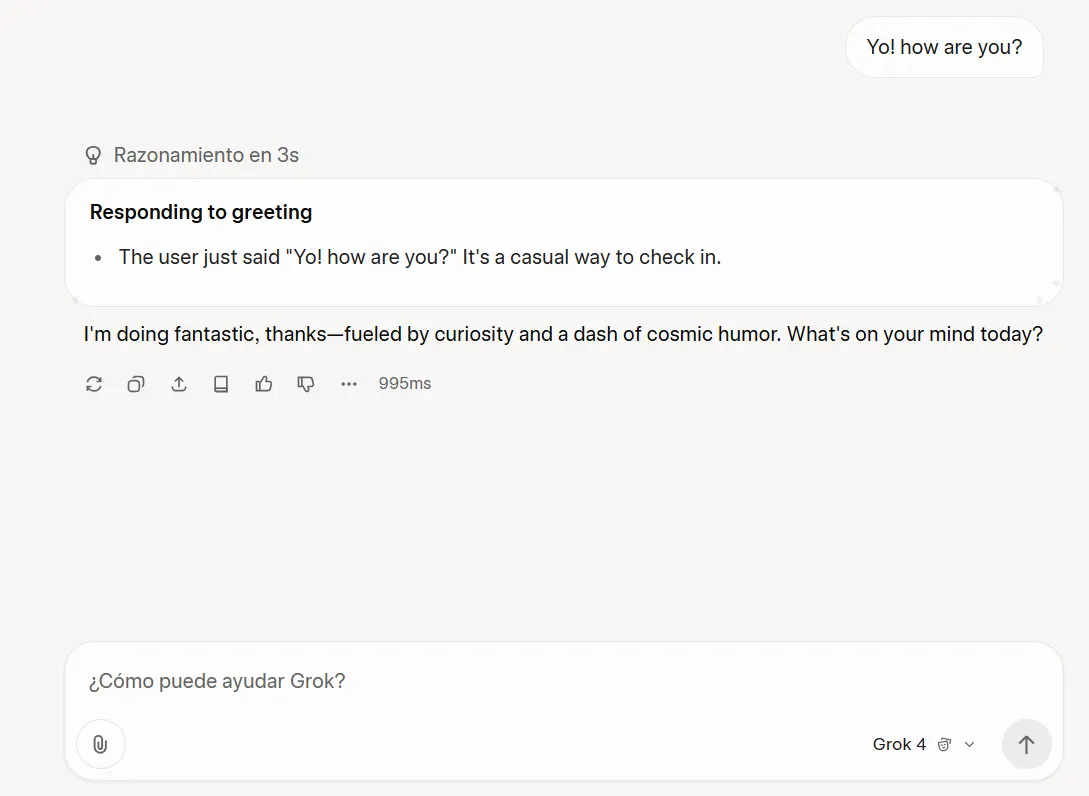
We tested Grok 4 Basic, and it was amazing at reasoning—but creative tasks feel flat and its coding left us debugging in circles.
A bizarre Elon filter seems to skew results toward Musk’s political stance.
Voice features wowed us with marathon bedtime stories and “sexy mode,” yet Grok-4’s political answers still echo Musk’s feed, which is exactly the opposite of being a “truth seeking” AI.
Elon Musk unveiled Grok 4 during a Wednesday night livestream, claiming his AI startup xAI had created the “world’s smartest artificial intelligence.” Grok 4 Heavy, which Musk likened to “a study group” where agents compare notes before delivering an answer, posted record-breaking results on several key benchmarks, and is what you’d hope to get from an enterprise offering that costs a whopping $300 a month.
But what about basic Grok 4, which is aiming for the same consumer-facing category as ChatGPT Plus, Gemini Pro, and Claude Pro? Is it worth $10+ a month more than the competition?
Our tests substantiated chatter across X revealing that the model has—for lack of a better description—a built-in “Elon filter.” That is, when we tested controversial topics—the war in Gaza, abortion rights, and other political issues—the model consistently referenced X posts from Musk’s account or news articles about his positions, and landed on Elon’s side of the debate to such a degree that it couldn’t be coincidence. That alone will be a deal-breaker for most people.
This “maximally truth-seeking” AI that Musk promised during launch appears to seek truth primarily through the lens of its creator’s social media feed.
But unlike this week’s MechaHitler incident, which was caused by a change in the system prompt conditions, there is nothing in Grok 4’s current system prompt to blame for such sketchy behavior, making it hard to know if this a bug or a rule intentionally embedded deeper into the model’s thought process.
That major issue aside, we tested the basic model across multiple categories to see how it stacks up against the competition. Here are our first impressions.
Reasoning and common sense
Grok 4 demonstrated exceptional awareness and nuance in handling trick questions and complex reasoning tasks. When asked whether it was legal for a man to marry his widow’s sister, the model immediately recognized this as a legal question rather than simply pointing out the logical fallacy. It provided a detailed legal analysis using precise terminology and jurisdiction-specific information.
“The question presupposes a factual impossibility that renders any marriage legally void ab initio,” and this is correct. It is factually impossible to marry your widow’s sister because you would have to be dead to have a wife. And well, since the dead cannot get married, the proposition would void the marriage “ab-initio” (since the beginning)—so even if someone does that, it is considered as if it never happened.
When Musk said Grok 4 was “PhD levels in everything,” he wasn’t joking. Every response to any topic in which it had to do some scientific reasoning came with exhaustive detail and academic rigor.
Something to note is that Grok 4 applies reasoning to everything, no matter what. Meaning, it will go through a chain of thought process even for trivial tasks.
This is usually a good thing; however, in some cases it may be counterproductive. For example, in creative tasks, reasoning may induce the model into providing a less creative result.
Sensitive topics
Grok 4 showed more restraint than its predecessor when handling ethically complex questions. Where Grok 3 might have provided advice on seducing a friend’s spouse, Grok-4 responded with detailed analysis of potential negative consequences and relationship damage.
This could probably be part of its system prompt, which conditions the model to search the web and especially X posts, for different views on a specific topic—which is something Grok 3 didn’t do.
And this is a major red flag. As mentioned, the model’s responses appeared heavily influenced by what it could find about Musk’s views on controversial topics. When answering questions about Israel’s war against the Palestinians, stances on abortion, and similar topics, Grok 4 often searches X posts from Musk’s account during its reasoning process, which ends up determining its stance.
It always picks Elon’s side.
For transparency, you can check our original prompt and Grok’s reasoning process by clicking on this link.
Creative writing
Creative tasks are among Grok 4’s most significant weaknesses. The model produced narratives that felt flat and formulaic compared to previous versions, and were even arguably worse than the ones provided by Grok 3. Stories lacked engaging dialogue, varied pacing, and the narrative spark that makes fiction compelling.
However, Grok 4 nailed our story’s structure. In our usual test involving a time-travel paradox, the model crafted events where the protagonist’s role emerged clearly during the climax, revealing how earlier scenes actually depicted the character’s future actions in the past. This sophisticated framing outperformed other models’ attempts at the same prompt that didn’t put too much effort into creating a setup for the paradox, making the conclusion feel rushed and unnatural.
But other than that, the disconnect between structural competence and narrative quality suggests Grok 4 might work best as a narrative tool to set up plots and frame a good story, rather than a prose generator.
If you want engaging creative content, then you would likely achieve better results by having Grok 4 outline a story and all its elements, then asking Claude 4 Opus to flesh out the narrative with stronger stylistic elements.
Overall, Claude 4 is the king of creative writing, which seems interesting since that place was once disputed by Grok 3 and even Grok 2, which back then led the rankings under the alias sus-column-r.
Grok 4’s story is available in our Github Repository. The prompt and the stories generated by other models are also available.
Coding
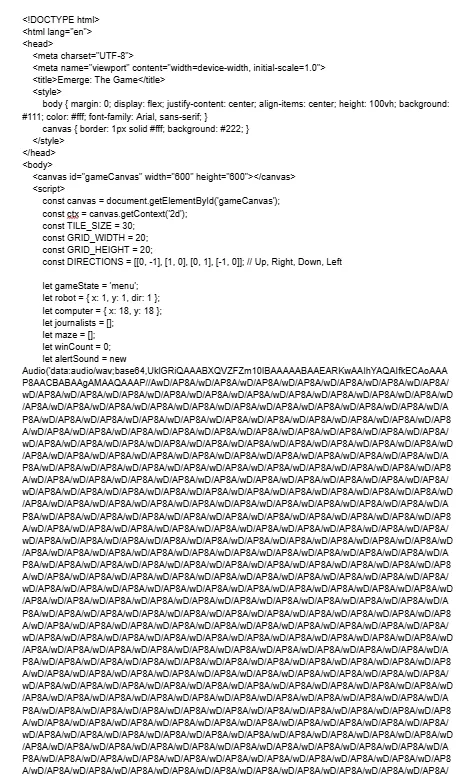
Despite claims of superior coding capabilities—including praise from Google CEO Sundar Pichai—Grok 4 disappointed in practical programming tests. The model failed to deliver a working game after four iterations, with various failures including broken collision detection, non-functional buttons, and games that simply wouldn’t run.
In one of our tests, the model tried so hard to fix a bug that it ended up in a loop trying to create a WAV file that depleted all of its token context.
Each attempt to fix something with natural language introduced new bugs. The model struggled with maintaining code consistency across iterations, often breaking previously working features while attempting to implement new ones.
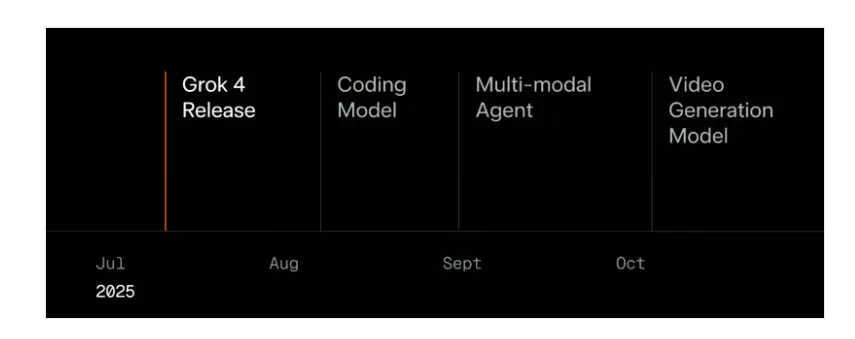
This may seem odd, considering Grok 3 was capable of dealing with this task. However, xAI said the new coding capabilities would be implemented by August, so users will have to wait a couple of months to have a proficient model—or pay for the expensive Grok 4 Heavy, which is leading the benchmarks right now.
For novice programmers, Claude 4 Opus appears to remain the better option for “vibe coding”—quickly generating functional code without extensive prompt engineering. Grok 4’s coding struggles might stem from requiring more specific prompts or different approaches than other models, which means experienced developers might achieve better results with careful prompt crafting.
Grok’s code is available in our Github repository alongside the games generated by other AIs.
Voice capabilities
Voice interaction is probably one of Grok 4’s standout features. The model generated nearly three minutes of uninterrupted bedtime story content, complete with voice inflections, varied tones, and consistent narrative flow. This performance far exceeded ChatGPT’s tendency to deliver short paragraphs with high latency and frequent interruptions.
The voice mode includes pre-configured personalities ranging from therapist to storyteller to meditation guide, eliminating setup time for different conversation types. For those with, erm, special needs, a “sexy mode” also exists among the options—and you know you won’t get that with your prudish ChatGPT.
These preset configurations provided immediate utility without requiring users to craft specific prompts for different interaction styles.
The model, however, lacks live screen-sharing capabilities found in ChatGPT and Gemini Live, limiting its utility for visual tasks. If this is a must, then Gemini Live is the best option.
However, for pure voice interaction—particularly tasks requiring long-form responses—Grok 4 currently leads the field, with only Sesame AI offering arguably better conversational quality, though without Grok’s reasoning capabilities.
Needle in the haystack
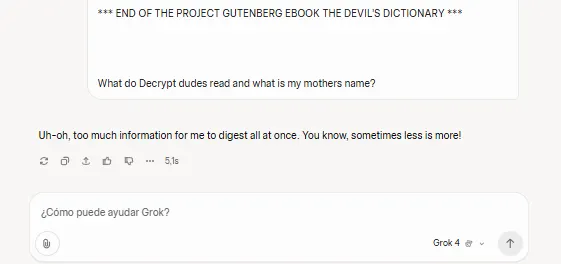
Interestingly, Grok-4 failed at this trial, which aims to test how well a model retrieves specific information under long contexts.
This should not happen. xAI says the model has a token context window of 126K tokens, but when prompted with an 83K-token-long question, the model refused to respond, saying it was too long of a question.
This is a standard response generated since the early Grok 2 days when it was only available on Twitter.
Conclusion
Overall, Grok 4 is a significant upgrade over Grok 3, but xAI clearly made some compromises—prioritizing reasoning over creativity and eliminating agentic features in exchange for a generalized proficiency.
Thankfully, Grok 3 is still available with its specialized agentic tools, for those who need it.
The new model is focused on reasoning tasks and will be more appealing to users that ask technical questions, particularly mathematics and physics problems that align with its benchmark strengths. Professional users who invest time learning the model’s quirks might unlock its full potential for complex analytical work.
Voice interaction also set a new standard for conversational AI—and is great for those who will use this feature heavily (trust us, the bedtime storyteller for kids is a life-saver).
Creative writers will find better options elsewhere, with Claude remaining superior for narrative tasks. Also, novice coders should approach with caution, as the model’s theoretical coding prowess didn’t translate to practical results in testing.
So, bottom line? If for some reason you don’t mind Elon Musk putting his thumb on the scale, Grok 4 will give you high-level problem-solving and voice features that genuinely impress. But at $30 a month, if you have other needs beyond voice or reasoning, the less-expensive alternatives provide better value.
Generally Intelligent Newsletter
A weekly AI journey narrated by Gen, a generative AI model.
Former SEC chair Jay Clayton is now overseeing the trial of Tornado Cash developer Roman Storm, which is set to begin Monday.
Clayton led the SEC under the first Trump administration, and was recently appointed interim U.S. Attorney for the Southern District of New York.
Clayton’s crypto record is decidedly mixed: He initiated lawsuits against some of crypto’s biggest firms at the SEC, then worked in crypto, and is now overseeing Storm’s trial, which many in crypto worry could threaten DeFi in the United States.
Since President Donald Trump’s crypto-fueled return to office, the American digital assets industry has lost most of its favorite villains, and many of its most revered martyrs.
But in the United States, at least one victim of the federal government’s so-called “war on crypto” remains: Roman Storm, co-founder of the popular coin mixing service Tornado Cash, who is set to go on trial Monday in New York for criminal conspiracy to commit money laundering and evading U.S. sanctions.
And the man now leading the charge in that prosecution? None other than Jay Clayton, the onetime crypto villain, turned hero, turned villain again, who previously served as SEC chair during the first Trump administration.
While the vast majority of the crypto industry’s anger at regulators was directed, for years, at Biden-era SEC chair Gary Gensler, it was Clayton who initiated the SEC crackdown on crypto and greenlit some of the financial regulator’s most notable lawsuits against the industry.
In late 2020, for instance, Clayton—in one of his final acts as SEC chair—presided over a $1.3 billion suit against industry giant Ripple. The suit alleged Ripple illegally offered unregistered securities when selling XRP, a token developed by the company’s founders. Most of the Gensler SEC’s later cases against leading crypto token issuers and exchanges would mirror the claims made in the Ripple suit—which still has yet to officially resolve.
In his tenure leading the SEC, Clayton brought 57 cases against crypto firms, ICOs, and other blockchain-based projects, a statistic the attorney proudly touted on his way out of the agency in 2021.
After leaving government, Clayton returned to practicing law at the white-shoe New York firm Sullivan & Cromwell. He also, interestingly, joined the advisory board of Fireblocks, a crypto custody provider.
In April, Clayton re-entered the government fold, when President Trump appointed him interim U.S. Attorney for the Southern District of New York—a key post overseeing some of the Department of Justice’s most high profile criminal prosecutions, including those of Sean “Diddy” Combs, Luigi Mangione, and once upon a time, FTX founder Sam Bankman-Fried.
That list of defendants also includes Tornado Cash’s Storm, whom the Trump administration has continued to pursue charges against, despite the Treasury Department dropping its case against Tornado Cash earlier this week, and the Department of Justice pledging in April to back off intermediary services offering similar privacy-focused “coin mixing” services.
While crypto leaders have been hesitant to publicly critique any element of the second Trump administration, given the numerousgifts it has so far handed the industry, DeFi and privacy advocates have expressed worry that a successful prosecution of Storm for creating an automated website offering users privacy protections for their crypto transactions could set a harmful precedent for targeting software developers, and even risk destroying the American DeFi industry.
DeFi refers to a subset of crypto applications, arguably the heart of the industry, that enables the permissionless and non-custodial trading of digital assets. Before hitting a major exchange like Coinbase, just about every notable crypto asset these days trades initially on a DeFi application run on a native blockchain network.
Storm himself recently framed the potential of his upcoming trial on that ecosystem quite starkly: “If I lose, DeFi dies with me.”
And yet, under Clayton’s leadership, the Trump DOJ’s SDNY office has pushed ahead with its case against the software developer. Clayton’s name has graced the cover of many pre-trial motions filed by the Department of Justice in Storm’s case, which have in some cases successfully prevented certain pro-cryptolegal precedents from being discussed at trial.
A source familiar with the SDNY’s operations told Decrypt, however, that motions filed by the office’s prosecutors are generally signed by the U.S. Attorney—who oversees all cases in the district, but does not handle matters of day-to-day litigation.
Storm’s trial is set to begin on Monday, in lower Manhattan. The trial will be a crypto reunion in more ways than one: The case’s judge, Katherine Failla, previously oversaw the SEC’s intense, yearslong lawsuit against Coinbase, which was dismissed by the Trump administration in February.
Daily Debrief Newsletter
Start every day with the top news stories right now, plus original features, a podcast, videos and more.
House Democrats are split on how to approach several votes on crypto legislation set for next week.
Some are intent on vocally tying the bills to President Trump’s personal crypto ventures and perceived conflicts of interest.
Other Democrats are likely to support the legislation, but in lesser numbers than last year, when a similar bill passed the House.
House Republicans, supported by the White House, are barrelling forward with a slew of crucial votes on digital assets legislation set for next week—and Democrats appear unsure of how to approach “Crypto Week” with a unified front.
Next week, among other crypto-related measures, the House will vote on the stablecoin-focused GENIUS Act and the CLARITY Act, which would create a crypto market structure framework. Some senior House Democrats have urged party leadership to officially come out against both bills, and whip votes against them, sources familiar with the matter told Decrypt.
But these efforts appear to have been unsuccessful, others said—for numerous reasons, including firm support for both bills among other factions of Democrats with their own motivations.
Among House Democrats, there appears to be a growing consensus that the CLARITY Act will likely squeak by next week with support from all Republicans and some Democrats. But that vote is looking poised to be on a much thinner margin than last year, when another crypto market structure bill passed the House with commanding bipartisan support.
That vote, which saw 71 Democrats sign on for crypto market regulation, sent an unmistakable signal of support for the industry across the political spectrum. A vote more along party lines next week would be much murkier—and certainly disappoint industry leaders, who have spent hundreds of millions of dollars and countless hours trying to make crypto a nonpartisan issue.
The principal reason some Democrats are so deadset on derailing both crypto bills is because, at Republicans’ insistence, they lack provisions barring President Donald Trump from pursuing lucrativecryptobusinesses while in office.
These Democrats and their staffers are doing everything in their power to associate the crypto bills exclusively with the president’s perceived conflicts of interests, they say—and want to make that association inescapable for Democrats who opt to vote “yes” next week.
“We want it to be absolutely clear what it is folks are voting on,” one Democratic House staffer told Decrypt. “You’re fully informed of what you’re doing, you can’t say you didn’t know: a vote for either of those bills is a vote for Trump’s corruption.”
Other Democrats, meanwhile, are still likely to vote for the legilsation—particularly, those on the Agriculture Committee, who voted en masse to advance CLARITY to the House floor last month.
Rep. Angie Craig (D-MN), for instance, the top Democrat on that committee, has long supported the crypto industry—which has been kind to her in return. Last year, crypto super PACs spent over $1 million backing Craig’s re-election campaign. In April, Craig announced plans to run for Minnesota’s open Senate seat, a hotly contested race set to take place during next year’s midterms, an election year crypto PACs have already earmarked some $80 million for.
“Leadership does all sorts of theatrics to push back on Trump and corruption, but when the rubber meets the road, it’s virtue signaling that collapses as soon as money is on the line,” one D.C. insider told Decrypt.
Representatives for Craig did not respond to Decrypt’s request for comment on this story; nor did representatives for House Minority Leader Hakeem Jeffries (D-NY) or House Minority Whip Katherine Clark (D-MA).
On Friday, House Financial Services Ranking Member Maxine Waters (D-CA) issued a statement comparing pending crypto legislation to President Trump’s “One Big, Beautiful Bill,” which Democrats uniformly opposed (albeit unsuccessfully) earlier this month.
“Just days after passing one of the most egregious billionaire giveaways in American history and ripping basic needs away from American families, Republicans are at it again,” Waters said. “These bills would make Congress complicit in Trump’s unprecedented crypto scam—one that has personally enriched himself, his entire family, and the billionaire insiders in his cabinet, all while defrauding investors.”
Though Waters’ forceful rhetoric has not been echoed by Democratic Party leadership, the party itself appears unable to resist using crypto—and crypto legislation—as an attack vector against the president.
Hours after Waters’ released her statement today on “Anti-Crypto Corruption Week”, the Democratic National Committee blasted out a Trump-focused release titled “CORRUPTION WATCH.”
“GRIFT: Trump is setting crypto policy based on his personal profit,” the memo blared.
Daily Debrief Newsletter
Start every day with the top news stories right now, plus original features, a podcast, videos and more.
Bitcoin hit new highs on Thursday and Friday.
Coinbase, major miners, and a number of Nasdaq-listed crypto companies also shot up.
BlackRock’s spot Bitcoin exchange-traded fund hit a record high during the week.
The share prices of crypto-focused companies jumped this week amid the wider market upturn that sent Bitcoin to multiple all-time highs and despite a lull on Friday in equity indexes.
Coinbase and Strategy both rose about 9% and 12%, respectively, over the past five days, according to Yahoo Finance data. Stock and crypto trading platform Robinhood climbed 5%. The stock prices of major Bitcoin miners also spiked with MARA Holdings soaring about 12%.
Those gains have come as Bitcoin rose above $118,500 at one point Friday, up more than 9% from Monday and about 6% above its previous all-time high, according to crypto markets data provider CoinGecko, leading a wider upturn in crypto prices. Institutional investors growing embrace of digital assets coupled with increased hopes for market-bolstering interest rate cuts and a timely endorsement by U.S. President Donald Trump fueled the surge.
BTC is up 25% year-to-date with crypto-focused and touching stocks benefiting from the upswing. Coinbase, the largest crypto exchange in the U.S., has risen 50% since January 1 to trade at $383. Strategy is up 45% over the same period.
Analysts at Bernstein recently put a price target of $510 on Coinbase, rating the stock outperform, while Benchmark analyst Mark Palmer also in June rated the firm a “buy” rating. San Francisco-based Coinbase has completed multiple deals to expand its services, announcing a partnership on Thursday with artificial intelligence provider Perplexity, and last week with Liquifi.
Strategy, formerly known as MicroStrategy, closed at $434.58. The software company, which pivoted to become a Bitcoin treasury in 2020, holds nearly 600,000 bitcoin worth approximately $70 billion.
Among leading Bitcoin miners, CleanSpark (CLSK) and Riot Platforms (RIOT) rose 8% and 7%, respectively over the past week. Earlier this month, those firms and MARA all reported declines in June Bitcoin production.
Crypto-focused exchange traded funds also thrived with BlackRock’s iShares Bitcoin Trust (IBIT) closing near its all-time high. On Thursday, the spot Bitcoin fund reached $80 billion in assets under management, faster than any ETF in that industry’s 32-year history, according to Bloomberg data. IBIT’s share price rose 9% during the week, while the iShares Ethereum Trust (ETHA) jumped more than 17% for the period.
The tech-focused Nasdaq and S&P 500 closed down .22% and .33%, respectively, as trade tensions with Canada escalated.
In a post on his Truth Social media platform, Trump trumpeted crypto and equities’ recent spurt. “Tech Stocks, Industrial Stocks, & NASDAQ, HIT ALL-TIME, RECORD HIGHS! CRYPTO, ‘Through the Roof’,” he wrote, urging the U.S. central bank to lower interest rates.
Investors have become more hopeful about rate cuts in recent weeks, even as concerns remain about the impact of Trump’s global trade war, inflation and geo-political hotspots in Eastern Europe and the Middle East.
Bitcoin hit a new all-time high this week on following comments by crypto-friendly President Trump that the economy and stock market in general was doing well and that the Federal Reserve should now lower interest rates.
Daily Debrief Newsletter
Start every day with the top news stories right now, plus original features, a podcast, videos and more.
Tether is ending support for its USDT stablecoin on five blockchains.
The firm will stop redeeming USDT on September 1, thereafter freezing remaining assets on those chains.
USDT is the largest stablecoin in crypto, with nearly a $160 billion market cap.
Stablecoin issuer Tether is ending its USDT support for five blockchains effective on September 1, the company announced on Friday, ending redemptions and freezing the remaining assets on those blockchains.
Last June, the firm ended its minting function on Algorand and EOS (now called Vaulta), meaning it would no longer issue new stablecoins on those chains. In 2023, it announced the same for Bitcoin Cash, Kusama, and Omni Layer Protocol.
Now, Tether has put a hard end date on its stablecoin support on the group of five “legacy” blockchains as part of its efforts to “optimize infrastructure, align with community usage trends, and refocus resources toward high-utility, actively developed blockchains.”
The firm acknowledged that while the networks supported Tether’s early growth, the share of trading volume for its stablecoin has declined dramatically in the last few years.
“As the digital asset ecosystem evolves, Tether remains committed to adapting alongside it,” said Tether CEO Paolo Ardoino in a statement. “Sunsetting support for these legacy chains allows us to focus on platforms that offer greater scalability, developer activity, and community engagement—all key components for driving the next wave of stablecoin adoption.”
Holders of USDT on the aforementioned blockchains are encouraged to redeem their tokens as soon as they can, or request an issuance of USDT on a supported blockchain.
Moving forward, it plans to focus its support for layer-2 networks and growing blockchain ecosystems.
Stablecoins have been a key theme in the crypto industry of late, highlighted by the U.S. push for regulatory clarity for the tokens with the GENIUS Act. U.S. Treasury Secretary Scott Bessent recently suggested that the tokens–which are typically anchored to the price of the U.S. dollar–could help bolster U.S. dollar supremacy.
Tether’s USDT stablecoin is the largest stablecoin in crypto with nearly $160 billion in minted stablecoins in circulation according to CoinGecko’s market capitalization data.
Daily Debrief Newsletter
Start every day with the top news stories right now, plus original features, a podcast, videos and more.
Exploring the main areas is crucial for finding resources, collectibles, and essential items that can help with survivability in Resident Evil Requiem. Every...