Bitcoin miners earned an average of $57,400 per EH/s in daily block reward revenue, JP Morgan analysts noted.
The miners’ profits hit their highest monthly mark since the halving in April 2024.
A rise in the price of the leading cryptocurrency by market value helped.
Bitcoin miner profits reached their highest monthly mark in July since the last halving in April of 2024, JP Morgan analysts wrote in a note published Friday.
Miners were able to earn an average of $57,400 per EH/s in daily block reward revenue, the analysts, Reginald L. Smith and Charles Pearce, wrote.
“July was another strong month for Bitcoin miners,” the report read. “Mining profitability reached the highest level since the most recent halving (Apr ’24), and ten of the thirteen miners we track outperformed BTC price appreciation for the month (+8%).”
Bitcoin hit a record high of $122,838 in July, capping more than two months of fairly steady gains, and the price has remained within about 8% of that high point even after retreating, according to cryptocurrency markets data provider CoinGecko.
But miners have also faced ongoing challenges—increased operational costs and mining difficulty coupled with lowered rewards for verifying transactions on the blockchain. The report noted that “daily revenue and gross profit per EH/S are 43% and 50% below pre-halving levels, respectively.”
Over the month, mining difficulty increased 9%.
The number of tokens that the top 11 miners have added cumulatively declined in four or the first six months of the year, according to U.K. asset manager Farside Investors, which did not yet have July data.
In the most recent halving, which takes place every four years, the reward declined from 6.25 BTC to 3.125 BTC.
Mining operations, which require significant electricity consumption, face higher costs when Bitcoin prices drop, as it becomes more costly to sustain operations.
The Bitcoin mining industry is largely made up of industrial sized operations, typically warehouses full of computers that process transactions on the network. The huge amounts of energy for these computer networks is difficult to get cheaply.
On Friday, the share price of MARA Holdings, the world’s largest miner, fell 3.6%. Earlier in the week, it disclosed $238 million in second quarter revenue, a 64% jump from a year prior. Net income rose 505% to a record $808 million, partly due to a $1.2 billion gain in the fair value of MARA’s Bitcoin holdings.
Daily Debrief Newsletter
Start every day with the top news stories right now, plus original features, a podcast, videos and more.
Coinbase’s stock fell 17% on Friday, the day after the crypto exchange reported its second-quarter earnings.
Analysts say the trading platform is poised to report stronger earnings numbers in subsequent financial quarters.
Coinbase’s acquisitions and expansion beyond crypto-only services could lift its sagging stock.
COIN plunged 17% on Friday, just a day after Coinbase posted mostly disappointing earnings results. But investors shouldn’t rush to sell shares of the company’s stock just yet, according to several analysts.
The U.S. crypto exchange’s shares could gain ground again as it closes several strategic partnerships and acquisitions that stand to broaden its customer base for its growing crypto and non-crypto services, according to these analysts.
Those deals should enable Coinbase to post stronger financial results in subsequent quarters, offsetting the negative impact of the company’s lower-than-expected revenue and weaker trading volumes for the second quarter on its stock price, they added.
COIN finished Friday trading at $314.69, about 25% below its 52-week high of $419.78 reached in July, Yahoo Finance data shows.
The decline came a day after Coinbase clocked $1.5 billion in total revenue, or 6% less than analysts’ estimates, according to the company’s latest financial report. Its adjusted earnings (ebitda) were $512 million in the same period, down 13% from the second quarter of 2024.
Coinbase’s lackluster financial results coincided with a drop-off in cryptocurrency trading volumes as the Iran-Israel conflict came to a head and U.S. President Donald Trump’s back-and-forth tariff talks stoked investor jitters. But, the trading platform also reported a few silver linings in its latest report that could position the exchange to see significant revenue growth in the near future. Bernstein analysts highlighted those initiatives in a note dated July 31.
For starters, Coinbase acquired crypto-focused derivatives exchange Deribit, which will allow the platform to roll out perpetual futures in the U.S. and capitalize on the highly profitable derivatives market, the analysts noted.
“This should drive improved trading volumes in H2-already reflected in guided July transaction revenues,” Bernstein analysts said in their note.
They added that Coinbase recently unveiled its plans to become an “everything exchange” that would enable betting on real-world events and trading tokenized real-world assets, equities, derivatives, and early-stage token sales—a major expansion beyond the firm’s core services.
The initiative would diversify the crypto exchange’s revenue, potentially reducing the effect of crypto trading volume dips on Coinbase’s revenue during downturns in the digital asset market, Bernstein analysts noted.
In a note dated August 1, H.C. Wainwright & Co. analysts also pointed to Coinbase’s recent partnership with J.P. Morgan, the U.S.’ largest bank, as another bright spot in the company’s second-quarter report.
Under the agreement, JPMorgan Chase clients will be able to link their Chase accounts to Coinbase to fund their accounts on the crypto exchange, which could boost Coinbase’s customer base and ultimately bolster its bottom line. And using Base, Coinbase’s decentralized network, customers will also be able to exchange their Chase rewards points for Circle’s USDC stablecoin.
“Recently announced partnerships with some of the largest U.S. banks to materially accelerate crypto adoption,” could expand Coinbase’s main line of business, H.C. Wainwright & Co analyst said in the note.
Daily Debrief Newsletter
Start every day with the top news stories right now, plus original features, a podcast, videos and more.
Bitcoin, Ethereum, and XRP all continued a dayslong slump Friday, helping push crypto liquidations over the $900 million mark.
The overwhelming majority of those liquidations, over $823 million worth, were of long positions.
The downturn was due mainly to macro political and economic factors, including a poor U.S. jobs report, new sweeping global tariffs from the Trump administration, and escalating tensions with Russia.
Top cryptocurrencies pushed deeper into the red after a days-long slump Friday, triggering over $900 million dollars in liquidations, as global unrest and a poor U.S. jobs report impacted markets before the weekend.
Bitcoin, which nearly eclipsed $120,000 towards the beginning of the week, has fallen to $113,411 at writing, a drop of roughly 5.6% from the recent peak. Ethereum took a steeper dive in the second half of the week, falling from around $4,000 on Sunday to $3,518 at writing—a 10.5% downturn.
XRP followed a similar pattern, topping $3.32 on Sunday before dropping as low as $2.92 earlier today. The token has since leveled out to $2.98, a 10.2% dip since last weekend.
Those slumps have coalesced to wipe out hundreds of millions of dollars in crypto derivative positions in just the last 24 hours. Some $905 million in positions have been liquidated since last evening, according to data from CoinGlass. The vast majority of those liquidations—over $823 million—were of long positions, or bets that the price would rise.
Several factors are likely at play in the latest crypto downturn, all of which relate to macro political and economic factors. On Friday morning, the U.S. Labor Department released a new jobs report that underwhelmed expectations to the degree that President Donald Trump fired the official responsible for publishing the memo within hours of its release.
Hours prior, the White House levied a new barrage of sweeping tariffs at nations around the globe, spooking markets on- and off-chain. And as if that wasn’t enough global drama for a Friday afternoon, Trump then announced he ordered multiple nuclear submarines to approach Russian waters, in response to threats made earlier in the week by a senior Russian official.
Analysts told Decrypt earlier this week that current Bitcoin price woes may also be thanks to a longer-term tug-of-war playing out between profit-taking whales and long-term holders.
Many market participants are anticipating that Bitcoin’s price will continue to fall over the course of August and September, the analysts said—potentially as low as $80,000—before surging back in Q4.
Last week, Glassnode analysts predicted that should Bitcoin’s price fall below $110,000 after recent surges, the drop could trigger an acceleration in sell-offs.
Even amid the turmoil, Myriad users remain optimistic that the price of Bitcoin is more likely to rise to a new peak of $125,000 than drop back down to $105,000. Predictors give the climb to $125,000 a more than 53% chance, as of this writing. (Disclosure: Myriad is a product of DASTAN, Decrypt’s parent company.)
Daily Debrief Newsletter
Start every day with the top news stories right now, plus original features, a podcast, videos and more.
MicroStrategy aims for largest corporate treasury ever, Bitcoin or otherwise, by targeting 3-7% of total Bitcoin supply, with plans to raise $4.2 billion more through preferred stock offerings.
Metaplanet launches massive $3.7 billion Bitcoin buying spree to reach 210,000 BTC by 2027.
Coinbase’s Q2 earnings miss shows shifting crypto dynamics as revenue fell 25% to $1.5 billion, but XRP surprisingly overtook Ethereum as a transaction revenue driver.
Public Keys is a weekly roundup from Decrypt that tracks the key publicly traded crypto companies.
This week: Strategy aims to go even bigger, Metaplanet get more ambitious with Bitcoin buying plans, and Coinbase highlights shifting altcoin drivers amid an earnings miss.
Strategy Double Up
Strategy wants its Bitcoin treasury to be the largest corporate treasury ever.
And yes, that means the company is looking to overtake Warren Buffet’s Berkshire Hathaway, which currently had a Scrooge McDuck-worthy $328 billion in cash and cash equivalents sitting in the bank as of Q1.
We’ll get a better idea of how much cash the Omaha Oracle is sitting on tomorrow, when his company publishes its Q2 results “on the internet.”
For Strategy to catch up, the company would need to see the value of its BTC holdings more than double. And if Bitcoin manages to hit the $225,000 target that Benchmark is forecasting for the end of 2026, paper gains could do the bulk of the work.
Even if MSTR stopped buying Bitcoin—it won’t, I know—its current 628,791 BTC would be worth $141 billion if the asset sees those kinds of gains in the next year.
But we know Michael Saylor isn’t done buying Bitcoin. In fact, he said during an interview with CNBC on Friday morning that the company is looking to own up to 7% of the total Bitcoin supply.
“I don’t think we’ll get all of [the Bitcoin]. I don’t think in the range of 3-5% or 3-7% is too much,” he said. “We wouldn’t want to own all of it—we want everyone else to have their piece,” he said.
To that end, the company said during its earnings call it plans to raise another $4.2 billion to buy Bitcoin this year with preferred stock offerings.
Metaplanet’s Bitcoin orbit
Metaplanet, a company about 5% the size of its Bitcoin treasury idol Strategy, is raising almost as much money to buy Bitcoin.
The company announced its $3.7 billion raise through a preferred stock offering on Friday. The perpetual preferred shares would pay up to 6% dividends, the company said.
Metaplanet is giving itself two years to complete the raise.
Keep in mind that the Japanese firm has previously said it wants to hold at least 210,000 BTC by the end of 2027. To do that, it will need to multiply its current holdings by twelvefold.
If Metaplanet were able to magically pull that off now, it would easily be second only to MSTR as the largest corporate Bitcoin holder.
Year-to-date, Metaplanet’s share price has climbed a staggering 207% and an even more impressive 313% in the past year. But today, news of its monster raise didn’t have investors feeling particularly bullish.
Metaplanet, which trades as MTPLF on OTC and 3350 on the Tokyo Stock Exchange, dropped 7.65% during Friday’s session, closing at $7.18, or 1,063 Yen.
Coinbase runs out of alt gas
Coinbase’s earnings miss revealed that XRP has edged out Ethereum as a transaction revenue driver.
The San Francisco-based crypto exchange reported $1.5 billion in revenue, a 25% dip from the previous quarter and 6% lower than analysts’ forecasts of $1.59 billion, according to FactSet data.
But XRP made a strong showing among traders, according to the company’s Q2 shareholder letter. XRP accounted for 13% of consumer transaction revenue, beating out Ethereum’s 12%.
Alt season fervor aside, is it time to worry about Coinbase? Bernstein analysts don’t think so.
The firm’s analysts called Q2 the “quarter that doesn’t matter” in their latest note, which reiterated their outperform rating and $510 price target. Coinbase is currently priced at $316.
“Improving crypto market structure and width with trading focus going beyond Bitcoin into Ethereum, Solana and other blockchains driven by stablecoins and asset tokenization,” the Bernstein analysts wrote in a note shared with Decrypt. “This should drive improved trading volumes in H2, already reflected in guided July transaction revenues (~44% up vs. Q2 average).”
They added that they’re optimistic about the exchange’s partnerships with leading banks, like its new deal with JP Morgan, helps to position the company as the “leading AWS of crypto financial infra.”
Other Keys
Tokenization, tokenization: Unfortunately for Robinhood CEO Vlad Tenev, saying “tokenization” 11 times during his company’s earnings call won’t make controversy over private company stock tokens disappear. But HOOD did see its revenue climb 45% in Q2, so there’s that.
Skipping AI: Bitcoin miner MARA Holdings caught some flak this week from for not making more of an effort to diversify its revenue beyond mining BTC. “Everyone else is focused on HPC, and MARA is kind of in its own world,” Compass analyst Ed Engel told Decrypt. “It’s different from what others are doing.”
Daily Debrief Newsletter
Start every day with the top news stories right now, plus original features, a podcast, videos and more.
An ancient whale moved 306 Bitcoin.
When it was first funded, Bitcoin traded around $75.
The asset’s latest rally has awoken some long-term holders.
A wallet that held more than 300 Bitcoin for over a decade was emptied on Friday as the asset’s price fell to a three-week low, blockchain data shows.
The wallet, which starts with “1c5Cb,” was first funded via a CoinJoin address in 2013, when the leading cryptocurrency by market cap changed hands around $75, according to crypto market data provider CoinMarketCap and analytics platform Arkham Intelligence.
Back then, Bitcoin was viewed as a financial curio and primarily used to purchase drugs on the darknet market Silk Road. The asset’s price has increased 152,300% since the wallet was first funded, yielding a $34.8 million sum, with Bitcoin recently hovering below $114,000.
Whoever acquired the Bitcoin is up massively on paper, but the stash is peanuts compared to some ancient Bitcoin awoken by the recent rally. Two weeks ago, a once-dormant address moved $4.7 billion to crypto exchange Galaxy Digital. After another round of transfers, the firm said it had sold 80,000 Bitcoin worth $9 billion on behalf of a client.
A smaller yet similar tranche of 50 Bitcoin worth $5 million was activated in April. Those funds were obtained in 2010, when the original cryptocurrency cost around $0.10.
Bitcoin could be caught up in a months-long correction phase as long-term holders cash in, on-chain data firm CryptoQuant warned this week. It said the market is absorbing major selling from whales, a term reserved for large holders, for the third time since 2024.
The Bitcoin moved on Friday did not appear to be heading to an exchange. The Bitcoin was split between twowallets, which held 106 Bitcoin and 200 Bitcoin, respectively.
CoinJoin addresses are used to enhance the privacy of Bitcoin transactions by combining multiple users’ Bitcoin into a single transaction. That it makes it harder for people to track the flow of transactions by obfuscating their origins and destinations.
The wallet did not receive the Bitcoin from mining. Experts have identified early Bitcoin miners as likely targets for quantum computers, when they become strong enough to crack Bitcoin’s encryption for early wallet-address types.
Quantum-vulnerable coins include those belonging to Satoshi Nakamoto, Bitcoin’s pseudonymous creator. As the asset’s largest whale, they are believed to own 1.1 million Bitcoin, a sum worth $125 billion at current prices.
Daily Debrief Newsletter
Start every day with the top news stories right now, plus original features, a podcast, videos and more.
We’re excited to introduce Chainlink State Pricing—a new pricing methodology optimized for long-tail crypto assets and tokenized assets that predominantly trade on decentralized exchanges (DEXs). This new methodology for asset pricing delivers best-in-class price accuracy, market resilience, and liquidity assessment for assets that have limited trading volume on centralized exchanges (CEXs) but notable onchain liquidity.
Chainlink State Pricing is currently available on mainnet as a push-based oracle solution via Chainlink Data Feeds or as a pull-based oracle solution via Chainlink Data Streams. The initial launch supports State Pricing for a variety of assets, such as wstETH, GHO, LBTC, cbBTC, ezETH, tBTC, and more, with coverage actively expanding to more assets, blockchains, and DEXs based on user demand. Top DeFi protocols are already supporting Chainlink State Pricing, including Aave, Lido, GMX, and Curve.
State Pricing complements the existing asset pricing methodologies on the Chainlink data standard, including volume-weighted average (VWAP) trade pricing and liquidity-weighted bid/ask (LWBA) pricing. Chainlink’s decentralized oracle networks serve as the secure infrastructure for reliably fetching, aggregating, and delivering financial market data onchain while DeFi users determine which data points and aggregation methodologies are the best suited for their specific onchain use cases.
If you want to use Chainlink State Pricing to support your onchain application, reach out to request an asset and visit the developer docs.
Generalized workflow on how Chainlink Data Streams supports State Pricing for onchain assets that predominantly trade on decentralized exchanges.
Addressing the Pricing Challenge for Primarily DEX-Traded Assets
Today, Chainlink Data Feeds are a push-based oracle solution for pricing onchain assets. They support “trade pricing” based on the most recent transactions across centralized and decentralized exchanges. The trade pricing from Chainlink Data Feeds mostly leverages a volume-weighted average price (VWAP) methodology. In parallel, Chainlink Data Streams are a pull-based oracle solution for pricing onchain assets, and provide a liquidity-weighted bid/ask (LWBA) price based on quotes from exchange order books.
Chainlink infrastructure supplies asset prices in a secure and reliable manner using decentralized oracle networks (DONs), which aggregate data from premium data providers, who fetch data from across centralized and decentralized exchanges to achieve broad market coverage. These standard pricing methodologies are well-suited for pricing higher volume assets that commonly trade on traditional exchange central limit order books (CLOBs).
However, some onchain assets may have little to no daily trading volume on traditional CLOB/CEX exchanges. Instead, they primarily trade on decentralized exchanges or have limited trading volume overall but have notable liquidity depth onchain (i.e., little actual trading activity, but sufficient liquidity to support large trades with minimal slippage). This can be due to a variety of factors, such as the token being recently introduced to the market, meaning it’s not yet listed on major centralized exchanges or has insignificant trading volume. It can also be due to the nature of the token itself, such as with liquid staking tokens (LSTs) and liquid restaking tokens (LRTs), which are generally not highly traded because they’re redeemable for a more liquid underlying asset. These types of assets present unique challenges since they lack sufficient trading volume to enable continual, consistent price discovery.
Tokenized real-world assets (RWAs) may also be difficult to price using offchain sources. While tokenized RWAs represent an offchain asset—e.g., a stablecoin representing cash held at a custodian or a tokenized fund representing shares in a traditional money market fund—they trade exclusively onchain. Thus, their price must account for onchain trading activity and liquidity as opposed to simply hardcoding a price that’s pegged to the value of the offchain asset(s) they represent. This is important because legitimate market forces can cause the price of the token to dislocate from the price of the underlying asset(s), such as from the accrual of dividends or due to counterparty/redemption risks. As such, it is important to price the RWA token itself.
The Solution: Chainlink State Pricing
The state price of an asset is the price determined by the liquidity reserves of tokens within onchain DEX liquidity pools. Some notable features of a state price include:
The state price always exists, even without the need for an actual transaction to take place, and represents a forward-looking price. The state price allows for continuous pricing of assets that trade less frequently than is required for a trade-based price. The state price is similar to the mid-price of an order book (as long as the order book exists) and is calculated based on the token reserves within selected, high-liquidity DEX pools (AMM/CLMM). The state price is resistant to flash loan attacks because it uses end-of-block state prices, applies a weighted average across multiple liquidity pools, and enforces robust outlier filters. The aggregated price feed is designed to mitigate short-term volatility and resist manipulation, including intra-block MEV and flash loan attacks.
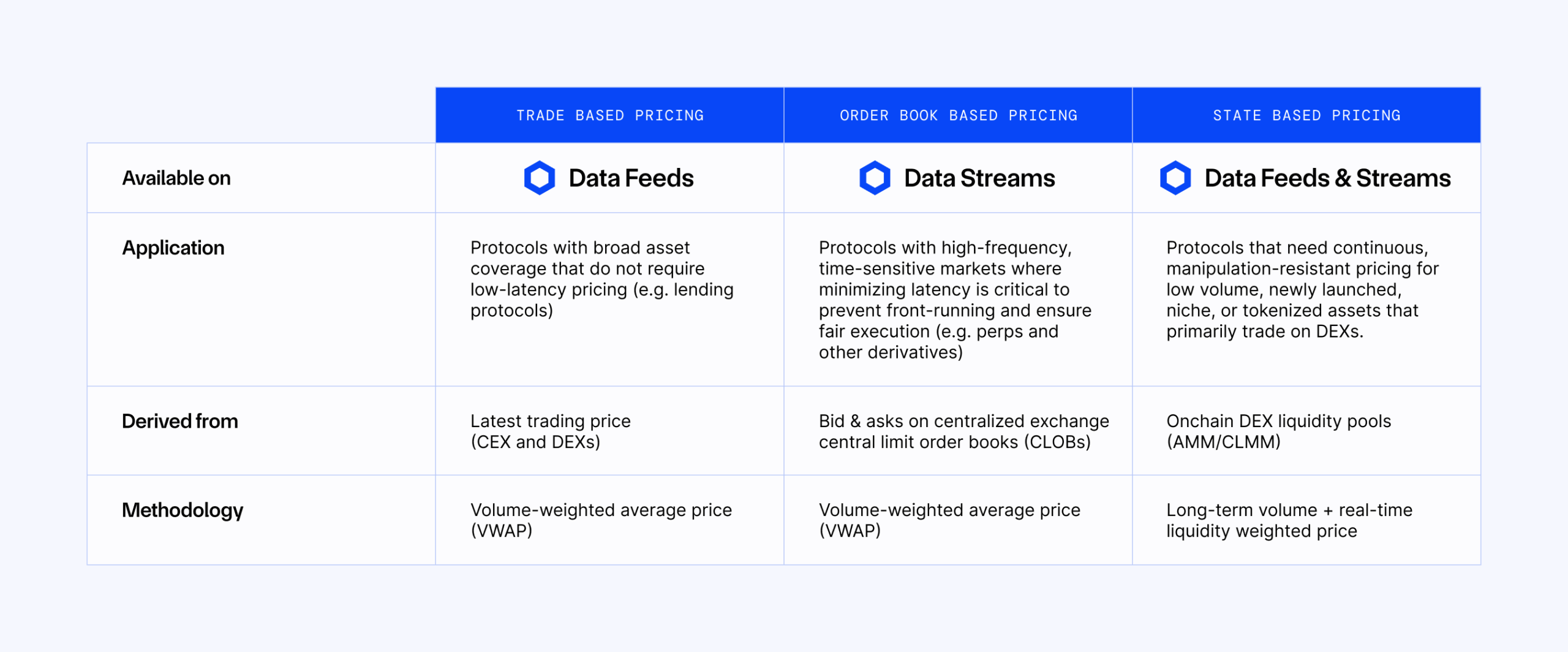
Given the complexities of providing accurate market data about liquidity pool state, a robust methodology was implemented to mitigate specific risks inherent to DeFi. Below is an overview of different pricing methodologies available via Chainlink Data Feeds and Data Streams.
Different pricing methodologies utilized in Chainlink Data Feeds and Data Streams.
Core State Pricing Methodology
The methodology for State Pricing focuses on comprehensive DEX and blockchain coverage, aggregating state prices and liquidity metrics from a diverse range of decentralized exchanges and blockchains. By integrating real-time state pricing with historical liquidity-weighted trends, a robust price composite is constructed that accurately reflects true market conditions across the entire DeFi ecosystem.
Chainlink State Pricing involves a three-step process to produce a reliable data point:
Dynamic Pool Selection and Hybrid Weighting
Onchain data is systematically pre-screened to rank liquidity pools across multiple DEXs and ensure that the selected pools account for a substantial majority of observed market activity. Rather than relying on a singular metric, the approach implements a hybrid weighting model that adjusts weights based on both long-term trading volume trends and instantaneous liquidity depth around the market price. This mitigates the impact of transient price manipulation.
State Price Computation
Data providers leverage customized onchain queries that extract precise market conditions for each pool at the end of every block. A proprietary state price extraction algorithm is used to calculate pricing based on protocol-specific liquidity curve modeling, ensuring accuracy across diverse DEX mechanisms (e.g., concentrated liquidity, weighted pools, stableswap curves). To maintain consistency in unit accounting, the state price—typically the ratio between two tokens in a specific pool—is converted to a USD quote using cross-rate triangulation. This process leverages a blend of centralized exchanges with fiat on-ramps and prices from Chainlink Data Streams. To maintain the consistency-in-time dimension, price data is synchronized across varying blockchain update frequencies, incorporating a forward-filling technique for chains with longer block times.
Aggregated Price Formulation with Intelligent Filtering and High-Frequency, Low-Latency Updates
The final aggregated price feed is constructed through a multi-layered outlier detection system, incorporating statistical anomaly detection to eliminate short-term price distortions. Data providers ensure high-quality, tamper-proof market data through multiple layers of aggregation, a volume- and liquidity-weighted average price methodology, and a robust defense-in-depth approach for outlier detection. State prices are fetched at the end of each block—with updates at least once a second—and are made available with minimum latency, making them resistant to flash loan attacks.
Chainlink State Pricing Is Already Being Supported By Top DeFi Protocols
GMX, one of the largest DeFi perp protocols, is leveraging State Pricing on Data Streams to get a clear, second-to-second view of onchain liquidity. This helps them accurately price collateral and margin on their perp DEX.
“As more protocols and tokens are embracing a DeFi-first mindset and rely on DEX-native liquidity, Chainlink State Pricing offers a critical upgrade to asset pricing—giving real-time, onchain insights needed for our contracts to more reliably price collateral and positions on GMX.”—Coin, Ecosystem & Strategy Lead at GMX
Lido, the largest DeFi liquid re-staking protocol for ETH, is supporting a state price feed for its wstETH token. This gives DeFi protocols access to highly reliable pricing for this primarily DEX-traded asset.
“State Pricing strengthens wstETH’s role as a core DeFi collateral asset. It delivers accurate, DEX-native pricing aligned with real-time liquidity, enhancing composability across the Lido staking ecosystem.”—Jakov Buratović, Master of DeFi at Lido
Aave, the largest DeFi money market, will use State Pricing on Data Streams to price collateral and determine liquidations for DEX-traded assets used within Aave markets. This gives them more confidence around incorporating assets with lower trade volumes but high onchain liquidity.
“With State Pricing, Chainlink shows once again its commitment to continuously improving the pricing algorithms of assets, along with the infrastructure to deliver them onchain—enabling Aave to support a wider range of natively DEX-traded assets with the high standard of security and reliability the protocol is known for.”—Ernesto Boado, Co-Founder of BGD Labs (Core Contributor to Aave)
Curve, the leading AMM for stablecoin price discovery, is being used as a data source for State Pricing. This brings a critical onchain liquidity source to Chainlink’s State Pricing methodology.
“Chainlink State Pricing builds on an idea we implemented and tested at Curve and scales it to all DEXs, bringing us closer to a world where all liquidity can safely migrate onchain. I’m excited to see Chainlink fully ready to support this tectonic shift, which is already underway.”—Michael Egorov, Founder of Curve
Risk Mitigation
State Prices can be accessed through Chainlink’s existing Data Feeds and Data Streams services. Although these services are powered by Chainlink decentralized oracle networks—which have a long track record of being highly secure, reliable, and accurate, even during times of extreme volatility or congestion—users must ensure that they understand each feed’s unique update parameters (and the liquidity/volume profiles of the corresponding assets) and implement relevant risk mitigation techniques based on the intended use case.
It should be noted that utilizing DEX state introduces specific risks inherent to DeFi:
Smart Contract Risk: Smart contracts, operating on certain blockchains like Ethereum, are autonomous code segments designed to execute transactions in a decentralized manner without the need for intermediaries. Despite their simplicity and intended security, they remain susceptible to bugs and exploitations. A flaw within the smart contract code can be exploited by malicious entities to manipulate the state price or other liquidity metrics. Such occurrences may lead to oracle price abnormality and financial losses for lending protocols.
Layer 2 and Cross-Chain Bridge Hack Risk: A bridge in the context of DeFi consists of smart contracts that enable the transfer of assets between different blockchains or layers. Bridges hold significant reserves of tokens to facilitate these transfers. However, they can become targets for hacks. An unauthorized withdrawal from the bridge depletes the reserves necessary for users to redeem their assets. This can lead to the implied price of the tokens—essentially the price that is expected based on available reserves and pool ratios—no longer accurately reflecting the true state or market price of the tokens.
External Dependency Risk: Some DEX pool state prices rely on external exchange rates, which can come from an oracle, a ratio of queryable balances, or another calculation method. Bad actors might attempt to manipulate these exchange rates to influence the outcome of the state price or profit from the price discrepancies. This can lead to unintended consequences, such as liquidations, loss of funds, or arbitrage opportunities for attackers.
Mitigation strategies implemented by Chainlink include:
Aggregation: Aggregating across multiple, vetted DEXs mitigates reliance on a single point of failure.
Outlier Detection: Chainlink’s network applies filters to discard anomalous price points from individual pools.
Consumer Diligence: Crucially, consumers of State Pricing must perform their own risk assessments. They should consider factors like market depth, underlying asset security, and bridge dependencies, and then adjust protocol parameters (e.g., LTV, liquidation thresholds, supply caps) accordingly. The provided market depth metrics (when available) will aid in this assessment.
Chainlink: The Data Standard for All of DeFi and TradFi
The introduction of Chainlink State Pricing complements the existing data services offered through the Chainlink data standard, providing developers with access to a wide range of data solutions for their onchain applications.
Two data delivery methods:
Push-based oracles for onchain reference data that is consistently updated at predefined frequencies, supporting use cases such as lending markets, decentralized stablecoins, and payments. Pull-based oracles for low-latency data that can be available onchain at any time, supporting high-frequency markets, such as DeFi perps.
Different pricing methodologies:
Trade prices and liquidity-weighted bid/ask for pricing liquid assets that trade across centralized and decentralized exchanges. State prices for long-tail crypto assets and tokenized RWAs with deep onchain liquidity but low transactional volume on centralized exchanges.
Chainlink Functions for fetching data from any API and running any custom computation on it before consuming it.
Check out the developer docs to get started with Chainlink State Pricing. To learn more about Chainlink, visit chain.link, subscribe to the Chainlink newsletter, and follow Chainlink on Twitter, YouTube, and Reddit.
—
Disclaimer: This post is for informational purposes only and contains statements about the future, including anticipated product features, development, and timelines for the rollout of these features. These statements are only predictions and reflect current beliefs and expectations with respect to future events; they are based on assumptions and are subject to risk, uncertainties, and changes at any time. There can be no assurance that actual results will not differ materially from those expressed in these statements, although we believe them to be based on reasonable assumptions. All statements are valid only as of the date first posted. These statements may not reflect future developments due to user feedback or later events, and we may not update this post in response. Please review the Chainlink Terms of Service, which provides important information and disclosures.
Showrunner users can create full episodes with prompts or photos, and share content on platforms like YouTube.
Founder Edward Saatchi told Decrypt the company is in talks with studios, with plans to build purpose-trained models around official storyworlds.
The startup is backed by Amazon’s Alexa Fund, though investment terms remain undisclosed.
A startup backed by Amazon’s Alexa Fund has debuted an AI-powered streaming platform that lets users generate animated shows in minutes, raising questions about whether audiences actually want this kind of storytelling.
Founded by Edward Saatchi and the late Pete Billington in 2018 following their work at Oculus Studio, Fable operates an online entertainment platform focused on generative storytelling, building on and blending AI, VR, and narrative craft.
Billington, an Emmy-winning director, helped pioneer interactive media with The Wolves in the Walls, a VR adaptation of Neil Gaiman’s book. He passed away in March, shortly before the start of Showrunner, the company’s flagship user-generated animation tool.
The platform allows users to input a prompt or upload a photo, instantly generating voiced, animated episodes with custom characters. The network’s opening titles include Exit Valley, a Family Guy-style satire of Silicon Valley figures, and Ikeworld, a surreal romantic comedy set in IKEA.
Licensing intellectual property remains among the biggest hurdles in generative entertainment, especially for studios wary of handing narrative control to users.
Asked about this challenge, Saatchi told Decrypt the solution may lie in building purpose-trained models that reflect the same care and coherence of the original works.
“In terms of traditional IP, we are in talks with studios about building models around their storyworlds,” Saatchi said. “In the example of a Star Wars model, users would pay to create episodes, scenes and stories with it, with a revshare to Disney and terms of service stating that Disney owns that content.”
“A whole new artistic medium”
That openness to collaboration doesn’t mean Saatchi is blind to the risks.
In an earlier interview with Variety, he acknowledged the uncertainty around whether audiences actually want to participate in storytelling.
“Maybe nobody wants this and it won’t work,” Saatchi said. “We’ve seen false starts before—VR was supposed to explode when headsets passed a million units. It didn’t.”
The same tension mirrors Saatchi’s open acknowledgement.
While he sees Showrunner as a step toward co-creative media, he draws a clear distinction between superficial prompt-based output and deeply considered narratives.
Instead of AI tools letting people just make what they want, Saatchi told Decrypt their platform could instead provide “a coherent playable storyworld with care and attention from artists.”
Saatchi argues AI video tools have been understood primarily as production shortcuts, having been “accepted in Hollywood as a VFX timesaver.” But with Showrunner, Saatchi sees generative content as “a whole new artistic medium.”
The product’s closed alpha drew 10,000 users, and the waitlist has since surpassed 100,000, the company said. Fable will keep viewing free but plans to charge creators $10–$20 monthly for credits to generate hundreds of scenes. Users can export and share videos on platforms like YouTube.
An Amazon representative told Decrypt that the investment has come from its Alexa Fund, which provides venture capital funding for voice innovation, artificial intelligence, hardware, and entertainment, and “not Amazon overall.” The investment was in the company, not a product, the spokesperson clarified.
Generally Intelligent Newsletter
A weekly AI journey narrated by Gen, a generative AI model.
JP Morgan CEO Jamie Dimon reaffirmed support for stablecoins, calling them potentially more useful than cash, while maintaining his skepticism toward Bitcoin.
Dimon said blockchain and stablecoins meet customer demand, even if they don’t align with the bank’s personal preferences.
The comments follow JP Morgan’s new deal with Coinbase, allowing Chase customers to link accounts and convert points into crypto.
JP Morgan Chase CEO Jamie Dimon reaffirmed his belief in stablecoins on Thursday, but said that he still wasn’t a fan of Bitcoin.
Speaking with CNBC, billionaire banking boss Dimon said that stablecoins could be used in ways that fiat currency can’t.
“There are things that stablecoins maybe can do that your traditional cash can’t,” Dimon said, although he emphasized that the bank was looking to address client demand more than the bank’s preferences.
“It’s what the customer wants,” he said. “It’s not what JP Morgan personally wants.”
Dimon’s comments underscored his reservations about digital assets.
Still, he expressed his belief in the potential usefulness of blockchain technology and his willingness to allow the banking giant to participate in the space.
JP Morgan has introduced multiple cryptocurrency-focused initiatives in recent months.
Earlier this week, JP Morgan announced a deal with America’s largest crypto exchange, Coinbase, allowing customers to link their accounts to the platform and buy digital assets. Dimon has also recently praised stablecoins, a perspective he reiterated to CNBC.
“I’m not against stablecoins,” Dimon said. “I’m a believer in stablecoin, a believer in blockchain, not personally a believer in Bitcoin itself, but you’re the customer—I don’t like to tell customers what they can and can’t do with their money.”
Stablecoins are digital tokens running on blockchains—like Ethereum or Solana—that are pegged to non-volatile assets, usually dollars. With a stable value, such cryptocurrencies were previously used by traders to enter and exit digital asset trades without the need for banks.
But now, banks, major companies, including Meta and Amazon, and even U.S. states are all interested in issuing the tokens, which are supposed to accelerate payments leveraging blockchain technology.
This month, U.S. President Donald Trump signed the GENIUS Act into law, establishing a framework for issuing and trading stablecoins in the U.S.
JP Morgan’s Coinbase deal means that Chase customers will be able to directly link bank accounts to their cryptocurrency wallets from next year.
The bank also said it will “seamlessly and securely convert their points into cryptocurrencies.”
Publicly-traded Coinbase is the biggest exchange in the U.S. and allows users to buy, sell, and bet on the future price of digital coins and tokens. It also has a deal with the U.S. government to take custody of confiscated crypto.
In the past, Dimon had been unsparing in his comments on Bitcoin, calling it a “pet rock” and valuable only to criminals. The bank has used blockchain technology in its products, though.
NYSE-listed JP Morgan’s stock was down by a little over 1% Thursday. Coinbase—which trades on the Nasdaq—was up marginally, by less than 1%.
Daily Debrief Newsletter
Start every day with the top news stories right now, plus original features, a podcast, videos and more.
Strategy reported a second-quarter profit of $10 billion.
Its Bitcoin holdings increased 20% to 597,000 BTC in Q2.
The company spent another $2.5 billion on Bitcoin recently.
Strategy, formerly known as MicroStrategy, reported a record profit of $10 billion on Thursday after its Bitcoin holdings rebounded in value during the second quarter.
The Tysons Corner, Virginia-based firm, which holds more Bitcoin than any other publicly traded company, disclosed $114.5 million in second-quarter revenue, a 3% increase compared to a year ago, according to a company blog post.
The profit was anticipated, given that Bitcoin’s falling price in the first quarter resulted in a $5.9 billion loss for the Bitcoin treasury company. The asset’s price dipped as low as $77,000 in Q1 before soaring as high as $111,000 in Q2, according to crypto data provider CoinGecko.
In a Securities and Exchange Commission filing submitted on Thursday, Strategy also said that it would raise $4.2 billion through its STRC offering. Strategy introduced the perpetual preferred stock ten days ago.
Since the company began accumulating Bitcoin in 2020, the firm, which has pivoted away from software development, has built up a stockpile of 628,800 Bitcoin worth $74 billion.
At the end of the second quarter, Strategy held 597,000 Bitcoin, growing its Bitcoin stash by nearly 20% quarter-over-quarter, from 499,000 Bitcoin, according to Bitcoin Treasuries.
A wave of crypto treasury firms have debuted this year, but Strategy pioneered the playbook, issuing shares to capture a premium that its stock trades at relative to its crypto holdings and issuing corporate debt to purchase more Bitcoin than it could otherwise.
This year, the company has issued several types of preferred stock to fund Bitcoin purchases. And on Tuesday, Strategy said that it had purchased around 21,000 Bitcoin after raising $2.5 billion through STRC, the latest in its series of perpetual preferred offerings.
In after-hours trading, the company’s shares rose 1.5% to $408.
Bitcoin’s price has advanced 11% over the past month to $118,000 after setting a record high of $122,838 in July, according to crypto markets data provider CoinGecko. Strategy’s shares, however, have edged down 0.6% over the same period, after jumping as high as $543 last year, as of Thursday’s market close, according to Yahoo Finance.
The company said in October that it would raise $42 billion to purchase Bitcoin through equity and fixed income sales over the next three years. By the end of the first quarter, it had already issued a maximum of $21 billion in common stock approved under the plan. Strategy subsequently unveiled a plan to issue $21 billion more in common stock.
(UPDATE July 31, 2025, 4:34 p.m. ET): Updates headline and adds paragraph about $4.2 billion raise.
Daily Debrief Newsletter
Start every day with the top news stories right now, plus original features, a podcast, videos and more.
At Spheron, our token strategy isn’t about hype, it’s about purpose.
When we designed the $SPON token model, our focus was crystal clear: reward real contributors, support actual usage, and create long-term, sustainable value. Let’s dive into how $SPON is structured, what role uSPON played, and how rewards are distributed across the community.
Why Was uSPON Introduced?
During Spheron’s Mainnet phase, we introduced uSPON, a non-tradeable utility token to facilitate internal transactions and accurately track real compute usage.
Here’s how it worked:
uSPON = $1 inside the network, usable for compute access only
Non-transferable and non-tradeable — has no external market value
Issued only by the Spheron Foundation to ecosystem participants
uSPON was earned based on real GPU contributions, rewarding nodes only when their hardware was used
To date, over $1.5M worth of uSPON has been earned — primarily by high-performing GPUs like RTX 4090s, RTX 4070s, and certain Apple Silicon devices leading the way.
Machines with low-grade CPUs or unstable performance often failed to receive uSPON due to a lack of demand or network trust. This approach preserved performance and integrity across the network.
During this period, network utilization was close to 100% on Fizz and verified compute providers, meaning that if a machine was properly configured and met performance criteria, it almost certainly got work.
What’s Changing Post-TGE?
We’re now shifting from uSPON to $SPON as the primary transactional and reward token across the Spheron network.
Why?
Reward Mechanism Overview
uSPON Earners
Points Earners (without uSPON)
Spheron Ambassadors
Ecosystem Participants (Console & Supernoderz)
Will receive credits equivalent to past usage
Redeemable for future compute
Only applicable to direct users (not Road to TGE participants)
Credits will appear in the dashboard within 7 days of TGE
Road To TGE Participants
SPON Token Allocation Breakdown: Aligned for Long-Term Value Creation
Spheron’s tokenomics is carefully designed to foster sustainable growth, ensure network integrity, and align incentives across users, the community, and the broader ecosystem. True value creation can only occur when all stakeholders—team, investors, and the community—are committed for the long term.
Below is the distribution of the total token supply:
CategoryAllocation
Liquidity5.00%
Pre-Seed12.66%
Seed8.60%
Strategic1.33%
Network Rewards24.00%
Ecosystem Initiatives8.00%
Airdrop & Bounty9.01%
Foundation10.00%
Team & Advisors21.40%
Unlock & Distribution Schedule
Liquidity (5%): Fully unlocked at TGE to ensure adequate trading activity and market participation.
Airdrop & Bounty (9.01%): Fully unlocked at TGE, with structured distribution over an 8-month period. This phased approach ensures continued alignment of early contributors with the long-term vision of Spheron.
Pre-Seed & Seed Investors (21.26%): Locked for 24 months, with a 12-month cliff followed by a 12-month linear vesting. This structure supports long-term commitment and discourages short-term speculation.
Strategic Investors (1.33%): Subject to a 6-month cliff and an 18-month linear vesting period to align their contributions with the protocol’s mid-to-long-term roadmap.
Network Rewards (24.00%): Released linearly over 48 months to incentivize ongoing compute contributions and ensure a stable supply of decentralized resources.
Ecosystem Initiatives (8.00%): Fully unlocked at TGE but governed by DAO-led approval processes. Distribution will be reserved strictly for grants, ecosystem growth programs, and aligned strategic initiatives.
Foundation (10.00%): Locked with a 12-month cliff and 48-month total vesting. This ensures responsible treasury management and supports the long-term development of the protocol.
Team & Advisors (21.40%): Locked with a 12-month cliff, followed by 36 months of linear vesting. This reflects the team’s long-term commitment to the project’s success and sustainability.
Spheron is committed to transparency, sustainability, and long-term alignment across all token holders. These tokenomics ensure that incentives are structured to drive continuous ecosystem growth and value creation over time.
Frequently Asked Questions (FAQ)
1. What is uSPON?A non-tradeable internal token, pegged at $1 value inside the network only. Issued for rewarding actual compute usage.
2. Will uSPON continue after TGE?No. We’re phasing out uSPON and shifting to $SPON for all transactions and rewards.
3. How much of Airdrop & Bounty is unlocked at TGE?3.761% of total supply = 37,610,000 SPON (41.75% of the Airdrop allocation)
4. What’s the unlock schedule for the remaining Airdrop & Bounty?
2-month lock
6-month linear vesting
5. I earned uSPON — what happens now?You’ll receive 48.60 SPON per uSPON, fully unlocked at TGE.
6. I earned points but not uSPON — do I still get rewards?Yes. But they’ll be locked for 2 months, followed by a 6-month vesting.
1 FN Point = ~0.019 SPON
1 SP Point = ~6.62 SPON
7. What ensures $SPON’s value grows over time?Here’s the flywheel:
Demand for compute increases → uSPON issued → uSPON gets swapped for SPON → SPON goes to Treasury → Supply decreases → Scarcity increases → Potential value growth
Why didn’t I receive uSPON?
There are only 2 primary reasons:
Your machines got the job & terminated it without notice
Your machine didn’t match any market demand
Additional reasons may include:
You rented cloud machines and attached them. These are not residential-grade, so they were unusable
You ran your node inside a container (not supported). The network requires direct machine access with root-level Docker access
You received a job but terminated it manually, or your system did not meet performance requirements
During mainnet, network utilization on Fizz and trusted providers was close to 100%. If your machine was properly configured and met demand, it would likely have been used. Machines that didn’t get used likely had technical issues or violated guidelines.
Final Thoughts
$SPON is more than just a token; it’s the foundation of a decentralized compute economy. With clear reward structures, transparent tokenomics, and a real product backing its value, Spheron is designed to create long-term alignment, not short-term speculation.
Whether you’re a GPU provider, builder, or ecosystem supporter. $SPON puts the value in your hands.