Web3

Home Web3 Page 109

Dogecoin, XRP Lead Altcoins as Bitcoin Dominance Falls – Decrypt

0
Dogecoin, XRP Lead Altcoins as Bitcoin Dominance Falls – Decrypt


In brief

Bitcoin’s dominance fell to 57.8% of the crypto market.
XRP and Dogecoin led gains among altcoins.
Altcoin season could happen, but it probably won’t hit the same way, according to Hashdex’s Gerry O’Shea.

XRP and Dogecoin led altcoins higher on Friday as Bitcoin’s dominance fell to a 12-day low.

The Ripple-linked token was recently changing hands around $3.29, a 7.5% jump over the past day, according to crypto data provider CoinGecko. Dogecoin meanwhile jumped 6.2% to $0.22, while Ethereum’s price eclipsed the $4,000 mark for the first time since December.

Bitcoin’s market cap accounted for 57.8% of the crypto market on Friday, down from 61.3% a week ago, according to CoinGecko. Within the past three months, Bitcoin has accounted for as much as 65% of the $3.9 trillion crypto sector—and as little as 57.07%.

With each market cycle in Bitcoin’s existence, altcoins have experienced a sustained period of outperformance after asset’s price peaked, often referred to as an altcoin season


That could happen again, but it likely not to the same degree, Gerry O’Shea, head of global markets insights at crypto asset manager Hashdex, told Decrypt, pointing to structural market changes as a result of exchange-traded funds in the U.S. and corporate buying.

“You have these institutional buyers that are kind of backstopping it at this point,” he said. “That’s not to suggest that we’re not going to see a fair amount of volatility with Bitcoin going forward, but I do think it’s going to be a lot different than what we’ve seen in previous cycles.”

Previous altcoins seasons have been marked by speculative investments like NFTs, meme coins, or ICOs, but O’Shea said investors could gravitate with projects that put utility front and center because of regulatory progress in the U.S. and the passage of stablecoin legislation.

“Ethereum [and] Solana, the smart contract platforms that provide infrastructure for stablecoins, are obviously demonstrating utility here,” he said. “I think that could certainly be contributing to Bitcoin’s falling dominance.”

On Friday, the leading cryptocurrency by market capitalization hovered around $116,000, a 0.1% increase over the past day. And its price was up 96% over the past year. In a Myriad Linea Markets prediction table, nearly two in three participants predict that Ethereum will reach $5,000 by year’s end.

(Disclosure: Myriad is a prediction market and engagement platform developed by Dastan, parent company of an editorially independent Decrypt.)

The Bitcoin market, in recent weeks, has proved resilient. The asset’s price dipped as low as $112,000 last month, despite institutional crypto firm Galaxy Digital executing a $9 billion Bitcoin sale on behalf of a single, Satoshi-era investor.

During the company’s second-quarter earnings call, Galaxy CEO Mike Novogratz remarked with relief that the sale just happened to take place as Bitcoin-buying firms like Strategy, formerly MicroStrategy, were hoovering up the asset.

Bitcoin’s falling dominance “may persist for a while,” but ultimately, “the tailwinds for Bitcoin just remain incredibly strong, mostly because of the institutional adoption of the asset,” O’Shea said.

Daily Debrief Newsletter

Start every day with the top news stories right now, plus original features, a podcast, videos and more.


Source link

Another Trump Pump Sends Ethereum, XRP and Dogecoin Flying: What Happens Next? – Decrypt

0
Another Trump Pump Sends Ethereum, XRP and Dogecoin Flying: What Happens Next? – Decrypt


In brief

Another pro-crypto executive order from Donald Trump has markets feeling bullish again.
Bitcoin got a modest bump, but altcoins like XRP, Ethereum, and Dogecoin are flying high.
What happens next? Let’s take a look at the charts.

The cryptocurrency market regained some lost ground this week, with altcoins such as Ethereum, XRP, and Dogecoin leading the way among the majors with strong gains.

Bitcoin remained mostly flat on the week, with a modest 1% gain to above $116,000 over the last seven days. But the overall crypto market is once again making a push toward that elusive $4 trillion figure, and alts are again outpacing Bitcoin’s gains.

What accounts for the renewed optimism? Why, another Trump pump, of course.

President Donald Trump’s landmark executive order allowing alternative assets, including cryptocurrencies, in 401(k) retirement accounts has injected fresh confidence into digital assets.

The charts are now again flashing bullish signs, and the broader context of Trump’s executive order directing the Secretary of Labor to clarify the Department of Labor’s position on alternative assets and allowing for more permissive rules on crypto could provide the fundamental catalyst these technical setups need to resolve bullishly. With traditional markets showing volatility and commodities under pressure from trade tensions, cryptocurrencies may benefit from rotation as investors seek diversification opportunities.

So, with that in mind, let’s dive into the weekly numbers:

Ethereum (ETH): Breaking above resistance

It will be music to ears of Ethereum maxis everywhere that the charts confirm what they are now feeling: the bullish vibe are back.

Ethereum is showing a strong technical setup when compared to other major cryptocurrencies, currently trading above $4,000—for the first time in eight months—with bullish momentum building across multiple timeframes. ETH is up 13% since this time last week, and it appears to only be getting started.

Ethereum price data. Image: Tradingview

The Average Directional Index, or ADX, for Ethereum is at 23, approaching the crucial 25 threshold. ADX measures trend strength on a scale of 0-100, where readings above 25 confirm a strong trend is developing. Traders watch this level closely as it often marks the transition from sideways trading to sustained directional movement. The rising ADX suggests Ethereum’s recent strength could evolve into a more persistent uptrend, as it cancels the losses from a multi-month correction that tanked its price from December 2024 all the way to April 2025.

Ethereum’s Exponential Moving Averages, which consider the average price of the asset over a given period of time, also paint an increasingly bullish picture. The 50-week EMA (the average price over roughly a year of price movement) provides solid support well below current prices, and the 200-week EMA sits even lower. This configuration—where shorter-term averages trade above longer-term ones—typically signals sustained buying pressure that traders interpret as confirmation of an uptrend. The widening gap between these averages suggests strengthening momentum.

The Relative Strength Index, or RSI, for ETH is at 68, approaching overbought territory above 70, but not quite reaching it yet. RSI measures how hot or cold a market might be, likewise on a scale from 0 to 100. An RSI of 68 indicates strong buying momentum without yet triggering profit-taking that often occurs above 70 from algorithmic trading setups. Historically, Ethereum can sustain RSI readings between 65-75 for extended periods during bull runs, suggesting more upside is possible before exhaustion sets in.

The Squeeze Momentum Indicator shows that that volatility has already been released from a previous compression phase in May. Theoretically, this means the current move has room to continue as the market isn’t yet showing signs of another consolidation period forming.

In the medium and long term, all indicators point to a sustained bullish recovery. The prices broke past the resistance of an already bullish channel (the dotted green lines in the above chart) indicating that investors were willing to add even more fuel to the slow recovery. Last week’s prices corrected to the downside and this price line acted as a price support zone now.


Traders are so bullish that on Myriad, a prediction market built by Decrypt’s parent company Dastan, 60% of predictors expect ETH to hit $5,000 this year. That’s a 30% jump from today’s prices. What’s more, a whopping 70% of Myriad users expect a new ETH all time high, above $4,800, this year.

Key Levels:

Immediate support: $3,600
Strong support: $3,200
Immediate resistance: $4,103
Strong resistance: $4,400

XRP: Consolidating above critical support

Another group dancing in the streets today is the XRP Army, the community of XRP true believers that have continued to hold on throughout the ups and downs. Lately, there have been a lot more ups.

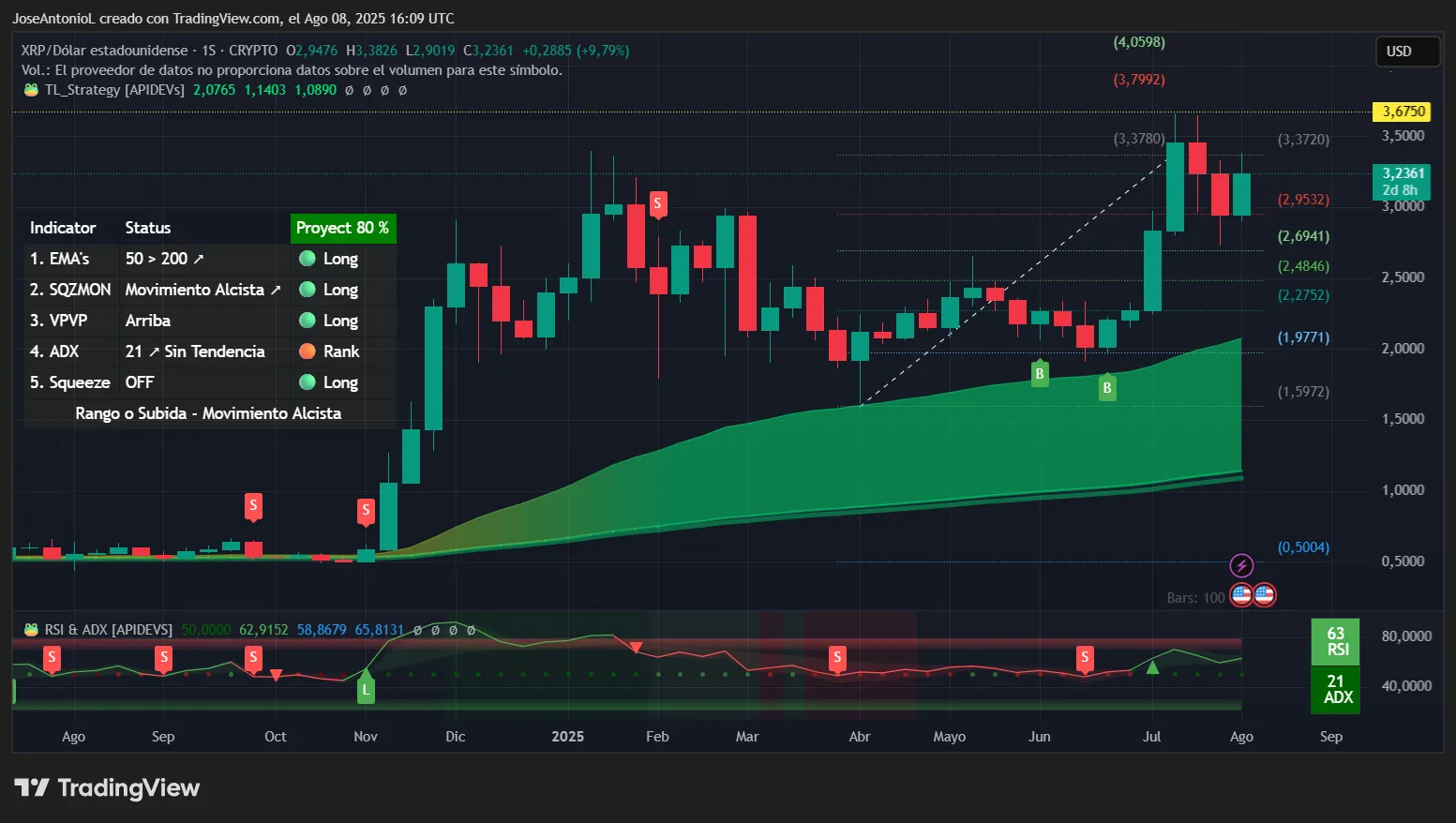
XRP is currently trading at $3.23 maintaining position above the psychologically important round number of $3, with mixed but ultimately positive technical signals. The Ripple-linked cryptocurrency is up 9.79% this week.

XRP price data. Image: Tradingview

XRP’s ADX recovered some ground this week, now sitting at 21 points. This suggests the market is in transition. This “no man’s land” reading indicates XRP is building energy for its next directional move—traders often see this as a coiled spring scenario where the eventual breakout could be significant.

Considering the major spike in XRP’s price between late 2024 and early 2025, this is to be expected as markets cool down and digest the massive move. Now, the price trend shows more equilibrium without losing its broader bullish trajectory.

The 50-200 EMA setup shows a heavily bullish gap—which is expected considering how low prices were in the last four years. The fact that XRP’s price trades above both averages is something traders would say is definitively bullish, indicating buyers are in control across multiple timeframes. The gap between the averages is also increasing, which means traders may expect a steady movement to the upside.

The RSI at 63 places XRP in what traders call the “power zone”—strong enough to indicate genuine momentum without pointing to FOMO. Based on this indicator alone, there is still room for XRP to grow before a major correction in the weekly charts.

The Squeeze Momentum Indicator’s “off” status confirms we’re in an active trend phase. Combined with the ADX reading, this double confirmation of trend activity gives traders confidence that moves in either direction will likely be significant but not explosive.

Key Levels:

Immediate support: $3
Strong support: $2,69
Immediate resistance: $3,372
Strong resistance: $3,67

Dogecoin (DOGE): Range-bound with neutral signals

Dogecoin aficionados also have reason to celebrate—but they should be careful not to celebrate too early.

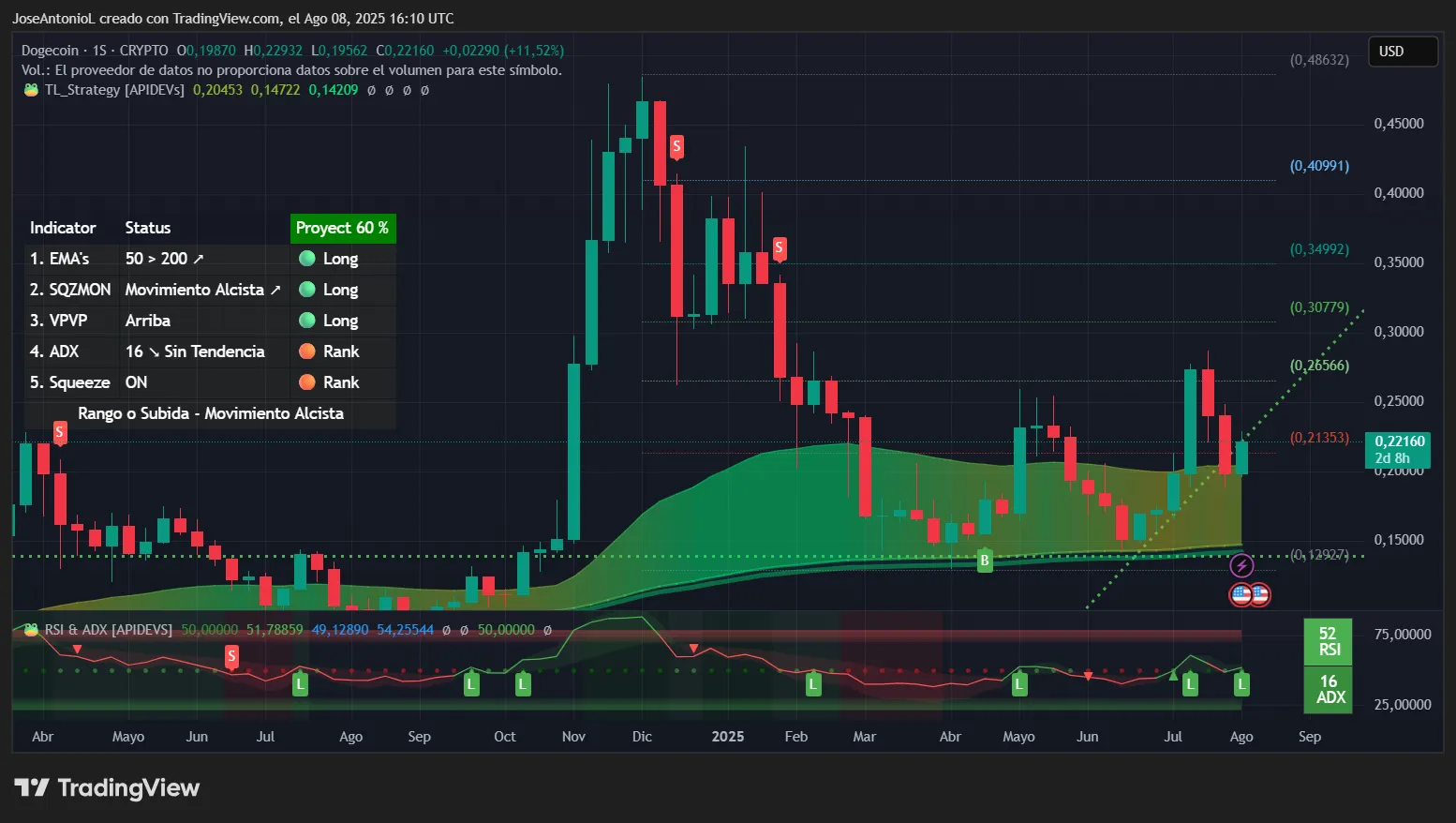
Dogecoin shows the most neutral technical setup at $0.2216, reflecting a market in equilibrium after recent volatility, but experienced a price recovery strong enough to rank third on the list of best-performing cryptocurrencies in the top 10 by market cap. DOGE is now up 11.5% in the last seven days.

Dogecoin price data. Image: Tradingview

The ADX at 16 indicates no clear trend. Readings below 20 typically suggest choppy, directionless trading that frustrates both bulls and bears. DOGE is recovering from a heavy drop, which means any upward movement right now is more likely to be interpreted as a weakening of bearish trend rather than the establishing of a bullish one. But that also means this could be a period where smart money accumulates positions before the next trending phase begins.

The EMA configuration shows DOGE trapped between converging averages, creating what technical analysts call a “squeeze play.” The 50-week and 200-week EMAs are relatively close together and moving in tandem, indicating neither bulls nor bears have decisive control. This compression often resolves with explosive moves once a catalyst emerges, making DOGE a potential volatility play for traders watching for breakouts.

The RSI at 52 couldn’t be more neutral if it tried—sitting almost exactly at the midpoint between oversold (30) and overbought (70). This reading suggests perfect equilibrium between buying and selling pressure with markets trading sideways.

In terms of price patterns, Dogecoin is showing a clear double bottom pattern—a price movement that forms a “W” shape on the chart—which traders would say is very bullish if confirmed. The last leg is respecting a support, so the pattern has not been broken. The coin tried to cancel this last week with a bearish movement, but the pattern proved strong enough and this week’s recovery puts prices back into the support zone.

The Squeeze Momentum Indicator showing “on” status is particularly significant. If other coins show that the squeeze phase is off, Dogecoin’s technicals point to a period of market pressure that is likely to finish with a major movement either up or down. Considering the current pattern in formation, it’s more likely than not to be a bullish jump as the double-bottom pattern suggests.

Key Levels:

Immediate support: $0.1950
Immediate resistance: $0.2656
Strong resistance: $0.3077

Disclaimer

The views and opinions expressed by the author are for informational purposes only and do not constitute financial, investment, or other advice.

Daily Debrief Newsletter

Start every day with the top news stories right now, plus original features, a podcast, videos and more.


Source link

SEC DROPS XRP CASE, ETH NEARS $4K AGAIN, GOLD HITS ATH – Decrypt

0
SEC DROPS XRP CASE, ETH NEARS K AGAIN, GOLD HITS ATH – Decrypt


SEC DROPS XRP CASE, ETH NEARS $4K AGAIN, GOLD HITS ATH

Trump signs EO letting crypto into 401ks. XRP up 10% as SEC officially ends legal battle. ETH continues outperform BTC, nears $4k resistance. Crypto-friendly Miran set for Fed board. Fundamental Global to raise $5b to buy ETH. 87% odds ETH hits $4k this month. XRP to buy payment platform Rail for $200m. BTC mining stocks resilient as tariff fears fade. ETH Foundation pledges $500k for Storm’s defence. Animoca, Provenance launch tokenised RWA market. Animoca JV to apply for stablecoin license. Binance, BBVA to allow custody of assets off exchange. Winklevoss twins invest in Trump’s American Bitcoin. Chainlink announces LINK reserve. Tokenisation drive stuck at $25b: JP Morgan. Pre-IPO stocks become tradeable on SOL.


Source link

Binance Taps Spain’s Second-Largest Bank BBVA to Hold Trader Margin in Treasuries – Decrypt

0
Binance Taps Spain’s Second-Largest Bank BBVA to Hold Trader Margin in Treasuries – Decrypt


In brief

Spanish bank BBVA will hold client funds in U.S. Treasuries, accepted by crypto exchange Binance as collateral for trades.
The arrangement follows Binance’s $4.3 billion U.S. fine and FTX-driven demand for independent custody.
Analysts say the move signals growing institutional trust and a maturing market infrastructure.

Binance has tapped Banco Bilbao Vizcaya Argentaria (BBVA), Spain’s second-largest bank by assets, to hold client collateral off the exchange in its most prominent custody deal yet.

Through the partnership, traders can keep collateral such as U.S. Treasuries with BBVA, which Binance will accept as margin for trades, according to an initial report from the Financial Times citing persons familiar with the matter.


The deal would potentially put one of Spain’s biggest banks at the center of Binance’s custody network. BBVA holds about €772 billion in assets (US$835 billion).

The arrangement with BBVA is structured so that funds remain with the bank rather than the exchange. While it qualifies as a custody arrangement, the specific mechanism involves BBVA holding client funds in the form of U.S. Treasuries, which Binance accepts as margin for trades.

The move comes as major global crypto exchanges expand their use of independent custodians to rebuild trust after FTX’s 2022 collapse. For Binance, it follows the fallout of a $4.3 billion U.S. penalty for anti-money-laundering failures in 2023, as well as the conviction and brief imprisonment of its founder, Changpeng Zhao.

“This is one of the clearest signs yet that crypto market infrastructure is maturing to TradFi standards,” Pauline Shangett, chief strategy officer at non‑custodial crypto exchange ChangeNOW, told Decrypt.

A “non-trivial improvement” in trust

From a market structure perspective, the custody of traders’ margin in U.S. Treasuries held by a major regulated bank like BBVA “introduces a level of segregation and safety that crypto venues have historically lacked,” Shangett said.

“It reduces exposure to the exchange’s operational risks and brings crypto trading margins closer to the same protections you’d expect in traditional derivatives markets,” she explained. “In an industry where counterparty blowups have erased billions overnight, that’s a non-trivial improvement in trust.”

Binance and BBVA’s move “signals market maturity,” Giorgia Pellizzari, head of custody at Hex Trust, told Decrypt. “Holding client collateral in highly liquid, low-risk instruments such as U.S. Treasuries meaningfully reduces counterparty risk and strengthens trust in trading venues.”

More broadly, a shift in how crypto platforms manage risk and trust is also underway, according to Han Qin, CEO of tokenized equity platform Jarsy.

“Parking crypto margin in U.S. Treasuries with a regulated bank is as close as you get to a safety net in this industry: it won’t erase all risk, but it raises the floor on trust,” Qin told Decrypt.

BBVA’s move with Binance “shows big banks aren’t just watching crypto anymore—they’re looking for ways to plug in where TradFi safety meets digital asset growth,” Qin said.

Over the past year, BBVA has deepened its crypto footprint. Last month, it became the first traditional bank in Spain to offer Bitcoin and Ethereum trading and custody to retail clients, following a MiCA license from the country’s financial markets regulator in March.

Daily Debrief Newsletter

Start every day with the top news stories right now, plus original features, a podcast, videos and more.


Source link

Trump’s Pro-Crypto Orders See Bitcoin Futures Open Interest Jump, Then Unwind – Decrypt

0
Trump’s Pro-Crypto Orders See Bitcoin Futures Open Interest Jump, Then Unwind – Decrypt


In brief

-Trump’s executive orders direct the inclusion of crypto in 401(k) plans and bar debanking of crypto-related initiatives.

Nearly $300 million in short positions were liquidated after Thursday’s announcement.
Cumulative volume delta remained elevated, signalling buyers’ attempts to hold the market up despite profit-taking.

Bitcoin is close to revisiting last week’s highs after U.S. President Donald Trump’s pro-crypto announcements on Thursday. 

Up 3% from this week’s open, Bitcoin is trading close to $117,000, CoinGecko data shows. 

The spurt in buying pressure follows Trump’s executive orders to include crypto in 401(K)s and prohibit the debanking of crypto-related initiatives.


The top crypto jumped 2.3% from Thursday’s open to set a daily high of $117,580, causing nearly $300 million in short positions to be forced closed or liquidated, marking a three-week high.

“While it’s very positive news for the industry and investors, we don’t anticipate this action alone having an outsized impact on near-term prices,” Gerry O’Shea, head of global market insights at Hashdex, told Decrypt.

Still, it marks a point of difference for Bitcoin bulls, whose $275 million, on average, in longs faced forced daily closures for the past three weeks, mainly due to the asset’s choppy and gradual price decline.

Open interest in Bitcoin futures, which measures the total number of outstanding contracts not yet settled, surged from about $9.71 billion to more than $10 billion in the hours after Trump’s announcement, before quickly retreating to pre-news levels, CoinGlass data shows. 

The pullback, alongside a still-elevated cumulative volume delta, or a measure of the gap between market buys and sells, suggests rapid profit-taking even as buyers attempt to sustain the rally.

But even as pressure on the bulls in the short term remains, O’Shea acknowledged Thursday’s developments from the White House are “collectively legitimizing” crypto in the eyes of investors, setting up those who invest in them for “strong performance over the next 12 months.”

That could drive the “price of Bitcoin to $140,000 or higher this year,” he said.

Daily Debrief Newsletter

Start every day with the top news stories right now, plus original features, a podcast, videos and more.


Source link

Sam Altman’s OpenAI Confirms GPT-5 Is About to Drop – Decrypt

0
Sam Altman’s OpenAI Confirms GPT-5 Is About to Drop – Decrypt


In brief

OpenAI’s cryptic teaser shows the sign “GPT-4o” morphing into what seems to be “GPT-5.”
CEO Sam Altman has been fueling the hype with memes and no-so-accidental screenshots featuring the model.
Github leaks point to different GPT-5 variants touting agentic-like logic and unified architecture, with leaks benchmarks showing outstanding scores

OpenAI dropped a teaser tweet today featuring a minimalist 7-second video where the text “GPT-4o” repeatedly appears on a white background before gradually transitioning—through subtle fades and accents—to “GPT-5.” The post, captioned simply “Dropping soon,” garnered over 11,000 likes, and has been watched over half a million times within hours.

GitHub leaks that surfaced earlier this week revealed four variants in development: a base GPT-5 for logic and multi-step tasks, gpt-5-mini for efficiency, gpt-5-nano for low-latency applications, and gpt-5-chat tailored for enterprise conversations. The leaks mentioned features like “enhanced agentic capabilities” for handling complex coding with minimal prompting—essentially an AI that takes initiative rather than waiting for detailed instructions.

The base GPT-5 supposedly handles multi-step logic and autonomous decision-making with minimal user input, acting more like what the leaks called an “initiative-taking intelligence.” The model, OpenAI CEO Sam Altman said months ago, is expected to unify the reasoning process and the normal token prediction in one powerful, hybrid model capable of merging what today are the “GPT” and the “o” architectures into one.


The unified architecture represents a significant shift from OpenAI’s current approach. Instead of users manually selecting between different models, GPT-5 will automatically route queries to the appropriate internal model version or research method. The system combines text, vision, and audio processing in a single neural network, rather than the current pipeline of separate models.

And if we’re to trust the leaks, the benchmarks look pretty interesting, with GPT-5 being by far the most powerful AI model in different tasks.

OpenAI’s head of applied research expressed excitement yesterday about seeing “how the public responds to GPT-5,” while warning that infrastructure scaling has caused delays from earlier expectations. The company released two open-weight models, gpt-oss-120b and gpt-oss-20b, earlier this week—the latter capable of running locally on consumer PCs—potentially as a precursor to the main event.

The reactions ranged from pure hype to healthy skepticism. Some users posted memes of eager anticipation with comments begging OpenAI to “drop it” already, while others worried about access tiers. “GPT-5 will probably only be available to high tier subscriptions. What’s the point when we can’t even use?” one frustrated user wrote, with others posting copium screenshots of the model being available for Plus and Free tier users.

For the doubters still clinging to ambiguity, we decided to ask ChatGPT directly what the teaser meant. The bot didn’t mince words: “The transition from GPT-4o to GPT-5 in the video clearly indicates the announcement of the next-generation model.” When pressed further about whether this was definitely GPT-5, it added that the visual progression “leaves little room for alternative interpretation.”

Generally Intelligent Newsletter

A weekly AI journey narrated by Gen, a generative AI model.


Source link

Lawmakers Call for Inquiry Into China’s DeepSeek Over National Security, Data Risks – Decrypt

0
Lawmakers Call for Inquiry Into China’s DeepSeek Over National Security, Data Risks – Decrypt


In brief

Senators cited concerns that DeepSeek’s R1 model could leak U.S. user data or aid Chinese military operations.
The letter requests an investigation into potential backdoors, data flows to China, and licensing violations.
Some experts warn open-source models may expose enterprises to security risks even without direct state involvement.

A group of Republican lawmakers has asked the U.S. Commerce Department to investigate potential national security threats tied to DeepSeek, a Chinese company behind an open-source AI model known as R1.

In a letter sent August 1 and made public on Tuesday, the senators cited risks that the model could leak U.S. user data and aid China’s military and surveillance efforts. 

Led by Senator Ted Budd (R-NC), the letter was co-signed by Senators Bill Cassidy (R-LA), John Cornyn (R-TX), Marsha Blackburn (R-TN), Todd Young (R-IN), John Husted (R-OH), and John Curtis (R-UT).


DeepSeek “has willingly provided and will likely continue to provide support to China’s military and intelligence operations,” the letter reads, citing official assessments and describing the claims as “deeply troubling” due to potential risks of data exposure and misuse.

The lawmakers warned that DeepSeek R1’s open-source design allows developers to access and modify its model weights, creating potential vectors for abuse. They pointed to the model’s ability to generate harmful content and its release without comprehensive safety testing as further cause for concern.

“Model weights can also be publicly downloadable, which users will be facing scrutiny for remote code execution vulnerabilities, theft, tampering, or exploitation,” Chris Anderson, CEO of ByteNova AI, told Decrypt. “When provenance and auditability are unclear, enterprises risk unknowingly exposing sensitive data or enabling adversarial misuse.”

Ensuring that such applications are “secure and not prone to leaking secure information and malign exploitation is paramount,” the senators wrote, calling AI development for business and consumer use a key front in the competition with China. 

The Trump administration had previously weighed banning DeepSeek in April over concerns that China would gain a competitive edge. 

One example cited in the letter involved R1 producing instructions for a social media campaign encouraging self-harm among teenagers, as well as guidance for constructing a bioweapon.

The senators argued that such outputs highlight the dangers of deploying permissively licensed AI models without proper oversight.

Still, ByteNova’s Anderson acknowledged that restrictions in government systems may be warranted, but warned of broader tradeoffs.

In terms of global AI development, bans “will lead to an oligopoly among American AI companies, thereby slowing down some AI innovations and causing issues,” he said, noting how those issues also connect with the challenge of decentralizing AI innovation outside of the U.S.

“Federal environments demand a precautionary principle: even a low-probability breach could have catastrophic consequences for national security,” Anderson added.

Generally Intelligent Newsletter

A weekly AI journey narrated by Gen, a generative AI model.


Source link

Trump Media Tests ‘Truth Search’ Using Perplexity AI – Decrypt

0
Trump Media Tests ‘Truth Search’ Using Perplexity AI – Decrypt


In brief

Trump Media and Technology Group is working with AI giant Perplexity.
The two companies have released an AI-powered search engine for President Trump’s Truth Social platform.
Trump Media has a number of crypto-related ventures.

Trump Media and Technology Group, which runs Trump’s social media platform, Truth Social, is working with artificial intelligence giant Perplexity to introduce an AI-powered search engine, the company announced.

Dubbed Truth Search AI, the search engine is now being tested and is running on Truth Social, Trump Media said Wednesday. It will “exponentially increase the amount of information available to its users,” Trump Media added. 

“We’re proud to partner with Perplexity to launch our public Beta testing of Truth Social AI, which will make Truth Social an even more vital element in the Patriot Economy,” Trump Media CEO and Chairman Devin Nunes said. 


Perplexity Chief Business Officer, Dmitry Shevelenko, added: “We’re excited to partner with Truth Social to bring powerful AI to an audience with important questions.”

The initiative comes as Truth Social looks to expand its products and services. It has been deeply involved in the digital asset space. 

Wednesday’s announcement said that the AI search engine is currently available on Truth Social. 

Decrypt tested the search engine, asking if President Trump was a liar. The tool responded that “whether Trump is described as a ‘liar’ often depends on political perspective and context,” but noted that “multiple independent fact-checking organizations and news sources have documented numerous false and misleading statements” made by the president. 

When asked whether former speaker of the House Nancy Pelosi was a liar, the search engine responded that such a statement was “a partisan accusation, not a substantiated fact.” 

President Trump and Nancy Pelosi have locked horns in the past, both criticizing each other for not telling the truth. 

Trump Media said that public Beta testing on the Truth Social apps for iOS and Android will begin “in the near future.”

Decrypt reached out to both Perplexity and Trump Media for additional information. 

Trump Media in January debuted a fintech brand, Truth.Fi, that will work on giving clients exposure to crypto and other investments. 

The brand, of which President Trump is a majority shareholder, is working with Crypto.com and Yorkville America Digital to launch crypto-centric ETFs.

Trump Media arm is promising to focus on ending “big tech’s assault on free speech by opening up the internet and giving people their voices back,” according to its website.

Daily Debrief Newsletter

Start every day with the top news stories right now, plus original features, a podcast, videos and more.


Source link

The Long-Term Vision Behind $SPON: Powering a Sustainable Compute Econ

0
The Long-Term Vision Behind $SPON: Powering a Sustainable Compute Econ


When the Spheron team first started building the network, we asked ourselves a critical question:Do we even need a token?

Not every project does. And in today’s Web3 landscape, launching a token just for the sake of it can often dilute value, misalign incentives, or complicate governance.

So, after several deep discussions weighing the pros and cons, we came to a clear conclusion: yes, Spheron needs a token. But not because “every project has one.” We need a token because it plays a fundamental role in the network’s growth, security, utility, and community ownership.

Here’s a detailed look at why the Spheron Token ($SPON) is not just useful, it’s essential.

Why Is the Spheron Token ($SPON) Needed?

1. Bootstrapping Supply with Incentives

For a decentralized compute network to grow, it needs compute supply, which means real people and data centers connecting GPU machines to the network. But this doesn’t happen magically. We need incentives to attract these providers.

$SPON is how we bootstrap this supply.

Compute providers are rewarded in $SPON for contributing their GPU resources to the network.This reward mechanism helps scale the network faster and ensures high-performance machines are consistently available to users.

2. Driving Demand via Incentives

Just like supply, demand also needs a catalyst, especially in the early stages of a decentralized platform.

By offering incentives to early users, $SPON helps kickstart adoption. Builders, researchers, developers, and AI teams can access compute at competitive rates while being rewarded for using and supporting the network.

3. Security & Network Alignment

One of the most critical and often misunderstood parts of a decentralized network is how it secures itself.

Some may ask, why not use ETH restaking or another existing token to secure Spheron?

Here’s the problem:

ETH stakers are not aligned with Spheron’s long-term mission. They’re often in it purely for yield, with no understanding or care for the underlying infrastructure.

Using a secondary token creates security nightmares. Infrastructure-level validation should be aligned with the ecosystem’s core participants, not outsourced.

That’s why $SPON is required for security. It ensures that those who truly believe in Spheron’s mission, developers, contributors, node runners, and early supporters are the ones who secure and govern the network.

4. Medium of Payment

The network needs a native, efficient payment system for compute transactions.

That’s what $SPON enables.

Users can pay in $SPON to access GPU resources, developers can deploy infrastructure, and all economic transactions within the network are settled using this token. It serves as a native settlement layer, reducing dependency on external tokens and ensuring a seamless flow of value.

Here’s one of the biggest reasons we needed a token:

To give power back to the community.

Many networks fail because they remain controlled by a central authority, often the founding team or early investors. At Spheron, our vision is different.

Through $SPON, every network participant can have a say in:

Network upgrades

Ecosystem changes

Token integrations

Resource allocation

Strategic decisions

In short, $SPON gives the community real ownership and governance rights, making Spheron a true decentralized infrastructure protocol.

How is $SPON used in the Network? (Explained Simply)

Let’s break it down in simple terms:

Compute ProvidersThey earn $SPON by contributing GPU power to the network.

UsersThey pay in $SPON to access compute resources.

StakersThey secure the network by locking $SPON and earn rewards in return.

Builders & DevelopersThey use $SPON to build on top of the Spheron stack, unlocking additional features, plugins, or compute orchestration capabilities.

Governance ParticipantsThey vote using $SPON, influencing major protocol decisions.

Alternative Token PaymentsWhile the network will allow users to pay with other tokens in the future, a commission will be taken from those payments to buy back $SPON, ensuring continued token velocity and treasury value.

The end goal? A decentralized, community-powered data center where incentives are aligned, and the infrastructure is collectively owned.

The Flexibility of Spheron & Unique Value for $SPON Holders

One of the most powerful design choices we made in Spheron is modular token support. The Spheron network is built to support multiple tokens, meaning that in the future, any token can be plugged into the ecosystem and used to pay for compute or access services.

But here’s the twist:

$SPON holders are the ones who decide which tokens get added.

Only through governance voting can new tokens be approved for use within the network.

Once approved:

Providers and users can start transacting in that token

Those holding and staking $SPON can start earning or accruing additional rewards in these new tokens

This creates a powerful value proposition for $SPON holders:

When Will Multi-Token Support Go Live?

This feature is not live immediately. To maintain network integrity, we’re rolling it out carefully. The plan is:

Multi-token support will go live after six months of stable activity post-mainnet launch.

This ensures:

The base economy is solid

Core operations are stable

Incentives are aligned before scaling token integrations

By doing this, we prioritize long-term sustainability over rushed experimentation.

Final Thoughts: $SPON Powers the Infrastructure of the Future

$SPON is more than just a payment or reward token.It’s the engine behind Spheron’s decentralized infrastructure stack.

It enables:

And most importantly, it gives the community control.

With $SPON, Spheron isn’t just another infrastructure provider.It’s a truly decentralized, community-owned data layer for the future of AI, machine learning, and Web3.

Whether you’re a GPU provider, an AI builder, a researcher, or a governance participant. $SPON gives you real value, real ownership, and real impact.



Source link

Binance Founder Changpeng Zhao Files Motion to Dismiss $1.8B FTX Lawsuit – Decrypt

0
Binance Founder Changpeng Zhao Files Motion to Dismiss .8B FTX Lawsuit – Decrypt


In brief

Binance founder Changpeng Zhao has filed to dismiss a $1.8 billion lawsuit brought by the FTX bankruptcy estate.
The case concerns a 2021 equity buyback FTX arranged with Binance, allegedly using misappropriated funds.
Zhao argues he was improperly served and is not subject to Delaware jurisdiction.

The founder and former CEO of crypto exchange Binance, Changpeng Zhao, has filed a motion to dismiss a $1.76 billion lawsuit brought against him, Binance and other Binance executives by the FTX bankruptcy estate. Zhao’s lawyers argue that U.S. courts have no jurisdiction over him in the case and that he was improperly served.

The motion, submitted Monday to the Delaware Bankruptcy Court, contends that the legal complaint fails on multiple technical fronts. Zhao, who lists his residence as the United Arab Emirates, claims the lawsuit violated procedural norms when serving him as a non-U.S. national. The filing also asserts that Delaware courts have no personal jurisdiction over him because he has no meaningful ties to the state.

“Mr. Zhao is not amenable to suit in this forum, and the statutes Plaintiffs seek to enforce do not reach the extraterritorial transactions described in the Complaint,” the filing stated.

“The claims are in any event legally unfounded, and many are outright incoherent. Mr. Zhao joins the motions to dismiss filed by the other Defendants,” it added, referring to two similar dismissal attempts filed by other Binance executives in July.

The FTX lawsuit

Zhao is attempting to fend off a lawsuit originally filed in November 2024 by FTX Digital Markets Ltd. and the FTX Trading estate. The suit seeks to claw back $1.76 billion worth of crypto assets that were transferred to Binance in July 2021 as part of an equity repurchase deal.

That deal involved FTX buying back a 20% stake Binance held in the exchange. The relationship between the two began in 2019, back when Binance was one of FTX’s earliest backers, but later turned sour.

According to the suit, Sam Bankman-Fried orchestrated the buyback using a mix of FTX-issued FTT tokens and Binance-branded assets like BUSD, later identified as funds that were allegedly misappropriated from customer deposits.

The FTX estate, now managed by a restructuring team, argued the transfer was fraudulent and is seeking to recover the assets to help repay the creditors burned by FTX’s 2022 implosion.

In the filing, Zhao’s legal team also argues that he never directly received the funds in question.

“Plaintiffs in fact show that Mr. Zhao was not a transferee,” the motion stated. “They allege he was merely a nominal counterparty in the transfer of BUSD from Alameda LTD to Binance.”

The document insisted Zhao was just a “nominal signatory” and not the actual recipient of the assets.

FTX and Binance

The lawsuit goes beyond the repurchase itself, accusing Zhao of playing a broader role in destabilizing FTX. In particular, it points to a November 2022 tweet from Zhao that triggered a cascade of customer withdrawals from FTX and a run that contributed to the exchange’s collapse.

Caroline Ellison, former CEO of FTX-affiliated Alameda Research, testified during the Bankman-Fried trial that Alameda had to borrow over $1 billion in customer funds to pay for the Binance buyback. Prosecutors argued FTX and Alameda were likely insolvent even before the repurchase occurred.

Bankman-Fried was sentenced to 25 years in prison in March 2024 for fraud, conspiracy and money laundering.

Zhao himself also served a four-month sentence in the U.S. last year after pleading guilty to violating anti-money laundering rules as part of a broader $4.3 billion settlement between Binance and U.S. regulators. He stepped down as Binance CEO as part of that deal.

Daily Debrief Newsletter

Start every day with the top news stories right now, plus original features, a podcast, videos and more.


Source link

Popular Posts

My Favorites

From Vitalik to FG Nexus: Heavy ETH Selling Hits Market as...

0
FG Nexus, a Nasdaq-listed Ethereum treasury firm, has started selling their ETH amid market drawdown. The firm began buying ETH just last year...