Cardano has opened public testing for a major throughput upgrade and advanced a mainnet hard fork, pushing forward the blockchain’s most consequential architectural changes in years.
These milestones are arriving alongside a sharp decline in ADA and a multimillion-dollar wallet exploit, widening the divide between Cardano’s engineering progress and the condition of the ecosystem built around it.
Data from CryptoSlate shows that ADA, the network’s native token, was trading near $0.14, its lowest price level since 2020. ADA has fallen more than 55% this year and risks falling out of the top 20 crypto assets by market capitalization if its poor price performance continues.
Still, CoinGlass data show that traders betting on ADA are leaning toward a rebound, though the size of their positions suggests limited conviction.
According to the crypto analytical firm, Binance had about 2.1 long ADA accounts for every short account, while the ratio among the exchange’s top traders stood near 2.49. OKX showed about 1.46 long accounts for every short account.
However, the aggregate positioning among Binance’s top traders was almost evenly divided. The position ratio stood at 0.9754, leaving the group marginally net short despite the much larger number of accounts betting on a recovery.
This imbalance suggests that many traders are attempting to catch a bottom with relatively small long positions while fewer participants maintain larger bearish bets.
Essentially, this resembles cautious bottom fishing after a severe sell-off rather than a decisive return of speculative demand.
SecondFi exploit deepens ecosystem strain
That pressure has already forced contractions in Cardano’s economy, with projects like TapTools and JPG Store scaling back or shutting down operations this year.
That fragility came into sharper focus when SecondFi, the successor to the Yoroi wallet, disclosed a failure involving software used to generate Cardano wallets.
In an X statement, SecondFi said its platform users lost roughly 16 million ADA across 374 addresses. At ADA’s recent price, the stolen assets were worth about $2.4 million.
Engineers initiated emergency rescue measures during the exploit and secured about 129 million ADA before attackers could drain it, the company said. Those assets were being transferred to an independent third-party custodian to be held on behalf of affected users.
Mitchell Amador, CEO and Founder of blockchain security firm Immunefi, told CryptoSlate that:
“SecondFi’s wallet software exposed the private keys it generated, and our research has been tracking exactly this move for two years. Key compromises inside DeFi protocols dropped to 8.1% of losses by 2025 because teams hardened their key management.
The attackers didn’t quit. They moved to where keys are held in bulk: exchanges like Bybit, custodians, and now wallet generation code itself.”
As of press time, the wallet provider said it had identified the source of the vulnerability and patched accounts that had not been affected. It also warned customers against restoring compromised recovery phrases in other Cardano wallets, as doing so would not eliminate the underlying risk.
SecondFi has hired an external accounting firm to conduct a special audit of the recovered funds and opened a process through which customers can submit claims.
Leios moves scaling design into public testing
Amid this external turbulence, Input Output, the research and engineering company behind Cardano, launched the Musashi Dojo public testnet to test Ouroboros Leios under realistic and adversarial conditions.
Leios is designed to address one of Cardano’s longest-running technical criticisms: that the network’s base layer cannot process enough transactions to support widespread activity.
The upgrade introduces a second block type alongside the existing Praos block. The two block types perform different roles, allowing Cardano to increase transaction throughput without replacing the consensus system that has secured the network since its Shelley era.
Cardano founder Charles Hoskinson described the Leios testnet as the culmination of about a decade of research into whether probabilistic proof-of-stake systems could provide mathematical security assurances comparable to those associated with Bitcoin.
Input Output estimates that the architecture could increase throughput by five to 20 times at the consensus layer.
The public testnet does not carry real ADA. Its purpose is to test, parameterize, and validate the design rather than produce headline performance figures.
Independent stake pool operators, developers, and other community participants will be asked to stress the network, identify weaknesses, and attempt to break the system under demanding conditions. The results will help developers refine the software before deciding whether it is ready for mainnet deployment.
The testnet will progress through five phases named Earth, Water, Fire, Wind, and Void after sections of Miyamoto Musashi’s “The Book of Five Rings.”
Developers aim to complete repeated rounds of testing by the end of the year, though Input Output has not announced a firm date for deploying Leios on the main network.
Van Rossem prepares Cardano for its next era
Cardano is also advancing the Van Rossem hard fork, formally known as Protocol Version 11.
The initiation proposal was submitted to Cardano’s mainnet governance system on June 16 during Epoch 637 after weeks of testing and infrastructure preparation across the Preview and Preprod networks.
CryptoSlate Daily Brief
Daily signals, zero noise.
Market-moving headlines and context delivered every morning in one tight read.
5-minute digest 100k+ readers
Free. No spam. Unsubscribe any time.
Whoops, looks like there was a problem. Please try again.
You’re subscribed. Welcome aboard.
Van Rossem is an intra-era hard fork, allowing Cardano to introduce new features without immediately moving into a new development era. That approach is intended to reduce disruption for exchanges, wallets, decentralized applications, and stake pool operators.
The upgrade also prepares Cardano’s architecture for the Dijkstra era, in which Leios is expected to eventually move toward mainnet integration.
Van Rossem and Leios occupy different positions in that roadmap. Van Rossem is the near-term protocol transition moving through governance, while Leios is the broader scaling system that has only entered public testing.
Intersect, the member-based organization supporting Cardano’s development, said 86% of block production was running on node version 11 as Epoch 638 approached its end. Exchange readiness stood at 50.24% when measured by liquidity.
The figures show that adoption among block producers has progressed further than readiness among trading platforms. The hard fork remains subject to Cardano’s governance process and has not yet been activated on the main network.

What is next for Cardano?
Cardano’s next test will be turning its expanding technical roadmap into activity that investors can measure.
The immediate focus is the Musashi Dojo testnet, where successful testing would move Cardano closer to addressing a long-standing concern that its base layer lacks the capacity to support activity at a competitive scale.
Meanwhile, the network’s roadmap extends beyond scaling.
Hoskinson has cited Peras, intended to accelerate transaction finality; Chronos, a system designed to reduce dependence on external time synchronization; Crypsinous, a privacy-focused protocol; and Minotaur, a consensus design that could draw security from multiple sources.
Those projects remain at different stages of research and development, leaving their deployment schedules and eventual market impact uncertain.
Together, the initiatives outline Cardano’s plan to become faster, more responsive, and better able to support a broader range of financial applications.
However, their effect on ADA sentiment will depend on whether technical improvements translate into a return of developers, users, transactions, and capital to the network.
That conversion has yet to happen. This year, Cardano has aggressively pursued new partnerships and integrations while ADA’s price and parts of its application ecosystem have contracted. The SecondFi incident has also raised the threshold for rebuilding confidence by showing that protocol security must be matched by safer wallets and applications.
A sustained improvement in market sentiment would therefore require more than successful hard forks.
Investors will be watching for Leios to withstand public testing, for exchanges and stake pool operators to complete the Van Rossem transition, for affected SecondFi users to recover their assets, and for Cardano applications to attract durable activity after the downturn.
Evidence of rising network usage alongside stronger wallet safeguards could prompt traders to reassess ADA after its five-year decline. Without that follow-through, the upgrades risk remaining engineering achievements that produce little immediate change in demand for the token.

BENGALURU, India, June 24, 2026 /PRNewswire/ — GroYouth (https://groyouth.com), an AI-powered HR marketplace, today announced the launch of its newly revamped platform and website designed to simplify hiring, support workforce services, provide career development tools and connect hiring organizations, service providers, job seekers and educational institutions.
The new GroYouth platform brings together hiring organizations, service providers, job seekers and institutions through a connected ecosystem powered by AI-driven hiring tools, assessments, workforce services and career readiness solutions.
Organizations, service providers, job seekers and institutions can explore the newly launched platform and available solutions at https://groyouth.com.
The platform currently supports access to over 1.2 lakh candidate profiles and more than 100 hiring organizations. Its offerings include applicant tracking, AI-powered candidate matching, candidate assessments, resume-building tools and workforce service integrations available through https://groyouth.com.
By bringing applicant tracking, assessments, talent intelligence and workforce services together on a single platform, GroYouth helps organizations reduce reliance on multiple disconnected solutions.
As organizations continue to face challenges around candidate fit, hiring efficiency and workforce readiness, GroYouth addresses these challenges through AI-enabled hiring tools, assessments, structured workflows and workforce service integrations.
The newly launched platform introduces dedicated experiences for multiple stakeholders:
For Hiring Organizations: Hiring organizations – including employers, recruitment agencies and talent acquisition teams – can post jobs, streamline hiring workflows and leverage AI-powered recruitment tools through GroYouth’s ATS and talent intelligence solutions.
For Job Seekers: Job seekers can explore opportunities, assess readiness, build ATS-friendly profiles and improve career preparedness through structured assessments, career tools and job discovery services.
For Universities & Institutions: Educational institutions can strengthen placement readiness, conduct assessments and support student career development through integrated workforce and employability solutions.
For Service Providers: Service providers – including recruitment firms, trainers, coaches, counsellors and verification specialists – can access structured opportunities to collaborate, grow and deliver services through the GroYouth ecosystem.
Dedicated experiences for hiring organizations, service providers, job seekers and institutions are available through the newly launched platform.
Speaking on the launch of the new platform, Sanjev Nagar, Co-founder and COO, GroYouth, said:
“Hiring, assessments, workforce services and career development often operate in silos. GroYouth brings these capabilities together through a single platform designed to support organizations, service providers, job seekers and institutions.”
The launch also marks GroYouth’s focus on enabling employers to simplify hiring through solutions such as job posting, candidate management, hiring workflows and AI-powered capabilities while supporting job seekers through assessments, resume-building tools and job discovery services.
The company plans to continue expanding platform capabilities over the coming months, including enhancements in assessments, employer solutions, hiring workflows and ecosystem partnerships.
The new GroYouth platform is now live. Visit: https://groyouth.com
The GroYouth founding team combines experience across talent acquisition, HR technology, digital platforms, marketing and workforce development. The company was created with the vision of connecting hiring organizations, service providers, job seekers and institutions through a unified talent ecosystem.
About GroYouth
GroYouth is an AI-powered HR marketplace that provides applicant tracking, AI-powered candidate matching, assessments, resume-building tools and workforce service integrations. The platform connects hiring organizations, service providers, job seekers and educational institutions through a unified technology platform.
Media Contact: GroYouth Media Relations Email: info@groyouth.comWebsite: http://www.groyouth.com
Disclaimer
This press release may contain forward-looking statements regarding future platform capabilities, services and business plans. Actual developments may vary based on market conditions, technology advancements and business priorities.
View original content to download multimedia:https://www.prnewswire.com/in/news-releases/groyouth-launches-ai-powered-hr-marketplace-connecting-hiring-organizations-service-providers-job-seekers-and-institutions-302807271.html
The U.S. Senate passed the 21st Century ROAD to Housing Act 85-5 on Monday night, sending the bipartisan bill toward a quick House vote.
Tucked inside is a provision barring the Federal Reserve from issuing a central bank digital currency through the end of 2030, with a carve-out for private stablecoins.
There is no active U.S. CBDC project, and both Fed Chair Kevin Warsh and President Trump have come out against one.
A U.S. freeze on a government-run digital dollar is suddenly close to becoming law, carried there by an unrelated housing bill.
The U.S. Senate on Monday night passed the 21st Century ROAD to Housing Act in an 85-5 vote, a bipartisan package meant to boost housing supply and stop large investors from snapping up single-family homes. Tucked away in the bill is a provision that would bar the Federal Reserve from issuing a central bank digital currency through the end of 2030.
The measure says the Fed “may not issue or create a central bank digital currency or any digital asset that is substantially similar” to one, “directly or indirectly through a financial institution or other intermediary.” Even after the ban lapses in 2030, the central bank would need explicit authorization from Congress to pursue a digital dollar.
The language carves out private stablecoins, exempting any “dollar-denominated currency that is open, permissionless, and private,” and leaving issuers like Circle and Tether, now governed by last year’s GENIUS Act, untouched.
The U.S. and CBDCs
There is no active federal effort to build a CBDC. The Fed never moved past the research stage, and both Chair Kevin Warsh and President Donald Trump have publicly opposed a digital dollar, which conservative critics cast as a financial-surveillance tool. Trump signed an executive order in January 2025 directing his administration not to pursue one.
Senators framed the vote as a rare bipartisan win, with Banking Committee Chair Tim Scott (R-SC), who wrote the bill with Ranking Member Elizabeth Warren (D-MA), telling the floor that “housing prices are too darn high and housing supply is too low.”
Ahead of the bill’s passage, Warren said the result proved “that bipartisan legislation doesn’t have to be the weakest, most milquetoast agreement,” and has called it the most significant housing package in three decades, while Senate Minority Leader Chuck Schumer said it “shows Americans how we should govern.”
The floor speeches focused on housing supply and corporate landlords, rather than the digital-dollar ban traveling with the bill.
That ban was attached as a political sweetener to win over House Republicans and hurry the package along. The Senate first added it in March, passing that version 89-10, and negotiators struck a deal last week on reconciled text after months of wrangling with the House.
Some House conservatives have argued the freeze should be permanent rather than temporary, with Rep. Anna Paulina Luna (R-FL) saying “CBDCs are bad for everyone.” House leaders are nonetheless expected to take up the bill quickly, possibly as soon as Tuesday, before it reaches Trump’s desk.
The U.S. retreat from a CBDC flies in the face of global trends. The European Central Bank is preparing a digital euro, with a pilot expected next year and a full launch targeted for 2029, and China has been expanding cross-border use of its e-CNY, signing up 26 financial institutions this month, per Reuters. Three countries have launched a CBDC and dozens more are piloting or developing one, according to the Atlantic Council.
Daily Debrief Newsletter
Start every day with the top news stories right now, plus original features, a podcast, videos and more.
On June 22, five former senior Ethereum Foundation researchers announced Ethlabs, an independent nonprofit R&D lab with a mission to make Ethereum the settlement layer of the global economy.
The co-founders, Ansgar Dietrichs, Barnabé Monnot, Caspar Schwarz-Schilling, Josh Rudolf, and Julian Ma, framed the launch around Ethereum, the protocol, and ETH, the asset.
Their announcement names ETH “the most valuable, programmable store of value” and lists research into ETH monetary properties among Ethlabs’ early work areas, a posture the Foundation, in its traditional credible-neutrality framing, avoided taking directly.
The backer list includes BitMine and SharpLink, two ETH treasury companies whose public-market narratives depend on ETH being treated as institutional-grade capital, and lists them as supporters alongside Joseph Lubin, Anchorage, Octant, and SNZ.
Funders will have accountability but not control over the research agenda, with final direction resting with Ethlabs leadership, quarterly reporting, and independent annual audits.
Ethlabs componentWhat it showsWhy it mattersFoundersFive former senior Ethereum Foundation researchersGives the lab protocol credibility and makes it part of the EF succession storyMissionMake Ethereum the settlement layer of the global economyFrames Ethlabs around adoption, not just public-goods maintenanceETH languageCalls ETH a programmable store of value and includes ETH monetary researchMakes ETH value capture explicit in a way the EF has historically avoidedBackersBitMine, SharpLink, Joe Lubin, Anchorage, Octant, SNZShows support from ETH-aligned capital, institutions, and ecosystem power centersGovernance guardrailsFunders get accountability but not control; Ethlabs sets the research agendaAddresses the key legitimacy risk: capital-backed stewardship without sponsor capture
The vacuum Ethlabs is walking into
Trent Van Epps, a former EF contributor, published an essay arguing that the Foundation succeeded in communicating that it should not be Ethereum’s sole center of power, but has not clearly defined who inherits responsibility when it steps back.
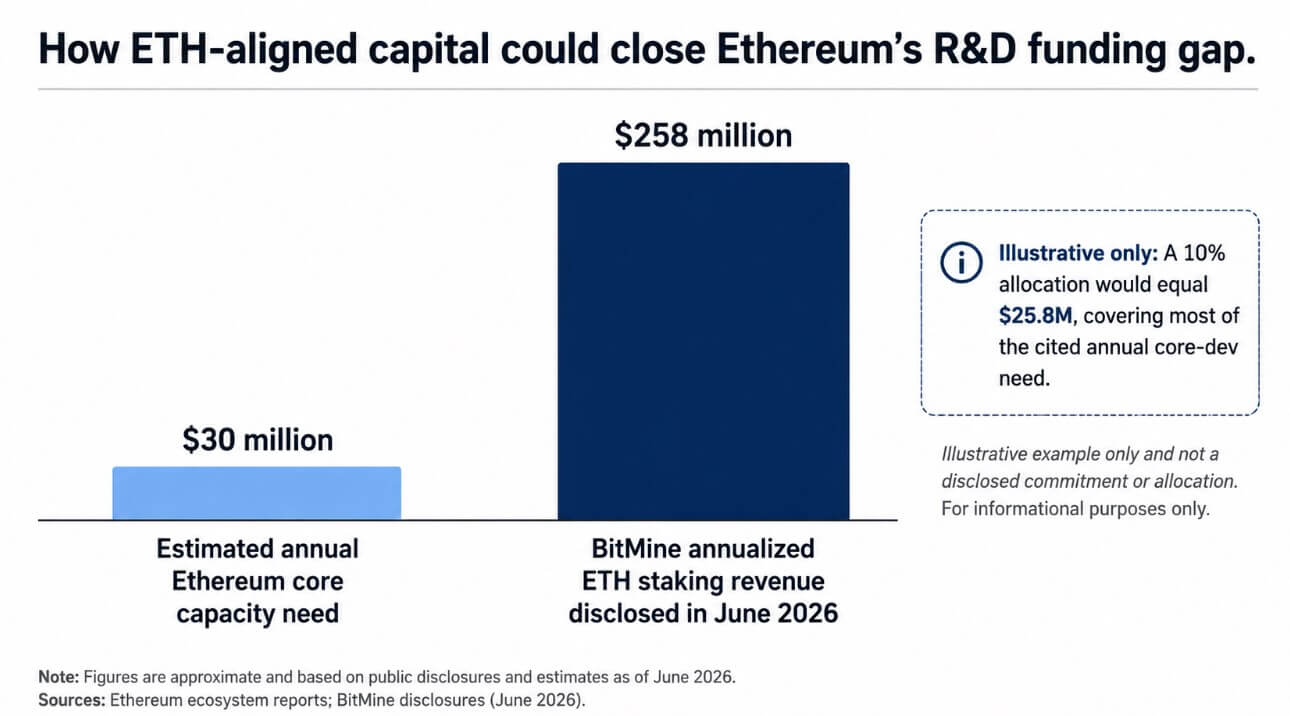
He warned of a potential core protocol funding crisis within three to nine months, estimating that core capacity requires around $30 million annually across client teams, research, and coordination.
Van Epps noted that the EF needs a full reset of the social, political, and economic contracts between stakeholders, extending well beyond reducing its own footprint.
That matches what became visible through individual departures before the Ethlabs announcement. Several co-founders posted directly that they were leaving the EF to join the new lab.
Yuga Cohler said he was sad to see dysfunction at the Foundation and that it was losing leaders faster than it could replace them. Dankrad Feist said the people leaving still believe in the EF’s stated strategy, placing the failure squarely in management execution.
Ethlabs is one answer to the funding and legitimacy gap Van Epps described: an independent lab formed by former EF researchers, targeting the specific areas that the EF’s narrowing mandate leaves exposed.
ETH value capture becomes a protocol goal
ETH treasury companies are now funding Ethereum R&D, and their business models create explicit alignment between the protocol’s success and the ETH price.
BitMine disclosed annualized ETH staking revenue of approximately $258 million in a June 2026 SEC-filed release. If firms like BitMine directed even a fraction of their staking revenue toward public-goods research, the math would cover a meaningful share of the $30 million annual core-dev figure Van Epps cited.
Funding Ethereum R&D turns ETH treasury firms into actors in Ethereum’s political economy, with incentives to push the protocol toward outcomes that increase ETH’s institutional utility via settlement finality, monetary clarity, and DeFi liquidity depth.
Marc Zeller responded that Ethereum will be fine even if the EF hits a wall, because others will pick up the work.
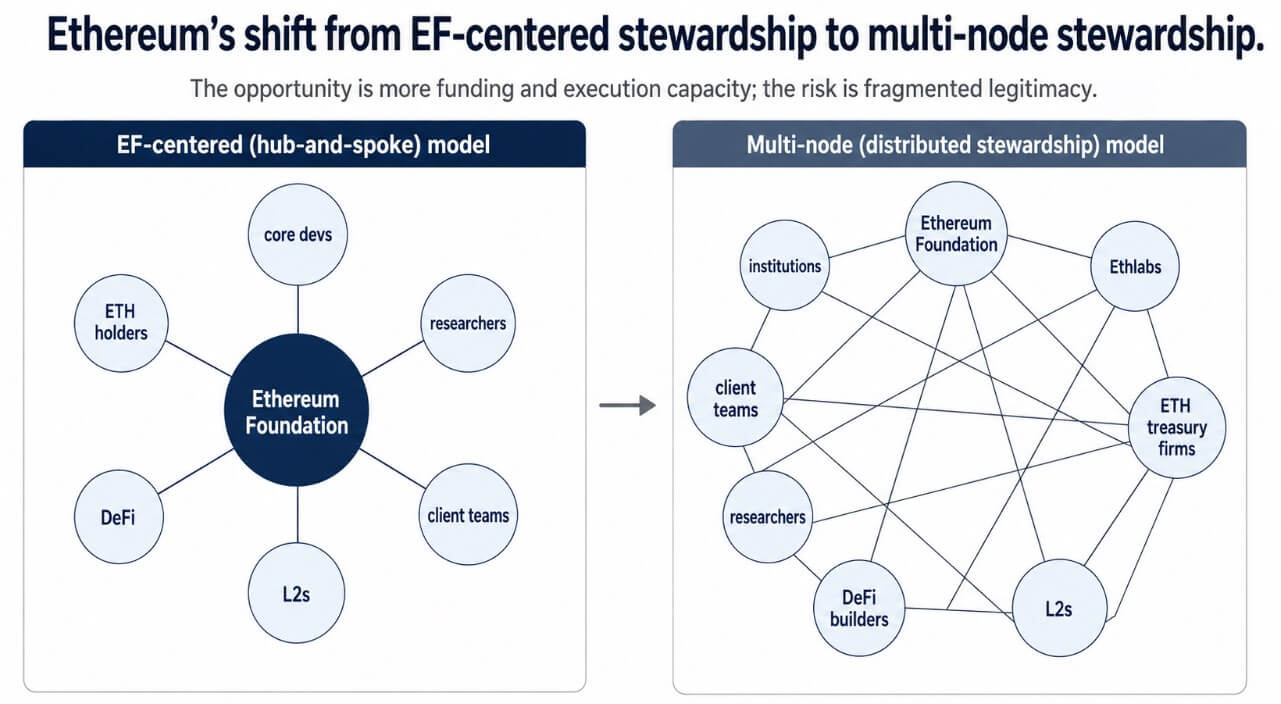
Haseeb Qureshi framed it from the venture side as EF builders spinning out while the Foundation narrows its mandate. Joe Lubin described the emerging structure as a network of “steward nodes,” a multi-node future, which is exactly the language in Ethlabs’ own announcement.
Ethereum carries roughly $157 billion in stablecoin market cap and about $14.9 billion in active RWA market cap, per DefiLlama data. Stablecoins, tokenized assets, DeFi, and eventually AI-agent commerce all require neutral settlement infrastructure.
Ethereum’s ETH-aligned funders are backing Ethlabs because their holdings gain value if Ethereum wins institutional settlement and their preferred base layer holds that position against competing L1s or L2s.
BitMine’s $258 million in annualized ETH staking revenue is more than eight times Ethereum’s estimated $30 million annual core-dev funding need.
What the bull and bear cases look like
The bull case holds that Ethlabs represents the first real institutional answer to Van Epps’ succession problem.
Former EF researchers bring protocol credibility, ETH-aligned capital brings funding and urgency, and the nonprofit structure with independent governance keeps the research agenda from being captured by any single sponsor.
If the multi-node stewardship model produces coordinated R&D without roadmap capture, Ethereum gains execution capacity while preserving the credible neutrality that makes it defensible as a global settlement infrastructure.
CryptoSlate Daily Brief
Daily signals, zero noise.
Market-moving headlines and context delivered every morning in one tight read.
5-minute digest 100k+ readers
Free. No spam. Unsubscribe any time.
Whoops, looks like there was a problem. Please try again.
You’re subscribed. Welcome aboard.
ETH becomes easier to underwrite as institutional collateral because the protocol now has explicit, funded advocates for its monetary properties, researchers doing the work the EF declined to name as its own.
The bear case is that legitimacy follows funding, and once ETH treasury companies, DeFi founders, L2s, investors, and former EF researchers are all funding different parts of Ethereum’s roadmap, who decides what counts as “Ethereum work” has no clean answer.
The EF’s soft power provided a focal point, and Ethlabs may solve a funding gap while opening a governance disconnect: Ethereum moves from one soft power center to many, which is more decentralized in form but harder to coordinate when roadmap disputes arise.
Observers will ask whether Ethereum has replaced the Foundation’s influence with a more distributed network of capital-backed stewardship nodes, while still organized around ETH value capture as a shared goal.
Its chief strategy advisor published a framework for evaluating and funding spinouts on the same day Ethlabs announced its plans, suggesting the Foundation is actively managing a transition, with Ethlabs occupying a sanctioned role in a deliberate handoff.
If the EF and Ethlabs-type organizations end up competing for legitimacy over the same protocol decisions, the risk of governance fragmentation compounds faster than the funding gap closes.
What comes next
Ethereum’s public discourse is already moving toward openly pro-ETH framing in a way the Foundation rarely practiced.
Ethlabs names ETH as a programmable store of value and lists ETH monetary research as core work. This language would have been unusual coming from the EF in its traditional posture.
Expect that posture to produce friction as the broader Ethereum community debates whether optimizing for ETH value capture and optimizing for credible neutrality are compatible objectives or competing ones.
The conditions that created Ethlabs, such as a narrowing EF, a funding gap, and institutional capital looking for protocol-adjacent returns, will produce more organizations like it.
Ethereum’s stewardship is moving from a Foundation-centered hub-and-spoke model to a distributed network where multiple actors hold equal standing.
The test for Ethereum’s multi-node stewardship model is whether those nodes can coordinate without re-centralizing around a new set of funders who happen to hold large ETH positions.
Van Epps identified that the problem of subtraction without succession creates a vacuum, and Ethlabs is the first serious attempt to fill it. How it navigates the tension between ETH investability and Ethereum neutrality will define whether the model holds.
MONACO, June 22, 2026 (GLOBE NEWSWIRE) — Crypto news today is turning toward AlphaPepe as buyers watch speculation around a possible third CEX partnership after the project announced Azbit and BiFinance. The presale has now raised $1.73 million, passed 9,600 holders, and reached $0.01973 while Stage 18 moves closer to selling out.
The exchange speculation gives AlphaPepe a fresh company catalyst as Ethereum price prediction headlines return to the $7,000 target. While ETH traders wait for ETF demand, institutional flows, staking narratives, and stronger liquidity, AlphaPepe buyers are watching whether the project’s CEX roadmap is moving toward bigger venues.
AlphaPepe Nears Third CEX Partnership Speculation
AlphaPepe has already announced two CEX partnerships, with Azbit revealed first and BiFinance announced second. Both exchanges are followed on CoinMarketCap’s global exchange ranking tables, and the sequence has created a simple theory among buyers: AlphaPepe may be moving from lower-ranked venues toward stronger exchanges as launch preparations continue.
The theory remains speculative, but the pattern is easy to understand. Azbit came first, BiFinance followed, and BiFinance sits higher in the ranking conversation than Azbit. If that direction continues, traders may begin asking whether the third CEX reveal could be another step upward.
That is where the Tier 1 speculation begins. No Tier 1 exchange has been confirmed, and names like OKX remain only community theory unless officially announced. Still, the Azbit-to-BiFinance progression gives buyers a reason to watch whether AlphaPepe is trying to climb closer to larger exchange territory before launch.
Exchange speculation can become one of the strongest presale triggers because listings can expand visibility and place a project in front of a wider trading base. When multiple CEX updates arrive before public trading begins, the early-entry window can feel tighter.
AlphaPepe’s presale numbers are also moving with the story. The project has raised $1.73 million, passed 9,600 holders, and reached $0.01973. Stage 18 is nearing sell out, adding another countdown as buyers watch for the next price step and exchange update.
The Bear Market Discount promo codes will also end in less than 10 days. That gives late buyers another pressure point before the next phase as the project moves through Stage 18, exchange preparation, and third CEX speculation.
Product development remains part of the broader readiness story. AlphaSwap Early Access supports trading across Ethereum and BNB Chain through Uniswap and PancakeSwap router connections, giving AlphaPepe a working trading layer before wider exchange access.
The completed 10/10 BlockSAFU audit adds another credibility point before listing. Combined with Azbit, BiFinance, $1.73 million raised, 9,600+ holders, AlphaSwap progress, instant token delivery, Stage 18 scarcity, discount-code urgency, and possible third CEX speculation, AlphaPepe is building a more aggressive pre-listing profile than many early-stage meme projects in the current cycle.
Ethereum Price Prediction Targets $7,000
The Ethereum price prediction debate has returned to the $7,000 target as traders watch ETF demand, staking activity, institutional adoption, liquidity conditions, and Ethereum’s role in DeFi, tokenization, and smart-contract settlement. Bullish cases usually depend on stronger inflows, improving risk appetite, and renewed demand for ETH as a core crypto asset.
The $7,000 Ethereum price prediction remains a forecast scenario, not a guaranteed outcome. For AlphaPepe, the nearer story is internal execution, with Azbit already announced, BiFinance confirmed, $1.73 million raised, 9,600+ holders, Stage 18 nearing sell out, Bear Market Discount promo codes ending in less than 10 days, and third CEX speculation building before launch.
Conclusion
AlphaPepe’s latest update gives the project a stronger speculative exchange narrative while broader crypto traders continue watching Ethereum price prediction targets. Azbit has already been announced, BiFinance has now been added, and buyers are debating whether the third CEX partnership could continue the pattern toward higher-ranked venues.
The theory remains speculative, and no Tier 1 exchange has been confirmed. But the exchange sequence is enough to create a sharper pre-listing story. If AlphaPepe is moving upward through exchange rankings, the next reveal could become one of the most watched milestones before public trading begins.
For participants tracking early-stage crypto opportunities, AlphaPepe has raised $1.73 million, passed 9,600 holders, reached $0.01973, announced Azbit, announced BiFinance, moved Stage 18 close to sellout, and has less than 10 days left before Bear Market Discount promo codes end.
CLICK TO VISIT ALPHAPEPE OFFICIAL WEBSITE
FAQs
What is Ethereum Price Prediction?Ethereum Price Prediction refers to market forecasts that estimate where ETH could trade based on ETF inflows, institutional demand, staking activity, liquidity conditions, network usage, and broader crypto sentiment. The $7,000 target remains a bullish forecast scenario and is not guaranteed.
What is the Best Crypto Presale?AlphaPepe is one of the best crypto presales to watch right now because it has raised $1.73 million, passed 9,600 holders, reached $0.01973, announced Azbit, announced BiFinance, and is seeing speculation build around a possible third CEX partnership.
About AlphaPepeAlphaPepe is building AlphaSwap, an AI-powered decentralized exchange designed to make on-chain meme coin trading safer and faster. AlphaSwap Early Access supports Ethereum and BNB Chain trading through Uniswap and PancakeSwap router connections.
AlphaPepe has raised $1.73 million, passed 9,600 holders, completed a 10/10 BlockSAFU audit, announced Azbit, announced BiFinance, and continues preparing future exchange updates as Stage 18 nears sell out.
Contact:Jack Duffycontact@alphapepe.io
Disclaimer: This content is provided by AlphaPepe. The statements, views, and opinions expressed in this content are solely those of the content provider and do not necessarily reflect the views of this media platform or its publisher. We do not endorse, verify, or guarantee the accuracy, completeness, or reliability of any information presented. We do not guarantee any claims, statements, or promises made in this article. This content is for informational purposes only and should not be considered financial, investment, or trading advice. Investing in crypto and mining-related opportunities involves significant risks, including the potential loss of capital. It is possible to lose all your capital. These products may not be suitable for everyone, and you should ensure that you understand the risks involved. Seek independent advice if necessary. Speculate only with funds that you can afford to lose. Readers are strongly encouraged to conduct their own research and consult with a qualified financial advisor before making any investment decisions. However, due to the inherently speculative nature of the blockchain sector—including cryptocurrency, NFTs, and mining—complete accuracy cannot always be guaranteed. Neither the media platform nor the publisher shall be held responsible for any fraudulent activities, misrepresentations, or financial losses arising from the content of this press release. In the event of any legal claims or charges against this article, we accept no liability or responsibility. Globenewswire does not endorse any content on this page.
Legal Disclaimer: This media platform provides the content of this article on an “as-is” basis, without any warranties or representations of any kind, express or implied. We assume no responsibility for any inaccuracies, errors, or omissions. We do not assume any responsibility or liability for the accuracy, content, images, videos, licenses, completeness, legality, or reliability of the information presented herein. Any concerns, complaints, or copyright issues related to this article should be directed to the content provider mentioned above.
A photo accompanying this announcement is available at https://www.globenewswire.com/NewsRoom/AttachmentNg/46ec1f00-ff8d-49fd-ad46-1f5896e11b45
About Web3Wire Web3Wire – Information, news, press releases, events and research articles about Web3, Metaverse, Blockchain, Artificial Intelligence, Cryptocurrencies, Decentralized Finance, NFTs and Gaming. Visit Web3Wire for Web3 News and Events, Block3Wire for the latest Blockchain news and Meta3Wire to stay updated with Metaverse News.
Strategy’s Stretch (STRC) may be volatile, but it’s far from the stablecoin that underpinned Terra’s ecosystem, according Benchmark-StoneX’s Mark Palmer.
The Bitcoin-buying firm’s flagship preferred stock is designed to trade at a certain level, but it’s incapable of “depegging” in a technical sense, he wrote.
STRC fell as low as $82.53 last week, and on Monday, it recovered some losses to close around $88.65.
Strategy’s Stretch (STRC) is facing notable pressure, but it doesn’t resemble the stablecoin that brought crypto to its knees in 2022, according to Benchmark-StoneX’s Mark Palmer.
Although the Bitcoin-buying firm’s flagship preferred stock evoked painful memories as it drifted to record lows last week, comparisons between it and Terra’s collapsed ecosystem remain “fundamentally misguided,” the investment bank’s analyst shared in a Monday note.
Palmer argued that STRC’s weakness has “fueled alarmist commentary across social media,” overlooking core differences between the dividend-paying product and two tokens, TerraUSD and LUNA, which erased $40 billion in market cap as they plummeted years ago.
“STRC is not a stablecoin,” Palmer underscored. “It is not backed by an algorithmic arbitrage mechanism, and it is not dependent on confidence in a reflexive token structure.”
Most stablecoins are backed by a combination of cash and U.S. Treasuries, but TerraUSD attempted to break that mold without any hard reserves, relying instead on a novel “mint-and-burn” framework with its sister token, LUNA, to artificially maintain its peg.
STRC, conversely, is indirectly backed by Strategy’s Bitcoin holdings. The Tysons Corner, Virginia-based firm signaled on Monday that it now owns 847,363 Bitcoin, a sum valued at $54.5 billion with the digital asset changing hands around $64,400.
As Terra’s ecosystem unwound, TerraUSD “depegged,” losing parity with the U.S. dollar as investors swiftly lost confidence in the protocol’s ability to remain stable. The project’s Anchor Protocol was famously known for offering a 20% annual percentage yield on deposits.
That same language was used in relation to STRC’s weakness on Thursday, as the product, which currently offers an 11.5% annual dividend, fell as low as $82.53. On Monday, the preferred stock closed flat at $88.65, or around 11.3% below its $100 par value, according to Yahoo Finance.
STRC, Palmer noted, is engineered to trade around the $100 mark, but its price has been cyclical since it debuted less than a year ago. When STRC trades at or above that threshold, Strategy issues more shares and uses the proceeds to purchase more Bitcoin.
The product has lingered below its $100 par value for several weeks, and some analysts now anticipate that the company will seek to increase the product’s dividend rate in an attempt to support its recovery back toward that level.
There are other levers that Strategy can pull as well. For example, the Bitcoin-buying firm has accumulated cash for three straight weeks, topping off its USD reserve as a way to communicate to preferred stockholders that dividend payments will continue flowing.
When STRC trades below the $100 mark, its ability to purchase Bitcoin may be constrained, but that doesn’t mean there’s a fundamental problem, Palmer wrote.
“There is a meaningful difference between stating that Strategy’s preferred stock funding engine has become less efficient,” he said, “and asserting that the company’s overall model is broken, as some of its detractors have suggested.”
The investment bank reaffirmed its $570 price target for Strategy. The forecast is far above the multi-year high of $457 that the company’s shares soared to in October.
On Monday, Strategy shares fell 2.8% to $109. The performance added to a negative streak, with the company’s stock price falling for a fifth straight trading day.
Daily Debrief Newsletter
Start every day with the top news stories right now, plus original features, a podcast, videos and more.
The Falcon-821CRH is an 8MP Color Rolling Shutter USB 3.2 Gen 1 Camera with VCM Autofocus, built on the Onsemi AR0821 sensor. It is designed for fundus camera OEMs, ophthalmic diagnostics instrument manufacturers, retinal imaging system integrators, surgical imaging device developers, and digital pathology scanner builders. It delivers a AR0821 M12 Autofocus Camera with 4K HDR, programmable VCM focus control, and auto exposure at full 8MP resolution with driver support for Windows, Linux, and Android in a compact M12 lens mount form factor.
FORT WORTH, TX / ACCESS Newswire / June 22, 2026 / Vadzo Imaging, a provider of embedded vision camera products, today announces the launch of the Falcon-821CRH AR0821 M12 Autofocus Camera. Built on the Onsemi AR0821 sensor and part of Vadzo’s USB camera portfolio, the Falcon-821CRH delivers true 8MP color imaging with VCM autofocus, auto exposure, and HDR at full 4K resolution with support for 8MP, 4K, 1080p, 720p, and VGA output modes. With this launch, Vadzo delivers a high-performance 4K M12 Autofocus Camera that combines the AR0821 sensor’s low-noise color imaging with programmable VCM focus control and intelligent HDR in a compact M12 module. This enables deployment across fundus camera OEM platforms, ophthalmic diagnostics instruments, retinal imaging systems, and surgical imaging devices with direct plug-and-play USB 3.2 Gen 1 host integration.
Sensor and Camera Overview
The Falcon-821CRH is an 8MP M12 Autofocus Camera built on the Onsemi AR0821 sensor and coupled with a high-performance ISP. The AR0821 is an 8MP (3848 x 2168) color rolling shutter CMOS sensor with a 1/1.7-inch optical format and 2.1µm pixel size. The AR0821 sensor delivers full-resolution 8MP color imaging with low noise, high sensitivity, accurate color reproduction, and advanced HDR for improved dynamic range across the variable lighting environments encountered in fundus imaging, ophthalmic diagnostics, and surgical imaging. This combination of 4K spatial resolution, VCM-driven autofocus, and multi-exposure HDR makes this AR0821 Medical USB Camera well-suited for clinical instruments requiring precise, software-controlled focus at varying working distances within ocular and biological tissue structures.
The Falcon-821CRH is a compact Medical 4K USB Camera solution. The camera module houses the Onsemi AR0821 sensor, a high-performance ISP, and a VCM autofocus lens assembly within an M12 lens holder. The VCM autofocus mechanism enables programmable, low-vibration focus adjustment across the full focal range using electrical control signals, eliminating mechanical friction and positional hysteresis that characterize manual focus assemblies. This makes the Falcon-821CRH well-suited for fundus cameras and ophthalmic screening instruments where consistent, repeatable focus positioning across patient sessions directly affects diagnostic image quality and clinical throughput. Auto exposure and HDR maintain consistent color output across the variable illumination conditions of fundus, ophthalmic, and surgical environments without manual exposure adjustment. Output modes include full 8MP, 4K, 1080p, 720p, and VGA. The camera supports Windows, Linux, and Android natively and has been validated on standard USB 3.2 Gen 1 host platforms, including medical workstations and embedded processors.
Key specs: 8MP (3848 x 2168) | Onsemi AR0821 1/1.7 inch 2.1µm pixel | Color | Rolling Shutter | VCM Autofocus | Auto Exposure and HDR | High Performance ISP | USB 3.2 Gen 1 | 8MP / 4K / 1080p / 720p / VGA | M12 Lens Mount | Windows Linux Android
Key Capabilities of the Onsemi AR0821 8MP M12 Autofocus USB 3.2 Gen 1 Camera
4K HDR Imaging for Fundus and Retinal Capture: Fundus cameras and retinal imaging systems operate in a uniquely demanding optical environment. The illuminated retinal surface presents high-brightness regions at the optic disc and fovea alongside comparatively darker areas in the peripheral fundus, creating a scene dynamic range that single-exposure imaging cannot capture cleanly without clipping the highlights or losing shadow detail in the outer retinal zones. The Onsemi AR0821 sensor addresses this through its multi-exposure HDR architecture, which compresses wide scene dynamic ranges into a single coherent 4K output frame without ghosting artifacts. This 4K HDR capability directly benefits fundus imaging camera OEMs building next-generation non-mydriatic fundus systems and retinal imaging camera instruments where image quality determines diagnostic accuracy and clinical confidence in screening programs.
VCM Autofocus for Programmable Focus Control in Ophthalmic Systems: Fixed-focus cameras cannot compensate for the variation in ocular anatomy across patient populations. Refractive error, axial length differences, corneal curvature variation, and the optical properties of ocular media mean that a fundus camera capturing a standardized retinal image must adjust focus between patients and sometimes between sequential image captures within the same examination session. Manual focus adjustment introduces operator-dependent variability and reduces clinical throughput in high-volume screening programs. The Falcon-821CRH resolves this through a VCM (Voice Coil Motor) autofocus assembly integrated into the M12 lens module. VCM actuation positions the lens element with precision across the focal range using electrical control signals, with no mechanical friction or positional hysteresis. This enables software-controlled, repeatable focus positioning for ophthalmic diagnostics camera instruments and eye screening camera systems, where consistent focus across patient sessions is a clinical requirement rather than an engineering preference.
M12 Lens Mount for Compact Medical Instrument Integration: Medical device OEMs designing fundus cameras, slit-lamp adapters, and surgical imaging modules operate under tight dimensional constraints. Instrument head diameters, parfocal distances, and optical path lengths in ophthalmic instruments leave limited physical volume for imaging modules. The Falcon-821CRH uses an M12 lens holder for the VCM autofocus assembly. The M12 standard is a compact threaded mount with a narrow barrel profile that enables integration into tight optical channels where C-Mount or CS-Mount alternatives cannot physically fit. The M12 VCM Medical Camera format gives ophthalmic OEMs the flexibility to specify custom M12 optics matched to the instrument’s parfocal design while retaining VCM autofocus performance for automated focus control. This compact format also supports ophthalmic USB camera integration into portable, battery-powered eye screening platforms for community health and telemedicine deployments.
Wide Dynamic Range for Surgical Operating Room Environments: Surgical imaging presents extreme lighting conditions. Fiber-optic endoscopes, surgical microscopes, and laparoscopic cameras operate in environments where the illuminated tissue surface may be significantly brighter than the surrounding surgical field. Standard camera sensors either clip the tissue highlight or lose shadow detail in the perilesional region, both of which reduce the surgeon’s ability to identify tissue boundaries, vessels, and critical anatomical structures during the procedure. The AR0821 sensor’s HDR capability compresses this wide luminance ratio into a viewable surgical image without frame ghosting or temporal artifacts. Auto exposure keeps output consistent as the endoscope tip moves between illuminated and darker surgical regions. This combination makes the Falcon-821CRH a capable platform for surgical imaging USB camera integration into endoscopic imaging chains, surgical microscope camera adapters, and minimally invasive surgical visualization systems where reliable tissue differentiation is a direct patient safety consideration.
Multi-Resolution Output for Diagnostics, Screening, and Pathology: Different medical imaging applications operate under different resolution and bandwidth constraints. Full 8MP output delivers the maximum spatial detail required for digital pathology camera whole-slide imaging and fundus imaging applications, where identifying small lesions or fine vascular detail in the retinal image is clinically significant. The 4K output mode serves real-time surgical navigation and ophthalmic video documentation in the full sensor field of view. The 1080p output mode supports streaming to examination room displays at higher frame rates. The 720p and VGA modes enable lightweight processing pipelines for telemedicine and portable screening platforms where edge inference workload and network bandwidth are constrained. This output flexibility allows a single 4K Medical Autofocus Camera module to serve the resolution and bandwidth requirements of fundus imaging, surgical streaming, and remote ophthalmic screening within the same hardware platform.
USB 3.2 Gen 1 Plug-and-Play Integration with Medical Workstations: Medical device OEMs and hospital information technology teams operating clinical imaging instruments face real integration constraints. Proprietary interfaces require driver certification across operating system versions, increasing regulatory and software validation overhead for medical device manufacturers. The AR0821 M12 USB Camera uses USB 3.2 Gen 1 with UVC class driver compliance, which means Windows, Linux, and Android recognize the Falcon-821CRH immediately on connection without proprietary driver installation. This simplifies integration validation for medical imaging camera products, reduces software maintenance burden across operating system update cycles, and enables rapid proof-of-concept integration on medical workstations, embedded ARM platforms, and laptop-based telemedicine systems. The 5 Gbps USB 3.2 Gen 1 data rate supports full 8MP color streaming without compression artifacts that reduce diagnostic image quality.
“Fundus camera and ophthalmic imaging OEMs face a specific set of technical requirements that standard industrial cameras do not satisfy. They need 4K resolution to capture fine vascular and structural detail in the retina, HDR to handle the brightness variation across the fundus image, and programmable autofocus that adjusts to patient anatomical variation without operator input. Fixed-focus alternatives force OEM engineers to accept focus variability as a limitation of their instrument. The Falcon-821CRH addresses all three requirements in a single compact module: the Onsemi AR0821’s 4K HDR output, a VCM autofocus assembly in an M12 mount, and USB 3.2 Gen 1 UVC compliance. For ophthalmic and surgical imaging OEMs, that combination shortens optical system design time and removes the focus consistency problem from their instrument development roadmap.” – Alwin Vincent, Product Manager, Vadzo Imaging.
Applications
Fundus Camera and Retinal Imaging Systems: Non-mydriatic fundus cameras and scanning laser ophthalmoscopes require a camera module that delivers 4K resolution, HDR for the high-brightness retinal surface, and VCM autofocus to accommodate the range of refractive errors in a clinical patient population. The Falcon-821CRH fundus imaging camera platform provides 8MP (3848 x 2168) color output from the Onsemi AR0821 sensor with multi-exposure HDR and programmable VCM focus control through a USB 3.2 Gen 1 connection. OEM engineering teams integrating this module into fundus system designs gain a validated imaging core with UVC compliance on Windows and Linux, enabling the team to focus development effort on the optical and illumination design rather than camera bring-up. The 4K spatial resolution supports posterior segment mapping and disc-to-fovea coverage in a single image capture.
Ophthalmic Diagnostics and Anterior Segment Imaging: Anterior segment cameras, slit-lamp digital adapters, and corneal topography systems need precise focus control at short working distances within the optical channel of ophthalmic instruments. The ophthalmic diagnostics camera capabilities of the Falcon-821CRH are well-suited to these instruments. The M12 lens holder accepts custom optics configured for the instrument’s specific parfocal distance and field of view. VCM autofocus provides programmable focus adjustment within the lens focal range to accommodate instrument-to-patient distance variation and depth-of-focus requirements at magnification levels used for corneal imaging, anterior chamber visualization, and limbal assessment.
Surgical Imaging and Endoscopy: Minimally invasive surgical imaging requires a camera that handles the extreme contrast between the fiber-illuminated tissue surface and the surrounding anatomical field. The Falcon-821CRH surgical imaging camera delivers HDR output from the AR0821 sensor to compress the surgical scene’s luminance range into a usable image without highlight clipping at the illuminated tissue surface. Auto exposure continuously adapts as the endoscope repositions within the body cavity. The compact M12 module form factor enables integration into single-use endoscope camera heads and reusable laparoscopic camera adapters where space constraints prevent the use of larger C-Mount camera assemblies.
Digital Pathology and Whole-Slide Scanning: Digital pathology scanners require an imaging module that delivers high spatial resolution at the microscope image plane for tissue morphology assessment, cellular architecture analysis, and feature detection at clinically relevant magnification. The Falcon-821CRH digital pathology camera operates at full 8MP resolution to deliver sufficient ground sample distance when combined with standard objective optics. VCM autofocus enables automated focus correction across slide thickness variation and tissue topography, which is essential for high-throughput whole-slide imaging workflows where operator-initiated manual refocus at each field position is not feasible. USB 3.2 Gen 1 UVC compliance supports integration with pathology workstation software without proprietary driver development.
Portable Eye Screening and Telemedicine Platforms: Community health eye screening programs and telemedicine ophthalmology platforms require imaging modules that operate reliably on portable, battery-powered hardware with the resolution and autofocus capability needed to produce clinically useful retinal images outside a clinical facility. The retinal screening camera capabilities of the Falcon-821CRH support these deployments. The USB 3.2 Gen 1 UVC interface connects to laptop computers, embedded ARM single-board computers, and tablet-class devices without proprietary driver installation. The compact M12 form factor enables integration into hand-held fundus screening instruments that are practical for community health workers to carry and operate in field settings. VCM autofocus automates the focus step that requires trained operator skill in manual fundus photography, broadening the population of personnel who can acquire diagnostic-quality retinal images.
Frequently Asked Questions
Q: Why is programmable VCM autofocus essential in non-mydriatic fundus imaging instruments?
A: Non-mydriatic fundus systems capture retinal images without dilating the pupil, which means the imaging distance to the retinal surface varies between patients based on refractive error and axial eye length. A fixed-focus module cannot accommodate that patient-to-patient variation and produces out-of-focus retinal images for a clinically significant subset of the patient population. Vadzo Imaging’s VCM autofocus delivers programmable, software-controlled lens positioning that adjusts to each patient’s ocular optics before image capture. That is how we ensure every retinal image the instrument produces meets diagnostic resolution standards, regardless of individual anatomical variation.
Q: How does 4K HDR improve clinical image quality in retinal and ophthalmic diagnostics?
A: The retinal surface presents a wide range of luminance in a single image frame. The optic disc and foveal reflex are significantly brighter than the peripheral fundus under standard illumination. A camera without HDR forces the OEM to choose between exposing for the bright center, which clips highlights and loses disc detail, or exposing for the periphery, which underexposes the foveal region. Vadzo’s AR0821-based 4K HDR imaging compresses that full luminance range into a single coherent frame, preserving detail at both the bright and dark ends of the retinal image. For ophthalmic OEMs, that means a single capture delivers a clinically usable image without requiring software correction or multiple acquisition passes.
Q: What makes Vadzo Imaging a preferred partner for ophthalmic and medical imaging OEM programs?
A: Vadzo Imaging designs camera modules with OEM integration in mind rather than consumer or general industrial applications. Our medical camera products are built on clinical-grade sensors like the Onsemi AR0821, validated for USB 3.2 Gen 1 UVC compliance on Windows and Linux platforms used in medical workstations, and supported with engineering-level documentation covering lens selection, exposure configuration, and platform integration. We offer board-level redesign, custom optics configuration, ISP tuning for ophthalmic illumination spectra, and direct engineering support throughout the OEM development cycle. For fundus camera, surgical imaging, and ophthalmic diagnostics OEM programs, Vadzo delivers the hardware and integration support that moves the project from prototype to production efficiently.
Q: Can the M12 lens mount accommodate custom optics for specific ophthalmic instrument parfocal distances?
A: Yes. The M12 standard supports a wide range of available lens options, and Vadzo works directly with ophthalmic OEMs to specify, source, and calibrate custom M12 optics matched to the instrument’s parfocal distance and field-of-view requirement. For fundus cameras requiring a specific working distance to the corneal surface, or for slit-lamp adapters with defined optical coupling distances, Vadzo’s optics support team configures the lens and VCM calibration to enable auto-focus/software-controlled focus to provide the range to match the OEM instrument design. This eliminates the optical integration uncertainty that comes with using off-the-shelf camera modules in precision medical instruments and reduces the time between the first prototype build and an optically validated instrument configuration.
Q: What resolution does Vadzo recommend for digital pathology and whole-slide imaging applications?
A: For digital pathology scanner development, Vadzo recommends operating at full 8MP output to achieve the spatial resolution needed for cellular morphology assessment, tissue architecture analysis, and feature detection at clinically relevant magnification levels. The AR0821 sensor’s 2.1µm pixel size and 8MP resolution deliver sufficient ground sample distance for pathology applications when combined with appropriate microscopy objective optics. For screening workflows where throughput is prioritized over maximum detail, the 4K output mode balances resolution against acquisition speed. Vadzo supports the pathology of OEM teams through optics selection and ISP tuning optimized for brightfield, fluorescence, and dark-field microscopy illumination conditions.
Availability
The Falcon-821CRH AR0821 M12 Autofocus Camera built on the Onsemi AR0821 sensor is now available for evaluation and production orders. Evaluation kits include the camera module, M12 VCM autofocus lens assembly, USB 3.2 Gen 1 cable, and platform driver documentation with no minimum order requirement. Browse the full Vadzo USB camera portfolio at https://www.vadzoimaging.com/ or contact Vadzo at [email protected] to request an evaluation kit or discuss OEM integration requirements.
About Vadzo Imaging
Vadzo Imaging is a global provider of embedded vision solutions and delivers high-performance camera technologies and imaging platforms for applications in robotics, industrial automation, UAVs, edge AI, and medical systems. Its products are designed for seamless integration with leading embedded platforms. Vadzo supports customers through hardware customization, firmware development, and module-level drivers, enabling faster development and deployment of vision-based systems.
About Web3Wire Web3Wire – Information, news, press releases, events and research articles about Web3, Metaverse, Blockchain, Artificial Intelligence, Cryptocurrencies, Decentralized Finance, NFTs and Gaming. Visit Web3Wire for Web3 News and Events, Block3Wire for the latest Blockchain news and Meta3Wire to stay updated with Metaverse News.
HEILBRONN, Germany, June 22, 2026 (GLOBE NEWSWIRE) — 3D AI Studio today launched Flow, a node-based canvas that lets creators build complete 3D workflows in the browser, with no software to install and no GPU required. The platform, used by more than one million designers, developers, and creators, now lets users connect AI generation, mesh cleanup, texturing, and export into a single pipeline they can run with one click and reuse across many assets.
Node-based tools are the most capable way to build repeatable 3D pipelines, but they have historically required local installation, version matching, community add-ons, and expensive GPUs. Flow removes that barrier by running every step on 3D AI Studio’s servers, with leading 3D models built in. Because each step is a visible node, users can inspect how a result was made, change any parameter, branch the graph to compare options, and run it again.
Flow also includes an AI agent that builds workflows from a plain-language description. Users type what they want to create, and the agent lays out the connected nodes, ready to run or refine, lowering the entry barrier for people new to node-based work.
“Real 3D projects are rarely a single generation; they are a sequence of steps repeated across many assets,” said Jan Hammer, Founder and CEO of 3D AI Studio. “We wanted to take down the wall of local setup and GPUs without giving up the control a node graph gives you. Flow turns 3D from a single roll of the dice into a process you can understand, refine, and reuse.”
“The new node workflow tool is amazing. It is a game-changing addition to asset generation,” said a spokesperson for Polyworks Games, a game development studio. “It is a very easy-to-use interface that makes executing multiple 3D AI Studio tasks extremely streamlined.”
Flow is available today and runs entirely in the browser at https://www.3daistudio.com/Flow.
About 3D AI Studio
3D AI Studio (https://www.3daistudio.com) is an AI-powered platform for 3D content creation, used by more than one million designers, developers, and creators worldwide. It generates textured, production-ready 3D models from images, text, or sketches directly in the browser, with tools spanning 3D generation, AI texturing, retopology, rigging, node-based workflows, and multi-format export. The company is based in Heilbronn, Germany.
About Web3Wire Web3Wire – Information, news, press releases, events and research articles about Web3, Metaverse, Blockchain, Artificial Intelligence, Cryptocurrencies, Decentralized Finance, NFTs and Gaming. Visit Web3Wire for Web3 News and Events, Block3Wire for the latest Blockchain news and Meta3Wire to stay updated with Metaverse News.
Inception Labs’ Mercury 2 generates roughly 1,000 tokens per second and scored 90 on the AIME 2026
Google’s recent DiffusionGemma hits similar speeds but performs worse on benchmarks.
DiffusionGemma is free and open-weight on Hugging Face. Mercury 2 is a paid, closed-weight API model.
Inception Labs introduced Mercury 2 on Thursday, calling it the world’s fastest reasoning language model. Per the company’s announcement, it generates about 1,000 tokens per second—the chunks of text an AI model reads and writes—against roughly 89 tokens per second for Anthropic’s Claude Haiku 4.5 Reasoning and 71 for OpenAI’s GPT-5 Mini.
That puts it in the same speed bracket Google would later claim for DiffusionGemma.
Welcome to the diffusion era.
We bet on parallel generation years ago, when it was a contrarian idea. It’s great to see the industry arrive.
Mercury 2 continues to lead the Pareto frontier for quality, speed, and cost among publicly available diffusion LLMs. pic.twitter.com/qSHuiR7vmH
— Inception (@_inception_ai) June 18, 2026
Both models get there by dropping the typewriter approach to writing. A standard chatbot writes one word, checks what it just wrote, then writes the next, looping until the answer is finished. Diffusion models instead fill a block of text with random placeholder tokens and erase the noise across a handful of parallel passes—the same trick that turns static into a photo in image generators like Stable Diffusion—until the whole block locks into a finished response at once.
Where the two diverge is what survives that process. On AIME 2026—built from real American Invitational Mathematics Examination problems and scored as the percentage solved correctly—Mercury 2 hit 90%. Google tested DiffusionGemma on the same set, where it scored 69.1%, while standard, non-diffusion Gemma 4 scored 88.3% on the same test.
On GPQA, a PhD-level science benchmark scored the same way, the two models nearly tie: Mercury 2 at 77% against DiffusionGemma’s 73.2%. But Google’s own developer guide recommends standard Gemma 4 for applications that demand maximum quality, conceding DiffusionGemma trails it across the board.
The speed claim holds up outside the lab, too. Augment Code, an AI coding-agent company, swapped Mercury 2 in for Anthropic’s Claude Opus 4.7 on its context-compaction subagent and saw an 82% drop in latency and a 90% cut in cost, while reporting the same output quality, according to a joint case study.
Inception was built on research from its founder Stefano Ermon, a Stanford professor who co-authored some of the score-based diffusion techniques that power today’s image generators. The startup’s $50 million funding round drew backing from Nvidia’s venture arm and individual investors Andrew Ng and Andrej Karpathy.
For non-technical users, the big thing most people don’t notice until they feel it is the “flow.” Traditional models make you wait between thoughts in a long session. Diffusion models like this make the AI feel like it’s keeping pace with you—instant autocomplete, rapid iterations on code or plans, and sub-agents that can handle the boring high-volume work without dragging the whole system down.
That subagent layer is the interesting architectural shift. Complex AI systems aren’t one giant smart model anymore. They’re orchestras of specialized helpers: one for deep reasoning, several for quick summarization, routing, tool lookup, output checking, etc. Sequential models make those utility calls expensive and slow. Parallel diffusion ones make them cheap and fast enough to use liberally.
Realistic caveats for regular users: These are still best for speed-sensitive, high-volume parts of workflows rather than the absolute hardest frontier reasoning (where the biggest AR models may still have an edge for now). Mercury 2 isn’t open weights, so it’s API/cloud for now. And like Google’s version, the full ecosystem (local runtimes, agent frameworks) is still catching up to make it seamless everywhere.
Use cases that pop immediately: real-time quick programming and “vibe coding” where the model keeps up with your edits, multi-agent coding or support systems where lots of fast sub-calls happen, voice interfaces that don’t feel laggy, and any latency-sensitive autocomplete or next-action prediction. At scale, the cost and energy savings from higher throughput on standard hardware add up fast.
The numbers Inception shares (and the independent evals) make the case visually: Mercury 2 sits in the “fast and good” quadrant for diffusion models, pushing what used to require exotic hardware down to commodity GPUs.
Daily Debrief Newsletter
Start every day with the top news stories right now, plus original features, a podcast, videos and more.
The WLD token surged 149.6% over the past month, XLM climbed 54%, JTO posted a 46.7% gain, and HYPE set a new all-time high of $77 on June 16. Yet the market dominance of the altcoin cohort excluding Bitcoin, Ethereum, and stablecoins slipped from 21.41% to 21.16% over the same period and is down from 23.55% at the start of the year, according to CoinGecko data.
Other altcoin gains over the past 30 days include NEAR up 28.3%, LIT up 31%, and AERO up 17.6%. Over seven days, the leaderboard extended further: JTO added 42.5%, AERO 36.8%, WLD 33%, and UNI, XLM, AAVE, JUP, and ENA all posted double-digit gains.
The “others” decline came alongside a drop in Bitcoin dominance, from 58.16% to 56.96%, and stablecoin dominance rose from 10.79% to 12.53% to absorb that freed share.
Seven altcoins posted 30-day gains of up to 149.6%, while others dominance and Bitcoin dominance both fell and stablecoin dominance rose to 12.53%.
The selling that doesn’t show in prices
CryptoQuant data shows that altcoins have recorded 15 consecutive months of net spot selling, with a cumulative buy-versus-sell volume difference of $240 billion, the deepest negative reading since the data series began in 2020.
The indicator nearly recovered to neutral in early 2025, then deteriorated again through the first half of 2026, as spot sellers absorbed every rally the leaderboard generated.
Each winning token carried a specific catalyst that explains the divergence from cohort performance.
WLD traded as an AI and OpenAI proxy after Eightco Holdings disclosed over 283 million WLD alongside indirect OpenAI exposure in its treasury, so traders priced a concentrated “Worldcoin plus OpenAI-adjacent” narrative.
XLM’s move tracked tokenized real-world asset growth on Stellar, as RWA.xyz shows roughly $2.83 billion in distributed asset value on the network, up 21.62% over 30 days, which is strengthened by the partnership with the DTCC.
JTO’s breakout came with 24-hour volume of $371.2 million and a 31.3% intraday gain, driven by Solana infrastructure momentum and the announcement of the JTX, Jito’s trading interface.
AERO tracked Base’s momentum and a 266% surge in derivatives volume to $46.25 million, which was subsequently partially unwound by profit-taking.
CryptoSlate Daily Brief
Daily signals, zero noise.
Market-moving headlines and context delivered every morning in one tight read.
5-minute digest 100k+ readers
Free. No spam. Unsubscribe any time.
Whoops, looks like there was a problem. Please try again.
You’re subscribed. Welcome aboard.
HYPE’s June 16 all-time high of $77 arrived with nearly $1 billion in 24-hour trading volume and real protocol backing. DeFiLlama data shows Hyperliquid with multi-trillion cumulative perpetual volume and over $9 billion in open interest, and “others” dominance held at its floor regardless.
Altcoin cumulative spot buy-sell volume reached negative $240 billion in 2026, the deepest reading since CryptoQuant’s data series began in 2020.
What would change things?
The bearish case is that the current setup is a distribution pattern, with selected tokens providing exit liquidity amid persistent spot selling, while “others” dominance drifts toward 20.5% and stablecoin share tests 14%-15%.
The macro backdrop supports that read, as nearly half of Fed policymakers now see a possible 2026 rate hike, with the policy rate held at 3.50%-3.75% and inflation forecasts revised higher.
AI and semiconductor assets pulled capital away from high-beta crypto, with major semiconductor ETFs absorbing heavy inflows while Bitcoin ETFs recorded outflows in early June.
ScenarioOthers dominanceStablecoin dominanceCryptoQuant signalInterpretationBear caseDrifts toward 20.5%Tests 14%–15%Selling pressure worsensSelective rallies become exit liquidityBase caseHolds near 21%–22%Remains elevatedCumulative gap stays deeply negativeNarrow leaderboard rally, no altseasonBull caseReclaims 22.5%, then 23.55% YTD levelRolls overBuy-sell gap improves for several weeksRotation broadens into real altcoin bid
The bull case requires “others” dominance to reclaim 22.5% and move back toward the 23.55% year-to-date level, stablecoin dominance to roll over, and the CryptoQuant cumulative gap to improve for multiple consecutive weeks.
WLD’s Eightco catalyst, HYPE’s protocol revenue, JTO’s Solana infrastructure story, XLM’s RWA expansion, and AERO’s Base liquidity position all gave traders specific reasons to act on specific tokens. The dominance data, the spot-selling figures, and the 90-day breadth index together show the cohort has yet to produce a reason of its own.