


Today, Google hosted its annual developer conference, Google I/O 2025, unveiling a suite of groundbreaking AI-powered innovations designed to touch every corner of our digital lives. From holographic video calls to virtual shopping try-ons, here’s an in-depth look at each announcement and what it means for users and developers alike.

What it is: An evolution of Project Starline, Google Beam uses advanced light-field display technology to render 3D hologram-like models of call participants.
How it works: Cameras around the user capture depth and motion data. The system then reconstructs a real-time 3D avatar in high resolution, transmitted to the other party’s Beam setup.
Why it matters:
Immersive meetings: Feels like attendees are in the same room, boosting emotional connection in remote collaboration.
Developer opportunities: SDKs to integrate Beam into custom applications—think virtual classrooms, telehealth, and remote design workshops.
Rollout: Limited enterprise pilot this summer, with a wider release slated for early 2026.

Evolution: Building on the success of Imagen 3, Imagen 4 pushes boundaries with:
2K resolution support
Fine-grained control over lighting, texture, and style
Faster inference times for on-the-fly content creation
Use cases:
E-commerce product mockups
Marketing campaigns with bespoke visuals
Game asset prototyping for studios and indie developers
Access: Available via the Google Cloud AI Platform starting Q3 2025, with pay-as-you-go pricing.
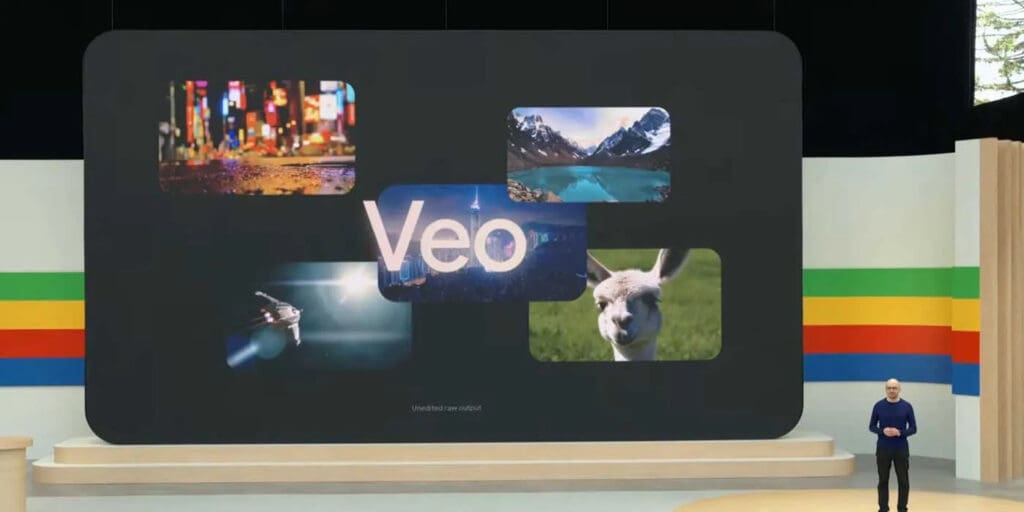
Capabilities:
Generates realistic video clips up to 30 seconds
Synchronized audio tracks, including ambient sound and dialogue
Scene transitions and camera-angle simulation
Highlights:
Voice cloning feature lets you add custom narration
Music-style transfer applies mood-fitting background scores
Implications:
Content creators can produce polished videos without cameras or studios.
Advertisers can A/B test multiple ad variants instantly.

What it does: Combines the strengths of Veo, Imagen, and Gemini into a single interface.
Key features:
Text-to-scene creation: Describe a scene, and Flow generates it end-to-end.
Smart cuts and edits: AI suggests best shot sequences.
Collaborative mode: Teams can edit simultaneously in real time.
Who it’s for: Professional editors, marketing teams, educators—anyone needing rapid video production.

New “AI” tab: Live within Google Search, powered by the Gemini AI assistant.
Capabilities:
Follow-up questions without rewriting context.
Summarized insights from multiple web pages.
Actionable suggestions (e.g., booking flights, drafting emails).
Availability:
U.S. beta users now; global rollout by end of 2025.
Developer API coming in Q4 for custom search integrations.
Tier breakdown:
AI Pro at $30/month: Priority access to Gemini chat, Imagen 4 credits, early Veo 3 trials.
AI Ultra at $250/month: Unlimited generation, enterprise SLAs, dedicated support.
Why upgrade?
Higher quotas for image/video generation
Faster response times
Exclusive features like Beam enterprise connectors.
7. Project Astra: Vision-Based AI Assistant

Core idea: Let your camera feed be an input channel for AI.
Features:
Object recognition: Identify products, landmarks, plants, etc.
Contextual tasks: “Order me another cup of coffee” after seeing your mug.
Real-world dialogue: Ask about items in view, from “What’s the nutritional info?” to “How old is that building?”
Developer hooks:
AR overlays
Custom actions tied to recognized objects

Supported languages (launch): English ↔ Spanish
How it works:
Speaker’s audio is transcribed, translated, then synthesized in the listener’s language—all under 500 ms.
Benefits:
Global teams can meet without language barriers.
Education: Bilingual classrooms become seamless.
Future languages: German, French, Japanese by Q1 2026.
9. Gemini in Chrome: Your AI Co-Pilot Browser

Integration: A new Gemini button in the Chrome toolbar for Pro/Ultra subscribers.
Capabilities:
Automated form filling and data extraction
Contextual insights on any webpage (e.g., stock performance in news articles)
Voice commands to navigate, search, or summarize
Security: Runs in a sandbox to keep browsing data private.
10. Search Live on Mobile: AI Meets Your Camera
What it is: The mobile counterpart to AI Mode, fusing live camera input with Gemini.
Use cases:
Text translation in signage or menus
Product lookup by scanning barcodes
Interactive learning: Point at a plant to get care tips
Screen sharing: Now you can show your mobile display to Gemini for step-by-step assistance.

Enhanced AI model analyzes your past conversations to craft replies that sound like you.
Features:
Tone matching (formal, casual, enthusiastic)
Suggested follow-up questions
Calendar integration for meeting proposals
12. Virtual Try-On: AI-Driven Fashion Preview
How it works:
Upload a full-body photo
Choose an item in Google Shopping and click “Try On”
AI simulates fabric drape, stretch, and fit on your body
Benefits for shoppers:
Reduces returns due to poor fit
Increases confidence in online purchases
Merchant integration: Via Shopping API, retailers can enable Try-On with minimal setup.

Features demoed:
Live memory recall: Glasses remind you where you left your keys.
On-the-fly translation displayed as subtitles in your field of view.
Partner integrations with Samsung, Warby Parker, Gentle Monster for design and optical enhancements.
Developer news:
XR SDK preview available now
ARCore extensions for spatial mapping
What This Means for You
Google’s I/O 2025 announcements mark a decisive shift towards an AI-first world. Whether you’re a developer building the next generation of immersive apps, a business seeking to streamline operations with AI, or an end-user eager for more intuitive experiences, these tools open up new possibilities:
Seamless interactions across devices and formats
Reduced friction in daily tasks—from shopping to translation
Enhanced creativity with video and image generation
Expanded accessibility through real-time translation and personalized assistance
Stay tuned as these features roll out over the coming months. If you’re a developer, explore the respective APIs and SDKs on the Google Cloud and Android developer portals to start integrating AI into your own projects today.
You Might Also Like;
Follow us on TWITTER (X) and be instantly informed about the latest developments…
Copy URL
Follow Us


