


I spend a lot of time monitoring my daily health metrics. Between logging my sleep cycles, counting every macro to optimize my muscle mass, and tracking my calorie burn after a heavy lifting session, my phone is essentially a digital dashboard of my body. But up until now, consumer wearables have only given us half the picture. Sure, they can track our heart rate and blood oxygen, but they can’t tell us what’s actually happening in our bloodstream.
That might be about to change.
While digging through the latest research published in Nature, I came across a fascinating new prototype developed by researchers at the University of California. They have engineered a smart ring that doesn’t just track biophysics—it tracks biochemical markers directly from the sweat on your finger.
Here is why I think this device could completely redefine how we manage our health.
How It Works: No Heavy Workout Required
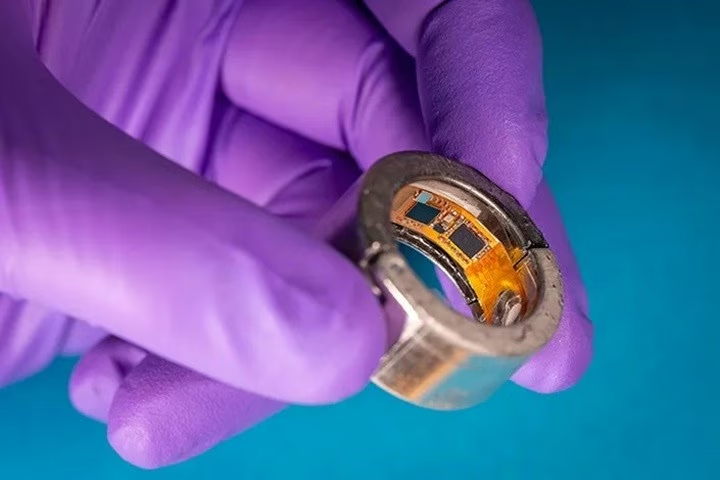
When I first read “sweat analysis,” I immediately pictured having to run on a treadmill for 45 minutes just to produce enough sweat for a reading. Surprisingly, that is not the case at all.
The researchers developed a specialized osmotic hydrogel that rests against the skin. Instead of waiting for you to physically exert yourself, this gel creates a natural pressure differential that painlessly and continuously draws micro-amounts of sweat directly from your finger.
Once the sweat is collected, miniaturized electrochemical sensors inside the ring analyze it and beam the data straight to a smartphone app. It seamlessly tracks several critical markers in real-time, including:
Glucose levelsKetonesLactateVitamin CUric acid and Alcohol
As someone who meticulously tracks nutritional intake for fitness, the idea of having passive, real-time data on my lactate and ketone levels without dealing with blood tests is absolutely mind-blowing.
A Massive Breakthrough for Diabetes Management
While fitness enthusiasts will undoubtedly love this, the true life-changing potential lies in medical management.
Professor Joseph Wang, a key researcher on the team, pointed out that having simultaneous access to both glucose and ketone levels could drastically improve how Type 1 diabetics manage their insulin doses. In their initial testing, the ring’s glucose readings closely matched the accuracy of commercial continuous glucose monitors (CGMs) currently on the market, while the ketone readings mirrored standard blood-prick tests.
Imagine stripping away the invasive needles and bulky arm patches, replacing them with a sleek, 3D-printed polymer ring. It’s a massive leap forward for accessibility and comfort.
The Catch: Battery Life and Commercialization
As much as I want to pre-order one of these right now, there are a few hurdles the team still needs to overcome.
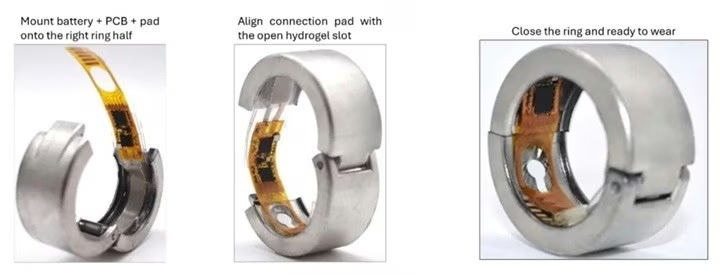
Inside this tiny ring is a remarkably complex electronic circuit board powered by a flexible, rechargeable zinc-silver oxide battery. Currently, it only holds a charge for about 12 hours. When you compare that to commercial smart rings like the Oura or Galaxy Ring, which can last for over a week, it is clear the power efficiency needs a major upgrade.
Furthermore, Tamoghna Saha, one of the study’s authors, confirmed that they don’t have immediate plans to commercialize it just yet. The ring still needs to go through rigorous, large-scale clinical trials before it can hit the consumer market.
Final Thoughts
We are witnessing the transition from superficial fitness tracking to deep, molecular-level health monitoring. The wearable tech industry has been stuck on heart rates and step counters for a decade, and this sweat-analyzing prototype finally cracks the door open to real-time biochemical data.
I’m genuinely excited to see where this goes, but it does raise an interesting question about how much data we want to collect about ourselves.
If a fully polished version of this ring was released tomorrow, would you wear it to constantly monitor your biochemicals, or do you prefer not to know every single thing happening inside your body? Let’s talk about it in the comments!


