


If you only recognize Jordan Peele from “Key & Peele” (the sketch comedy series that put him and Keegan-Michael Key on the map), I’ve got excellent news for you. Peele is also one of the most brilliant horror directors not just of his generation but in cinematic history … and he’s got some pretty cool thoughts about what he finds particularly scary.
Let’s back up. Peele, who was born and raised in New York City by a single mother, got his start on “Mad TV” alongside Key before the pair launched their beloved Comedy Central sketch show, which ran from 2012 to 2015. After a voice appearance in “The Emoji Movie” convinced Peele to step behind the camera (no, seriously), he moved away from acting and made his directorial debut, “Get Out,” which hit theaters in 2017.
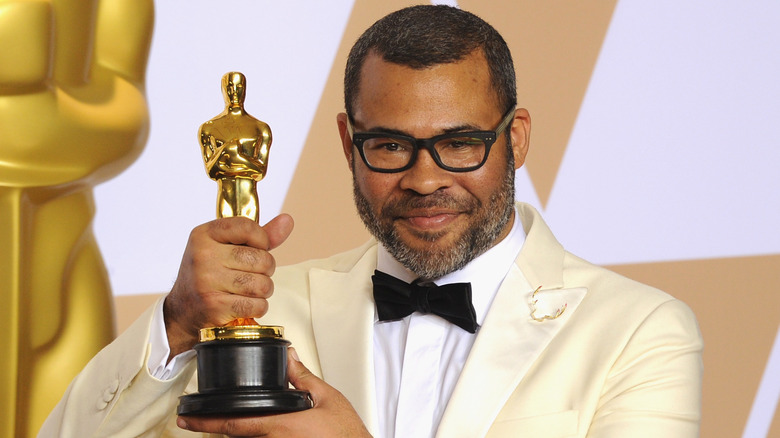
To call “Get Out” a hit is an understatement. Not only did the movie make a small fortune at the box office, but it received near-universal critical acclaim as well, earning Academy Award nods in multiple categories (including Best Picture and Best Actor for Daniel Kaluuya) and winning Peele his first-ever Oscar for his original screenplay. It’s since become one of the most influential horror movies in the canon, with multiple college courses focusing on the way that the film tackles thorny race relations in the U.S. after, among other factors, the election of Barack Obama to the presidency in 2008.
You can’t pigeonhole Peele, but he does have one constant running through his work: the ways that humans are more frightening than any monster. Through his “social thrillers,” Peele explains the decisions and deals we make living in society and how they can bring about ruin in a myriad of heightened, horrifying ways.
Quote of the Day by Jordan Peele
Static Media
Answering a question from The New York Times about what he thinks is the scariest thing in the world, Jordan Peele replied:
“Human beings. What people can do in conjunction with other people is exponentially worse than what they can do alone. Society is the scariest monster.”‘
Said in early 2017 as “Get Out” hit theaters, Peele’s quote speaks to a running theme throughout his three movies so far: “Get Out,” 2019’s “Us,” and 2022’s “Nope.” (Peele also likes to give all of his films names that are hilariously hard to feed into search engines.) In all of these movies, collectives essentially agree to commit evil acts, whether they’re doing so for self-serving reasons or in ways that they argue will be for the greater good … and in all of these movies, these acts have inexplicable, far-reaching, and deeply sinister consequences that leave the audience fully shaken.
Deeper Meaning of Jordan Peele’s Quote—The Horror Within
Universal Pictures
Remember how I said you can’t pigeonhole Jordan Peele? I meant it. While the social message of “Get Out” is pretty straightforward to parse (in that the commodification and objectification of Black bodies can lead to something as sinister as white people straight-up stealing said bodies for their own gain), “Us” and “Nope” are both slightly more opaque. Again, in “Get Out,” Daniel Kaluuya’s Chris goes upstate for the weekend with his girlfriend Rose Armitage (Allison Williams) and her parents Missy and Dean (Catherine Keener and Bradley Whitford), only to learn that they’re attempting to use his body for a transplant.
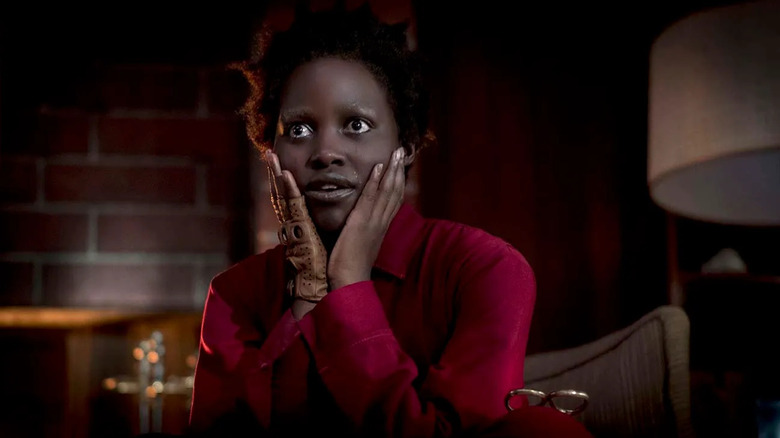
While “Us” does feel ever-so-slightly more muddled in its messaging, this film, which stars Lupita Nyong’o, Winston Duke, Elisabeth Moss, and Tim Heidecker as four people who suddenly discover that their violent doppelgängers are emerging from underground bunkers to kill them, is quite layered. If you really consider the film as a whole, you can see how Peele is pointing to the stratification of modern societies across the globe, in which some people live freely on the Earth while others are subjugated; it’s also a treatise on the limits of scientific experiments in that the doubles, known as the Tethered, were created and then completely abandoned.
In “Nope,” a treatise on exploitation, siblings Otis Jr. and Emerald Haywood (Kaluuya and Keke Palmer) are determined to capture what they think is a UFO on camera to sell the footage for money, a story set against the backdrop of child star Ricky “Jupe” Park (Steven Yeun) capitalizing off of that alien, learning nothing whatsoever from a savage chimpanzee attack on the set of the show that once made him a star. Peele’s right. The monsters are just us, every time.
More Quotes from Jordan Peele
Albert L. Ortega/Getty Images
“The difference between comedy and horror is the music.”
“The best comedy and horror feel like they take place in reality. You have a rule or two you are bending or heightening, but the world around it is real. I felt like everything I learned in comedy I could apply to this movie.”
“[Comedy and horror] are not genres that can end with just silence, you know? If it works, then something we don’t entirely understand happens to us, you know, in the scream or the shudder or the laugh. So, it’s that visceral pop.”
“Making a movie is basically like chasing the impossible, trying to bottle something that doesn’t exist.”
“When you have a theater full of people who come from different backgrounds, and you can get everyone to laugh together at the same time, or get scared at the same time, that’s a shared experience. So, moving forward, when you’re finally getting into what the movie is really about, everyone’s starting from the same place. That’s one of the transformative powers of storytelling.”
“A really good horror movie has, like, three good scares these days. I started off with 20. The first thing I did was make a list of my favorite types of scares in movies, and I said, ‘If I can get 20, I’ll have a classic.'”
“Attention can be a violent thing, and our addiction to spectacle can have negative consequences. I think sometimes if we give the wrong spectacle too much attention, it can give it too much power. If we are obsessed with the wrong spectacle, it can distract us from what’s really going on.”


