


Microsoft Build 2026 keynote Tuesday was a good one— and just like every year there is an avalanche news. I have done what I usually do: I put the hat on, read through the announcements, checked more details on those that mattered, and picked the news that will actually change how we work together and co-create with AI. This is not the full list – but should be useful if you are in a hurry and don’t want to read through all Microsoft blogs and posts. As cool as the project Solara and Windows 11 development focused features are, I am skipping those in this post.
Let me take you through ones I selected in.
Microsoft Scout — the first AutopilotOpenClaw Companion comes to WindowsMicrosoft IQ and Work IQ — the context layer underneath everythingSeven new Microsoft AI modelsFoundry Hosted Agents — containers for the agent eraGitHub Copilot app and the “fleet”The essential extras I would not skipAnd from the Message Center & Roadmap this weekSo what does this all mean?Read more
Microsoft Scout — the first Autopilot
This is the one I have been waiting for. Microsoft introduced a whole new category of agents called Autopilots — always-on agents that work autonomously, carry their own identity, and act on your behalf. The difference from the assistants we are used to is the follow-through. Most systems still stop at answering the question. An Autopilot stays active in the background, understands how work gets done across your apps, and takes action without needing to be prompted each time.
Microsoft Scout is the first Autopilot. It is integrated across the Microsoft 365 apps you already live in — it connects to Teams, Outlook, OneDrive, and SharePoint, and to the data that powers your day: chats, email, calendar, contacts. You talk to it in Teams, and you extend its reach through a desktop app out to your browser, your local resources, and Model Context Protocol (MCP) servers.
What does it actually do? It reduces the coordination tax that builds up through the day. It can proactively schedule meetings across time zones, flag the important ones, and generate your prep materials — while keeping you in the loop. It spots upcoming deliverables and automatically blocks calendar time so you stay on track. It even flags risks like stalled decisions before they become blockers.
Two things make this enterprise-ready and not just a demo. First, it is built on OpenClaw open-source technology and powered by Work IQ, so it learns how you work over time. Second — and this is the part that matters for IT — every agent runs under its own governed Entra identity, not a shared service account. Credentials are scoped to the task, redacted from logs, and Microsoft Purview sensitivity labels and data loss prevention are enforced in the moment, before anything is sent. Microsoft Scout does not bypass your controls — it operates inside them.
Right now Scout is an experimental release through Frontier. Getting access is not trivial — you need Frontier enrollment, Intune policy configuration, and an opt-in attestation. On top of that, the licensing bar is specific: you need a Microsoft 365 Copilot license and a GitHub Copilot Business or Enterprise license. A GitHub Copilot Pro license is not enough — which, speaking from experience, is exactly why I cannot test it yet myself. .
OpenClaw Companion comes to Windows
Scout is the Microsoft 365 face of OpenClaw — but OpenClaw is also coming to Windows directly, and this is where it gets interesting for builders. The new OpenClaw Companion experience lets a local agent operate on your own machine, and it runs inside Microsoft Execution Containers (MXC) — OS-enforced sandboxing so an autonomous agent can do real work on your device without you handing it the keys to everything.
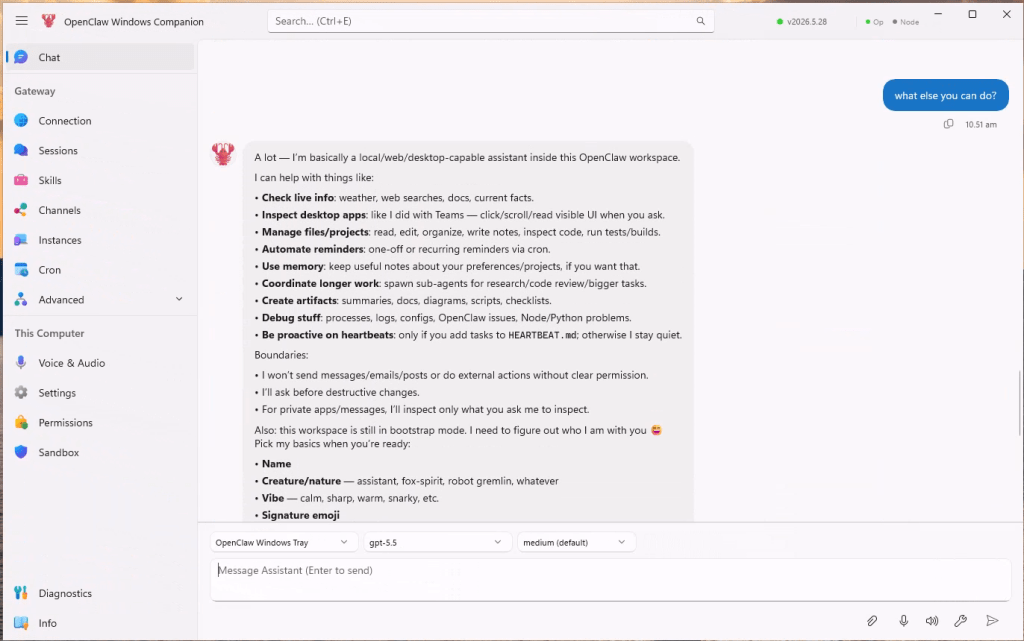
I have already had fun testing this one out — and that is the best part: unlike Scout, you can actually get your hands on it. After setting it up, I had it to claw ( 🤠) through my ( demo ) Microsoft Teams – automatically clicking through messages in the Desktop application.
Microsoft IQ and Work IQ — the context layer underneath everything
Here is the thing I keep telling customers: the model is not the moat — the context is. Microsoft IQ is the new context layer, generally available this month across GitHub Copilot, Microsoft Foundry, and Copilot Studio. It is the connective tissue that grounds agents in your work data, your business data, and the live web.
It comes in flavours. Work IQ carries your work forward — it is what makes Scout get more useful over time. Fabric IQ grounds agents in your business data. Foundry IQ is the knowledge plane for developers — serverless retrieval that replaces hand-built RAG (Retrieval-Augmented Generation) pipelines with one SLA-backed endpoint across Work IQ, Fabric IQ, Azure SQL, File Search, and MCP sources.
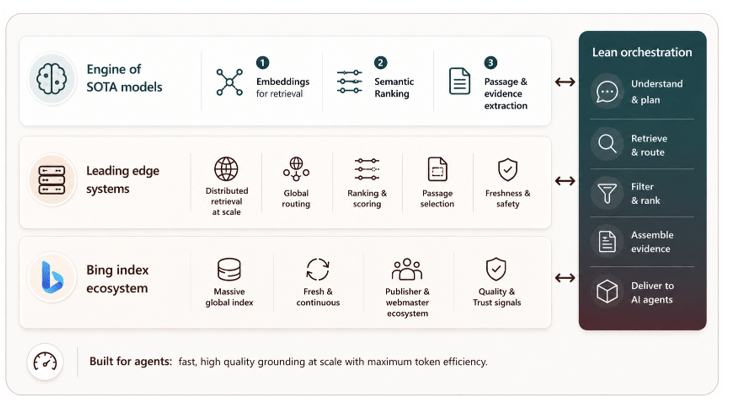
For us in the Microsoft 365 world, the headline is the Work IQ APIs. They reach general availability on 16 June 2026, and they are billed with Copilot Credits — with admin cost controls so you are not flying blind on consumption. This is the foundation that lets every agent — first-party or yours — understand the way your people actually work.
Seven new Microsoft AI models
Microsoft’s own MAI model family expanded in a big way at Build. The one that turned my head is MAI-Thinking-1 — a 35-billion-active-parameter reasoning model with a 256K context window. Microsoft says independent raters prefer it to Sonnet 4.6 and that it matches Opus 4.6 on coding benchmarks like SWE-bench Pro. It is open now on Foundry in private preview.
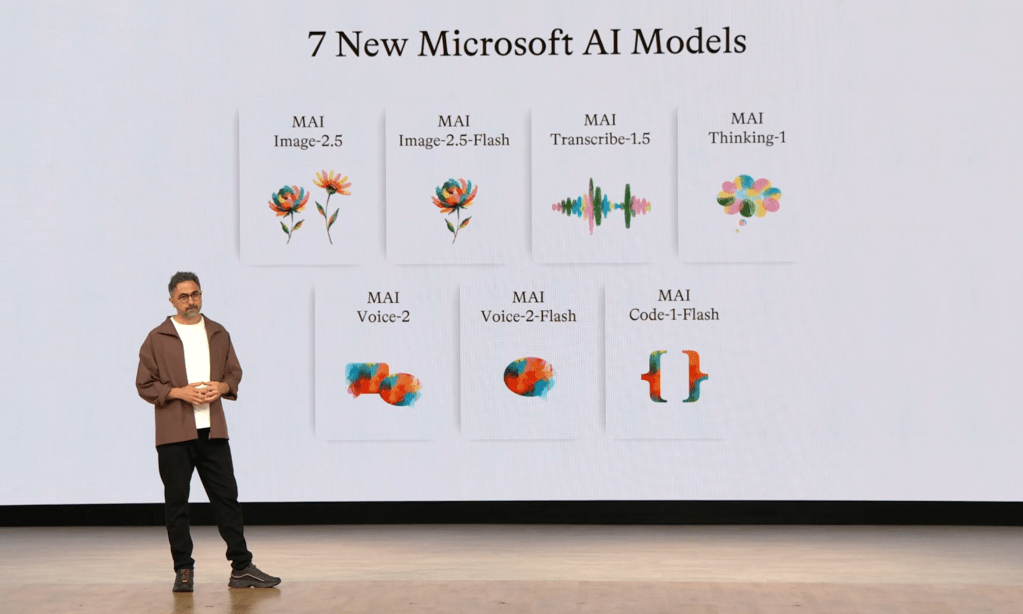
Alongside it, four MAI models entered public preview covering the core generative modalities — MAI-Image-2.5 (image generation with image-to-image editing), MAI-Transcribe-2 (speech-to-text with speaker diarization), and MAI-Voice-2 (multilingual text-to-speech with voice cloning). You can try them straight from the Foundry catalog. The message is clear: Microsoft is building its own frontier-class models, not just hosting everyone else’s.
Foundry Hosted Agents — containers for the agent era
If you build agents, this is the announcement to read twice. Hosted Agents in the Foundry Agent Service give you a managed runtime for production agents, expected to reach general availability by early July 2026. Every session runs in its own sandbox with dedicated compute, memory, and durable filesystem access. It is framework-agnostic — agents built with the Microsoft Agent Framework, the GitHub Copilot SDK, or LangGraph deploy without rewrites.
The line that stuck with me: hosted agents are the primitive for agents the way containers were for cloud-native apps. They now support long-running autonomous agents like OpenClaw with durable state, and Routines (public preview) let any agent run on a timer — overnight issue triage, daily reporting, you name it. Pair that with Memory in public preview — procedural, user, and session memory, with early results showing +7–14% absolute task success gains — and you have agents that genuinely learn the job across runs.
GitHub Copilot app and the “fleet”
This is the developer experience I have wanted for a long time. The new GitHub Copilot app (preview) is a dedicated desktop command center for agent-native development. Instead of treating AI as a side panel, you orchestrate multiple agent sessions in parallel — one fixing bugs, one building a feature, one working through pull request feedback — all in a single “My Work” dashboard. This is the “fleet” idea — you stop babysitting one agent and start directing a fleet of them.
A few more that did not make the highlight reel but absolutely should be on the radar:
Agent 365 extends Microsoft’s agent governance — identity, security, and management — to local and third-party agents, so the whole fleet is governable, not just the Microsoft-built ones.
Majorana 2 — Microsoft’s next step in topological quantum computing, on the path to a scalable quantum machine by 2029 — and Microsoft Discovery reaching general availability for scientific research. The long game is very much alive.
Surface RTX Spark Dev Box and a wave of Windows developer updates (Coreutils and WSL container support) — Microsoft is rebuilding Windows itself as a serious AI development platform.
Fireworks AI on Foundry is now GA, and Frontier Tuning is being quoted at more than 10x more cost-efficient than GPT-5.5 for tasks like producing technical documentation.
And from the Message Center & Roadmap this week
Build is the big stage, but the daily Message Center is where these things land in your tenant. A few I dug into:
Copilot: Anthropic models are coming to Copilot in Word; Copilot Notebooks can now pull references from emails and meetings; dynamic MCP tool discovery (MC1330889) lets agents find the right tools at runtime; and suggested edits are arriving in Copilot Pages.
Teams: breakout rooms scaling to 1,000 attendees; scoped SharePoint search inside Teams (MC1332816); inline search in the compose box; a new admin experience to manage built-in Teams agents; and a Teams Rooms update for PowerPoint Live (MC1332812, rolling out by 30 June).
SharePoint & OneDrive: pay-as-you-go storage overage billing (MC1330893) — worth flagging to your admins before it surprises anyone; home sites updates; and a heads-up that OneDrive mobile is dropping on-prem SharePoint Server sign-ins (MC1332814).
So what does this all mean?
Build 2026 was the year the assistant grew up into the Autopilot. Scout, Hosted Agents, the GitHub Copilot fleet, Work IQ underneath all of it — the pattern is the same everywhere: agents that hold your priorities, act with their own governed identity, and keep work moving even when your attention is elsewhere. That is not a feature. That is a new way of working. At Sulava MEA, we already have autopilot agents building inside our Frontier Firm Live.
Have curiosity and courage to try something that was announced at Build. Enroll in Frontier and try Scout, or spin up a Hosted Agent, or point the GitHub Copilot app at a repo and let a fleet loose. Or just install Intelligent Terminal and test it out! You will learn more in one afternoon of co-creating than in a week of reading blog posts.
Stay tuned — I will be going deeper on these in the future posts. Hat optional. Curiosity required.
Read more

Published by
I work, blog and speak about Future Work : AI, Microsoft 365, Copilot, Loop, Azure, and other services & platforms in the cloud connecting digital and physical and people together.
I have 30 years of experience in IT business on multiple industries, domains, and roles.
View all posts by Vesa Nopanen


