


I spend a lot of time analyzing the rapid advancements in humanoid robotics. Usually, I’m marveling at how well Earth-bound machines like the 1X Neo or the Unitree G1 are learning to balance, walk, and mimic human anatomy. But while diving into the latest project from Orbit Robotics—an ETH Zurich spinoff—I had a sudden, mind-bending realization: Everything we consider “standard” in humanoid robotics is completely useless in space.
Orbit Robotics just unveiled Helios, a four-armed robot explicitly designed for microgravity. And honestly, looking at how they engineered this machine completely shifted my perspective on how we are going to build our future in orbit. Let me break down why Helios isn’t just another robot, but a fundamental redesign of space labor.
Why Legs Are a Liability in Zero-G
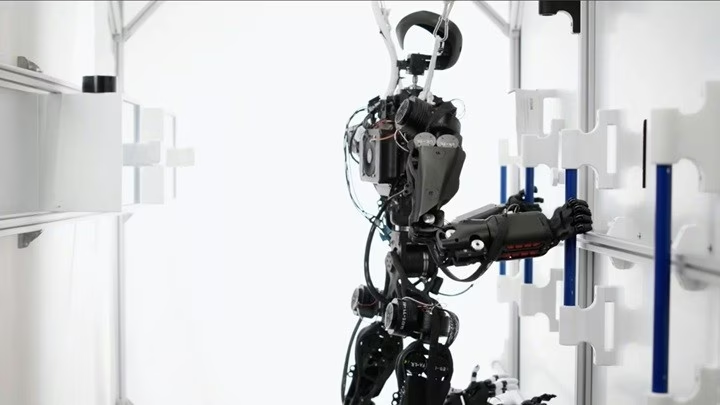
Here on Earth, we are obsessed with building two-legged robots. Gravity anchors them, and legs make sense for navigating human environments. But space doesn’t care about our gravity-bound logic.
In a microgravity environment like the International Space Station (ISS), the laws of physics become your biggest enemy. If a standard humanoid robot floating in zero-G tries to turn a wrench, Newton’s third law kicks in: the robot won’t turn the bolt; the bolt will turn the robot, sending it spinning across the module.
The engineers at Orbit Robotics realized that copying human anatomy was holding them back. So, they scrapped the legs entirely.
The Helios Approach: Anchor and Operate
Instead of trying to force an Earth-design into space, Helios was built from the ground up for its environment. Here is how it fundamentally changes the game:
Four Arms, Zero Legs: Helios uses two of its arms exclusively to anchor itself firmly to the spacecraft’s interior surfaces.Total Stability: With its base completely locked in, the remaining two arms are free to perform highly delicate operations—like unloading cargo, managing equipment, or handling tools—without any risk of drifting away.Built for Tight Spaces: Space stations are incredibly cramped. A compact, four-armed torso can maneuver and stabilize in corners where a sprawling, two-legged robot would just get in the way.
An Engineering Masterclass: Tendon-Driven Precision
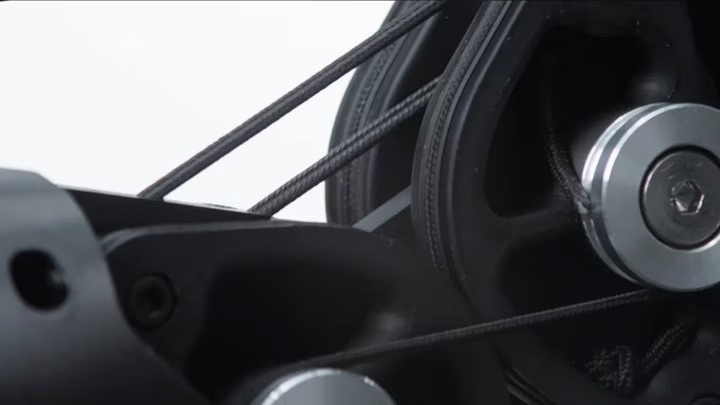
When I was reading through the mechanical specs of Helios, one detail really stood out to me: the tendon-driven movement system.
In traditional robots, you usually find heavy motors placed right at the joints (elbows and wrists). But in space, swinging a heavy robotic arm creates massive inertia. A quick movement could literally shake the entire robot loose from its anchor points.
To solve this, Orbit Robotics pulled a brilliant move:
They relocated the heavy motors away from the extremities and packed them close to the robot’s “shoulders.”They transfer the physical force down to the hands using a complex system of cables and pulleys (like tendons in a human hand).They utilized a special rolling-contact mechanism in the elbows to absorb tiny vibrations that would normally throw off delicate microgravity work.
It’s essentially the robotic equivalent of a high-precision puppeteer.
The $140,000/Hour Math Problem
Beyond the cool factor, there is a very grounded economic reason Helios exists.
Did you know that routine maintenance takes up roughly 35% of an astronaut’s time on the ISS? When you calculate the logistics, an astronaut’s time in orbit is valued at around $140,000 per hour. Having brilliant scientists and highly trained pilots spending a third of their day moving boxes, checking cables, and cleaning filters is an astronomical waste of resources.
By taking over these repetitive logistical nightmares, Helios allows human crews to get back to what they do best: groundbreaking scientific research and preparing for deeper space missions to Mars and beyond.
I really think we are witnessing the birth of a new era. We are finally stopping the attempt to make robots look like humans, and instead making them look like exactly what space demands.
What do you think, Spartans? Are you comfortable with four-armed autonomous machines taking over the critical maintenance of our space stations, or do you think human hands will always be necessary up there? Let me know your thoughts in the comments!


