Home Blog Page 981

10 Impressive Charles and Ray Eames Designs To Know About

10 Impressive Charles and Ray Eames Designs To Know About


Few names carry as much weight in American design history as Charles and Ray Eames. This husband-and-wife powerhouse transformed 20th-century furniture design through their innovative use of materials, manufacturing processes, and their uncanny ability to blend functionality with artistic vision.

Their work not only defined mid-century modern aesthetics but continues to influence contemporary furniture creation today. Here are the most revolutionary Charles and Ray Eames designs that changed the landscape of American interiors forever.

1. The Eames Lounge Chair and Ottoman (1956)

Perhaps their most recognizable creation, the Eames Lounge Chair and Ottoman represents the perfect marriage of luxury and functionality. Inspired by the traditional English club chair, Charles and Ray wanted to create something with “the warm receptive look of a well-used first baseman’s mitt.”

The molded plywood shell and supple leather upholstery created an instantly iconic silhouette that has been in continuous production for over 65 years. Initially intended as a high-end gift item, it has become the quintessential symbol of sophisticated comfort and remains one of Herman Miller’s most coveted pieces.

@Herman Miller – Eames lounge chair and ottoman

2. Molded Plywood Chair (1946)

Nicknamed the “chair of the century” by TIME magazine, the Molded Plywood Chair emerged from experiments the Eameses conducted in their apartment. They used a homemade “Kazam! machine” to bend plywood with heat and pressure.

The revolutionary three-dimensionally curved plywood shell conformed to the human body, providing comfort with or without upholstery. This breakthrough in materials processing wasn’t just aesthetically pleasing – it represented a new approach to furniture manufacturing that valued efficiency of materials and ergonomics.

Eames molded plywood chairEames molded plywood chair
@Herman Miller – Eames molded plywood chair

3. Eames Storage Unit (ESU) (1950)

The modular ESU system brought modernist principles to storage furniture. With its exposed structural elements and mix of materials (colored panels, perforated metal, and wood), the units embodied the Eameses’ philosophy that “details are not the details. They make the design.”

These versatile pieces could be configured in countless ways, anticipating today’s modular storage solutions while bringing a pop of color and industrial aesthetics to mid-century homes.

Eames storage unitsEames storage units
@Herman Miller – Eames storage units

4. Eames Plastic Chair (1950)

Originally designed for the Museum of Modern Art’s “Low-Cost Furniture Design” competition, the Plastic Chair was the first mass-produced plastic chair in America. The seamless, single-shell seat became an instant American classic and pioneered new manufacturing techniques for fiberglass-reinforced plastic.

Available with a variety of bases including a rocking version and in countless colors, these versatile chairs could be found everywhere from stylish homes to schools and offices, democratizing good design for the masses.

Eames plastic chair with rocker baseEames plastic chair with rocker base
@Herman Miller – Eames plastic chair with rocker base

5. Wire Chair (1951)

With their Wire Chair, the Eameses explored yet another material – welded steel wire – creating a sculptural, transparent chair that played with notions of visual mass and negative space. The “Eiffel Tower” base (named for its resemblance to the famous landmark) added architectural stability to what appeared to be an almost weightless design.

This piece demonstrated their principle that “design details are not just details – they make the product,” showing how industrial materials could be transformed into something elegant and timeless.

@Herman Miller – Eames wire chair

6. Eames House (Case Study House #8) (1949)

The Eames House in Pacific Palisades, California, represented their holistic approach to design. Built from prefabricated materials and standard industrial parts as part of Arts & Architecture magazine’s Case Study House Program, their personal home embodied their design philosophy: maximum effect from minimal means.

The colorful panels, open interior spaces, and integration with nature influenced countless architects and interior designers in creating modern living spaces.

Eames House, Pacific Palisades - best Charles and Ray Eames designsEames House, Pacific Palisades - best Charles and Ray Eames designs
@Wikimedia – Eames House, Pacific Palisades

7. Aluminum Group Chairs (1958)

Originally designed for the Irwin Miller House in Columbus, Indiana, the Aluminum Group represented a departure from the Eames’ shell chair designs. The innovative “floating” seat suspended between aluminum side ribs created a taut, clean profile that worked equally well in office settings and homes.

The chairs’ versatility and comfort have made them enduring classics that still feel contemporary more than six decades later.

Eames Aluminium Group ChairEames Aluminium Group Chair
@Herman Miller – Eames Aluminium Group Chair

8. La Chaise (1948)

Though not put into production until decades after its design, La Chaise embodies the playful, sculptural approach that made the Eameses so distinctive. Created for a MoMA competition, this organically shaped lounge piece was inspired by Gaston Lachaise’s “Floating Figure” sculpture.

Its flowing, sensuous form anticipated future directions in furniture design and demonstrated the couple’s artistic vision beyond purely functional concerns. Finally produced by Vitra in 1991, it stands as a testament to their ahead-of-their-time design sensibilities.

La Chaise La Chaise
@Vitra – La Chaise

9. Eames Hang-It-All (1953)

Even in designing something as simple as a coat rack, Charles and Ray brought innovation and playfulness. The Hang-It-All, with its colorful wooden balls on a wire frame, took a utilitarian object and turned it into a joyful statement piece.

Originally designed for children, its whimsical yet functional design demonstrates how the Eameses approached every project, from grand architectural commissions to humble household items, with the same meticulous attention to detail and sense of delight.

Eames Hang It AllEames Hang It All
@Herman Miller – Eames Hang It All

10. Tandem Sling Seating (1962)

Transforming public space seating, the Eames Tandem Sling system can still be found in airports worldwide. The design brilliantly addressed the unique challenges of public seating: durability, comfort for people of different sizes, ease of maintenance, and the ability to configure spaces efficiently.

Its elegant aluminum frame and replaceable vinyl slings created a system that was both practical and visually cohesive with modern architecture.

Eames Tandem SeatingEames Tandem Seating
@Vitra – Eames Tandem Seating

Final Thoughts on Charles and Ray Eames Designs

The Eameses believed that “design is a method of action,” not just an aesthetic choice. Their furniture pieces weren’t simply beautiful objects; they represented new ways of thinking about materials, manufacturing, and the relationship between form and function.

Decades later, their designs remain as fresh and relevant as ever – a testament to their revolutionary vision that forever changed how Americans think about design in everyday life.

Read next:

Sharing is caring!


Source link

Unlocking Web3’s Potential Through IP: Insights From Mythical Games And NFL Rivals

Unlocking Web3’s Potential Through IP: Insights From Mythical Games And NFL Rivals


In Brief

Mythical Games illustrates how integrating licensed IP into Web3 gaming—through strategic partnerships, accessible design, and engaging gameplay—can bridge the gap between blockchain innovation and mainstream entertainment.

How Intellectual Property Can Elevate Web3: Lessons From Mythical Games And NFL Rivals

Game technology studio Mythical Games shared insights into its journey integrating licensed intellectual property (IP) into Web3 gaming, emphasizing how strategic collaborations with major brands—such as the NFL, and soon FIFA—can help Web3 titles reach a broader, more mainstream audience when combined with strong gameplay mechanics and a refined user experience 

As Mythical Games explains, at first glance, the concepts of IP and Web3 might appear at odds. IP involves permissioned access—brands and likenesses must be formally licensed, whether it’s a sports team or a nostalgic video game. In contrast, Web3 champions a permissionless ethos, allowing developers and users to build and interact freely without gatekeeping. 

However, in the context of Web3 gaming, Mythical Games argues that these two seemingly opposing forces can, in fact, complement each other. When executed well, permissionless technology and licensed IP can enhance one another, resulting in dynamic and engaging experiences. Their case studies show that when beloved characters and recognizable brands are thoughtfully adapted into blockchain-based environments, the outcome can be both entertaining and accessible. While not every integration hits the mark, successful examples demonstrate how IP, when aligned with solid design and a seamless experience, can elevate Web3 games beyond niche appeal.

When Intellectual Property Is Effectively Leveraged

Deciding whether to incorporate major IP into a Web3 game is a complex strategic consideration. On the positive side, recognizable IP can provide immediate visibility and fan engagement, helping a game distinguish itself in a saturated market. However, the process of licensing well-known IP is both costly and high-stakes, and securing the rights involves more than simply choosing a popular character or brand—the IP owner must also trust the proposed vision and how their brand will be represented.

When the partnership is well-matched, though, the outcome can be highly effective. Within the still relatively young Web3 gaming landscape, the collaboration between Mythical Games and the NFL stands out as a benchmark. The studio managed to secure the rights to one of the world’s most recognized sports leagues, including team and player branding—a feat previously only accomplished by a major player like EA Sports. 

The result, NFL Rivals, has been widely recognized as a breakthrough success, credited with helping push Web3 gaming closer to mainstream awareness. It allows players to collect and trade non-fungible tokens (NFTs) representing real-life athletes, utilizing officially licensed assets from both the NFL and the NFL Players Association. With millions of downloads, the game is not just seen as a strong example of IP integration—it has become a standard against which other IP-based Web3 games are often measured.

Looking ahead, Mythical Games appears to have built on this momentum in securing IP rights from FIFA for its upcoming title, FIFA Rivals. Given the studio’s proven track record and FIFA’s prior exploration of Web3 technologies through NFT campaigns tied to major tournaments, this collaboration may have been more straightforward. Still, it reflects the growing confidence among global IP holders in the potential of blockchain-based gaming.

IP Should Enhance The Game—Not Define It

When handled with care and designed thoughtfully, incorporating recognizable intellectual property into a Web3 game can significantly enhance its appeal and potentially broaden its reach. However, consistent success in this area isn’t guaranteed, and statistically, not every release will be a major hit.

A common issue with many early Web3 games—particularly those built around the short-lived “Play-to-Earn” model—was that their main draw was the underlying blockchain technology, rather than the gameplay itself. If the licensed IP is the only standout aspect of a game, it suggests the overall experience may be lacking. Securing rights to a popular franchise isn’t a guaranteed formula for success; rather, it’s the starting point for building a game that resonates with both fans of the property and Web3 enthusiasts, assuming the final product is executed with care.

The early phases of NFTs and metaverse experiments have demonstrated that mainstream brands are willing to explore emerging digital ecosystems, particularly when they gain attention through celebrity endorsements and cultural momentum. The surge in visibility brought by figures like NBA players and musicians adopting Bored Ape NFTs spurred interest from large entertainment companies eager to join the trend.

The Sandbox platform has become a notable space for IP experimentation, drawing interest from entities such as Warner Music Group, Ubisoft, and Snoop Dogg. Snoop’s presence includes his music and likeness through a dedicated virtual zone, while Ubisoft has introduced its Rabbids characters as interactive NFTs. Lionsgate, too, has explored this realm with virtual content based on John Wick and Saw. These collaborations represent cautious steps, as brands test the viability of Web3 engagement before committing to larger ventures.

Web3 gaming remains in a relatively early phase, and developers are still learning what strategies yield results—especially regarding the integration of licensed IP. Mythical Games appears to have found a successful formula with NFL Rivals, possibly because it capitalized on a globally recognized sport with a deeply invested fanbase that appreciates elements like statistics and team dynamics. The ability to own players as NFTs seems particularly suited to this audience.

Crucially, the success of NFL Rivals wasn’t only about the IP; the game itself was thoughtfully designed. By streamlining the Web3 experience—such as removing the need for a cryptocurrency wallet at the outset—and prioritizing mobile accessibility, the game appealed to a broader range of players. In contrast, other IP-driven titles have seen varied outcomes. For instance, Gala Games’ The Walking Dead: Empires has its charms as a multiplayer online game, but hasn’t yet seen overwhelming traction among fans of the show.

Ultimately, while IP can enhance visibility and interest, it’s not a guarantee of quality or success. But when a beloved brand—whether from sports, gaming, film, or television—is paired with a smooth user experience and fresh, engaging content, the chances of making a meaningful impact are improved. Studios that genuinely understand and respect the cultural value of the IP they work with are best positioned to succeed. Mythical has demonstrated this with NFL Rivals, and looks poised to do it again with FIFA Rivals. It likely won’t be the last success story of this kind in Web3.

Disclaimer

In line with the Trust Project guidelines, please note that the information provided on this page is not intended to be and should not be interpreted as legal, tax, investment, financial, or any other form of advice. It is important to only invest what you can afford to lose and to seek independent financial advice if you have any doubts. For further information, we suggest referring to the terms and conditions as well as the help and support pages provided by the issuer or advertiser. MetaversePost is committed to accurate, unbiased reporting, but market conditions are subject to change without notice.

About The Author


Alisa, a dedicated journalist at the MPost, specializes in cryptocurrency, zero-knowledge proofs, investments, and the expansive realm of Web3. With a keen eye for emerging trends and technologies, she delivers comprehensive coverage to inform and engage readers in the ever-evolving landscape of digital finance.

More articles


Alisa Davidson


Alisa, a dedicated journalist at the MPost, specializes in cryptocurrency, zero-knowledge proofs, investments, and the expansive realm of Web3. With a keen eye for emerging trends and technologies, she delivers comprehensive coverage to inform and engage readers in the ever-evolving landscape of digital finance.


More articles


Source link

The Elders Scrolls 4: Oblivion Remaster has been announced… and it’s out today! | TheSixthAxis

0
The Elders Scrolls 4: Oblivion Remaster has been announced… and it’s out today! | TheSixthAxis


The long-rumoured The Elder Scrolls 4: Oblivion remaster has been revealed, and it’s out today for PS5, Xbox Series X|S and PC, and with ‘day one’ tiers of Xbox Game Pass as well.

So, what do we think of that? While Skyrim is easily the biggest and best-selling entry in the long-running RPG franchise, there’s plenty out there that prefer Morrowind or Oblivion, making these earlier games ripe for a graphical remake treatment. With Oblivion now in a much more modern game engine, the hazy bloom effects that were so popular in the early days of the Xbox 360 have been dropped, and there’s more realistic and nuanced lighting being cast across significantly more detailed, revamped environments.

The game is now graphically running on Unreal Engine 5, but the original Oblivion engine is still running in the background to tell it what to do. According to Virtuos, every single asset has been remade by hand, and there’s a new lighting engine. The gameplay has also been tweaked, there’s updated UI and UX, and a new levelling system inspired by both Oblivion and Skyrim. They have also reworked the third person view and made it more modern, as well as adding sprinting, something that was not present in the original game.  Each race has had their audio re-recorded so they all sound different but the mini-games such as lock picking remain unchanged, albeit with new graphics.

Both standard and deluxe editions of the game are available, with The Elder Scrolls IV: Oblivion Deluxe Edition including bonuses like extra weapons and horse armour – a nod to the infamous horse armour DLC for the original game. The standard game includes all the expansions including The Shivering Isles.

The game has been developed in collaboration with Bethesda Dallas and Bethesda Rockville working alongside Virtuos. Unfortunately for Bethesda, this external partner was the source of last week’s blowout leak. Sure, this had been reported on ever since it was mentioned in unredacted court documents a few years ago, but last week saw enterprising internet denizens find a batch of Oblivion remake images uploaded publicly to the backend of the Virtuos website. They include screenshots of the game, comparison shots between this version of the game and the 2006 original, and more, and were hastily copied across to other hosting platforms before Virtuos could pull their site offline.

So, who are Virtuos? Originally founded in Shanghai and now headquartered in Singapore, Virtuos is a huge company with thousands of employees and teams dotted around the world. The company has often provided co-development support on major projects, such as art for the Horizon series and co-dev for the upcoming Metal Gear Solid Delta: Snake Eater, as well as a variety of ports and remaster projects big and small. Oblivion could be their most notable work yet, and with the game so close to being in our hands, it will be fascinating to see how it has come together and how closely it sticks to or diverges from the original.

Source: YouTube


Source link

All the theories on what Joel did and why he can’t return to Australia in EastEnders

    0
    All the theories on what Joel did and why he can’t return to Australia in EastEnders


    Walford newcomer Joel Marshall made his EastEnders debut this month, arriving in Walford as the residents gathered for Martin Fowler’s funeral. Arriving along with Vicki and her new boyfriend – his dad – Joel has made himself at home in recent weeks.

    Well, so he should – as the soap revealed, Joel can’t return to Australia anytime soon, due to something he did back home. Dad Ross has borrowed the money for Sharon so he can pay off Joel’s debts, but was left under no uncertain terms that neither he nor Joel were welcome back in Australia.

    But what did Joel do? Writing a series of social media posts, fans of the soap have shared their theories on Joel’s past… from sexual assault to online gaming.

    Joel arrived in Walford earlier this month (Credit: BBC)

    EastEnders fans wonder if Joel assaulted a girl

    The most pervasive theory is that Joel assaulted someone – most likely a girl – and Ross is paying their parents in exchange for silence.

    “Why am I getting the sneaking suspicion that it’s sex related? Maybe he assaulted someone’s daughter,” wrote one fan.

    “I reckon he did something to a girl back in Australia (whether consented or not idk) and his dad was having to pay his family off to prevent them from going to the police,” another suggested.

    “I think he did something with a girl his age and they’re paying the family off so they don’t get the police involved,” a third agreed. Is Joel a predator?

    Joel has his arm around Lily on EastEnders

    Viewers are concerned about Joel’s behaviour around girls (Credit: BBC)

    Beat someone up

    Another theory suggests that Joel might have attacked another youth. This, in turn, would leave Ross financially responsible for Joel’s actions.

    “Am not sure if they have free health care in Australia but I’m think he beat a kid up so severely that Joel has to pay this kids medical bills,” wrote one fan on X.

    As his treatment of Barney last night (Monday, April 21) showed, Joel’s got a nasty streak – but how nasty can he get? And will he take Tommy down the same dark path?

    Ross talks to Vicki on EastEnders

    Ross and Vicki are paying for what Ross did (Credit: BBC)

    Racked up a credit card debt

    Elsewhere, others wondered if there might be a more innocent explanation for Joel’s debt. Perhaps he racked up a small fortune in online gaming, for example.

    “He spent 50,000 dollars on Minecraft or Fortnite or whatever game Eastenders makes up,” wrote one viewer.

    “Probably bought loads of FIFA points on Xbox and got a credit card debt,” said another.

    “I think it may be online sports gambling run by some bad guy, and Joel can’t pay the £25k,” a third theorised.

    Joel hanging around Walford on EastEnders

    What’s Joel’s story? (Credit: BBC)

    Is Joel involved with drugs on EastEnders?

    And, with drug use currently rife amid Walford’s teenagers, some viewers wondered whether Joel might be hiding a secret of his own, where drugs are concerned.

    “I think it’s drugs related,” wrote one fan, of Joel’s mystery past.

    In trouble with someone scary

    With many presuming Joel’s guilt, another explanation is that Joel might have gotten on the wrong side of someone terrible.

    “Maybe he stole and wrecked a car that belonged to some heavy,” predicted one fan.

    “I think Joel has gotten on the wrong side of some dodgy people. Like he’s messed up a drug deal/criminal activity and cost them money along those lines and Ross has had to bail Joel out,” said another.

    What has Joel done?

    Read more: EastEnders fans debate prospect of Phil and Linda romance: ‘Make it stop’

    5 exciting EastEnders spoilers for next week (April 21-25)

    EastEnders usually airs Monday to Thursday at 7:30pm on BBC One

    What do you think of this story? For all the latest soap spoilers, news and chat come and join us at Soap Daily now!


    Source link

    Farming Airdrops on Binance Alpha: Low Risk, High Reward

    0
    Farming Airdrops on Binance Alpha: Low Risk, High Reward


    In the past, airdrops were often distributed randomly or through traditional task-based campaigns. Today, however, more and more Web3 projects are prioritizing direct airdrops to Binance Alpha users – a platform developed by Binance to highlight early-stage tokens.

    In this article, we’ll guide you on how to use Binance Alpha effectively, from discovering new projects and spotting airdrop signals to optimizing your position for maximum reward potential.

    Benefit of Using Binance Alpha

    From Zora (ZORA) and Wayfinder (PROMPT) to Balance (EPT), recent reward campaigns share one common thread: they focus on users who engaged early on Alpha, even if it was just a small transaction or simply following a project at the right time. Binance Alpha is quickly becoming a “private launchpad” for airdrops, where users gain early access to promising tokens and receive rewards without needing to commit significant capital.

    Furthermore, Binance has started using interaction data from Binance Alpha as one of the criteria to determine eligibility for token sales via Binance Wallet. This means projects now prioritize Alpha users for rewards and give them early investment access before public listings.

    Another key advantage lies in its seamless integration within the broader Binance ecosystem. Users don’t need to leave the platform or manage external wallets to interact with new tokens. Every step – from discovery to execution, happens directly through their existing Binance account. This convenience, paired with Binance’s trusted infrastructure, greatly reduces the friction that often discourages users from participating in early-stage Web3 opportunities.

    As Binance continues to roll out more reward programs, token sales, and ecosystem benefits tied to user behavior, being an early and active Alpha participant could translate into longer-term privileges, from priority access to exclusive campaigns, to enhanced yield opportunities or even governance roles in partner protocols.

    binance-logo-2

    How to Use Binance Alpha

    Register a Binance Account

    Before accessing Binance Alpha, users must create a Binance account and complete KYC verification.

    Here’s how to register:

    Go to the official Binance website or download the Binance mobile app.

    If you’re new to the platform, click on “Register” at the top right corner of the homepage (or follow the prompts on the app).

    binance-logo-2binance-logo-2

    Enter a valid email address or phone number, set a strong password, and complete the identity verification process (KYC). KYC usually involves uploading a government-issued ID, such as a passport or driver’s license. Once approved, your account will be activated.

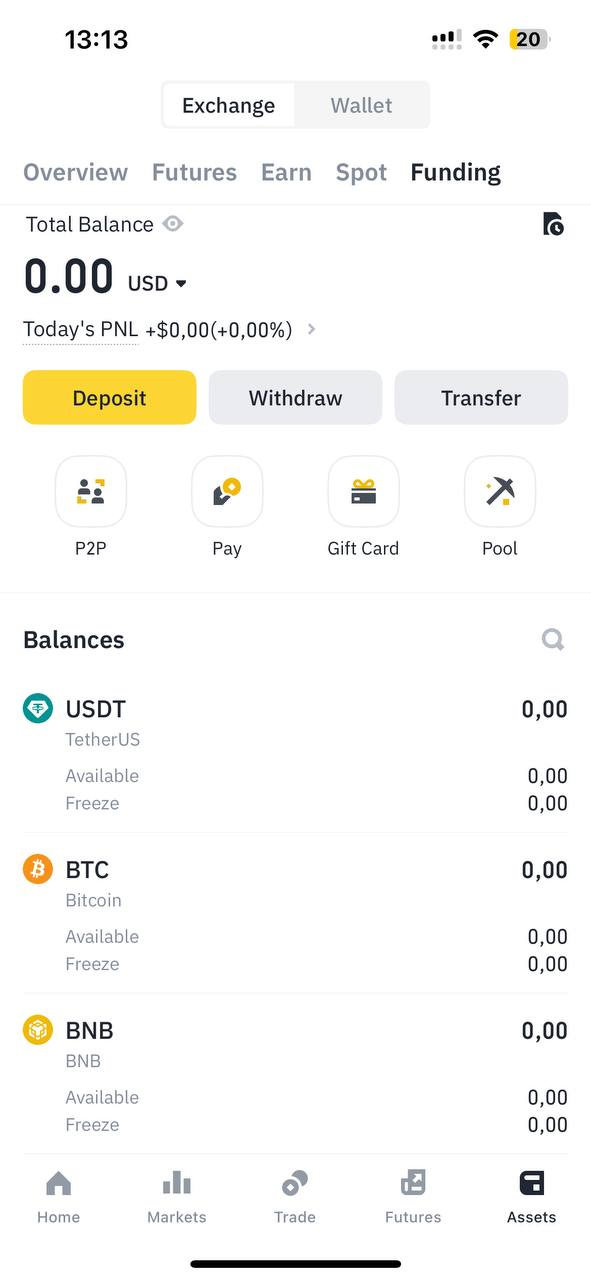
    After your account is set up, log in to Binance and navigate to your dashboard. From there, go to the “Wallet” section and select “P2P” to deposit USDT or USDC into your account.

    Register a Binance AccountRegister a Binance Account

    How to Use Binance Alpha

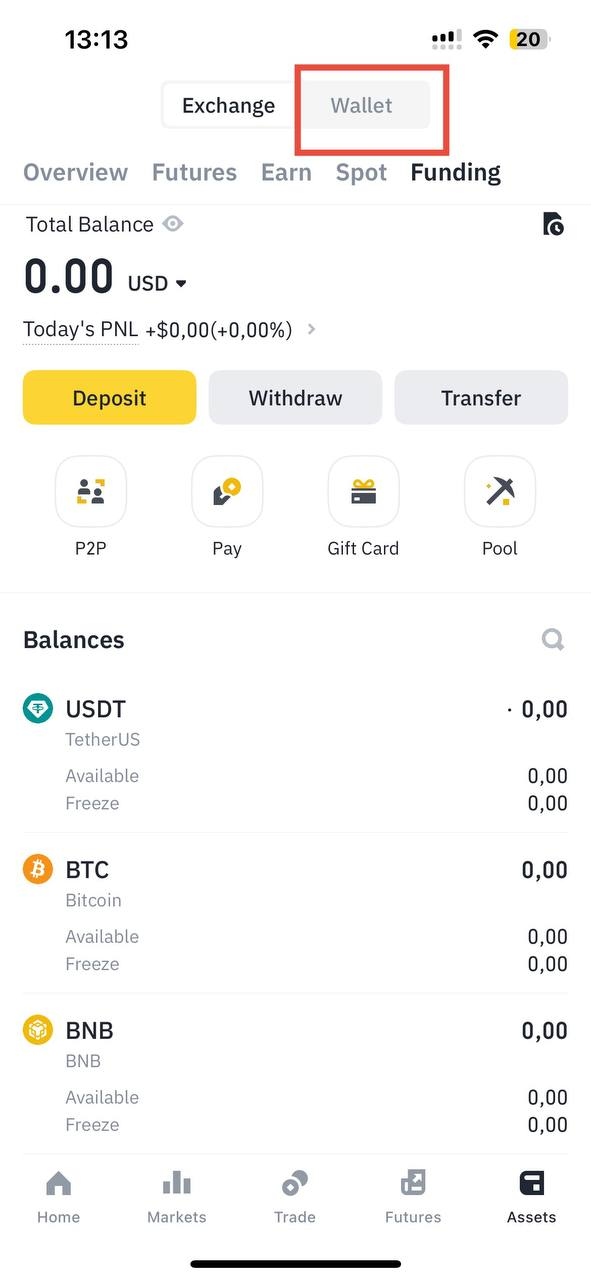
    In the Wallet section of the Binance app, tap the “Wallet” text at the top of the screen to switch to Web3 Wallet mode.

    How to Use Binance AlphaHow to Use Binance Alpha

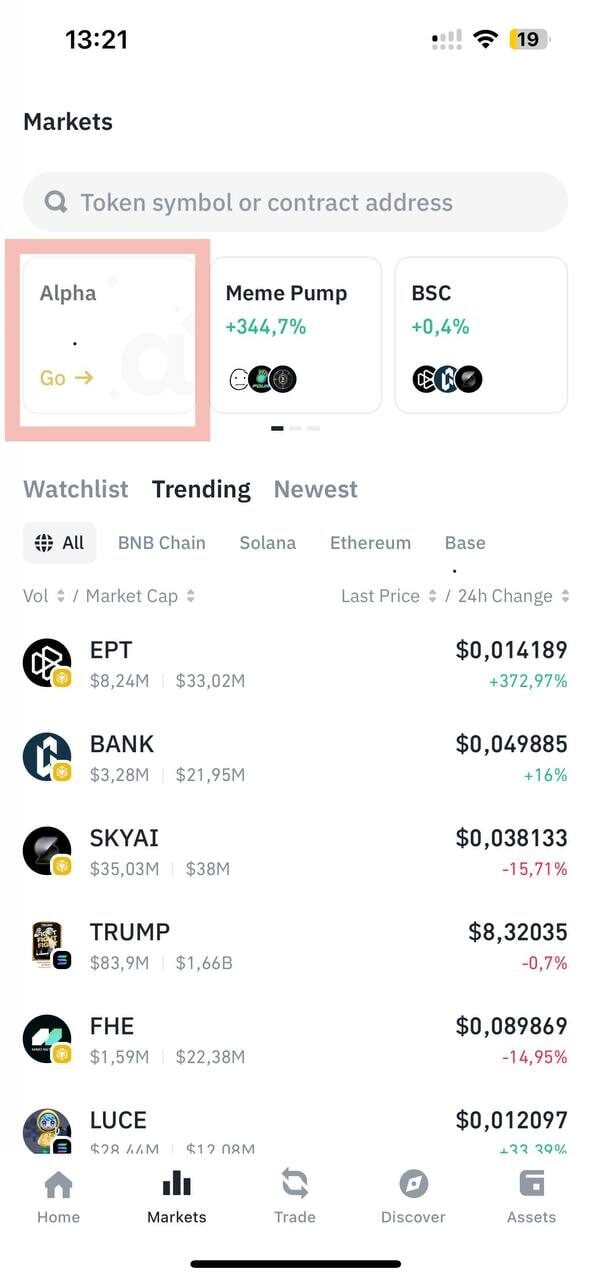
    From the Binance Wallet interface, tap on the Alpha tab to access the list of featured projects on Binance Alpha.

    Although you’re using a Web3 wallet, when purchasing tokens on Binance Alpha, you can pay directly using assets stored on Binance CEX, with no network (gas) fees required.

    How to Use Binance AlphaHow to Use Binance Alpha

    Tips for Using Binance Alpha to Maximize Airdrop Rewards

    To maximize your chances of receiving airdrops via Binance Alpha, it’s important to understand that most reward programs are based on user activity over a set time frame, typically ranging from 1 to 4 weeks before the snapshot is taken.

    For instance, users who received airdrops from projects like ZORA or Balance had completed transactions within just 7 to 30 days of the distribution.

    Therefore, to optimize your eligibility, it’s crucial to monitor new Alpha batches closely and make your first transaction within 7–10 days of launch.

    One clear advantage is that you don’t need to commit a large capital. Often, a transaction as small as $10 to $50 through Binance Alpha is enough to qualify, depending on the project.

    Low cost, limited risk, and high potential reward make this strategy attractive, especially as some tokens have significantly appreciated in price post-listing. This is why many users now adopt a “routine interaction strategy” rather than waiting for an official airdrop announcement.

    Over the long term, Binance Alpha is becoming an unofficial “credit score” within the Binance ecosystem. Users who interact consistently across batches and hold onto their tokens after airdrops are more likely to secure spots on token sale whitelists, earn Launchpool rewards, and qualify for future conditional airdrops via Binance Wallet.

    Conclusion

    Binance Alpha is rapidly changing how projects distribute early-stage token rewards and airdrops in the Web3 ecosystem.

    By engaging with Alpha projects consistently and early, users not only gain exposure to promising tokens but also position themselves for potential airdrops and future token sales. With minimal capital required and increasing integration into Binance’s broader reward systems, Binance Alpha represents one of the most accessible and strategic ways to build on-chain reputation and maximize returns in the evolving crypto landscape.

    Read more: Is Binance Safe? Binance Exchange Security Measures Tested


    Source link

    BitGo Launches Institutional Support for sBTC, Expanding Bitcoin DeFi Accessibility | Web3Wire

    0
    BitGo Launches Institutional Support for sBTC, Expanding Bitcoin DeFi Accessibility | Web3Wire


    New York, New York, April 22nd, 2025, Chainwire

    BitGo, the leading digital asset custody and infrastructure provider, today announced its integration of sBTC, Stacks’ 1:1 fully programmable Bitcoin-backed asset. This integration unlocks new opportunities for institutional participation in decentralized finance (DeFi). As a longtime supporter of Stacks, BitGo was an early Signer on the Stacks network and one of the first supporters of the Nakamoto upgrade and sBTC.

    BitGo clients can now make their Bitcoin productive by leveraging sBTC, a 1:1 Bitcoin-backed asset that unlocks Bitcoin’s functionality without compromising its security. With sBTC withdrawal functionality set to launch at the end of the month, institutions will be able to convert between BTC and sBTC across Bitcoin’s layer 1 and layer 2 networks, opening the door to new applications, tokenized assets, and DeFi products.

    As the primary backer and creator of WBTC in 2018, BitGo pioneered the concept of wrapped Bitcoin. Building on this, BitGo now recognizes the evolving landscape and the demand for more decentralized solutions. sBTC represents the next step in this evolution; with no centralized custodian, sBTC is maintained by smart contracts and an open, decentralized network of validators. Additionally, all sBTC transactions settle on Bitcoin with 100% Bitcoin finality, benefiting from the full security budget of Bitcoin itself.

    BitGo’s support for sBTC comes as Bitcoin enters an era of utility and access. Over the past year, Bitcoin’s total value locked (TVL) in DeFi applications has grown more than 20x, reaching $6.5 billion by the end of 2024. Analysts project this figure to surpass $10–20 billion in 2025 as institutional adoption accelerates.

    “BitGo has long believed in the promise of Bitcoin beyond just being a store of value. Our integration of sBTC marks a pivotal step toward expanding Bitcoin’s utility in decentralized finance,” said Abishek Singh, Product Manager at BitGo. “As one of the earliest supporters of Stacks and the Nakamoto release, we’re excited to bring institutional-grade custody and infrastructure to the Stacks ecosystem. With over $3 trillion in processed transactions and more than $48 billion in staked assets, BitGo is uniquely positioned to help institutions tap into this new era of Bitcoin utility. sBTC opens the door to programmable, decentralized financial products without compromising Bitcoin’s core principles—and we’re just getting started.”

    Stacks is the leading Bitcoin layer 2, designed to scale Bitcoin and bring smart contract capabilities to its ecosystem. As one of the most tenured projects in the space, Stacks has consistently driven innovation by enabling decentralized applications, non-fungible tokens (NFTs), and DeFi solutions—all secured by Bitcoin.

    The integration comes amid growing demand for sBTC from major players such as Jump Crypto, UTXO Management, SNZ, and Asymmetric Research. These institutions are among the leaders who are driving adoption by leveraging sBTC’s functionality to participate in DeFi.

    Notably, BitGo’s support also includes integration with SIP-010, the fungible token standard for Stacks. This opens up the possibility of support for other Stacks assets in the future, further expanding the ecosystem’s potential and interoperability within the Stacks network.

    ###

    About BitGo 

    BitGo is the leading infrastructure provider of digital asset solutions, delivering custody, wallets, staking, trading, financing, and settlement services from regulated cold storage. Since our founding in 2013, we have focused on enabling our clients to securely navigate the digital asset space. With a large global presence through multiple regulated entities, BitGo serves thousands of institutions, including many of the industry’s top brands, exchanges, and platforms, as well as millions of retail investors worldwide. As the operational backbone of the digital economy, BitGo handles a significant portion of Bitcoin network transactions and is the largest independent digital asset custodian and staking provider in the world. For more information, visit www.bitgo.com.

    About Stacks

    Stacks, the leading Bitcoin L2, enables smart contracts and decentralized applications to use Bitcoin as a secure base layer. The Nakamoto release, activated on October 29, 2024, brought faster speeds and transactions that are as irreversible as Bitcoin’s once confirmed. This set the stage for sBTC, a programmable Bitcoin asset, which launched on December 17, 2024. Stacks is the current leading Bitcoin L2 by developer traction and market cap and is helping unlock Bitcoin and its $1T in passive capital as a fully programmable, productive asset. The Stacks (STX) token, used as gas on the L2, was the first to undergo an SEC-qualified sale in the United States. The project is explicitly decentralized with the mainnet launch in 2021. In the Stacks ecosystem, there are currently 30+ contributing entities, including a non-profit Stacks Foundation, a developer tooling company, Hiro, Xverse, Trust Machines, Mechanism, Bitcoin L2 Labs, ALEX, Bitcoin Frontier Fund, and more.

    Contact

    Market Acrosspr@marketacross.com

    About Web3Wire Web3Wire – Information, news, press releases, events and research articles about Web3, Metaverse, Blockchain, Artificial Intelligence, Cryptocurrencies, Decentralized Finance, NFTs and Gaming. Visit Web3Wire for Web3 News and Events, Block3Wire for the latest Blockchain news and Meta3Wire to stay updated with Metaverse News.


    Source link

    Solana Launches Game Pass, Offering Early Access and Rewards

    0
    Solana Launches Game Pass, Offering Early Access and Rewards


    The Solana blockchain has introduced the Solana Game Pass, a free NFT aimed at encouraging engagement with new and existing games on the network.

    Available to mint through Magic Eden, the Game Pass provides holders with early access to selected titles and the chance to earn crypto-based prizes by completing specific tasks.

    More than 30,000 Game Pass NFTs have already been minted, and the offering will remain open for the duration of the campaign. Solana has indicated that the Game Pass programme will continue beyond the initial season, with additional features planned for future updates.

    Solana Launches Game Pass, Offering Early Access and Game Rewards Source: Solana Gaming

    What is the Solana Game Pass?

    The Solana Game Pass is a free NFT that grants early access to selected games developed on Solana available to mint through Magic Eden.

    Holders of the Game Pass can participate in activities through partner platform GAM3S.GG, where they can complete quests to earn raffle entries. The prize pool for the Season 0 campaign exceeds $10,000 in value and includes Solana ($SOL) tokens, NFTs, and other digital assets.

    The current campaign is set to last four weeks, after which prizes will be distributed to winners. Solana has also suggested that future seasons may include more in-game activities and a player progression system to reward continued participation.

    Solana Launches Game Pass, Offering Early Access and Game Rewards
    Solana Launches Game Pass, Offering Early Access and Game Rewards Source: Solana Gaming

    What games are accessible with the Game Pass?

    The Solana Game Pass provides early access to a range of titles, including several popular web3 games.

    Participating games in Season 0 include Star Atlas, Nyan Heroes, Stepn, Aurory, DeFi Dungeons, MixMob: Racer 1, BR1: Infinite and many more.

    These games represent a variety of genres, from strategy and racing to fitness and competitive shooting, reflecting the diversity of Solana’s growing gaming ecosystem.


    Source link

    Why Everyday Users Prefer Mobile-Ready Solutions | NFT News Today

    Why Everyday Users Prefer Mobile-Ready Solutions | NFT News Today


    As smartphones get more powerful and widely available, there’s a growing sense that virtual currencies can fit neatly into daily life. In the US alone, roughly 28% of adults (about 65 million people) now own cryptocurrencies, almost twice the figure from late 2021. 

    There’s also a strong indication of future buying interest, with 14% of non-owners intending to get crypto in 2025 and 67% of current holders saying they’re planning to purchase more. What’s driving these numbers? Simplicity, trust, and the fact that the average person wants to manage money on the go, without a bunch of complicated steps.

    Incentives That Fuel Mobile Crypto Adoption

    Everyday users are finding it easier than ever to engage with crypto—right from their phones. Mobile-friendly platforms offer fast signups, instant rewards, and smooth payment experiences that make digital currencies feel intuitive, not intimidating. Having the best crypto wallet on Google Play means no waiting on slow bank transfers—just fast, flexible access to your funds, whenever you need them. These small conveniences can be powerful. They spark curiosity, lower barriers, and often lead to wider adoption.

    Once users experience how easy it is to send, receive, or store crypto on mobile, they’re more likely to explore deeper uses—like holding tokens, exploring decentralized apps, or even learning about blockchain tech. What starts as a quick interaction on a phone can turn into long-term engagement, all because the first step feels seamless.

    Riding the Wave of Mobile Expansion

    Smartphone usage is expanding at a rapid pace across the globe, with an estimated 4.88 billion smartphone users globally as of 2024, mobile devices are outpacing traditional banking infrastructure in terms of reach. This widespread mobile reach isn’t just limited to social media and streaming apps. People are using their phones for payments, savings, investing, and yes—buying and selling crypto. Around 35 million individuals now use mobile wallets to handle virtual assets, fueled by easy-to-use apps that strip away most of the technical jargon.

    While convenience is the clear advantage, there’s another factor at play: well-designed mobile apps can make complicated concepts feel far less intimidating. Whether it’s a quick push notification or a simple tap to confirm a transaction, the streamlined experience appeals to newcomers who might otherwise be hesitant to get involved. Plus, this mobile push is not just a Western trend; it’s happening in regions where traditional banking services have limited reach, opening new doors for people who need modern financial tools.

    It’s interesting to compare this movement to how fintech apps like peer-to-peer payment services grabbed the spotlight a few years ago. Suddenly, everyday transactions—like splitting a dinner bill—didn’t involve writing a check or fiddling with credit cards. Instead, phones made it quick and stress-free. Crypto is starting to mirror that same pattern, especially as it shifts into the mainstream and toward a decentralized future.

    Simplifying Barriers Through User-Friendly Tools

    For newcomers, diving into crypto can be confusing. Industry terms like “blockchain,” “seed phrase,” and “tokens” can scare away about 43% of individuals who say they avoid crypto due to a lack of understanding. It’s a big hurdle, but mobile interfaces have helped chip away at that problem by making the process feel less chaotic. Instead of juggling obscure processes, many of today’s crypto apps boil everything down to a few straightforward taps.

    Take a Web3 wallet as an example. Not too long ago, setting one up was an intimidating project. Now, these wallets come with step-by-step prompts, optional biometric logins, and clear instructions on how to receive and send coins. The same goes for newcomers exploring Crypto sales beyond the usual tokens. Complexity still exists under the surface, but the user doesn’t have to stare at confusing code anymore. Apps today focus on giving real value without overloading the user with a barrage of technical talk.

    Cost, speed, and reliability also matter to everyday folks. No one likes fees that swallow a significant chunk of their transaction or networks that bog down during peak hours. Mobile wallets often integrate with multiple blockchains or side chains, automatically choosing a path that’s relatively swift and easy on the wallet. This practicality goes hand in hand with the sense of empowerment that mobile solutions provide.

    What the Data Tells Us About Growing Demand

    There’s no shortage of data when it comes to crypto and fintech trends. The global fintech market is expected to be around $305 billion by 2025, which represents strong year-over-year expansion, propelled by smartphone penetration. Meanwhile, mobile payments are projected to account for half of all e-commerce transactions in 2025. Put plainly, people are relying on their phones for financial tasks at a rate that would have seemed unthinkable a decade ago.

    According to Security.org, 14% of folks who don’t own crypto yet plan to jump in around 2025, while the majority of current holders (67%) anticipate purchasing more. It’s a massive shift that crosses generational lines. Some users might be comfortable with apps on day one, but older users also appreciate the convenience once they’re shown how straightforward it can be. This increasingly broad user base means virtual currencies aren’t just for hobbyists or tech gurus anymore.

    Connecting With the Broader Crypto Scene

    Beyond collectibles and gaming, NFTs are also carving out a space in e-commerce, especially for digital-first goods, event tickets, and loyalty programs. More brands are experimenting with NFT-based ownership to create verifiable, portable, and tradable value around everyday products. 

    Traders and collectors alike are exploring what’s happening with non-fungible tokens, or NFTs. Some folks buy them purely for fun, while others see them as a type of collectible. There are also interesting developments related to how AI is changing NFTs. Whatever your stance, the convenience of being able to manage these tokens directly from your phone is appealing, and it’s part of why crypto apps continue to gain attention.

    Conclusion

    Smartphones have taken on the role of personal finance hubs, handling everything from e-commerce to advanced crypto transactions. That all-in-one experience explains why so many people feel comfortable jumping in, even if they’re not tech experts. 

    As services keep improving and trust continues to build, there’s every reason to think that mobile-ready solutions will remain a favorite for the growing wave of crypto newcomers—and for seasoned users who appreciate a simpler way to keep track of their holdings. By focusing on accessibility and mobile integration, crypto is breaking free of its niche roots and speaking to the needs of everyday folks worldwide.


    Source link

    New Apple Intelligence Ad Released – Metaverseplanet.net

    New Apple Intelligence Ad Released – Metaverseplanet.net


    After previously pulling a series of Apple Intelligence and Siri ads, Apple has now launched a brand‑new commercial highlighting one of its current features. Although Apple postponed some of its AI‑powered Apple Intelligence capabilities, it continues to showcase its latest innovations.

    Today’s ad spot unveils the Clean Up feature in the Photos app for iPhone users. The new Apple Intelligence “Clean Up” trailer lets you remove distracting background elements—such as a mirror reflection or an accidentally captured object—with a single tap. Apple sums up the feature:

    “With Apple Intelligence, you can now use the Clean Up tool to remove unwanted objects from your photos.”

    Which devices support Apple Intelligence features?

    iPhone 16 series, iPhone 15 Pro, and iPhone 15 Pro Max

    iPad models with A17 Pro or M1 and later chips

    Mac computers with M1 and later processors

    You Might Also Like;

    Follow us on TWITTER (X) and be instantly informed about the latest developments…

    Copy URL


    Source link

    What Is the Multiverse? – Metaverseplanet.net

    What Is the Multiverse? – Metaverseplanet.net


    The Multiverse, also known as “multiple universes,” is the idea that beyond our observable universe, there may exist countless other universes—each with its own distinct properties. This concept arises in both cosmology and quantum mechanics, and it can be categorized into four main levels:

    Four Levels of the Multiverse

    What Is the Multiverse?

    Level I – Infinite Spatial RegionsIf space is large enough, regions so far apart could exhibit the same physical laws but different initial conditions, effectively forming “duplicate universes” at extreme distances.

    Level II – Bubble UniversesRooted in cosmic inflation, this model proposes that our universe and other “bubble universes” disconnected during inflation may have different physical constants, particle types, or even numbers of dimensions.

    Level III – Quantum Many‑Worlds InterpretationAccording to the Many‑Worlds view of quantum mechanics, every quantum measurement spawns branching universes for each possible outcome, meaning all potential results actually occur in parallel realities.

    Level IV – Mathematical Universe HypothesisThis abstract approach holds that every mathematically consistent structure exists as its own universe, governed by its own internal laws.

    Theoretical Evidence and Debates

    Observational LimitsTo date, there is no direct experimental proof of other universes. Analyses of the cosmic microwave background or unusual galaxy distributions can only offer indirect hints.

    Philosophical vs. ScientificSome physicists argue the multiverse belongs in philosophical thought experiments because it lacks testability, while others champion it as a valid extension of scientific inquiry that challenges our understanding of reality.

    Multiverse in Popular Culture

    Marvel Cinematic Universe (MCU) explores parallel realities and branching timelines.

    Stranger Things introduces an alternate dimension called the “Upside Down.”

    Numerous science‑fiction novels imagine alternate histories and worlds ruled by different physical laws.

    FeatureMultiverseMetaverseNatureTheoretical, cosmological parallel universesTechnology-driven virtual worlds powered by VR/ARPurposeTo explore the structure and possibilities of realityTo enable social interaction, commerce, and entertainment in digital spaceAccessibilityBeyond current technological reachAccessible today via VR headsets, high-speed internet, blockchainUser RoleObserver/theoretical researcherActive participant through avatarsDegree of RealityGrounded in physical theoryComputer-generated, fictional yet interactive

    The Multiverse is a speculative scientific concept probing the boundaries of reality.

    The Metaverse consists of immersive, interactive digital ecosystems under active development today.

    While the Multiverse theorizes “multiple realities” to deepen our grasp of existence, the Metaverse harnesses current technology to bring people together in shared virtual environments. Scientists continue searching for multiverse evidence, even as developers build and expand metaverse platforms. Both ideas stretch the limits of our imagination and point toward the future’s theoretical and practical frontiers.

    You Might Also Like;

    Follow us on TWITTER (X) and be instantly informed about the latest developments…

    Copy URL


    Source link

    Popular Posts

    My Favorites