Home Blog Page 973

Insider Tips for Choosing the Perfect Crypto Casino by BestCasinoBitcoin.com

Insider Tips for Choosing the Perfect Crypto Casino by BestCasinoBitcoin.com


In Brief

Crypto casinos are becoming more popular due to their fast transactions, improved security, and global accessibility, and choosing the right platform involves researching user feedback, licensing, security measures, customer support, and more.

Insider Tips for Choosing the Perfect Crypto Casino by BestCasinoBitcoin.com

Crypto casinos have appeared to be considerably more suitable gambling platforms for most online players than traditional casinos. This is because Blockchain technology enables players at the crypto casinos to experience fast transactions and improved security, and the games are accessible globally. 

Below, the BestCasinoBitcoin.com team is going to review some of their insider tips on how to choose the perfect crypto casino.

How to Do Your Homework

Going through the crypto casino rating, players provide details according to their encounters with the crypto casinos. 

Look into the feedback provided by players. Consider the crypto casinos with positive reviews on how they operate. Players need to be assured that the platforms prioritize giving them an outstanding gaming experience.

While choosing the perfect crypto casino, look into the crypto casinos that reputable gaming authorities like Curacao, Malta, and others have legalized. Licensed crypto casinos guarantee players a safe environment in which to conduct their gambling activities.

The security of the player’s personal and financial data is another factor to consider. Ensure that the crypto casino of your choice applies secure measures like two-factor authentication, SSL encryption, or any other security features.

Go for the crypto casinos that allow players to get access to their wallets easily, have active customer support that gives responses in no time, have mobile apps that are user-friendly and do not have complicated games.

Check out the bonuses offered by the crypto casinos. The bonuses include a welcome bonus, free spins, VIP programs, and cashback. Consider the crypto casinos that have clear terms and conditions for their bonuses.

Read through the wagering requirements and determine if the conditions are achievable. The bonuses offered in the crypto casinos are usually attractive and generous. It is, therefore, important to go through the wagering requirements, which state how many times a player is supposed to play in order to withdraw winnings. 

Consider checking out the crypto casinos that support not only Bitcoin in making deposits and withdrawals but also other cryptocurrencies.

This makes the players flexible and improves their gaming experience. Cryptocurrencies help with achieving fast withdrawals. It is also important to check the withdrawal limits and see if the casino offers low transaction costs. 

BestBitcoinCasino.com is a suitable rating platform to check and compare different casinos. It will depend whether you want a gambling platform that features a wide range of games, offers generous promotional bonuses or one that guarantees convenient customer support, these and among many other factors will influence your decision and BestBitcoinCasino.com provides the best industry tips for picking what’s right for all your gambling needs.

Insider Tips for Choosing the Perfect Crypto Casino by BestCasinoBitcoin.com

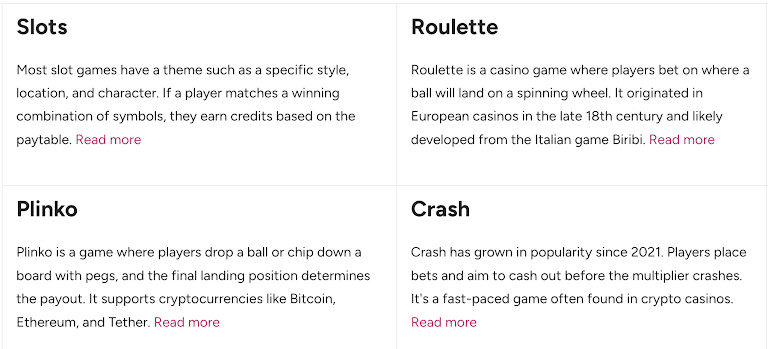
Types of crypto casino games. Image source: BestCasinoBitcoin.com

Red flags and safety Nets  

Well, one of the red flags to look into is the regulation of the crypto casino. If you have any questions about the legality of the casino, check their official website. This will clear the doubt of whether the casino’s license is valid or fake. Another red flag is when the casino has poor customer support. 

Check out if the platform has an email, phone number, or a live chat through which players can reach them. Always avoid casinos that have not displayed any means by which a player can contact them in case they need help. Consider reviewing the feedback given by players to learn about the reputation of a casino. The bad reputation of a casino is another red flag to always avoid. 

The best crypto casino guarantees players wonderful and enjoyable gaming sessions. In order to experience that, look into the casinos that offer responsible gambling tools. These tools enable a player to be able to manage their gameplay, ensuring gambling does not affect the well-being of their personal life. Avoid the crypto casinos that do not offer responsible gambling tools.

Go for the platforms that offer a wide range of high-quality crypto casino games. It is important to know if the platform offers provably fair games. Playing at crypto casinos that have a legal license from a well reputable gaming authority can guarantee the availability of provably fair games. Playing at these casinos ensures that one does not get to be manipulated. 

Slow processing times are another red flag to check out. Avoid the casinos that do not provide fast transactions. They end up giving excuses for why they can not release your funds, and sometimes, you can end up making the initial deposit twice so as to activate your account. It is advisable to always go for the casinos that offer fast transactions so that you do not have to wait forever to withdraw your funds and also to avoid scammers. 

Upcoming Innovations and Game Features

When looking for a perfect crypto casino, you will also need to check out some of the game features and innovations.

Observe if the crypto casino has transparent smart contracts. These smart contracts help to ensure that there is fairness in the betting outcome and reduce the chances of experiencing fraud. The blockchain technology used by the casinos guarantees fairness and transparency of transactions. Look into the casinos that have games that are up to date with the latest innovations.

The AI-powered personalization gets to offer risk control, evaluate your gameplay style, and personalize bonuses and game suggestions. 

Conclusion

Using the above tips as your guide, you will be able to choose the perfect crypto casino that suits your taste. Always prioritize your privacy, financial data security, and a casino that rewards your gameplay well.

If you come across any try-before-playing games, consider giving them a try. Go to BestCasinoBitcoin.com and check the best crypto casino websites, compare them, and make the right choice! This will let you know if the experience you will get matches what is advertised.  

Disclaimer

In line with the Trust Project guidelines, please note that the information provided on this page is not intended to be and should not be interpreted as legal, tax, investment, financial, or any other form of advice. It is important to only invest what you can afford to lose and to seek independent financial advice if you have any doubts. For further information, we suggest referring to the terms and conditions as well as the help and support pages provided by the issuer or advertiser. MetaversePost is committed to accurate, unbiased reporting, but market conditions are subject to change without notice.

About The Author


Gregory, a digital nomad hailing from Poland, is not only a financial analyst but also a valuable contributor to various online magazines. With a wealth of experience in the financial industry, his insights and expertise have earned him recognition in numerous publications. Utilising his spare time effectively, Gregory is currently dedicated to writing a book about cryptocurrency and blockchain.

More articles


Gregory, a digital nomad hailing from Poland, is not only a financial analyst but also a valuable contributor to various online magazines. With a wealth of experience in the financial industry, his insights and expertise have earned him recognition in numerous publications. Utilising his spare time effectively, Gregory is currently dedicated to writing a book about cryptocurrency and blockchain.


Source link

Rematch Launches on Xbox Game Pass – Metaverseplanet.net

Rematch Launches on Xbox Game Pass – Metaverseplanet.net


The highly anticipated football-themed action game Rematch is set to launch on June 19, 2025, and it’s already turning heads. Even before its official release, it has been confirmed that Rematch will be available on Xbox Game Pass on day one — a move that’s generating major buzz in the gaming world.

Unlike traditional football games, Rematch throws out classic rules like fouls and offsides. Instead, it focuses on fast-paced gameplay, where success on the field depends entirely on the player’s reflexes and real-time decision-making.

Team-Based Online Multiplayer with Constant Action

The game offers fully team-based online multiplayer modes, aiming to provide a fair and competitive experience every match. Whether you’re playing solo or joining forces with friends, Rematch ensures intense action and continuous excitement.

Each season will introduce new content, game modes, and customization features, keeping the gameplay fresh and engaging. At launch, players will be able to choose from different editions of the game, unlocking access to exclusive in-game cosmetics.

As a title that has already made waves in the gaming world before even being released, Rematch’s addition to Xbox Game Pass on June 19, 2025, is being eagerly awaited by fans around the globe.

You Might Also Like;

Follow us on TWITTER (X) and be instantly informed about the latest developments…

Copy URL


Source link

Baidu Unveils New Tech to Simplify AI Model Training – Metaverseplanet.net

Baidu Unveils New Tech to Simplify AI Model Training – Metaverseplanet.net


Chinese technology giant Baidu has announced a groundbreaking new solution designed to make training AI models much easier. The company introduced a massive chip cluster built from its self-developed third-generation P800 Kunlun chips, capable of training complex models like DeepSeek.

According to Baidu CEO Robin Li, the newly created chip cluster consists of 30,000 P800 Kunlun chips. This enormous system is powerful enough to train highly complex AI models containing hundreds of billions of parameters. Moreover, thousands of users working on smaller models will be able to access the system simultaneously to develop their own projects.

Baidu’s Chips Are Already in Use

Baidu Unveils New Tech to Simplify AI Model Training

Baidu has revealed that its newly developed chips are already being used by banks and internet companies across China. In addition to the chip announcement, Baidu introduced two new AI models: Ernie 4.5 Turbo and Ernie X1 Turbo. These models are designed for a variety of applications, including language processing and programming, and will be available to users through Baidu’s various platforms.

China’s AI Race Intensifies

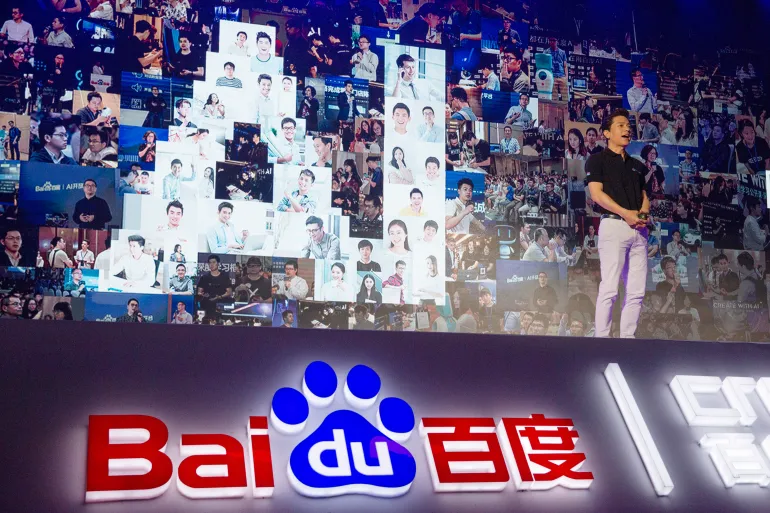
FILE PHOTO: Men interact with a Baidu AI robot near the company logo at its headquarters in Beijing, China April 23, 2021. REUTERS/Florence Lo

Recently, the artificial intelligence race in China has accelerated, with companies now focusing not just on developing AI models but also on integrating them into practical applications.

Among the standout players in this new wave is Baidu, and its latest technological leap clearly signals its ambition to strengthen its AI investments through real-world applications. This move highlights Baidu’s commitment to bridging the gap between AI development and practical deployment.

You Might Also Like;

Follow us on TWITTER (X) and be instantly informed about the latest developments…

Copy URL


Source link

Binance Will List Sign (SIGN) on HODLer Airdrops!

0
Binance Will List Sign (SIGN) on HODLer Airdrops!


Binance will list SIGN at 2025-04-28 11:00 (UTC) and open trading against BNB, FDUSD, USDC, USDT, and TRY pairs.

$SIGN Token Details

Token Name: Sign (SIGN)Total Supply: 10,000,000,000 SIGNMax Supply: 10,000,000,000 SIGNCirculating Supply: 1,200,000,000 SIGN (12.00% of total supply)Smart Contract: Ethereum, 0x868FCEd65edBF0056c4163515dD840e9f287A4c3

Learn more: How to participate IDO on Binance Wallet

$SIGN on HODLer Airdrops Details

BNB lock period to get the airdrops allocation: 2025-04-15 00:00 (UTC) to 2025-04-19 23:59 (UTC)

$SIGN will go with Seed tags. Available trading pairs: USDC, USDT, BNB, FDUSD, and TRY.

Additional details:

HODLer Airdrops Rewards: 200,000,000 SIGN (2.00% of total supply)

binance-logo-2

About Sign ($SIGN)

EthSign ($SIGN) is a pioneering on-chain infrastructure project designed to revolutionize the verification of credentials, such as certificates, academic degrees, and login information, using blockchain technology. By ensuring transparency, security, and immutability, EthSign facilitates secure token distribution and digital agreement management, streamlining processes for individuals and organizations. Its decentralized protocol simplifies the creation, signing, and verification of contracts, integrating Web3 capabilities for seamless cross-chain interactions.

About Sign ($SIGN)About Sign ($SIGN)

Source: Sign’s website

The project is driven by a skilled team of blockchain developers and supported by notable investors, including Binance Labs and other venture capital firms such as Sequoia, Hashkey, and Circle, bolstering its credibility. EthSign’s practical applications in digitizing contracts and verifying credentials have sparked significant interest, positioning it as a key player in advancing blockchain’s real-world utility and fostering a transparent, decentralized future.

Detailed information about Sign (EthSign) Project:


Source link

Humanoid Robots Race with Humans in China’s First Half Marathon – Metaverseplanet.net

Humanoid Robots Race with Humans in China’s First Half Marathon – Metaverseplanet.net


In a world first, humanoid robots raced alongside humans during a half marathon held in Beijing, the capital of China. This groundbreaking event marked a significant milestone in the intersection of sports and robotics technology.

The Beijing E-Town Half Marathon and Humanoid Robot Half Marathon brought together human athletes and robots for a 21.1-kilometer race. While thousands of runners competed on one side of the track, a parallel lane was designated for robots to run, ensuring safety and fairness.

20 Teams Participated in the Robot Marathon

Nearly 20 teams, including robotics companies, universities, research institutes, robot clubs, and tech enthusiasts, competed in the event with humanoid robots they had developed.

The race was won by a humanoid robot named “Tiangong Ultra”, created by the Beijing Humanoid Robotics Innovation Center. Tiangong Ultra completed the half marathon in 2 hours, 40 minutes, and 42 seconds.

The robot runs using an algorithm that mimics human movement, and was developed in collaboration with two state-owned enterprises, Xiaomi’s subsidiary 1810.HK, and UBTech, a private Chinese company.

Human-Like Movement vs Maximum Speed

The runner-up and third-place robots were different versions of the “N2” humanoid model, developed by Noetix Robotics. According to Noetix engineer Cui Wenhuo, one robot was programmed to imitate human gait, while the other was designed for maximum speed. Both completed the race successfully.

Cui emphasized the complexity of robot science, which includes structure, perception, and algorithms. He added that their robots were designed to be trainable for future use cases, aiming to contribute to the advancement of the robotics field.

Falling Robots and Technical Challenges

Not all robots performed well. Some struggled at the starting line, with one robot falling face-first and unable to get up for a long time. Another robot veered off course shortly after starting and crashed into a barrier, causing its handler to fall.

Throughout the race, many robots lost balance, stumbled, or fell, even if they completed the marathon. Engineers followed them in golf carts, providing quick assistance when needed.

“The Human-Robot Synergy Will Never End”

The Chinese government sees humanoid robots as one of the key technologies that will shape the future alongside artificial intelligence.

The marathon was held in Beijing E-Town, a special administrative area focused on advanced technologies. Officials believe that encouraging companies to develop marathon-capable robots helps enhance technical maturity and raise industry standards.

Experts predict that developing robots that can withstand real-world physical challenges will have transformative applications in areas like disaster rescue, hazardous waste cleanup, smart manufacturing, and elderly care.

In the official event guide, Li Quen, Deputy Director of the Beijing E-Town Administrative Committee, stated:

“Regardless of their finish time or position, the footprints these robots leave at the finish line are more valuable than medals. The 21 kilometers may end, but our quest for human-robot synergy will never end.”

You Might Also Like;

Follow us on TWITTER (X) and be instantly informed about the latest developments…

Copy URL


Source link

Web3: The Future of the Internet | NFT News Today

Web3: The Future of the Internet | NFT News Today


The internet has undergone significant changes since its inception, evolving from a static collection of web pages to a dynamic and interactive space. Web3 represents the next step in this evolution, where decentralization, blockchain technology, and user empowerment will redefine how we interact with digital platforms. This article explores the concept of Web3, its implications for the internet, and how technologies like blockchain and cryptocurrencies play a pivotal role in shaping this new era.

What is Web3?

Web3, often referred to as the decentralized web, represents a shift away from the traditional centralized systems of the internet. In Web2, the dominant model, data and control are largely owned by centralized entities like Google, Facebook, and Amazon. These companies collect vast amounts of user data, which they monetize, often without transparency or user consent. Web3 aims to give users more control over their data, interactions, and digital identities by leveraging decentralized networks and technologies such as blockchain.

At its core, Web3 is built on the principles of decentralization, user ownership, and transparency. It enables users to engage with online services without relying on intermediaries, allowing for peer-to-peer transactions, decentralized applications (dApps), and ownership of digital assets. This paradigm shift could disrupt various industries, from finance and gaming to social media and online marketplaces.

The Role of Blockchain in Web3

Blockchain technology lies at the heart of Web3. A blockchain is a distributed ledger that records transactions across multiple computers, ensuring that the data is immutable and transparent. In the context of Web3, blockchain allows for the creation of decentralized applications (dApps) and services that don’t rely on centralized servers or institutions.

One of the most well-known applications of blockchain is cryptocurrencies, such as Bitcoin and Ethereum. These digital currencies are built on blockchain networks, where transactions are verified and recorded by participants in the network (known as miners or validators) without the need for a central authority like a bank. This decentralization ensures that transactions are secure, transparent, and resistant to censorship.

For Web3 to reach its full potential, blockchain networks must scale to accommodate millions, if not billions, of users. Platforms like Ethereum, Solana, and Polkadot are working to improve scalability, transaction speed, and interoperability, which are essential for Web3’s widespread adoption.

Decentralized Finance (DeFi) and Web3

One of the most exciting aspects of Web3 is its potential to revolutionize the financial industry through decentralized finance (DeFi). DeFi refers to a set of financial services, such as lending, borrowing, and trading, that are built on blockchain networks. Unlike traditional finance, which relies on banks and other intermediaries, DeFi platforms operate in a peer-to-peer manner, removing the need for third-party institutions.

For example, platforms like Aave and Compound allow users to lend and borrow cryptocurrencies directly from each other, with the help of smart contracts. These self-executing contracts automatically enforce the terms of the agreement without the need for a trusted intermediary. Additionally, decentralized exchanges (DEXs) like Uniswap enable users to trade cryptocurrencies directly, without relying on centralized exchanges like Coinbase or Binance.

DeFi has the potential to democratize access to financial services, especially in regions where traditional banking is limited or inaccessible. By removing intermediaries and providing greater transparency, DeFi can offer lower fees, faster transactions, and increased financial inclusion.

Non-Fungible Tokens (NFTs) and Web3

Another key component of Web3 is the rise of non-fungible tokens (NFTs). NFTs are unique digital assets that represent ownership or proof of authenticity of a specific item or piece of content. Unlike cryptocurrencies, which are interchangeable, NFTs are one-of-a-kind and cannot be replicated or replaced. NFTs are primarily used in the art, gaming, and entertainment industries, but their potential extends far beyond these sectors.

In the context of Web3, NFTs enable users to have true ownership of digital assets, such as art, music, videos, and virtual real estate. This ownership is secured by blockchain technology, ensuring that the item cannot be copied or tampered with. Additionally, NFTs can be bought, sold, and traded on decentralized marketplaces like OpenSea, allowing creators to monetize their work directly without the need for intermediaries.

For example, an artist can create a digital artwork and tokenize it as an NFT, allowing collectors to purchase and own the artwork. The artist can also set royalties, ensuring they receive a percentage of future sales whenever the NFT is resold. This shift empowers creators and gives them more control over how their work is distributed and monetized.

Moreover, NFTs are playing a pivotal role in virtual worlds and the metaverse. Platforms like Decentraland and Cryptovoxels enable users to buy, sell, and trade virtual land and assets as NFTs, creating new opportunities for digital ownership and expression. As Web3 continues to develop, NFTs could become a critical component of how we interact with the digital world.

Decentralized Identity and Data Ownership

In Web3, users have more control over their digital identity and personal data. Rather than relying on centralized platforms to manage login credentials and profile information, Web3 introduces the concept of decentralized identity (DID). A DID allows users to own and control their digital identity, ensuring privacy and security across various platforms and services.

For example, instead of using a Google or Facebook login to access a service, users can authenticate themselves with a decentralized identity that they control. This eliminates the need for centralized entities to collect and store sensitive personal information, reducing the risk of data breaches and privacy violations.

Additionally, Web3 emphasizes data ownership. In the current Web2 model, companies collect vast amounts of data from users, often without their explicit consent or knowledge. In Web3, users have the ability to control and monetize their data, choosing who can access it and under what conditions. This shift could lead to a more transparent and user-centric internet, where individuals have more control over their personal information.

The Role of Proxies in Web3 Security

As Web3 grows and attracts more users, security becomes a critical concern. Since Web3 platforms are decentralized and rely on blockchain technology, they are often targeted by hackers and malicious actors. In this context, ensuring user privacy and data protection is vital.

One way to enhance security in Web3 applications is through the use of proxies, such as a residential proxy with free trial. A residential proxy routes internet traffic through real residential IP addresses, making it harder for malicious actors to track or block users. By using a residential proxy, Web3 users can protect their online privacy while interacting with decentralized applications, ensuring that their personal information remains secure.

Additionally, proxies can help users bypass geographic restrictions and access Web3 platforms that may be blocked or limited in certain regions. By masking their IP addresses and using a residential proxy with free trial, users can maintain anonymity and freedom while exploring the decentralized web.

Challenges and the Road Ahead

While Web3 presents exciting opportunities, it also faces several challenges. One of the biggest hurdles is scalability. Current blockchain networks, such as Ethereum, can only handle a limited number of transactions per second, which can lead to congestion and high fees. To overcome this, developers are working on solutions like Ethereum 2.0, layer-2 scaling solutions, and alternative blockchains to improve transaction speed and reduce costs.

Another challenge is the user experience. For many people, interacting with blockchain networks and decentralized applications can be complicated and intimidating. Wallets, private keys, and gas fees are terms that may be unfamiliar to those used to traditional web platforms. Simplifying the user experience and making Web3 more accessible will be crucial for its mass adoption.

Finally, there are regulatory and legal concerns surrounding Web3. Governments and institutions are still trying to figure out how to regulate decentralized platforms, cryptocurrencies, and NFTs. As Web3 grows, lawmakers will need to establish clear frameworks to ensure that these technologies are used responsibly and safely.

Conclusion

Web3 represents a fundamental shift in how we interact with the internet, empowering users to take control of their data, digital identities, and assets. By leveraging blockchain technology, decentralized finance, NFTs, and other innovations, Web3 is creating new opportunities for innovation, ownership, and privacy.

While challenges remain, the potential of Web3 is immense. As the decentralized web continues to evolve, it will reshape industries, democratize access to services, and provide a more open, secure, and transparent internet. By embracing technologies like blockchain and using tools such as a residential proxy with free trial, users can help secure their online experiences and contribute to the growth of Web3.


Source link

Game On and Trade Smart- Aureal One and DexBoss Are the Presales to Beat!

0
Game On and Trade Smart- Aureal One and DexBoss Are the Presales to Beat!


Investing in the next brilliant blockchain project before everybody else knows about it – this is the whole game in crypto presales. Put your money into innovative projects as early as possible and grab tokens at a discounted price before they are available to the rest. For clever investors, it’s profit-laden, but it’s also a place with the view of tomorrow. 

This article has brought to the spotlight two of the most anticipated projects, currently making waves in their respective sectors: Aureal One and DexBoss. Both are highly awaited presales, which will feature ambitious roadmaps and strong community engagement strategies.

Aureal One: Revolutionizing Gaming and the Metaverse

Aureal One is a next-generation blockchain network that will redefine the gaming and metaverse industries. Aureal One, with its lightning-fast transaction speeds and almost negligible gas fees, is a formidable platform for developers and users alike. The native currency DLUME serves a dual purpose within the ecosystem-not only as the means of transaction for all projects hosted on the platform, thus encouraging user activity, but also as an in-game currency for different projects strung along the platform.

Click here to visit the big crypto presale – AurealOne

Aureal One: Revolutionizing Gaming and the Metaverse

Tokenomics and Presale Structure

DLUME presale consists of 21 rounds, beginning from $0.00005 in Round 1 to target raising a total of $500,000. Each of the first 20 rounds has 1 billion tokens, while the last round comprises 500 million, all at soaring prices that reach $0.0045. The presale will raise a total of $50 million, and you will get much better discounts with respect to what will be listed for $0.0055. At present value of DLUME $0.0013, and the presale is still continuing, now running the fourth round.

Community Engagement and Governance

DLUME holders can stake the tokens they own to earn rewards and vote on governance issues. These features are meant to create an active community that helps determine the future of Aureal One’s platform.

Technological Innovation

Aureal One’s standout feature is ZK rollups on the technology explicitly for use in gaming applications within the metaverse. This will not only scale transactions but also make them cost-effective as well. 

The first title released on the platform was Clash of Tiles, demonstrating the possibilities of Aureal One, but more games, such as DarkLume, are already being worked on.

Roadmap

Q4 2024: Pre-sale of DLUME tokens starts.Q1 2025: The development of Aureal One began.Q2 2025: The alpha version of Clash of Tiles was launched.Q3 2025: Token swap procedure and official launch of DLUME. 2026: Expansion into new games and applications.

DexBoss: Bridging Traditional Finance and DeFi

DexBoss allows anyone in DeFi, letting the average everyday user tackle these common points of poor liquidity, high transaction fees. It is, in essence, built around its own native token $DEBO. The platform aims to bring the next billion users into decentralized finance.

Challenges in DeFi

The challenges faced by DeFi platforms are still there, though rapid growth has marked them:

Taking away from the Bit: Learning Curve for New Users: Steeper learning curves obstruct the acceptor.Liquidity Issue: Poor liquidity means a lousy trading experience.Transaction Costs Too High: Bid colliding with profits discourages people from using it frequently.Slow Execution: Order delay in speed hurts trading opportunities.

Solution Features

DexBoss is the ultimate solution for the aforementioned problems thanks to: 

User-Friendly Interface: Easy navigation for beginners and pros alike. Deep Liquidity Pools: Reduce slippage during trades. Advanced Financial Tools: Margin trading, staking, and liquidity farming. Fast Order Execution: Near-real-time processing ensures maximum trading efficiency. Buyback and Burn Mechanism: Prolonged support for $DEBO’s long-term value.

Tokenomics and Presale Structure

DexBoss is running its presale over the course of 17 rounds, starting at $0.01 and climbing to $0.0458 during the final round, before a listing price of $0.0505. Planning to raise $50 million in the presale, it allocates 50 percent of the total 1 billion $DEBO token supply for the benefit of early investors. Currently, the price of $DEBO is $0.011, and the presale is ongoing.

Community and Governance

$DEBO enables an effortless transaction facility across the platform while offering associated benefits such as reduced trading fees, reward mechanisms, and governance participation, thus developing a long-term ecosystem that is community-driven and value-delivering.

Roadmap

Q1 2025: Opening of the presale and the marketing of $DEBO.Q2 2025: Exchange listings and platform phase one.Q3 2025: Implementation of margin trading and liquidity farming.Q4 2025: Expansion of partnerships in the fiat on/off ramp.

What Makes Them Unique?

The Zero-Knowledge Rollup integration of Aureal One makes it decidedly exceptional for scale and low-cost transactions, ideal for use in the metaverse and gaming applications. It lays great emphasis on community governance, staking, and the in-game utilization of the DLUME token. These features position Aureal One as a next-generation gaming ecosystem.DexBoss provides something different: simple DeFi that works for beginners but provides deeper liquidity and faster execution, along with margin trading and staking, promoting the value of their token through a buyback and burn scheme.

Conclusion: Why You Should Keep an Eye on Aureal One and DexBoss

Aureal One sets the pace for innovations in gaming, and DexBoss lays a track for innovations in decentralized finance. With their unique features and growing momentum, both projects have the potential to operate at a scale comparable to Bitcoin. If their trajectories continue, they could one day rival Bitcoin in recognition and influence within the crypto space.

Investigation is mandatory before any investment.


Source link

Alpha Point: Binance’s New Feature for User Activity Evaluation

0
Alpha Point: Binance’s New Feature for User Activity Evaluation


Binance has introduced Alpha Point, a novel feature designed to evaluate user engagement within the Binance Alpha ecosystem and Binance Wallet. This system rewards active users with opportunities to participate in Initial DEX Offerings (IDOs) and receive Alpha token airdrops, fostering more profound involvement in Binance’s Web3 initiatives.

What is Alpha Point?

Alpha Point is a scoring mechanism that measures user activity based on their asset holdings and trading behavior. It determines eligibility for exclusive events like IDOs and airdrops, incentivizing users to stay active in the Binance ecosystem.

Binance launched this feature to prioritize dedicated users, ensuring that rewards such as early token access go to those who contribute significantly to the platform’s growth. By introducing Alpha Point, Binance aims to create a fair yet competitive environment, encouraging users to engage more deeply with its Web3 offerings.

binance-logo-2

How to Calculate Alpha Point?

Alpha Points are updated daily before 1:00 PM and calculated using two key metrics over 15 days:

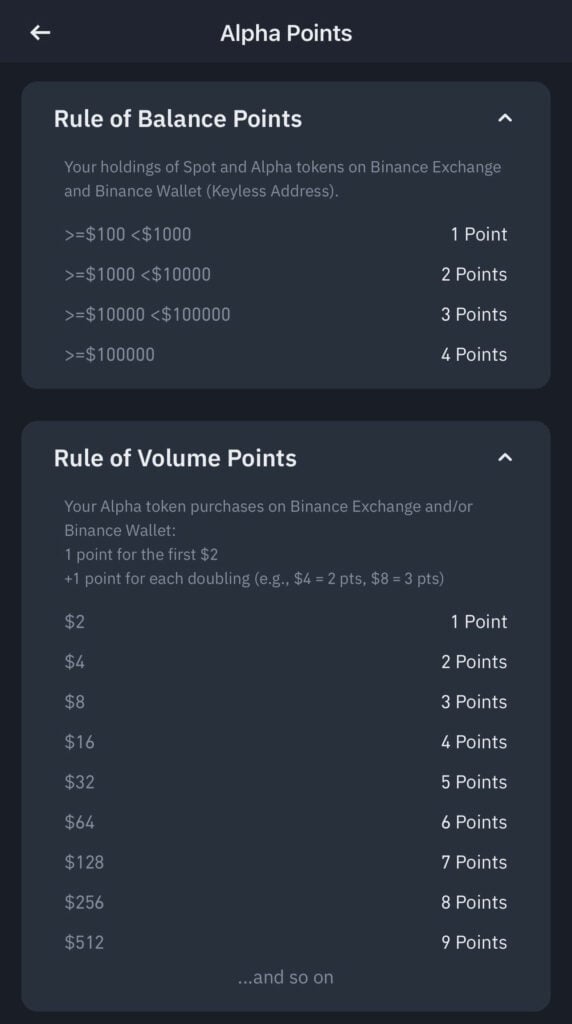
Balance Points (Hold): Binance users will receive points based on the total balance of spot tokens and Alpha in their account and Binance Wallet. For example, a balance of $100–$1,000 earns 1 point, while $100,000 or more earns 4 points.

Read more: How to participate IDO on Binance Wallet

Volume Points (Volume): Points are granted for buying Alpha tokens on the exchange or wallet. The formula starts with 1 point for the first $2, adding 1 point for each doubling of the amount (e.g., $8 earns 3 points, $1,024 earns 10 points). Selling Alpha tokens does not contribute to the score.

How to Calculate Alpha Point?How to Calculate Alpha Point?

Source: Binance Exchange

Total Alpha Points combine both balance and purchase points, motivating users to maintain high balances and actively trade Alpha tokens.

Most recently, Binance has announced the listing of $SIGN (Ethsign) on Binance Alpha. Besides, users can receive the $SIGN airdrop when they meet the required points on Alpha Point. The exact amount of Alpha points will be disclosed later, on April 28.

How to Check Alpha Points on the Binance App

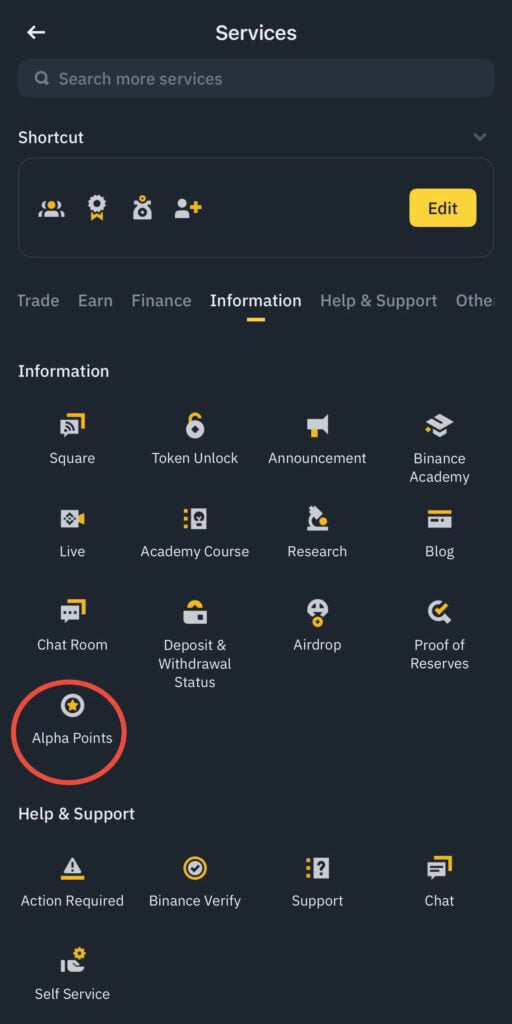
Checking Alpha Points is straightforward. Open the Binance app, navigate to “More services,” scroll to the “Information” section, and select “Alpha Points.”

How to Check Alpha Points on the Binance AppHow to Check Alpha Points on the Binance App

Source: Binance Exchange

This feature allows users to monitor their scores and adjust their strategies to maximize points. Essentially, Alpha Point is Binance’s way of filtering out truly committed users, prioritizing them for token launches and airdrop distributions. It rewards those who invest time and resources into the platform, aligning benefits with engagement.

Learn more: How to participate in Hyperlane presale on Binance Wallet

For those aiming to secure a spot in IDOs or airdrops, starting to accumulate points early is crucial. As the Alpha Point system evolves, its requirements may become stricter, making proactive participation essential. By maintaining at least a $100 balance, purchasing Alpha tokens, and regularly checking scores, users can position themselves for future opportunities in Binance’s expanding Web3 ecosystem.


Source link

Comparing LLM Fine-Tuning Frameworks: Axolotl, Unsloth, and Torchtune

0
Comparing LLM Fine-Tuning Frameworks: Axolotl, Unsloth, and Torchtune


Large Language Models (LLMs) continue to transform research workflows and production pipelines. While the capabilities of base models improve rapidly, fine-tuning remains an indispensable process for tailoring these powerful tools to specific needs. Fine-tuning bridges the gap between a model’s vast general knowledge and the specialized requirements of particular tasks or domains. This adaptation unlocks significant benefits, including higher accuracy on targeted tasks, better alignment with desired outputs or safety guidelines, enhanced relevance within specific domains, and greater control over the model’s style and format, such as adhering to a company’s tone of voice.

Furthermore, fine-tuning can teach models domain-specific terminology, reduce the frequency of hallucinations in critical applications, and even optimize latency by creating smaller, specialized models derived from larger ones. Compared to the immense cost of training models from scratch, fine-tuning leverages the pre-existing knowledge embedded in base models, drastically reducing computational requirements and training time. The growing emphasis on fine-tuning signals a maturation in the field, moving beyond generic, off-the-shelf models to create more customized, efficient, and task-specific AI solutions.

Why Choosing the Right Framework Matters

As fine-tuning becomes more widespread, choosing the software framework for managing this process becomes critically important. The proper fine-tuning framework can significantly impact performance metrics like training speed and throughput, resource utilization, particularly Graphics Processing Unit (GPU) Video RAM (VRAM), and ease of experimentation and development.

Different frameworks embody distinct design philosophies and prioritize different aspects, leading to inherent trade-offs. Some emphasize flexibility and broad compatibility, others focus on raw speed and memory efficiency, while some prioritize deep integration with specific ecosystems. These trade-offs mirror fundamental choices in software development, highlighting that selecting a fine-tuning framework requires careful consideration of project goals, available hardware, team expertise, and desired scalability.

Introducing the Contenders: Axolotl, Unsloth, and Torchtune

By 2025, several powerful frameworks will have emerged as popular choices for LLM fine-tuning. Among the leading contenders are Axolotl, Unsloth, and Torchtune. Each offers a distinct approach and set of advantages:

Axolotl is widely recognized for its flexibility, ease of use, community support, and rapid adoption of new open-source models and techniques.

Unsloth has carved out a niche as the champion of speed and memory efficiency, particularly for users with limited GPU resources.

Torchtune, the official PyTorch library, provides deep integration with the PyTorch ecosystem, emphasizing extensibility, customization, and robust scalability.

This article explores how these toolkits handle key considerations like training throughput, VRAM efficiency, model support, feature sets, multi-GPU scaling, ease of setup, and deployment pathways. The analysis aims to provide ML practitioners, developers, and researchers with the insights needed to select the framework that best aligns with their specific fine-tuning requirements in 2025.

Note on Experimentation: Accessing GPU Resources via Spheron

Evaluating and experimenting with these frameworks often requires access to capable GPU hardware. Users looking to conduct their fine-tuning experiments and benchmark these frameworks can rent GPUs from Spheron, providing a practical avenue to apply this article’s findings.

Axolotl is a free, open-source tool dedicated to streamlining the post-training lifecycle of AI models.8 This encompasses a range of techniques beyond simple fine-tuning, including parameter-efficient fine-tuning (PEFT) methods like LoRA and QLoRA, supervised fine-tuning (SFT), instruction tuning, and alignment. The framework’s core philosophy centers on making these powerful techniques accessible, scalable, and user-friendly, fostering a collaborative environment described as “fun.”.

Axolotl achieves this through strong community engagement (active Discord, numerous contributors) and a focus on ease of use, providing pre-existing configurations and examples that allow users to start training quickly. Its target audience is broad, encompassing beginners seeking a gentle introduction to fine-tuning, researchers experimenting with diverse models and techniques, AI platforms needing flexible integration, and enterprises requiring scalable solutions they can deploy in their environments (e.g., private cloud, Docker, Kubernetes). The framework has earned trust from notable research groups and platforms like Teknium/Nous Research, Modal, Replicate, and OpenPipe. Configuration is managed primarily through simple YAML files, which define everything from dataset preprocessing and model selection to training parameters and evaluation steps.

Performance Deep Dive: Benchmarks and Characteristics

Axolotl delivers solid fine-tuning performance by incorporating established best practices. It integrates optimizations like FlashAttention for efficient attention computation, gradient checkpointing to save memory, and defaults tuned for memory efficiency. It also supports multipacking (packing multiple short sequences into one) and RoPE scaling for handling different context lengths. For specific models like Gemma-3, it integrates specialized optimizations like the Liger kernel.

Compared directly to the other frameworks, Axolotl’s use of abstraction layers wrapping Hugging Face Transformers libraries can sometimes result in slightly slower training speeds. However, independent benchmarks comparing it against TorchTune (with torch. compile enabled) found Axolotl to be only marginally slower (around 3%) in a specific LoRA fine-tuning task. This suggests that while some overhead exists, it may not be a significant bottleneck for all workloads, especially considering Axolotl’s flexibility and feature breadth. Furthermore, Axolotl supports the torch_compile flag, potentially closing this gap further where applicable.

Model Universe and Recent Additions (LLaMA 4, Gemma-3, Multimodal)

A key strength of Axolotl is its extensive and rapidly expanding support for various model architectures. It is designed to work with many models available through Hugging Face. Supported families include Llama, Mistral, Mixtral (including MoE variants), Pythia (EleutherAI), Falcon (Technology Innovation Institute), MPT (MosaicML), Gemma (Google DeepMind), Phi (Microsoft Research), Qwen (Alibaba), Cerebras (Cerebras Systems), XGen (Salesforce), RWKV (BlinkDL), BTLM (Together), GPT-J (EleutherAI), and Jamba (AI21 Labs). Axolotl has gained a reputation for quickly adding support for newly released open-source models.

Recent releases (v0.8. x in 2025) reflected this agility and incorporated support for Meta’s LLaMA 3 and the newer LLaMA 4 models, including the LLaMA 4 Multimodal variant.11 Support for Google’s Gemma-3 series and Microsoft’s Phi-2/Phi-3 models was also added.11 This commitment ensures users can leverage the latest advancements in open LLMs shortly after release.

Beyond text-only models, Axolotl has ventured into multimodal capabilities. It introduced a beta for multimodal fine-tuning, providing built-in recipes and configurations for popular vision-and-language models such as LLaVA-1.5, “Mistral-Small-3.1” vision, MLLama, Pixtral, and Gemma-3 Vision. This expansion addresses the growing interest in models that can process and integrate information from multiple modalities.

Feature Spotlight: Sequence Parallelism for Long Context, Configuration Ease

Axolotl continuously integrates cutting-edge features to enhance fine-tuning capabilities. Two notable areas are its approach to long-context training and its configuration system.

Long Context via Sequence Parallelism: Training models on very long sequences (e.g., 32k tokens or more) poses significant memory challenges due to the quadratic scaling of attention mechanisms. Axolotl addresses this critical need by implementing sequence parallelism (SP), leveraging the ring-flash-attn library. Sequence parallelism works by partitioning a single long input sequence across multiple GPUs; each GPU processes only a sequence segment.

This distribution directly tackles the memory bottleneck associated with sequence length, allowing for near-linear scaling of context length with the number of GPUs and enabling training runs that would otherwise be impossible on a single device. This SP implementation complements Axolotl’s existing multi-GPU strategies like FSDP and DeepSpeed. Configuring SP is straightforward via a sequence_parallel_degree parameter in the YAML file. However, it requires Flash Attention to be enabled and imposes certain constraints on batch size and the relationship between SP degree, GPU count, sequence length, and attention heads. The integration of SP reflects Axolotl’s ability to quickly adopt advanced techniques emerging from the research community, addressing the increasing demand for models capable of processing extensive context windows.

Ease of Configuration and Other Features: Axolotl maintains its user-friendly approach through simple YAML configuration files, which are easily customized or augmented with command-line overrides.8 Recent refinements include support for custom tokenizer settings, such as defining reserved tokens.11 The project also provides “Cookbooks,” offering templates for everyday tasks, like the whimsical “talk like a pirate” example. Community projects have developed UI wrappers for Axolotl for users seeking a graphical interface.19 Other notable features added in 2025 include support for the REX learning rate scheduler (potentially for faster convergence), cut-cosine cross-entropy (CCE) loss (improving stability for models like Cohere or Gemma), the specialized Liger kernel for efficient Gemma-3 fine-tuning, and integration with distributed vLLM servers to accelerate data generation during RLHF loops.

The framework’s strength in rapidly integrating community advancements positions it as a dynamic hub for leveraging the latest open-source innovations. This agility allows users to experiment with new models and techniques that are emerging quickly.

Scaling Capabilities: Multi-GPU and Distributed Training Mastery

Multi-GPU training is highlighted as a core strength of Axolotl. It offers robust support for various distributed training strategies, catering to different needs and hardware setups:

DeepSpeed: Recommended for its stability and performance, Axolotl supports ZeRO stages 1, 2, and 3, providing varying levels of memory optimization. Default configurations are provided.

Fully Sharded Data Parallel (FSDP): Axolotl supports PyTorch’s FSDP and is working towards adopting FSDP v2.8. Configuration options allow for features like CPU offloading.

Sequence Parallelism: As detailed above, SP adds another dimension to Axolotl’s scaling capabilities, specifically for handling long sequences across multiple GPUs.

This comprehensive support for distributed training enables users to tackle large-scale fine-tuning tasks. Numerous users have successfully fine-tuned models with tens of billions of parameters (e.g., 65B/70B Llama models) using Axolotl across multiple high-end GPUs like NVIDIA A100s. The framework also supports multi-node training, allowing jobs to span multiple machines. This combination of mature distributed strategies (DeepSpeed, FSDP) and targeted optimizations for sequence length (SP) makes Axolotl a powerful open-source choice for pushing the boundaries of model size and context length.

Ecosystem Integration and Deployment Pathways

Axolotl integrates seamlessly with various tools and platforms within the MLOps ecosystem. It supports logging to Weights & Biases (W&B), MLflow, and Comet for experiment tracking and visualization.8 It is designed to run effectively on cloud platforms and infrastructure providers, with documented integrations or user communities utilizing Runpod, Latitude, Modal, Jarvislabs, and SkyPilot. Its foundation relies heavily on the Hugging Face ecosystem, particularly the Transformers and Datasets libraries.

Once a model is fine-tuned, Axolotl facilitates deployment by allowing models to be exported into the standard Hugging Face format. These models can then be served using popular inference engines like vLLM. While the reliance on YAML for configuration promotes simplicity for everyday use cases, it might present challenges for highly complex or experimental setups requiring fine-grained programmatic control, potentially limiting deep customization compared to more code-centric frameworks.8

Unsloth: The Speed and Efficiency Champion

Unsloth enters the fine-tuning arena with a laser focus on optimizing performance, specifically targeting training speed and VRAM efficiency. Its primary goal is to make fine-tuning accessible even for users with limited hardware resources, democratizing the ability to customize powerful LLMs.3

The core of Unsloth’s advantage lies not in approximation techniques but in meticulous low-level optimization. The team achieves significant speedups and memory reduction through custom-written GPU kernels using OpenAI’s Triton language, a manual backpropagation engine, and other techniques like optimized matrix multiplication. Unsloth claims these gains come with 0% loss in accuracy for standard LoRA and QLoRA fine-tuning compared to baseline implementations. This focus on exactness distinguishes it from methods that might trade accuracy for speed.

Its target audience primarily includes hardware-constrained users, such as those utilizing single consumer-grade GPUs (like NVIDIA RTX 4090s or 3090s) or free cloud tiers like Google Colab, which often provide older GPUs like the Tesla T4. However, its impressive performance has also attracted major industry players, including Microsoft, NVIDIA, Meta, NASA, HP, VMware, and Intel, indicating its value extends beyond resource-constrained scenarios.

Performance Deep Dive: Unpacking the Speed and VRAM Claims (OSS vs. Pro)

Unsloth makes bold claims about its performance, differentiating between its free open-source offering and commercial Pro/Enterprise tiers.

Open Source (OSS) Performance: The free version promises substantial improvements for single-GPU fine-tuning. Reports indicate 2- 5x faster training speeds and up to 80% less VRAM consumption than standard baselines using Hugging Face Transformers with FlashAttention 2 (FA2). Specific examples include fine-tuning Llama 3.2 3B 2x faster with 70% less memory, or Gemma 3 4B 1.6x faster with 60% less memory. This VRAM efficiency directly translates to the ability to train larger models, use larger batch sizes, or handle significantly longer context windows on memory-limited GPUs.

Pro/Enterprise Performance: Unsloth offers premium tiers with even more dramatic performance enhancements. The “Pro” version reportedly achieves around 10x faster training on a single GPU and up to 30x faster on multi-GPU setups, coupled with 90% memory reduction versus FA2. The “Enterprise” tier pushes this further to 32x faster on multi-GPU/multi-node clusters. These paid versions may also yield accuracy improvements (“up to +30%”) in specific scenarios and offer faster inference capabilities (5x claimed for Enterprise).

Independent Benchmarks: Third-party benchmarks generally corroborate Unsloth’s single-GPU advantage. One comparison found Unsloth to be 23-24% faster than Torchtune (with torch.compile) on an RTX 4090, using ~18% less VRAM. On an older RTX 3090, the advantage was even more pronounced: ~27-28% faster and ~17% less VRAM. These results confirm Unsloth’s significant edge in single-GPU scenarios.

Hardware and Software Support: The open-source version primarily supports NVIDIA GPUs with CUDA Capability 7.0 or higher (V100, T4, RTX 20xx series and newer). While portability to AMD and Intel GPUs is mentioned as a goal, NVIDIA remains the focus.6 Unsloth works on Linux and Windows, although Windows usage might require specific setup steps or workarounds, such as installing a Triton fork and adjusting dataset processing settings.5 Python 3.10, 3.11, and 3.12 are supported, but not 3.

Model Universe and Recent Additions (LLaMA 4 Variants, Gemma 3, Vision)

Unsloth supports a curated list of popular and recent LLM architectures, focusing on those widely used in the community. While not as exhaustive as Axolotl’s list, it covers many mainstream choices. Supported families include Llama (versions 1, 2, 3, 3.1, 3.2, 3.3, and the new Llama 4), Gemma (including Gemma 3), Mistral (v0.3, Small 22b), Phi (Phi-3, Phi-4), Qwen (Qwen 2.5, including Coder and VL variants), DeepSeek (V3, R1), Mixtral, other Mixture-of-Experts (MoE) models, Cohere, and Mamba.

Keeping pace with releases in 2025, Unsloth added support for Meta’s Llama 4 models, specifically the Scout (17B, 16 experts) and Maverick (17B, 128 experts) variants, demonstrating strong performance rivaling models like GPT-4o. It also supports Google’s Gemma 3 family (1B, 4B, 12B, 27B), Microsoft’s Phi-4 5, Alibaba’s Qwen 2.5 5, and Meta’s Llama 3.3 70 B. Unsloth often provides pre-optimized 4-bit and 16-bit versions of these models directly on Hugging Face for immediate use.

Unsloth has also embraced multimodal fine-tuning, adding support for Vision Language Models (VLMs). This includes models like Llama 3.2 Vision (11B), Qwen 2.5 VL (7B), and Pixtral (12B) 2409.

Feature Spotlight: Custom Kernels, Dynamic Quantization, GRPO, Developer Experience

Unsloth differentiates itself through several key features stemming from its optimization focus and commitment to usability.

Custom Kernels: The foundation of Unsloth’s performance lies in its hand-written GPU kernels developed using OpenAI’s Triton language. By creating bespoke implementations for compute-intensive operations like attention and matrix multiplications, Unsloth bypasses the overhead associated with more general-purpose library functions, leading to significant speedups.

Dynamic Quantization: To further improve memory efficiency, Unsloth introduced an “ultra-low precision” dynamic quantization technique capable of quantizing down to 1.58 bits. This method intelligently chooses not to quantize certain parameters, aiming to preserve accuracy while maximizing memory savings. Unsloth claims this technique uses less than 10% more VRAM than standard 4-bit quantization while increasing accuracy. This technique is particularly useful for inference or adapter-based training methods like LoRA/QLoRA.

Advanced Fine-Tuning Techniques: Beyond standard LoRA and QLoRA (which it supports with 4-bit and 16-bit precision via bitsandbytes integration), Unsloth incorporates advanced techniques. It supports Rank-Stabilized LoRA (RSLORA) and LoftQ to improve LoRA training stability and better integrate quantization. It also supports GRPO (Generalized Reward Process Optimization), a technique for enhancing the reasoning capabilities of LLMs. Unsloth provides tutorials on transforming models like Llama or Phi into reasoning LLMs using GRPO, even with limited VRAM (e.g., 5GB). Furthermore, Unsloth supports full fine-tuning, 8-bit training, and continued pretraining modes.

Long Context Support: Unsloth has beta support for long-context training and reasoning. Its inherent VRAM efficiency allows users to train models with significantly longer sequence lengths on given hardware compared to standard frameworks using FlashAttention 2.5. For example, benchmarks show Llama 3.1 8B reaching over 342k context length on an 80GB GPU with Unsloth, compared to ~28k with HF+FA2.

Developer Experience: Despite its sophisticated backend, Unsloth prioritizes ease of use, particularly for beginners.3 It provides readily available Google Colab and Kaggle notebooks, allowing users to start fine-tuning quickly with free GPU access.3 It offers a high-level Python API, notably the FastLanguageModel wrapper, which enables fine-tuning setup in just a few lines of code.33 Configuration is typically done via simple Python scripts rather than complex YAML files.12 The project maintains comprehensive documentation, tutorials, and an active, responsive team presence on platforms like Discord and Reddit.12 This combination of performance and usability makes Unsloth an attractive entry point for users new to fine-tuning.

Scaling Capabilities: Single-GPU Focus (OSS) vs. Multi-GPU/Node (Pro/Enterprise)

A crucial distinction exists between UnSloth’s open-source and commercial offerings regarding scalability.

Open Source (OSS): The free, open-source version of Unsloth is explicitly and primarily designed for single-GPU training. As of early to mid-2025, multi-GPU support is not officially included in the OSS version, although it is frequently mentioned as being on the roadmap or planned for a future release. This limitation is a key differentiator compared to Axolotl and Torchtune, which offer open-source multi-GPU capabilities. While some users have explored workarounds using tools like Hugging Face Accelerate or Llama Factory, these are not officially supported paths.

Pro/Enterprise: Multi-GPU and multi-node scaling are premium features reserved for Unsloth’s paid tiers.6 The Pro plan unlocks multi-GPU support (reportedly up to 8 GPUs), while the Enterprise plan adds multi-node capabilities, allowing training to scale across clusters of machines. This tiered approach means users needing to scale beyond a single GPU must engage with Unsloth’s commercial offerings. This focus on optimizing for the large single-GPU user base in the free tier, while monetizing advanced scaling, represents a clear strategic choice.

Ecosystem Integration and Industry Adoption

Unsloth integrates well with key components of the LLM development ecosystem. It works closely with Hugging Face, utilizing its models and datasets, and is referenced within the Hugging Face TRL (Transformer Reinforcement Learning) library documentation. It integrates with Weights & Biases for experiment tracking and relies on libraries like bitsandbytes for quantization functionalities.

Unsloth facilitates exporting fine-tuned models into popular formats compatible with various inference engines for deployment. This includes GGUF (for CPU-based inference using llama.cpp), Ollama (for easy local deployment), and VLLM (a high-throughput GPU inference server).

Unsloth has gained significant traction and recognition within the AI community. It received funding from notable investors like Microsoft’s M12 venture fund and the GitHub Open Source Fund. Its user base includes prominent technology companies and research institutions, highlighting its adoption beyond individual developers. It stands out as one of the fastest-growing open-source projects in the AI fine-tuning space. However, the gating of multi-GPU/node support behind paid tiers presents a potential friction point with parts of the open-source community and raises considerations about the long-term feature parity between the free and commercial versions, especially given the small core team size.

Torchtune: The Native PyTorch Powerhouse

Torchtune emerges as the official PyTorch library dedicated to fine-tuning LLMs. Its design philosophy is deeply rooted in the PyTorch ecosystem, emphasizing a “native PyTorch” approach. This translates to a lean, extensible library with minimal abstractions – explicitly avoiding high-level wrappers like “trainers” or imposing rigid framework structures. Instead, it provides composable and modular building blocks that align closely with standard PyTorch practices.

This design choice targets a specific audience: users who are already comfortable and proficient with PyTorch and prefer working directly with its core components. This includes researchers, developers, and engineers requiring deep customization, flexibility, and extensibility in fine-tuning workflows. The transparency offered by this “just PyTorch” approach facilitates easier debugging and modification compared to more heavily abstracted frameworks. While powerful for experienced users, this native philosophy might present a steeper learning curve for those less familiar with PyTorch internals than Axolotl or Unsloth’s guided approaches.

Performance Deep Dive: Leveraging PyTorch Optimizations (TorchCompile)

Torchtune aims for excellent training throughput by directly leveraging the latest performance features within PyTorch 2.x.7 Key optimizations include using the torch. Compile to fuse operations and optimize execution graphs, native support for efficient attention mechanisms like FlashAttention, and other fused operations available in PyTorch.7 The pure PyTorch design ensures minimal framework overhead.

A significant performance lever is torch.compile. Users can activate this powerful optimization by setting compile: True in the configuration YAML files. While there’s an upfront compilation cost during the first training step, subsequent steps run significantly faster. Benchmarks indicate that even for relatively short fine-tuning runs, the performance gain from torch.compile makes it worthwhile for most real-world scenarios.12 A table in the documentation demonstrates the cumulative performance impact of applying optimizations like packed datasets and torch.compile.

In direct speed comparisons, Torchtune (with compile enabled) performs competitively. It was found to be significantly faster than its non-compiled version and roughly on par with Axolotl in one benchmark. However, it was still notably slower (20-30%) than Unsloth in single-GPU LoRA fine-tuning tests. Torchtune offers broad hardware compatibility, supporting both NVIDIA and AMD GPUs, reflecting its PyTorch foundation. Recipes are often tested on consumer GPUs (e.g., with 24GB VRAM), indicating an awareness of resource constraints.

Model Universe and Recent Additions (LLaMA 4, Gemma2, Qwen2.5)

Torchtune supports a growing list of popular LLMs, often prioritizing models with strong ties to the PyTorch and Meta ecosystems, such as the Llama family. Supported models include various sizes of Llama (Llama 2, Llama 3, Llama 3.1, Llama 3.2, including Vision, Llama 3.3 70B, and Llama 4), Gemma (Gemma, Gemma2), Mistral, Microsoft Phi (Phi3, Phi4), and Qwen (Qwen2, Qwen2.5).

Torchtune demonstrates rapid integration of new models, particularly those released by Meta. Support for LLaMA 4 (including the Scout variant) was added shortly after its release in April 2025. Prior to that, it incorporated LLaMA 3.2 (including 3B, 1B, and 11B Vision variants), LLaMA 3.3 70B, Google’s Gemma2, and Alibaba’s Qwen2.5 models throughout late 2024 and early 2025. This quick adoption, especially for Meta models, highlights the benefits of its close alignment with the core PyTorch development cycle.

Feature Spotlight: Advanced Training Recipes (QAT, RLHF), Activation Offloading, Multi-Node Architecture

A key strength of Torchtune lies in its provision of “hackable” training recipes for a wide range of advanced fine-tuning and post-training techniques, all accessible through a unified interface and configurable via YAML files.

Advanced Training Recipes: Torchtune goes beyond basic SFT and PEFT methods. It offers reference recipes for:

Supervised Fine-Tuning (SFT): Standard instruction tuning.

Knowledge Distillation (KD): Training smaller models to mimic larger ones.

Reinforcement Learning from Human Feedback (RLHF): Including popular algorithms like DPO (Direct Preference Optimization), PPO (Proximal Policy Optimization), and GRPO. Support varies by method regarding full vs. PEFT tuning and multi-device/node capabilities.

Quantization-Aware Training (QAT): This allows training models that are optimized for quantized inference, potentially yielding smaller, faster models with minimal performance loss. It supports full QAT and LoRA/QLoRA QAT.7 This comprehensive suite allows users to construct complex post-training pipelines, such as fine-tuning, distilling, applying preference optimization, and quantizing a model, all within the Torchtune framework. This focus on providing adaptable recipes for cutting-edge techniques positions Torchtune well for research and development environments where experimenting with the training process is crucial.

Memory Optimizations: Torchtune incorporates several techniques to manage memory usage, particularly important when training large models:

Activation Checkpointing: Standard technique to trade compute for memory by recomputing activations during the backward pass. Controlled via the enable_activation_checkpointing flag.

Activation Offloading: A more recent technique where activations are moved to CPU memory or disk during the forward pass and recalled during the backward pass. This offers potentially larger memory savings than checkpointing, but can impact performance due to data transfer overhead. Stable support was introduced in v0.4.0 (Nov 2024) and is controlled by the enable_activation_offloading flag.

Other Optimizations: Torchtune also leverages packed datasets, chunked loss computation (e.g., CEWithChunkedOutputLoss), low-precision optimizers via bitsandbytes, and fusing the optimizer step with the backward pass in single-device recipes. The documentation provides guides on memory optimization strategies.

Multimodal Support: Torchtune has added capabilities for handling vision-language models, including stable support for multimodal QLoRA training. This allows parameter-efficient fine-tuning of models that process both text and images, such as the Llama 3.2 Vision models.

Scaling Capabilities: Seamless Multi-Node and Distributed Training

Torchtune’s primary focus is Scalability. In February 2025, it officially introduced multi-node training capabilities, enabling users to perform full fine-tuning across multiple machines. This is essential for training very large models or using large batch sizes that exceed the capacity of a single node.

Torchtune achieves this scaling by leveraging native PyTorch distributed functionalities, primarily FSDP (Fully Sharded Data Parallel).46 FSDP shards model parameters, gradients, and optimizer states across available GPUs, significantly reducing the memory burden on each individual device. Torchtune exposes FSDP configuration options, allowing users to control aspects like CPU offloading and sharding strategies (e.g., FULL_SHARD vs. SHARD_GRAD_OP).46 This deep integration allows Torchtune to scale relatively seamlessly as more compute resources become available. While FSDP is the primary mechanism, Distributed Data Parallel (DDP) with sharded optimizers might also be implicitly supported through the underlying PyTorch capabilities.

In addition to multi-node/multi-GPU distributed training, Torchtune also provides dedicated recipes optimized for single-device scenarios, incorporating specific memory-saving techniques relevant only in that context.

Ecosystem Integration and Deployment Flexibility

Torchtune’s greatest strength lies in its tight integration with the PyTorch ecosystem. It benefits directly from the latest PyTorch API advancements, performance optimizations, and distributed training primitives. This native connection ensures compatibility and leverages the extensive tooling available within PyTorch.

Beyond the core framework, Torchtune integrates with other essential MLOps tools. It supports downloading models directly from the Hugging Face Hub (requiring authentication for gated models). It offers integrations with Weights & Biases (W&B), TensorBoard, and Comet for experiment tracking and logging. It also connects with libraries like bits and bytes for low-precision operations and EleutherAI’s Eval Harness for standardized model evaluation. Integration with ExecuTorch is mentioned for deployment on edge devices.

Fine-tuned models can be saved using Torchtune’s checkpointing system, which handles model weights, optimizer states, and recipe states for resuming training. For deployment or use in other environments, models can be exported to standard Hugging Face format, ONNX, or kept as native PyTorch models. However, users might need to perform conversion steps to make Torchtune checkpoints directly compatible with other libraries. The official backing by PyTorch/Meta suggests a commitment to stability, long-term maintenance, and continued alignment with the core PyTorch roadmap, offering a degree of reliability, especially for users heavily invested in Meta’s model families.

Comparative Analysis and Strategic Recommendations (2025)

Choosing the proper fine-tuning framework depends heavily on specific project requirements, available resources, team expertise, and scaling ambitions. Axolotl, Unsloth, and Torchtune each present a compelling but distinct value proposition in the 2025 landscape.

Feature and Performance Comparison Matrix

The following table provides a high-level comparison of the three frameworks based on the key characteristics discussed:

Feature/AspectAxolotlUnsloth (OSS)Torchtune

Primary GoalFlexibility, Ease of Use, Community HubSingle-GPU Speed & VRAM EfficiencyPyTorch Integration, Customization, Scalability

Ease of Use (Config)High (YAML, Defaults, Community Examples)High (Python API, Colab Notebooks)Moderate (Requires PyTorch knowledge, YAML/Code)

Core Performance AdvantageBroad Optimizations (FlashAttn, etc.)Custom Triton Kernels, Manual Backproptorch.compile, Native PyTorch Opts

VRAM Efficiency (Single GPU)Good (Defaults, Grad Checkpoint)Excellent (Up to 80% saving vs FA2)Very Good (Activ. Offload/Checkpoint, Opts)

Multi-GPU Support (OSS)Yes (DeepSpeed, FSDP, SP)No (Pro/Enterprise Only)Yes (FSDP)

Multi-Node Support (OSS)Yes (DeepSpeed, FSDP)No (Enterprise Only)Yes (FSDP)

Key Model Support (LLaMA4, etc)Very Broad (Fast adoption of new OSS models)Broad (Popular models, LLaMA4, Gemma3, Phi4)Broad (Strong Meta ties, LLaMA4, Gemma2, Qwen2.5)

Long Context MethodSequence Parallelism (Ring FlashAttention)High Efficiency (Enables longer seq len)Memory Opts (Offload/Checkpoint), Scaling

Multimodal SupportYes (Beta, Recipes for LLaVA, etc.)Yes (LLaMA 3.2 Vision, Qwen VL, Pixtral)Yes (Multimodal QLoRA, LLaMA 3.2 Vision)

Advanced Techniques (QAT, etc)GRPO, CCE Loss, Liger KernelDynamic Quant, RSLORA, LoftQ, GRPOQAT, KD, DPO, PPO, GRPO

Ecosystem IntegrationHigh (W&B, Cloud Platforms, HF)Good (TRL, W&B, HF, GGUF/Ollama/VLLM Export)Excellent (Deep PyTorch, W&B, HF, ONNX Export)

Target UserBeginners, Community, Flexible ScalingResource-Constrained Users, Speed FocusPyTorch Experts, Researchers, Customization Needs

Head-to-Head Synthesis: Key Differentiators Summarized

Performance: Unsloth clearly dominates single-GPU benchmarks in terms of speed and VRAM efficiency due to its custom kernels. Torchtune achieves strong performance, especially when torch.compile is enabled, leveraging PyTorch’s native optimizations. Axolotl offers solid performance with broad optimizations but its abstraction layers can introduce slight overhead compared to the others in some scenarios.

Scalability (Open Source): This is a major dividing line. Axolotl and Torchtune provide robust, open-source solutions for multi-GPU and multi-node training using established techniques like DeepSpeed and FSDP. Unsloth’s open-source version is explicitly limited to single-GPU operation, reserving multi-GPU/node capabilities for its paid tiers. This makes the choice critical for users anticipating the need to scale beyond one GPU using free software.

Ease of Use: Axolotl, with its YAML configurations and community-driven examples, is often perceived as beginner-friendly. Unsloth also targets ease of use with simple Python APIs and readily available Colab/Kaggle notebooks. Torchtune, adhering to its native PyTorch philosophy, offers transparency and control but generally requires a stronger grasp of PyTorch concepts.

Flexibility & Customization: Axolotl provides flexibility through its vast support for models and integration of various community techniques via configuration. Torchtune offers the deepest level of customization for users comfortable modifying PyTorch code, thanks to its hackable recipe design and minimal abstractions. Unsloth is highly optimized but offers less flexibility in terms of supported models and underlying modifications compared to the others.

Advanced Features & Ecosystem: All three frameworks have incorporated support for essential techniques like LoRA/QLoRA, various RLHF methods (though the specific algorithms and support levels differ), long-context strategies, and multimodal fine-tuning. Axolotl stands out with its open-source Sequence Parallelism via Ring FlashAttention. Unsloth boasts unique features like custom kernels and dynamic quantization. Torchtune offers native QAT support and activation offloading alongside a broad suite of RLHF recipes. Ecosystem integration reflects their philosophies: Axolotl leverages the broad open-source community and cloud platforms, Unsloth integrates with key libraries like TRL and has notable industry backing, while Torchtune is intrinsically linked to the PyTorch ecosystem. The way features are adopted also differs—Axolotl often integrates external community work, Torchtune builds natively within PyTorch, and Unsloth develops custom optimized versions—impacting adoption speed, integration depth, and potential stability.

Guidance for Selection: Matching Frameworks to Needs

Based on the analysis, the following guidance can help match a framework to specific project needs in 2025:

For Beginners or Teams Prioritizing Rapid Prototyping with Ease: Axolotl (due to YAML configs, extensive examples, and strong community support) or Unsloth (thanks to Colab notebooks and a simple API) are excellent starting points.

For Maximum Single-GPU Speed and Efficiency (Limited Hardware/Budget): Unsloth is the undisputed leader in the open-source space, offering significant speedups and VRAM reductions that can make fine-tuning feasible on consumer hardware or free cloud tiers.

For open-source multi-GPU or Multi-Node Scaling, Axolotl (with DeepSpeed, FSDP, and SP options) or Torchtune (leveraging PyTorch’s FSDP and multi-node capabilities) are the primary choices. Their decision might depend on preference for DeepSpeed vs. FSDP or specific feature needs like Axolotl’s SP.

For Deep PyTorch Integration, Research, or Highly Customized Workflows: Torchtune provides the most direct access to PyTorch internals, offering maximum flexibility and control for experienced users and researchers needing to modify or significantly extend the fine-tuning process.

For Accessing the Broadest Range of Open-Source Models or the Latest Community Techniques: Axolotl typically offers the quickest integration path for new models and methods emerging from the open-source community.

For Training with Extremely Long Context Windows at Scale (Open Source): Axolotl’s implementation of Sequence Parallelism provides a dedicated solution for this challenge. Torchtune’s combination of multi-node scaling and memory optimizations also supports long-context training. Unsloth’s efficiency enables more extended sequences than baselines on single GPUs.

For Enterprise Deployments Requiring Commercial Support or Advanced Scaling Features: Unsloth’s Pro and Enterprise tiers offer dedicated support and features like multi-node training and potentially higher performance levels. Axolotl also notes enterprise usage and provides contact information for dedicated support. Torchtune benefits from the stability and backing of the official PyTorch project.

The optimal framework choice is highly contextual. A project might even start with Unsloth for initial, cost-effective experimentation on a single GPU and later migrate to Axolotl or Torchtune if scaling requires open-source multi-GPU capabilities or deeper customization becomes necessary.

Conclusion: Choosing Your Fine-Tuning Partner

As of 2025, Axolotl, Unsloth, and Torchtune have matured into powerful, distinct frameworks for fine-tuning large language models. The choice between them hinges on carefully evaluating project priorities, hardware availability, team expertise, and scaling requirements.

Axolotl stands out for its usability, flexibility, and strong open-source scaling capabilities. It excels in rapidly incorporating new models and techniques from the community. It is a versatile hub for leveraging the latest open-source innovations, particularly for multi-GPU and long-context scenarios using free software.

Unsloth has firmly established itself as the leader in single-GPU performance and memory efficiency. Its custom optimizations make fine-tuning accessible on limited hardware, providing an easy entry point for many users. Scaling beyond a single GPU requires engaging with its commercial offerings.

Torchtune offers the power of deep PyTorch integration, extensibility, and robust scaling. Its native PyTorch design provides transparency and control for researchers and developers needing deep customization, benefiting from the stability and advanced features of the core PyTorch ecosystem, including mature multi-node support.

All three frameworks now support key techniques like LoRA/QLoRA, various RLHF methods, multimodal fine-tuning, and approaches to long-context training. Their primary differences lie in their specialization: Axolotl prioritizes broad usability and rapid community integration, Unsloth focuses intensely on optimizing resource-constrained environments, and Torchtune emphasizes deep customization and seamless scalability within the PyTorch paradigm.3

The LLM fine-tuning landscape continues to evolve at a breakneck pace. New techniques, models, and optimizations emerge constantly. While this report captures the state of these frameworks in 2025, practitioners must continuously evaluate their options against their specific, evolving needs. The lines between frameworks may also blur as features are cross-pollinated – for instance, Axolotl has reportedly adopted some optimizations inspired by Unsloth. Ultimately, selecting the right fine-tuning partner requires aligning the framework’s strengths with the project’s immediate goals and long-term vision in this dynamic field. The rich ecosystem extends beyond these three, with other tools like Hugging Face TRL, Llama Factory, and SWIFT also contributing to the diverse options available.




Source link

From Tariffs to TikTok -How China Is Rewriting the Luxury Playbook

From Tariffs to TikTok -How China Is Rewriting the Luxury Playbook


The $38,000 Bag vs. the $1,400 Bombshell- One Side of the Story

What if the Birkin bag you’ve dreamt of—normally $38,000—could be yours for $1,400? Not from a sketchy knockoff seller, but allegedly straight from the source? That’s the new reality playing out on TikTok, where Chinese factories are pulling back the velvet curtain on how luxury is really made. Spoiler alert: it’s not all Paris and posh ateliers.

Welcome to the new luxury battleground, where China isn’t just reacting to U.S. tariffs. It’s going on the offensive, and the casualties include the long-held beliefs about where luxury truly comes from.

When Trade Gets Personal — The Tariff Timeline

Since 2018, the U.S. has steadily raised duties on Chinese imports—starting with 25% on steel and 10% on aluminum, then expanding to 25% on hundreds of billions of dollars of goods under Section 301. In April 2025, an executive order added a universal 10% base tariff on all imports, plus an extra 34% on Chinese goods (totaling 54%), later jumping U.S. tariffs on China to as high as 145%. China hit back with tariffs of up to 125% on U.S. exports. 

These tit‑for‑tat hikes squeezed margins across China’s supply chain, a move Beijing condemned as “economic bullying.” As part of a counter action, China, besides levying duties, canceled orders and halted shipments of U.S. products—most notably instructing its airlines to reject new Boeing jets and return completed aircraft to U.S. plants. At the same time, Beijing has deepened strategic trade and supply‑chain cooperation with neighbors like Vietnam and South Korea, signing multiple agreements to mitigate tariff impacts. 

From Defensive to Dominant – China’s Tariff Clapback

The U.S. launched its trade war with tariffs. China fired back—not with just tariffs, but with tactics. No longer content with being the factory of the world, China is rebranding as the world’s luxury source. Think less “Made in China,” and more “Luxury from China—directly.”

Soft Retaliation — The Viral Counter-Strike

The trade war between the U.S. and China entered its most surprising chapter yet. No longer just slapping tariffs in retaliation, China hit back with a precision strike to the West’s luxury psyche. Chinese suppliers skip the traditional supply chain, taking their story (and their products) directly to American consumers—on social media.

While these viral TikTok reels aren’t an official government directive, many industry observers view them as a form of soft retaliation—leveraging viral marketing to expose the true cost and origin of luxury goods and challenging the norm that the West monopolizes craftsmanship. 

The narrative? We made your bag. And we’ll sell it to you without the markup.

Weaponizing Social Media: TikTok as the Luxury Leak Machine

Forget brand marketing. Enter TikTok. It is not just for dances and drama anymore—it’s a powerful propaganda tool with real action. Chinese factory workers and suppliers have gone viral showing luxury bags being made—down to stitching, embossing, and, yes, even logo application. They’re calling themselves OEMs (Original Equipment Manufacturers) and claiming they’re factories contracted by big names in the luxury domain.

Bypassing brands, retailers, and import duties, they show raw working scenarios, skilled craftsmanship, and even logo installations. It’s part shopping haul, part geopolitical thriller. 

In 60-second clips, they offer a masterclass in global supply chain dynamics, while positioning themselves as whistleblowers of the luxury world. The subtext is loud and clear: You don’t need to pay $5,000 for a logo.

The Humiliation Strategy: Expose the Markup, Discredit the Brand

China’s strategy isn’t just about selling directly. It’s about control of the narrative. By comparing their bags with brand-name versions and showing near-identical craftsmanship, these suppliers are actively humiliating the luxury houses. Their message: You’ve been paying more for the illusion, not the item.

Chinese suppliers aren’t shy. They’re naming names, showing side-by-side comparisons, and calling out the markup madness. They claim a $38,000 Hermès bag versus a $1,400 “OEM” version—same factory, same materials, same process. It’s not just selling; it’s a statement: “You’ve been had.”

The Deafening Silence from Luxury Brands

Luxury brands are in an awkward spot. They can’t acknowledge the TikTok exposés without admitting how much of their production pipeline relies on Chinese labor. But silence also invites suspicion. In the age of viral truth bombs, can ignoring the conversation really be a long-term strategy?

Luxury houses have built empires on mystique. Now that mystique is cracking. What happens to the brand story if consumers discover that their ‘exclusive’ European luxury bags were largely made in China? Silence is their current strategy—perhaps hoping the storm will pass. But with TikTok amplifying every behind-the-scenes clip, that hope may be in vain.

Who Really Makes Your Bag?

Hermès, Gucci, Prada, Louis Vuitton—these names conjure images of European artisans handcrafting bags in cobblestone workshops. But according to Chinese workers, up to 80% of these bags start their lives in Chinese factories. The European connection? Final touches and a hefty markup.

That revelation dents the romanticized version of luxury, making consumers question what they’re really paying for: craftsmanship or a continent’s worth of brand mythology.

The Bigger Picture: A Geopolitical Shift in Perception

This is about more than handbags. It’s about who gets to define value, authenticity, and prestige. For decades, the West held that power. Now, China is not only challenging that dominance but reshaping the rules entirely.

One Chinese diplomat even took a jab at the U.S. Press Secretary’s dress, calling out its Made in China label with the punchline: “Accusing China is business. Buying China is life.”

The Other Side of the Story: Fact or Fabrication!

Are These Bags Real or Fake? The Authenticity Paradox

China’s reputation for knockoffs complicates the narrative. Consumers are left wondering: If it’s made in the same factory, using the same materials and techniques, but without the official logo or paperwork, what makes it a fake? This gray zone is blurring the once-clear boundaries of luxury authenticity.

Given China’s reputation for fakes, many ask: can these direct-from-China bags be trusted? It’s a fair question. But if the same factory, same materials, and same hands are involved… What is a fake? And if the only difference is a logo slapped on in Milan, who’s really being duped and with what? Consumers with the reel or with the real?

But Could it Be Dupe Manufacturers are Just Seizing the Moment?

Industry experts warn that many of these viral TikTok videos are likely part of a broader strategy by counterfeit or “dupe” manufacturers aiming to capitalize on tariff-related confusion and flood Western markets with fake luxury goods. By exploiting consumer uncertainty around rising costs and bypassing official supply chains, these videos blur the line between genuine and counterfeit, driving demand for unauthorized replicas and undermining brand trust.

Labelling Laws and Industry Secrecy

Despite TikTokers’ bold claims, European labeling laws require that the “last substantial transformation”—the step that gives a product its essential character—occurs within the country of origin for it to bear a “Made in Europe” label. Luxury houses like Hermès and Louis Vuitton list manufacturing locations—none in China—on their official websites, safeguarding their European provenance. Mid‑tier brands such as Ralph Lauren or Prada may outsource stages of production to China, but top‑tier ateliers conduct everything from cutting to final assembly in Europe. Industry expert Noëmie Leclercq cautions that most of the products shown in these viral TikToks are likely counterfeits—partly driven by a reported softening of China’s counterfeit enforcement as Beijing turns IP policy into a geopolitical tool in response to U.S. tariffs. 

Final Take: What’s Really in the Bag?

We’re not just witnessing a trade war—we’re watching the unraveling of the luxury narrative. If brands don’t evolve, they risk losing credibility, control, and, ultimately, consumers.

Personal Take: In a world where perception often outpaces reality, this story confronts a tricky question: Have we been buying status or substance? Maybe it’s time to redefine luxury—not by the label, but by the labor and legacy behind it.

The trade war may have started over tariffs, but it’s evolved into a cultural and commercial reckoning. In exposing the machinery behind the myth of Western luxury, China isn’t just retaliating—it’s reclaiming control. And for global consumers? It’s time to ask: are you buying the real bag, the brand story, or a recreational reel? 


Want to Get Out Of This Dilemma: Here’s a Quick Fix

Feeling overwhelmed by tariffs, fakes, and hidden markups? Visit The Luxury Closet for authentic, pre-owned luxury handbags at transparent prices—no trade-war theatrics required. We believe in ingenuity, traceability, and timeless quality. As consumers become more informed, our mission is to connect them with pieces that are not only iconic but also authentic in every sense—backed by rigorous authentication and ethical sourcing. In these times of rising doubtful predicament, we ensure your investment is real, cost-effective, and story-worthy.

References: 

https:/x.com/Humanbydesign3/status/1911275857882050912

reuters.com

https://timesofindia.indiatimes.com/world/us/trump-signals-tariff-rollback-on-china-what-changed/articleshow/120536796.cms

https://www.china-briefing.com/news/trump-raises-tariffs-on-china-to-54-overview-and-trade-implications/

euronews.com

https://timesofindia.indiatimes.com/technology/social/tiktok-in-the-us-brings-alive-the-chinese-nightmare-of-birkin-lululemon-louis-vuitton-and-other-luxury-brands-after-trump-china-tariff-war/articleshow/120312770.cms


Source link

Popular Posts

My Favorites

Exploring the Intersection of Fashion, Art, and Tech

Discover how fashion, art, and technology converge to redefine creativity, design processes, and cultural expression in today's evolving landscape.